Summarize using AI





Prompt copied. Paste it into Gemini.
Today’s topic: How to get criminal charges dismissed?
Facing formal criminal accusations carries severe consequences. These charges range from minor misdemeanors to serious felonies. Crucially, an arrest does not equal a conviction.
In fact, legal statistics reveal a vital trend. Prosecutors and judges resolve many cases before trial.
Fortunately, the legal system provides clear constitutional pathways. These paths allow defendants to challenge or dismiss charges entirely.
Consequently, an accused individual must move past panic. They must understand procedural law to navigate this system.
Ultimately, achieving a dismissal rarely involves dramatic courtroom arguments. Instead, it relies on a data-driven audit of the evidence.
The Reality Of The Charging Decision
Many people think the police hold the ultimate power. They believe police choose to press charges.
In reality, an arrest is merely an initial step. The true turning point is the “charging decision.” This administrative process belongs exclusively to prosecutors.
Here are the four steps of the charging process:
- Police Arrest: Officers detain a suspect based on immediate field evidence.
- Evidentiary Review: Investigators hand the case file to the prosecution team.
- Prosecutorial Discretion: Prosecutors independently evaluate the legal merits of the file.
- Final Resolution: The state formally files charges or drops the case entirely.
Specifically, law enforcement hands over a case file. Then, the prosecutor evaluates the evidence independently. They check if it satisfies the legal elements.
Moreover, prosecutors routinely reject police arrests early. They drop cases due to structural weaknesses. They also drop them due to changing witness testimony.
Therefore, understanding this division of power is vital. The defense team must prove the case is weak.
How To Get Criminal Charges Dismissed? Practical Grounds For Dismissal Of Charges
The prosecution bears a heavy burden of proof. They must prove guilt beyond a reasonable doubt. However, the state’s case often fails strict thresholds.
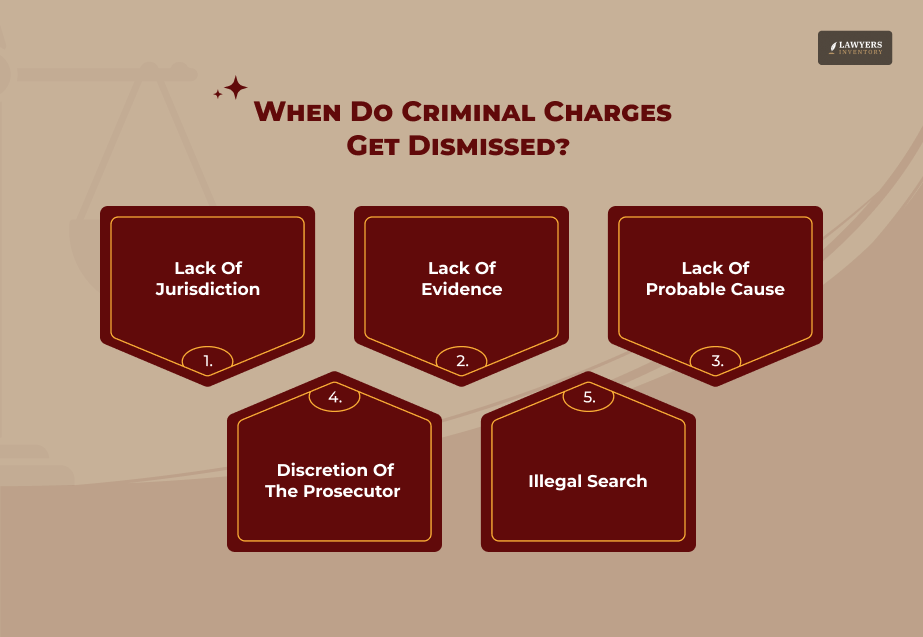
When this happens, defense attorneys move for dismissal. They rely on five primary legal pillars.
1. Lack Of Jurisdiction
Courts only hold authority within specified geographic boundaries. For example, an incident might occur on federal land. It might happen inside a sovereign tribal nation.
It could occur across state lines. In these cases, a state prosecutor lacks authority. The court cannot legally hear the matter. As a result, the judge must dismiss the charges.
2. Insufficient Evidence
The prosecution must present evidence for every element. Consequently, key evidence is sometimes missing or contradictory. It might rely entirely on uncorroborated hearsay.
In these scenarios, a judge stops the case. The case is simply too weak to proceed. Simply put, the charges cannot legally stand.
3. Lack Of Probable Cause
The Fourth Amendment protects individuals against arbitrary arrests. (Source: Legal Information Institute).
To enforce this, officers must possess probable cause. They need concrete facts linking a suspect to a crime.
Furthermore, this standard requires more than a hunch.
- Valid Probable Cause: A red sports car flees a hit and run acident. Police stop a matching vehicle blocks away.
- Lack of Probable Cause: Officers arrest a black SUV owner. They have no connecting facts.
In short, arrests without factual support violate rights. This violation renders subsequent charges invalid.
4. Unlawful Search And Seizure
Police generally need a judicially sanctioned warrant. This warrant allows them to search private property.
Admittedly, limited exceptions exist under the law. However, unauthorized searches violate the Constitution. This includes searches of homes and digital devices.
Subsequently, courts label this evidence illegally obtained. It becomes “fruit of the poisonous tree.” Through the exclusionary rule, the judge bars it. Ultimately, this forces the prosecutor to drop charges.
5. Prosecutorial Discretion And Diversion
Prosecutors evaluate cases based on resource allocation. They also consider the overall interest of justice. Accordingly, defense attorneys negotiate dismissals for minor offenses.
This usually applies to first-time offenders. Typically, this outcome occurs if victims refuse to testify. It also happens if defendants complete diversion programs.
If Charges Are Dismissed Do You Have A Criminal Record?

Unfortunately yes. Even after dismissal, an arrest record remains visible to the public. However, you do not have a criminal conviction record.

To completely clear your name, you must file a separate legal petition for expungement or record restriction, depending on your state's specific laws.
Current Trends: How Technology Drives Modern Dismissals
The legal landscape is experiencing a massive shift. This shift stems from the rise of digital evidence.
Indeed, technology has completely changed pretrial defense strategies. As a result, the focus has moved away from disputes. It now centers on objective digital data.
Body-Worn Camera (BWC) Audits
Defense attorneys win rapid dismissals using bodycam footage. Specifically, they compare written police reports against recordings.
This process frequently exposes fatal contradictions. It reveals structural procedural errors by law enforcement.
Undeniably, if the video contradicts an officer, credibility collapses. This collapse forces an immediate dismissal.
Digital Footprints As Irrefutable Alibis
Simultaneously, digital footprints have become a cornerstone of defense. Teams leverage Google Location History and cell tower pings.
They also use rideshare receipts and smartwatch metrics. By doing so, they establish a suspect’s location. Consequently, presenting this data results in withdrawn charges.
How To Get Criminal Charges Dismissed Using Pretrial Motions As A Defense Tool?
Filing a pretrial motion is a formal request. The defense asks a judge for a ruling. This happens before a trial begins. Without a doubt, this is an effective mechanism.
Here are the key pretrial motions explained:
| Motion Type | Legal Objective | Expected Outcome |
| Motion to Dismiss | Challenges the validity of the charging document. | The judge terminates the case before trial. |
| Motion to Suppress | Requests the exclusion of illegal evidence. | The judge bars critical prosecution evidence. |
| Motion for Discovery | Compels the prosecution to surrender all evidence. | The defense uncovers hidden case weaknesses. |
Basically, in practice, strong motions force prosecutors to re-evaluate. For instance, a successful motion to suppress eliminates evidence. This makes proceeding with a trial logistically impossible.
Tactical Missteps: The Pitfalls Of Self-Help
While building a strategy, defendants frequently commit errors. These mistakes inadvertently destroy their chances of dismissal. To avoid these common pitfalls, protect your options:
1. Speaking On Recorded Jail Phones:
Firstly, detention facilities record and monitor all calls. Unfortunately, defendants often compromise their own cases. Rather, they try to explain their side to the family. By doing so, they hand evidence to prosecutors.
2. Social Media Venting:
Secondly, posting about an ongoing case is catastrophic. Specifically, public posts can waive constitutional privileges. They provide prosecutors with statements for cross-examination. Additionally, they also alert investigators to potential witnesses.
3. Relying On The Miranda Rights Myth:
Finally, many believe a Miranda failure drops a case. In reality, it only suppresses custodial statements. Therefore, if independent evidence exists, the trial proceeds.
Actionable Toolkit: The Defense Triage Checklist
An accused individual must stay organized. This allows an attorney to identify procedural flaws. Consequently, gathering specific documentation saves critical time. Furthermore, it ensures action before evidence disappears.
So, here are some of the things that you should keep handy:
- The Citation or Arrest Ticket: Contains exact statutory codes and officer names.
- Bail and Bond Documentation: Details mandatory upcoming court dates.
- A Written Timeline: A detailed log of the arrest. Note: Label this “For Counsel Only” immediately.
- Digital Evidence Preservation List: A list of private surveillance footage.
- Witness Roster: Names and phone numbers of nearby individuals.
So, How To Get Criminal Charges Dismissed?
In conclusion, achieving a dismissal requires rapid action. It demands strict constitutional enforcement and professional advocacy. Because the legal system uses strict timelines, these delays harm cases.
Delays can result in waiving vital rights. Therefore, working with an experienced lawyer early remains best. It is the standard path to protecting your future.
Read Also:
- Financial Crime Lawyer: I Bet You Didn’t Know THIS!
- Is It legal To Record A Conversation In NY? Find It Out!
- How to Find a Good Criminal Defense Attorney Easily and Win the Case
Leave A Reply







What Is Reckless Driving In Texas: Legal Consequences You Need To Know!
Read More
ROC Nation Kansas City Police Lawsuit: Exposing Police Misconduct And Corruption
Read More
How Can Criminal Identity Theft Occur And Your Legal Standing
Read More
Why Didn’t Biden Release The Epstein Files? The Legal, Political, And Practical
Read More
What Is The Epstein Files? A Primer On The 2025 Releases
Read More
0 Reply
No comments yet.