Quick Answer

Costco is facing a class-action lawsuit filed in April 2026 by a California resident, Russel George, claiming the retailer violated California’s Automatic Renewal Law by sending membership renewal notices 60 days in advance instead of the mandated 15-to-45-day window.
I’ve been tracking the Costco auto-renewal legal challenge class action since it was filed, and I want to walk through it properly. If you’re a Costco member, or you’re researching this case for legal reasons, you need the underlying law, not just the headline.
Costco Auto-Renewal Legal Challenge: What The Lawsuit Actually Alleges
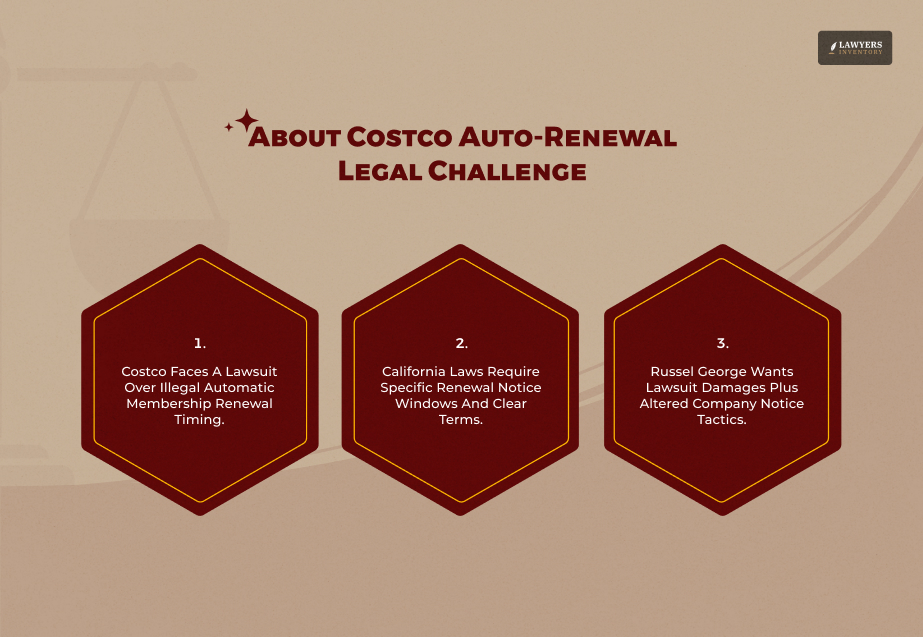
California resident Russel George II filed the case in March 2026. He filed it in the U.S. District Court for the Northern District of California. The case is docketed as George II v. Costco Wholesale Corp., Case No. 3:26-cv-02369. Matthew Smith of Migliaccio & Rathod LLP represents George.
Here are the core facts as I read them.
George signed up for a $65 Gold Star membership online in 2023. By late 2025, he was reconsidering whether to keep it. Then Costco charged his card for renewal on January 2, 2026. This happened before he could act on his decision. [Source: Scripps News]
Costco did send a renewal email. But the complaint says it arrived roughly 60 days before the charge. California law sets a specific window.
Notice must come no earlier than 45 days before the charge. It must come no later than 15 days before. Sixty days falls outside that window on the early side. [Source: Law Commentary]
The complaint raises a second problem beyond timing. It says the notice didn’t clearly state the renewal amount. It also didn’t spell out the renewal terms. And it lacked a straightforward way to cancel.
George sent Costco a demand letter in January 2026. Costco responded in February. But it declined to change its process, according to the filing. The lawsuit followed. It seeks damages. It also seeks a court order requiring Costco to overhaul its renewal notices going forward.
The complaint invokes three more California statutes alongside the core Automatic Renewal Law claim:
- California’s False Advertising Law
- The Consumers Legal Remedies Act.
- The Unfair Competition Law.
The California Law Behind Costco Auto-Renewal Legal Challenge
This Costco Auto-Renewal legal challenge turns on California’s Automatic Renewal Law. It’s codified at Business and Professions Code § 17602. I want to lay out what it actually requires. Most coverage skips this part entirely.
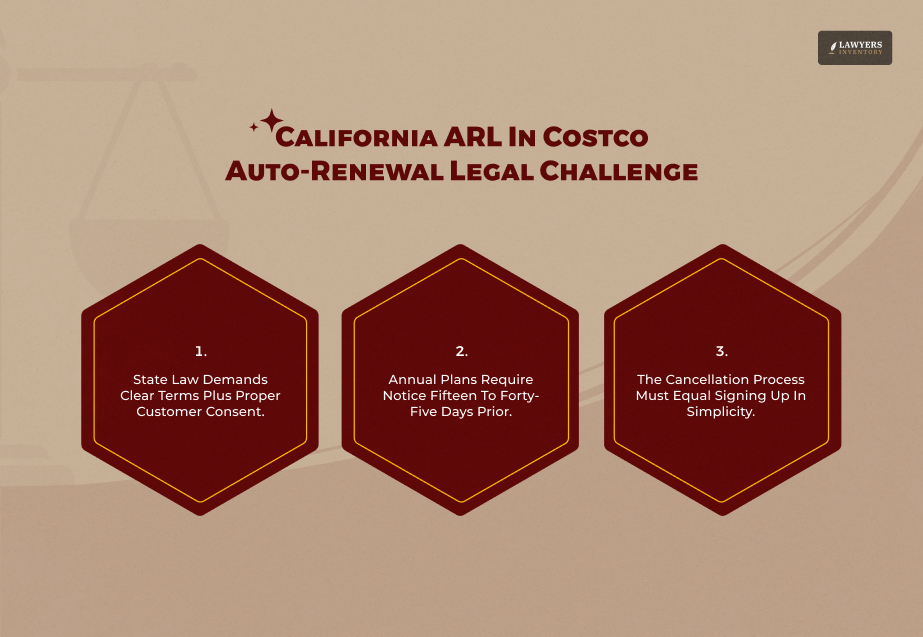
Under § 17602, a business must do three things before a customer agrees to auto-renewal. First, it must present the renewal terms clearly. Second, it must get the customer’s affirmative consent to those terms. Third, it must send an acknowledgment the customer can keep for their records. [Source: Justia]
Annual memberships fall under an extra rule. For any renewal term of a year or longer, the business must send a separate reminder. That reminder must arrive between 15 and 45 days before the renewal charge. This rule covers a standard Costco membership.
The notice also spell out how to cancel. And the cancellation method has to be just as easy as signing up was.
California amended this law in 2021. Assembly Bill 390 made the change. The stricter notice-and-cancellation rules became operative on July 1, 2022. Lawmakers built this framework for a specific reason.
Subscription and membership renewals had become a common source of consumer complaints. People kept getting charged for services they had stopped using, without warning. [Source: Top Class Actions]
Where Costco Auto-Renewal Legal Challenge Sits In The Federal Picture
Most coverage of the Costco case skips this part too. But it matters. It explains why California, not federal law, is currently the main enforcement route.
Federal law already has a piece of this. The Restore Online Shoppers’ Confidence Act requires clear disclosure for online negative-option offers. It also requires informed consent. And it requires a simple cancellation mechanism.
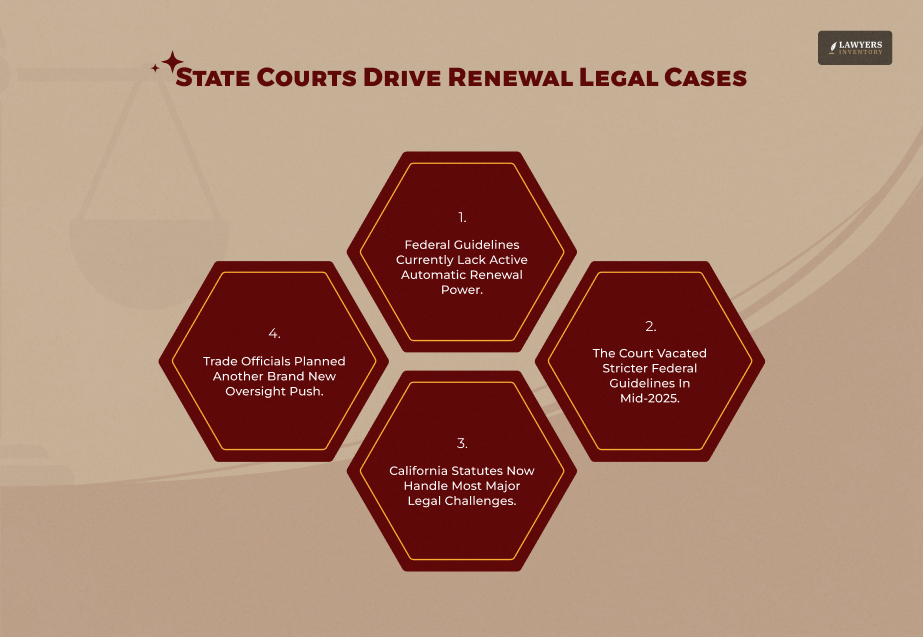
The FTC tried to go further in October 2024. It proposed an expanded Negative Option Rule. People nicknamed it “Click-to-Cancel.” It would have applied stricter disclosure and cancellation rules across nearly all subscription and membership types. [Source: Federal Trade Commission]
That rule didn’t survive. The Eighth Circuit vacated it in mid-2025. The court found the FTC’s rulemaking process legally deficient. But the FTC hasn’t dropped the issue. It submitted a new Advance Notice of Proposed Rulemaking in January 2026. This signals it intends to try again.
No federal rule is in force right now. So state laws are doing most of the practical work. California’s ARL is one of the most detailed automatic-renewal statutes in the country.
It also gives consumers a real private right of action. That combination is part of why California keeps producing these cases.
This Isn’t Costco’s First Renewal-Adjacent Fight – Or Its Only One This Year
Context matters here. Costco has faced multiple consumer class actions in 2026 alone. Separate suits target rotisserie chicken salmonella concerns. Others target alleged tariff-driven price increases. [Source: AL.com]
The auto-renewal case fits a broader pattern. Costco is facing real consumer-protection scrutiny this year. This isn’t an isolated dispute.
California’s ARL has generated similar litigation before. Other subscription-based and membership-based businesses have faced these suits for years. The statute gives consumers a direct path to sue over notice and disclosure failures.
Most consumer-protection statutes don’t work this way. They usually route enforcement through a state attorney general instead of private litigants. California’s law is different.
What This Means If You Are A Costco Member
Here are a few things that you should keep in mind:
If You’re In California:
The ARL protections above apply directly to you. If the court certifies this case as a class action, it could eventually cover other California members. That includes anyone with similar renewal timing or disclosure issues.
If You’re Elsewhere In The U.S.:
About a dozen other states have their own automatic-renewal statutes. Most are modeled loosely on California’s. But notice-window requirements vary by state.
Your protections depend on which state’s law applies to your account. Check your own state’s automatic-renewal statute. Don’t assume California’s timeline applies to you.
If You’re Outside The U.S.:
Costco runs international memberships in Canada, the UK, Japan, Korea, Australia, and elsewhere. Each falls under its own country’s consumer-protection framework, not California’s ARL.
Maybe you’re researching this from India or another market where Costco doesn’t operate directly. If so, the specific California statute isn’t the useful takeaway. The underlying principle is.
Courts and regulators worldwide are increasingly enforcing one core idea: businesses can’t treat silence as consent, and cancellation has to be roughly as easy as signup was.
What You Should Actually Check On Your Own Membership:
Look at the date of your last renewal notice. Compare it to your charge date. Check whether that notice stated the exact amount and renewal term.
Check whether it gave you a clear way to cancel. If you believe California law entitled you to better notice, keep your renewal emails and charge records.
That’s the practical first step before you speak with a consumer-protection attorney.
Disclaimer: This article is legal information, not legal advice for your specific situation. If you believe you have a claim, it would be best to consult a consumer-protection attorney licensed in your state.
Source:
- Top Class Actions reporting on George II v. Costco Wholesale Corp.
- Law Commentary’s coverage of the ARL claims
- Scripps News
- California Business and Professions Code § 17602 (Justia, FindLaw)
- Practical Law summary of AB 390
- Federal Trade Commission Negative Option Rule materials
- Sidley Austin, Goodwin, Crowell & Moring, and Arnold & Porter client alerts on the FTC’s 2026 ANPRM and the Eighth Circuit’s vacatur of the 2024 rule.
Leave A Reply






Tampax Lawsuit Update 2026: Lead Claims Move Forward As Settlement And Payout Questions Remain
Read More
The Complete ADA Compliance Checklist: Physical, Digital, And Legal
Read More
Class Action Lawsuit With No Proof: What “No Proof” Actually Means (Legally)
Read More
Equifax Breach Settlement: Your Guide To Claims And Payouts
Read More
Herbalife Relaxation Tea Recall: Lot Numbers, FDA Class II Risk, And Consumer Legal Rights
Read More
0 Reply
No comments yet.