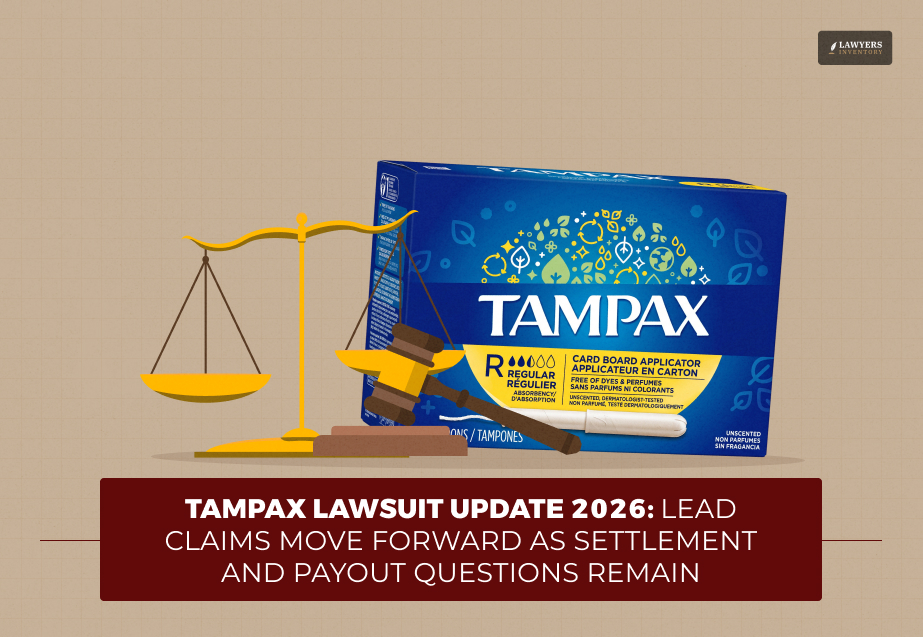
Quick Answer

As of September 2026, the Tampax lawsuit landscape splits into several distinct tracks. The forever-chemicals (PFAS) claim tied to Tampax Pure Cotton was dismissed with prejudice by a federal judge in July 2025 and cannot be refiled. The more active track involves allegations that Tampax Pearl tampons contain undisclosed lead. These cases are currently pending in California, Ohio, and Illinois federal courts. A newer, broader lawsuit filed in 2026 adds claims of reproductive harm. This suit targets PFAS and endocrine disruptors across several different feminine hygiene brands. No court has certified a class or approved a settlement yet. Furthermore, no court has opened a claims process for any of these cases. There is currently no official way to join the lawsuit for compensation. No legitimate site can process a Tampax lawsuit claim today.
Procter & Gamble’s Tampax brand sells to tens of millions of consumers who assume the product on the shelf has been tested and disclosed honestly.
That assumption is now being tested in federal court, across more than one case, on more than one legal theory.
For anyone searching for a Tampax lawsuit update, the difficulty is not a lack of information. It is that different lawsuits, filed in different years on different grounds, tend to get blended together in search results.
The State Of The Tampax Lawsuit In 2026
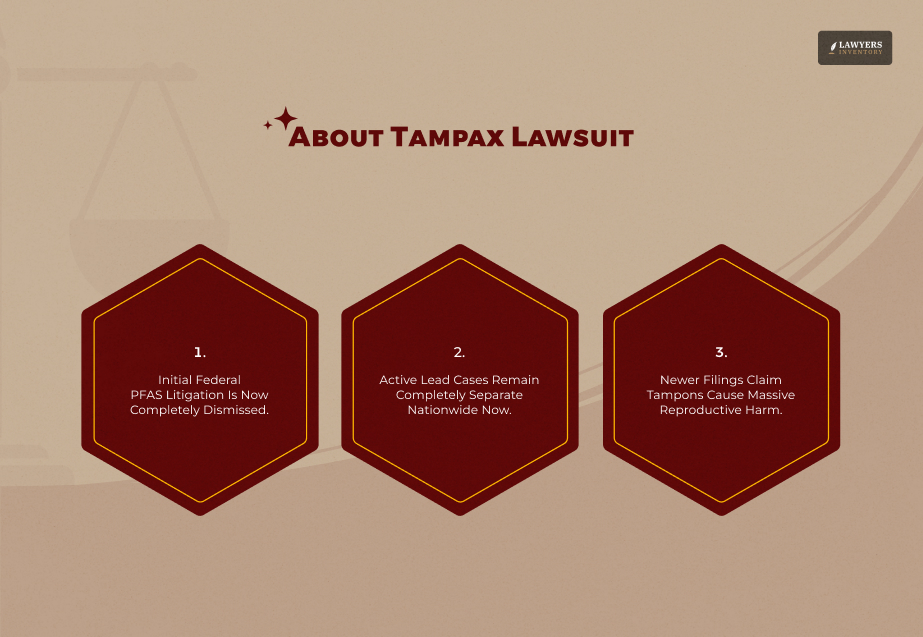
The Tampax lawsuit is not one case.
It is a cluster of federal lawsuits filed since 2024, each targeting a different alleged problem with the product line. Some have already failed in court. Others are still in early stages.
Understanding which track a claim belongs to matters, because it determines whether a consumer has any legal avenue at all right now.
The PFAS Claim Is Closed
The product that originally attracted a lot of complaints was said to contain per – and polyfluoroalkyl substances (PFAS). This occurred even though Tampax Pure Cotton was heavily advertised as being made with just and only cotton and nothing else.
The lawsuit brought in the California federal court relied on independent test results. These tests were not conducted by the company itself. Instead, they found the distinct presence of organic fluorine.
The plaintiffs saw this finding as a strong indication of PFAS contamination. They argue that this chemical presence directly contradicts the product’s purely organic marketing claims.
Procter & Gamble moved to dismiss the case three times.
On July 7, 2025, U.S. District Judge Araceli Martinez-Olguin granted the company’s motion for good, finding the plaintiffs’ testing allegations still lacked the factual detail needed to proceed.
The case was closed the same day, with no further opportunity to amend the complaint. Anyone hoping to join this specific PFAS claim has no case left to join.
The Lead Contamination Track Is Where the Activity Is
A separate line of lawsuits alleges that Tampax Pearl tampons contain undisclosed lead. This track began in 2024 and has grown steadily since.
Barton v. Procter & Gamble (Case No.3:24-CV-01332-GPC-SBC), filed in the Southern District of California in July 2024, survived a partial motion to dismiss, and a federal magistrate judge ordered the parties into early neutral evaluation and settlement discussions in September 2025.
No settlement has resulted.
Sanchez et al. v. Procter & Gamble (Case No.1:2025cv00852), filed in the Southern District of Ohio in November 2025, remains in early pleadings.
Otkina et al. v. Procter & Gamble (Case No.1:2026cv00773), filed in the Northern District of Illinois in January 2026, seeks to represent a nationwide class of purchasers, excluding California residents, and cites testing that found lead in the absorbent core of the tampons.
These cases proceed independently.
No authority has consolidated the claims into a single federal action yet. The Judicial Panel on Multidistrict Litigation handles transferring cases to centralized proceedings. However, it has not required any consolidation of the Tampax lawsuits up to this moment.
Because of this, the individual claims remain separate and independent. They will continue to move through the court system on different paths until an official panel order dictates otherwise.
The Newest Filing Widens The Claims
In 2026, a new lawsuit broadened the legal exposure facing feminine hygiene manufacturers well beyond Tampax alone.
Seven women in California sued Procter & Gamble, Prestige Consumer Healthcare, Essity North America, Kimberly-Clark, Edgewell Personal Care, and The Honey Pot Company, naming products across the Tampax, Always, Always Discreet, and L. Organic lines.
According to Newsweek’s reporting on the case, the plaintiffs allege the products contained PFAS, endocrine disruptors, carcinogens, and other substances linked to serious reproductive harm, including:
- Miscarriage.
- Polyendocrine metabolic ovarian syndrome.
- Chronic pelvic pain.
- Pelvic inflammatory disease.
One plaintiff described using the products for 14 years before developing conditions she says required multiple surgeries and hospitalization.
Kimberly-Clark filed to move the case from Los Angeles Superior Court to federal court in July 2026, a routine procedural step that does not resolve the underlying claims. [Source: Top Class Actions]
The case refers to a study conducted by Harvard University. This research was published in a well-known journal named Environmental Research.
The study revealed a clear association between prenatal exposure to PFAS and health risks. Specifically, it showed an increased occurrence of the exact ovarian syndrome claimed in the lawsuit.
What Are The Tampax Lawsuit Allegations?
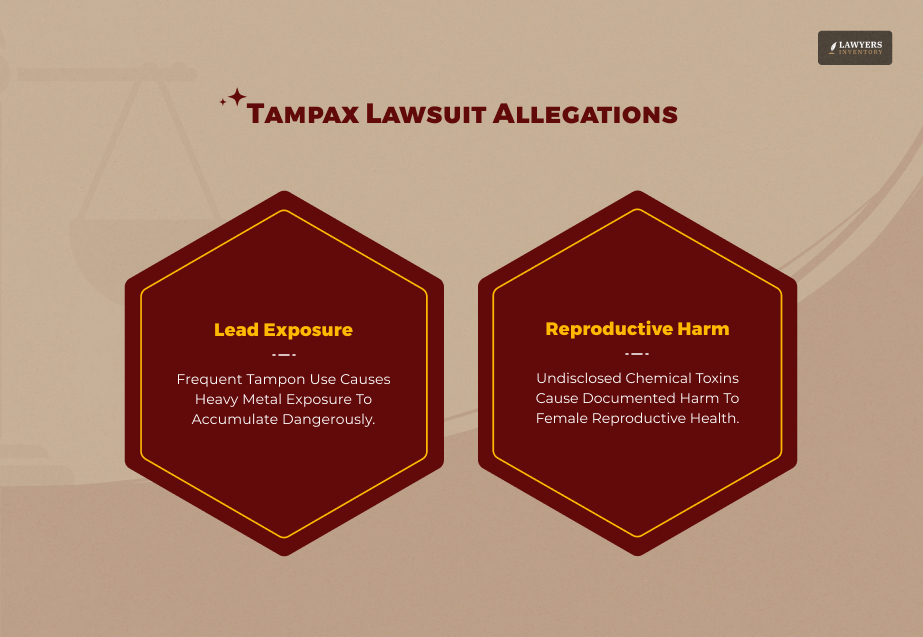
Each track rests on a distinct legal theory, and the details matter for anyone trying to assess their own exposure.
Lead Exposure Allegations
The main lawsuits refer to test results from independent labs. These were originally quoted in a first report released in 2024.
The lab tests found a lead content of 0.181 micrograms per gram in Tampax Pearl tampons. This specific level sits below California’s individual Proposition 65 limit for a single isolated exposure.
However, the plaintiffs’ suits argue that this exposure must be considered cumulative. The product packaging explicitly recommends changing a tampon every four to eight hours on average.
Because of this frequent rotation, regular use may cause the total daily exposure to exceed the state’s maximum allowable dose level.
Plaintiffs also allege that P&G completely failed to warn consumers about this risk. This failure occurred even though the product was actively advertised as entirely free of harmful ingredients.
Reproductive Harm Allegations (PFAS & Endocrine Disruptors)
The latest claims over harm to reproduction are brought on an entirely different legal basis. These complaints focus on PFAS and other undisclosed chemicals that were supposedly used in the products.
The presence of these chemicals is claimed to be a direct cause of documented medical conditions in the named plaintiffs. In addition to fighting over labeling and disclosure issues, these lawsuits point a finger at the physical safety of the product itself.
The Legal Distinction

This shift in allegations creates a highly important difference in legal terms. It changes the core legal theory from consumer protection to strict product liability.

Consumer protection cases focus primarily on misleading advertising and labeling. In contrast, product liability cases require a much higher burden of proof.Plaintiffs must provide a direct demonstration of a medical link between the product and their specific physical injury.
How To Join The Tampax Lawsuit?
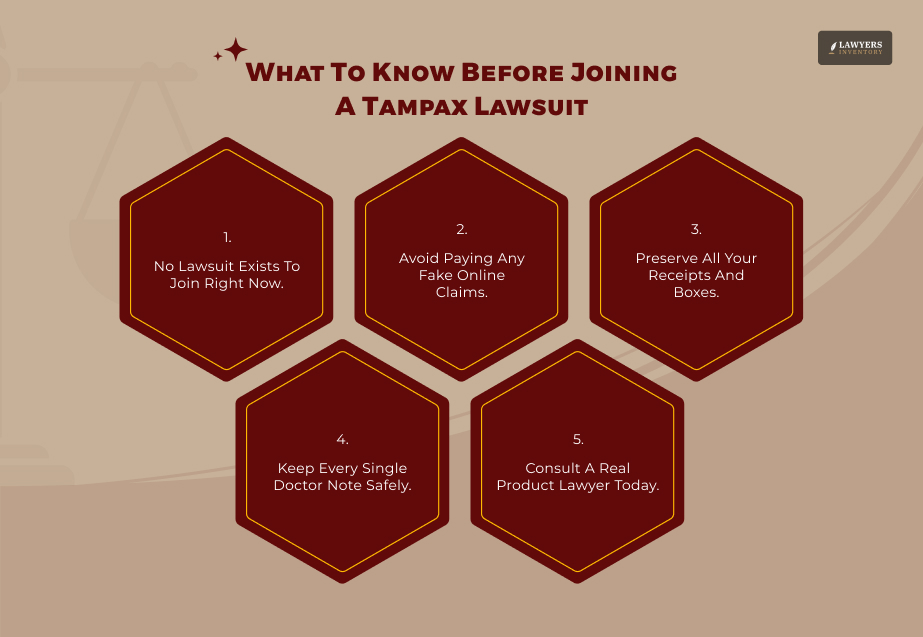
For most people, the honest answer is that there is nothing to join yet.
None of the pending cases have reached class certification, which is the stage at which courts formally define who belongs to a class and how those members can participate or opt out.
Consumer-protection attorneys generally advise against paying any company or site that claims to process a Tampax lawsuit claim before certification. This is because no legitimate claims process currently exists.
What consumers can reasonably do now is preserve evidence. That means keeping purchase records, product packaging, and any medical documentation connecting tampon use to a diagnosed condition.
If a case eventually reaches settlement or trial, this kind of documentation typically determines who qualifies and how compensation is calculated.
Consulting a product liability attorney directly, rather than relying on a lead-generation website, is the more reliable way to evaluate whether a specific set of facts supports an individual claim.
Read Also: 3M Earplug Lawsuit: The LARGEST Mass Tort Litigation In US History!
Is There A Tampax Lawsuit Settlement Yet?
As of September 2026, no court has approved a settlement in any Tampax-related case, and no payout program exists.
The closest case to reach a courtroom involves the Barton matter. A magistrate judge ordered the involved parties to attend mandatory settlement conference meetings in September 2025. Those specific meetings have not resulted in an official agreement yet.
Federal multidistrict litigation (MDL) cases very often have settlement discussions set directly through the judges.
These formal proceedings are quite different from the actual settlements themselves. Because of this, reaching an agreement is a massive step forward from the initial court orders.
Consumers should absolutely not trust online sites that promise a guaranteed Tampax lawsuit payout. You should avoid any platforms that charge you fees to join a case. Do not fill out any unofficial online claim forms.
This specific style of litigation generally spans several years of time. The legal process moves slowly through filing, class certification, discovery, and eventual settlement or trial.
Many comparable mass torts, like the Camp Lejeune litigation, took a number of years to develop. A massive time gap typically exists between the initial pleadings of a case and the actual commencement of the claiming process.
What To Do If You Believe You Were Harmed

Anyone who suspects a health condition connects to tampon use should start with a medical evaluation, not a legal one.
Self-reported symptoms may give some initial indication of an issue. However, you really need a medically confirmed diagnosis to support future compensation claims. This is especially true when a doctor explicitly writes that a product might be the cause.
This diagnosis is exactly when the role of a product liability or mass tort attorney begins. The lawyer will review all of the information you have collected.
Based on those details, they can determine if there is enough of a case to get on board, or if the case needs to be filed as a separate lawsuit.
You should not wait until a verdict has been reached to take action. Statutes of limitations differ heavily from one state to another. They also vary based on the specific type of claim. If you wait too long, you may lose the right to take legal action entirely.
What Comes Next In The Tampax Lawsuit?
Lead contamination cases will drive the most substantial change in the months ahead. Furthermore, California court-mandated settlement discussions are actively driving this shift because they are already in progress.
A case on reproductive harm is scheduled for 2026 but remains at the very beginning stage. It will likely spend most of the year dealing with procedural motions due to a ruling that transferred it to the federal court.
Cases will continue to go along different paths without merging into a nationwide court case. This independent progression will last until the Judicial Panel on Multidistrict Litigation issues a formal multidistrict consolidation order.
Therefore, you should view the Tampax lawsuit as a multilateral, year-long process if you are following it for personal concerns. At this point, the emphasis is still strictly on lawsuit aspects rather than any compensation.
Disclaimer: The information provided in this article is for general informational purposes only. It does not, and is not intended to, constitute legal advice. Please consult an attorney for legal help.
Sources:
- ClassAction.org, “Tampax Class Action Lawsuit Says Pure Cotton Tampons Contain Toxic ‘Forever Chemicals'” (updated July 17, 2025)
- Newsweek, “‘Forever Chemicals’ in Tampons? Here’s What We Know” (July 24, 2026)
- Top Class Actions, reporting on Barton v. Procter & Gamble, Sanchez v. Procter & Gamble, and Otkina v. Procter & Gamble
- Legal News Feed, reporting on Procter & Gamble Tampax defective-design class action (August 19, 2025)
- Harvard T.H. Chan School of Public Health, Mahalingaiah Lab, PFAS and PMOS/PCOS study coverage
- U.S. EPA, PFAS health effects fact sheet
Leave A Reply







The Complete ADA Compliance Checklist: Physical, Digital, And Legal
Read More
Why Costco Is Being Sued Over Membership Auto-Renewals – And What The Law Says
Read More
Class Action Lawsuit With No Proof: What “No Proof” Actually Means (Legally)
Read More
Equifax Breach Settlement: Your Guide To Claims And Payouts
Read More
Herbalife Relaxation Tea Recall: Lot Numbers, FDA Class II Risk, And Consumer Legal Rights
Read More
0 Reply
No comments yet.