Quick Answer:

When hiring a criminal defense lawyer effectively, an individual must execute a strategic vetting process: verify the attorney's specific trial experience within the relevant local jurisdiction, audit their past case history regarding similar statutory charges, establish explicit boundaries regarding daily case delegation, and secure a transparent, comprehensive fee agreement that fully complies with regional ethical mandates.
When an individual faces state or federal prosecution, the decision to retain counsel is the single most critical factor influencing the trajectory of their liberty.
Through my systematic analysis of criminal justice data, I have observed that navigating the legal landscape without specialized advocacy is a direct path to severe systemic penalties.
Data aggregated from consumer legal resource platforms like Lawyers.com confirms that criminal defense requires highly specialized procedural knowledge that general practitioners simply do not possess.
Why Your Choice of Criminal Defense Matters
A criminal case differs fundamentally from a civil disagreement. The government is backed by unlimited resources. They have a trained and organized investigative division. They also have an entire group of prosecutors. These prosecutors focus only on getting a verdict for the state.
The Constitution provides legal protection for a thorough defense. This protection ensures you need to pick a lawyer. The right lawyer will protect you. They guard against possible government heavy-handedness.
Groups like the National Association of Criminal Defense Lawyers (NACDL) express a professional consensus. This consensus makes one thing really clear.
Finding or hiring a criminal defense lawyer should not be a gut-feeling-based move. You should not just choose an advertisement that grabbed your attention.
On the contrary, you must take a dispassionate view. This view should be based on facts. You must assess the areas of law that your case requires. You also need to determine whether the lawyer is affordable. Make sure they will not take your money without doing enough work.
The Dual Track Of Criminal Proceedings
When managing a criminal case, your attorney will simultaneously navigate two distinct procedural pathways to protect your rights:
| Litigation Pathway (In Court) | Negotiation Pathway (Out of Court) |
| Arraignment: The formal reading of charges and entry of a preliminary plea. | Charge Review: Analyzing the prosecution’s charging documents for overcharging. |
| Evidentiary Motions: Filing requests to suppress illegally obtained evidence. | Discovery Audit: Reviewing police reports, video footage, and witness statements. |
| Jury Selection: Exposing and eliminating potential juror bias during voir dire. | Plea Evaluation: Testing the prosecution’s willingness to offer reduced charges. |
| Trial & Verdict: Presenting arguments, cross-examining state witnesses, and seeking acquittal. | Sentencing Mitigation: Compiling character references and expert reports to minimize penalties. |
Hiring A Criminal Defense Lawyer? Critical Operational Factors To Vet
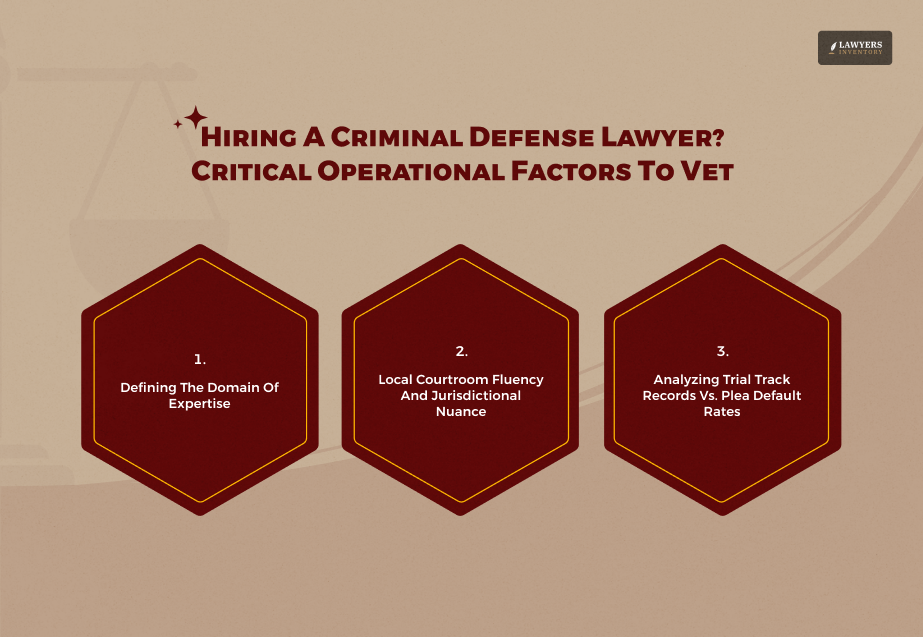
Here are some of the things that you need to consider when hiring a criminal defense lawyer:
1. Defining The Domain Of Expertise
A common systemic error made by defendants is assuming that all trial lawyers are universally competent across all statutory violations. Criminal law is incredibly dense, fractured, and constantly evolving.
As outlined in comprehensive practitioners’ guides like the Erskine Law Criminal Defense Framework, specialization within specific sub-categories of the penal code is mandatory for a viable defense.
Violent Crimes:
Violent crimes require a deep and comprehensive grasp of forensic science. You must understand DNA replication methods. It is critical to know how to interpret bloodstain patterns. The lawyer must also know how to cross-examine state medical examiners.
Crimes Related To Money, Banking Or White-Collar:
White-collar, money, or banking crimes require a different defense. This field needs an expert understanding of forensic accounting. Attorneys must track electronic money trails. They need a deep knowledge of corporate law. They must also know federal regulatory statutes in a multi-jurisdictional context.
Opioids And Drunken Driving:
Opioid and drunken driving cases require a specific approach to win in court. One must have a thorough knowledge of constitutional law. This includes the protections under the Fourth Amendment to the US Constitution.
These laws guard against the unlawful search of a person or their effects. You also need to know the proper functioning of alcohol breathalyzers and other intoxication testing devices. Finally, the case depends on a strict handling and documentation chain of evidence.
2. Local Courtroom Fluency And Jurisdictional Nuance
An attorney may possess an exceptional understanding of abstract legal theory, yet fail completely if they lack localized institutional knowledge.
In my research of procedural defense frameworks, I have noted that court dynamics vary significantly between municipal, state, and federal benches.
An attorney who frequently practices in a specific courthouse understands the unwritten local rules of civil and criminal practice, the administrative tendencies of the presiding judges, and the negotiating parameters of the local district attorney’s office.
This contextual familiarity is vital when drafting motions to suppress evidence or negotiating complex plea agreements.
3. Analyzing Trial Track Records vs. Plea Default Rates
Third, the vast majority of criminal cases in the United States are resolved via negotiated pleas rather than full trials. However, your attorney’s willingness to litigate is your primary source of leverage.
A study published in PubMed Central (PMC12649738) regarding defense counsel psychology reveals that prosecutors explicitly exploit attorneys who exhibit a systematic aversion to trial.
If a defense lawyer has a reputation for never picking a jury, the prosecution has no incentive to offer meaningful concessions.
When interviewing counsel, you must explicitly ask for their recent trial data. Things like how many cases have they taken to a jury verdict in the past 24 months, and what were the outcomes?
Firm Logistics: Who is Managing Your File?
One of the most frequent consumer complaints highlighted in professional liability reviews involves the “bait-and-switch” mechanic utilized by certain large-scale criminal defense firms.
During the initial consultation, a highly charismatic, senior managing partner pitches their expertise and secures the retainer.
However, once the contract is signed, the daily management of the case, discovery review, and minor court appearances are silently delegated to a junior associate with minimal trial experience.
To mitigate this risk, you must clear up the assignment of responsibilities before transferring funds. Explicitly ask:
- Who will be the lead counsel of record presenting arguments in front of the judge?
- What specific tasks will be delegated to paralegals or law clerks?
- Will the lead attorney personally handle the critical evidentiary hearings and final trial?
The Architecture Of Defense Fee Structures

Navigating the financial realities of retaining private counsel requires absolute clarity and an understanding of the legal ethics that govern consumer protections.
The Prohibition Of Contingency Fees
First and foremost, my research into the American Bar Association (ABA) Model Rules of Professional Conduct – specifically Rule 1.5(d)(2) – confirms that contingency fees are strictly illegal in criminal defense cases.
A lawyer cannot condition their fee on securing an acquittal, a dismissal, or a specific reduced sentence. This ethical firewall is designed to prevent conflicts of interest, ensuring that a lawyer’s advice to accept or reject a plea is never compromised by their own immediate financial payout.
Flat Fees Vs. Retainer Agreements
Private criminal defense typically operates under two distinct financial models, as documented by comprehensive consumer legal guides like Nolo:
- The Flat Fee Model: Common in standard, predictable cases such as first-offense DUIs or minor misdemeanor shoplifting. The client pays a single upfront sum that covers all standard pre-trial appearances and negotiations. It is critical to verify if this flat fee includes the cost of a full trial, as many contracts state that an additional “trial fee” is triggered if a plea cannot be reached.
- The Retainer and Hourly Model: Utilized in complex felony and federal litigation. The client deposits a substantial sum (the retainer) into a trust account, from which the attorney draws an hourly rate as they document their time.
Accountable Litigation Disbursements
A professional fee agreement must clearly delineate ancillary expenses. A comprehensive defense often requires substantial capital allocations that extend far beyond an attorney’s baseline hourly billings. These include:
- Private Investigators: Essential for independent witness tracking and scene documentation.
- Expert Witnesses: Toxicologists, digital forensic experts, or ballistic specialists needed to counter state evidence.
- Administrative Disbursements: Expenses related to deposition transcripts, travel, and expedited court filing fees.
Enforcing Clear Protocols For Communication
A breakdown in the attorney-client relationship rarely stems from a lack of legal acumen; it almost always stems from poor communication.
The stress of facing a criminal charge amplifies the need for consistent updates. When evaluating counsel, establish an explicit communication framework.
Inquire about their standard return-call policy – reputable practices generally mandate a 24-hour response window for non-emergency inquiries.
Furthermore, clarify what secure portal systems they utilize to share sensitive discovery documents, ensuring your data remains completely confidential and protected from interception.
Leave A Reply







0 Reply
No comments yet.