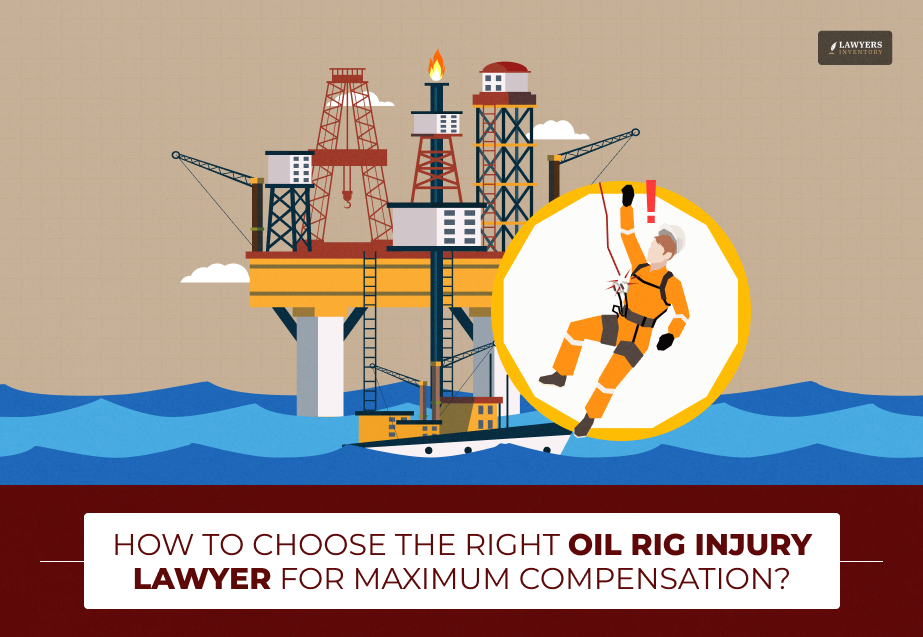
Today’s topic: Choosing an oil rig injury lawyer!
Based on the data from the U.S. Center for Disease Control, worker fatality rates in oil and gas production are 6-times higher compared to workers’ direct contact with other industries.
Of all oilfield fatalities, around 75% are related to trucks and transportation, while 50% of those who are catastrophically burned or severely injured in an accident or explosion are, in fact, well-site employees.
There’s no doubt that oil rig work is a highly dangerous job. And this is mainly due to:
- Long hours.
- Presence of volatile hydrocarbons and gases.
- Hazardous drilling equipment.
Yet it seems that many oil and gas companies are willing to sacrifice safety standards just for the sake of speeding up production. Accidents happen, and workers suffer from injuries.
But what about the compensation? That is exactly why you need the legal guidance of an oil rig injury lawyer.
In this blog, we will break down the following things:
- Legal rights and governing laws in maritime injury cases.
- Common injuries in a maritime accident case
- Who is an oil rig injury lawyer?
- How to choose the right lawyer for oil rig injury cases?
- Liability and negligence in maritime injury cases
- Immediate steps to take after a maritime accident
- Compensation and damages in maritime accident cases.
Therefore, if these are a few things that you want to know, keep on reading this blog till the end…
What Are The Legal Rights And Governing Laws In Maritime Injury Cases?
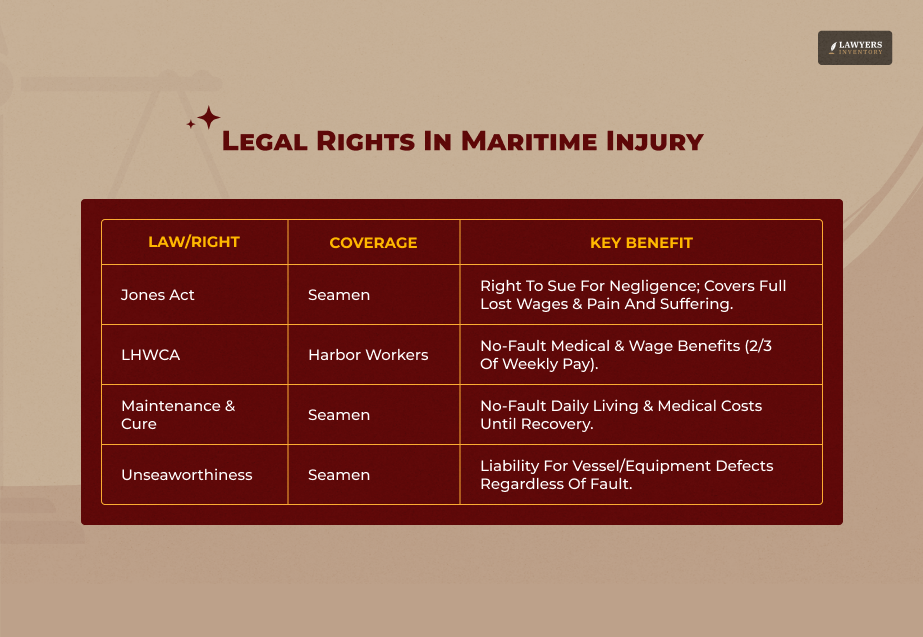
Maritime personal injury claims are dealt with under a separate set of federal and international laws called Admiralty Law. These basically offer unique protections and legal options for workers and passengers who are injured on navigable waters.
The major laws that play a key role in these cases include:
- The Jones Act (Merchant Marine Act of 1920): This is the main federal statute for seamen, defined as workers who spend at least 30% of their time on a vessel.
- Longshore and Harbor Workers’ Compensation Act (LHWCA): A federal workers’ compensation program that is mainly designed for maritime workers other than seamen, including dockworkers, shipbuilders, and harbor workers.
- General Maritime Law: It basically covers the Doctrine of Unseaworthiness, among other things. This doctrine makes vessel owners answerable if a ship, its crew, or its equipment is not reasonably fit for the intended use.
- Death on the High Seas Act (DOHSA): Covers deaths that happen more than three nautical miles from shore. It enables the deceased’s relatives to claim pecuniary (financial) damages due to the death.
Fundamental Legal Rights For Workers

• Receive maintenance and cure

• Choose your own doctor

• Claim unearned wages

• Claim for punitive damages
What Are The Common Injuries In A Maritime Accident Case?
Maritime accidents frequently result in severe, life-altering injuries. Primarily, this occurs due to unpredictable vessel movements, heavy machinery, and exposure to the elements. Some of the most common ones are:
- Slips, trips, and falls.
- Struck-by and caught-between.
- Lifting and overexertion.
- Burns and chemical exposure.
“These injuries frequently require years of treatment and may permanently reduce a worker’s ability to earn a living,” according to Barret Legal.
Who Is An Oil Rig Injury Lawyer?
An oil rig injury lawyer is a type of personal injury lawyer with the expertise and focus on helping offshore platform, jack-up rigs, and land-based drilling workers get compensation for their injuries.
These lawyers are skilled in dealing with the complicated mix of maritime laws, federal laws, and state regulations that govern catastrophic work and related accidents to get just compensation for their clients.
Roles & Responsibilities Of An Oil Rig Injury Lawyer
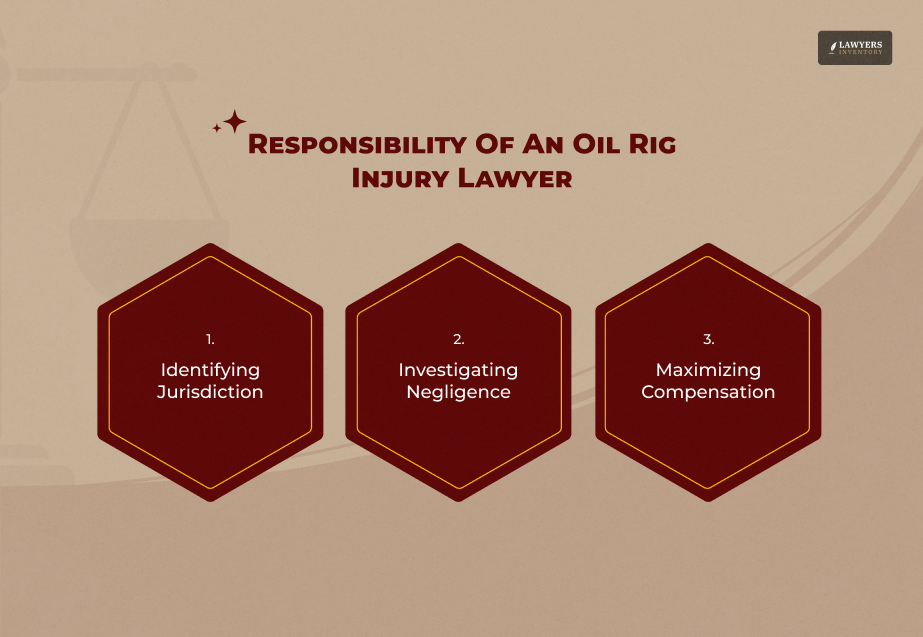
Some of the main tasks of an oil rig injury lawyer are as follows:
- Identifying Jurisdiction: If the lawyer determines that the rig is a vessel “in navigation” (hence a vessel status), or it is fixed to the ocean floor, they will accordingly determine the set of laws applicable.
- Investigating Negligence: Attorneys will collect as evidence maintenance logs, safety records (JSA), drilling floor camera footage, etc., to demonstrate the fault of the employer or a third party.
- Maximizing Recovery: They demand compensation for “non-economic” damages, including physical and mental suffering, loss of enjoyment of life, etc., in addition to medical expenses.
Can An Oil Rig Injury Lawyer Help You Maximize Compensation?
An oil rig injury lawyer can help you get the highest possible payout by directing all aspects of the case, including complex maritime laws, and determining all possible sources of liability.
Though oil companies usually have a large legal team to keep their payout to a minimum, a specialized lawyer will employ the following tactics to keep your interests safe. For instance, they do this simply by:
- Identifying The Correct Legal Pathway: They determine which law governs the case, such as the Jones Act, the LHWCA, or state workers’ compensation. This is because some laws really offer a much higher level of compensation for pain and suffering than others.
- Calculating Full “Non-Economic” Damages: Attorneys consider a situation with an eye to future rewards beyond the medical bills. In addition to the immediate ones, they make sure you are also paid for other long-term effects. For instance, this includes loss of earnings, pain and suffering, and future medical costs.
- Pursuing Multi-Defendant Claims: A lawyer can uncover third-party negligence. In this way, it will allow you to receive compensation for additional damages apart from what your employer’s insurance is covering.
- Leveling The Playing Field: To demonstrate the extent of your physical impairment before the jury, your lawyer will engage vocational experts and medical professionals.
How To Choose The Right Oil Rig Injury Lawyer?
To choose the right oil rig injury lawyer, you should first confirm their specialized expertise in maritime law, as just having a personal injury experience is not usually enough for offshore claims.
Here’s how you can select the right oil rig injury lawyer for your case:
Verify Specialized Maritime Expertise
Firstly, make sure the lawyer is very familiar with the specific federal laws that regulate offshore work. They should know all the details of the Jones Act, LHWCA, and OCSLA.
Evaluate Trial Experience And Track Record
Secondly, oil companies regularly equip their legal teams in a very aggressive manner. Therefore, you will need a lawyer who is not afraid of going to court. Additionally, you must check their jury verdicts and go over their case results.
Understand The Fee Structure
Finally, you should learn about their fee structure. Most reputable oil rig injury lawyers will agree to work on a contingency fee basis.
- Percentage: Such fees usually represent 33% to 40% of the final recovery.
- Upfront Costs: Make sure that you would not be held accountable for court costs or filing fees in the case of a loss of the case.
Additionally, a just firm will furnish you with a written agreement explaining the deduction of costs (like the expert fees) from the settlement.
Compensation & Damages In Maritime Accident Cases
Maritime personal injury cases can easily become very complex. However, a basic understanding of how the jury calculates damages should go a long way toward clarifying the situation.
One of the main aspects of these cases is that the injured party should be compensated for the injuries that happened during his/her work, which in this case is working on or near water, like, for example, on ships or offshore platforms.
In maritime personal injury cases, damages are primarily of two categories: economic and non-economic.
- Economic damages: These are costs directly related to the injury, such as medical bills, lost wages, and any other future financial loss.
- Non-economic damages: It refers to the pain, suffering, and emotional distress that come as a result of the injury.
Moreover, even though it is very uncommon, you can also claim punitive damages. This usually occurs as a means to punish the defendant for their outrageous behavior.
Additionally, according to the figures that Thompson Stam PLLC provides, here’s what the typical settlement amount looks like:
- Minor to Moderate Injuries: $100, 000 $500, 000.
- Severe Spinal or Limb Injuries: $1 Million to $5 Million.
- Catastrophic Brain Injuries: Jury Verdicts Frequently Above $10 Million
What Are The Immediate Steps To Take After A Maritime Accident?
The first few hours after an accident at sea are crucial for both your health and the future of a legal claim against the responsible party. If you follow these steps, you will stay within the letter of the law and also secure your avenue for claiming damages.
So, here are the steps to take after a maritime accident:
- Prioritize immediate safety and medical care.
- Official reporting and documentation.
- Preserve evidence on the scene.
- Do not sign settlements or recorded statements.
- Consult a maritime specialist.
Read Also: How Can A Construction Accident Attorney Help You?
Liability & Negligence In Maritime Injury Cases
Maritime injury cases entail that workers can hold their employers liable if their negligence, no matter how slight, caused the injury of a seaman, as per federal laws that have specially tailored liability rules.
Moreover, the main reason for negligence is usually accompanied by the employer’s failure to provide the following things:
- Safety of the workplace.
- Proper working knowledge.
- Ship’s equipment in a seaworthy condition.
Besides, damages are often assessed by comparative negligence. Basically, this allows the injured party to recover even if they were also partially at fault.
Some of the major points of liability in the maritime cases are:
- “Featherweight” Negligence Standard.
- Unseaworthiness.
- Burden of Proof.
- Comparative Negligence.
Generally, maritime law adheres to the doctrine of pure comparative negligence as opposed to the strict “all-or-nothing” contributory negligence rules that are in some states.
Essentially, when an injured party is partly to blame, their total damages will be decreased by their share of the fault.
For instance, if the court gives a judgment of $100, 000 but decides that the worker is 40% responsible (e.g., for not following a safety warning), then the worker gets $60, 000.
However, one exception is that of Negligence Per Se. When an employer’s violation of a safety statute results in an employee’s injury, the employer may be held fully liable even if the worker is partially at fault.
Leave A Reply






Slip And Fall Lawyer: Famous Cases And Expert Hiring Tips
Read More
Attorney Kenneth Powell: Fighting For Justice In Personal Injury Cases
Read More
Attorney Josh Bonnici On The Responsibility Of Handling Serious Personal Injury Cases
Read More
0 Reply
No comments yet.