Today’s topic: Adriana Chechik lawsuit!
The Adriana Chechik foam-pit incident at TwitchCon 2022 remains one of the most talked-about convention injuries in recent memory. What looked like a fun, harmless attraction at the Lenovo/Intel booth resulted in a severe spinal fracture for Chechik.
This was the incident that sparked immediate public outrage, industry-wide safety questions, and ongoing speculation about a potential Adriana Chechik lawsuit.
As of 2025, the full legal picture is still unclear, but the consequences of the accident continue to unfold.
In this article, we will explain the following things:
- Who is Adriana Chechik, and what was the TwitchCon 2022 event?
- What happened at the TwitchCon 2022 event?
- Was there a lawsuit?
- Waiver limits under the California law.
- Legal and expert commentaries on the Adriana Chechik lawsuit.
Therefore, if these are what you want to know about, then keep on reading this blog till the end…
Who Is Adriana Chechik, & What Was The TwitchCon 2022 Event?
Adriana Chechik is a famous online figure who made a successful transition from adult entertainment to mainstream livestreaming, gaming, and influencer culture.
By 2022, she had become a significant influencer across Twitch, YouTube, and other social media platforms, and she was always present at fan meet-ups, gaming conventions, and sponsor events.
Her move to the streaming world placed her among the creators who mainly depend on their live appearances and brand partnerships for their income.
One of the biggest creator conventions in the world is TwitchCon, which is an annual event organized by Twitch. It includes various activities for participants such as panels, meet-and-greets, competitions, and experiential booths. The event includes streamers, fans, esports players, gaming companies, and sponsors.
The 2022 event in San Diego was the platform’s return to large-scale, in-person meetings after the pandemic interruptions.
This is the exact location where the now-famous Lenovo/Intel foam-pit incident happened — an accident that emotionally impacted the streaming community and was the cause of a considerable number of people expressing their concern about the safety of convention
When Adriana Chechik suffered a severe spinal injury after jumping into what appeared to be a “safe” foam pit, her case drew massive media attention because it combined three potent factors:
- One high-profile influencer.
- A serious life-altering injury.
- A corporate activation that looked fun but allegedly lacked basic safety standards.
What Happened: The Foam-Pit Incident Explained
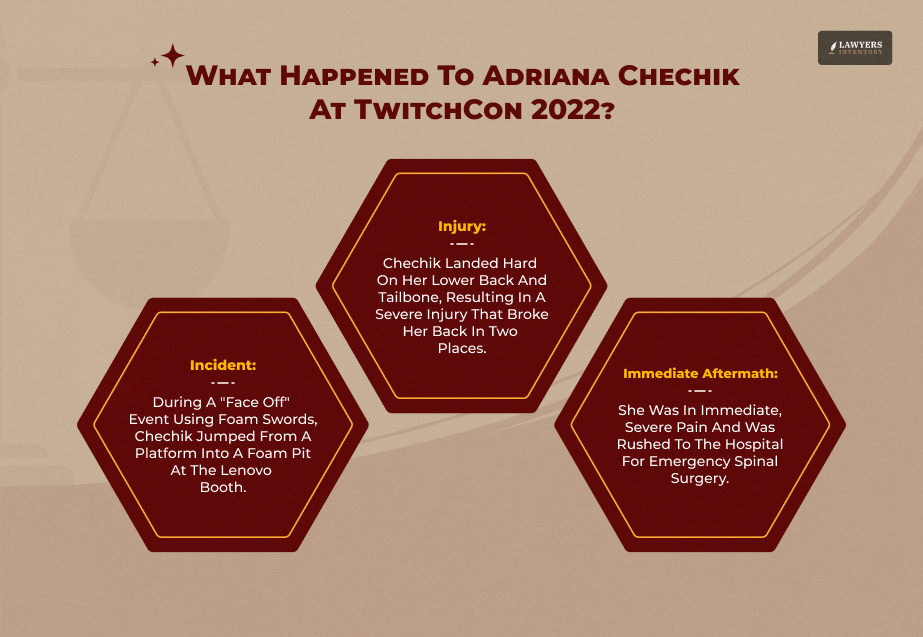
To really understand the lawsuit and Adriana’s claims, you have to know what the incident was about.
The Setup: Lenovo/Intel Booth, Foam-Pit Mechanics & What Went Wrong
The foam pit at TwitchCon 2022 was operated at the Lenovo Legion/Intel booth. Promotional footage and eyewitness accounts showed a dueling-platform setup: two raised pedestals where participants could knock opponents off with padded batons, similar to a gladiator-style game. Beneath the platforms was a shallow bed of foam cubes — giving the impression of a soft landing.
However, early videos and photographs revealed a critical design flaw. The foam cubes were placed directly over a hard floor with very little depth, cushioning, or internal fire-retardant padding typically required for safe athletic pits.
In safer environments — such as gymnastics facilities, trampoline parks, or competitive sports centers — foam pits generally have:
- 4–6 feet of depth.
- Multiple layers of soft foam and air pockets for compression.
- A trampoline-style or sprung floor beneath the cubes.
- Trained safety attendants and strict usage rules.
- Mandatory fall-technique instructions.
According to reporting from SVG and BuzzFeed, experts noted that the Lenovo/Intel pit appeared to be only one to two cubes deep, equivalent to a few inches of foam — grossly below standard safety guidelines.
Convention attendees also later reported they could feel the concrete or plywood substrate beneath them after jumping.
This mismatch between appearances (a “fun, bouncy pit”) and reality (a thin layer of cubes over hard ground) created the conditions for catastrophic injury.
The Fall And Immediate Medical Aftermath
Footage from multiple angles circulated widely online.
In the video:
- Chechik successfully knocks down her opponent.
- She celebrates by jumping into the pit with her legs extended forward.
- She lands on her tailbone/lower spine in a seated position.
- Immediately, she collapses and appears unable to move without assistance.
Shortly after, Chechik posted on Twitter/X:
“Well, I broke my back in two places and am getting surgery to put a rod in for support.”
She later confirmed:
- A lumbar spine fracture in two places.
- Spinal fusion surgery.
- A support rod implant.
- Nerve damage and ongoing mobility issues.
Tubefilter and Business Insider reported that multiple attendees were injured in the same pit, including:
- A streamer who dislocated their knee.
- Another participant who reported ankle and leg injuries.
- At least one attendee who required a wheelchair after their fall.
These additional injuries reinforced claims that the pit was fundamentally unsafe, not just a freak accident.
Surgery, Recovery & Long-Term Health Effects
Chechik’s injuries were not temporary. Her recovery extended for months, with repeated public updates describing:
- Spinal fusion surgery.
- Persistent nerve damage.
- Chronic pain.
- Limited mobility.
- Rehabilitative physical therapy.
- Use of a back brace.
- Herniated discs developing post-surgery.
Coverage from Tuko.co.ke summarized her long-term medical challenges, including difficulty sitting, walking long distances, and participating in physically demanding activities she previously enjoyed.
Spinal injuries of this nature have lifelong implications. Many individuals with spinal fusion experience:
- Reduced flexibility.
- Susceptibility to further disc issues.
- Ongoing pain.
- Dyspareunia and pelvic-floor complications.
- Limitations in pregnancy and childbirth.
For a creator whose career depends on mobility, travel, and physical presence at events, the economic and professional consequences can also be substantial.
Personal Loss: Pregnancy Termination & Emotional Toll
One of the most devastating revelations came weeks later.
Chechik shared that she was pregnant at the time of the accident and had to terminate the pregnancy due to the spinal trauma and surgical requirements.
This personal loss added another dimension to the event — beyond medical costs and legal theories, the emotional, psychological, and reproductive impact of the injury was profound.
Chechik has spoken openly about:
- The emotional toll of abruptly ending a wanted pregnancy.
- Depression during recovery.
- Fear and anxiety about future mobility.
- Trauma from the sudden public exposure of a deeply private experience.
From a damages perspective, if a lawsuit had occurred, these factors could have significantly increased non-economic damages, such as:
- Pain and suffering.
- Emotional distress.
- Loss of enjoyment of life.
- Reproductive harm.
Legal Questions & Liability: Could This Become An Adriana Chechik lawsuit?
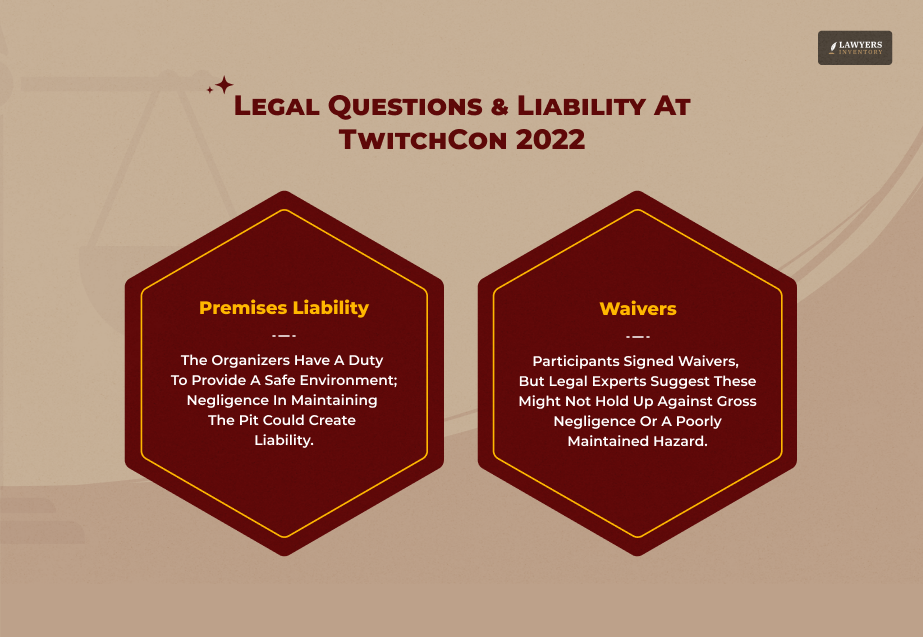
If a lawsuit had been filed, the most straightforward legal framework would be negligence. To prevail, a plaintiff must show:
- Duty of Care: Exhibitors at conventions owe attendees a duty to maintain reasonably safe conditions.
- Breach of Duty: A shallow pit over a hard surface, marketed as safe to jump into, could constitute a breach.
- Causation: The unsafe design directly caused Chechik’s fractured spine.
- Damages: Medical bills, lost earnings, pain and suffering, and reproductive loss.
Additional legal theories that could apply:
- Premises liability claims that the event host or venue maintained a dangerous condition.
- Negligent design or construction against contractors who built the pit.
- Negligent supervision against booth staff who allegedly encouraged jumping.
- Product liability if the pit or platform was defective or improperly assembled.
Legal analyses such as the Syracuse Law Review’s commentary on waiver enforceability emphasize that event sponsors must ensure attractions meet industry-standard safety expectations, regardless of signed waivers.
What Challenges Exist: Waivers, Assumption Of Risk & Defenses
Events like TwitchCon often require participants to sign liability waivers. These waivers typically include:
- Assumption of risk.
- Release of liability for ordinary negligence.
- Agreement to arbitration.
However, California law (where TwitchCon 2022 occurred) sets important limits on waivers. For instance, they:
- Do not protect against gross negligence.
- Can be invalid if they violate public policy.
- Cannot release liability for reckless conduct.
Additionally, ambiguous or poorly communicated waivers may be unenforceable.
If the foam pit truly lacked standard safety features, a plaintiff could argue gross negligence, meaning:
A severe departure from the standard of care expected of a reasonable operator.
Courts have repeatedly held that dangerous setups disguised as safe attractions often exceed the protections waivers provide.
Who Could Be Responsible: Multiple Defendants & Shared Liability
A foam-pit injury at a large convention can involve multiple parties, including:
- Twitch (event organizer) – responsible for overall event safety.
- Lenovo and Intel (exhibitors) – responsible for booth design, supervision, and safety protocols.
- Contractors or booth designers – responsible for pit construction and compliance.
- San Diego Convention Center (venue) – responsible for premises safety and oversight.
- Third-party staffing companies – responsible for supervising participants.
California follows a comparative negligence model, meaning liability can be apportioned among several defendants based on their percentage of fault.
This complexity, even before a trial is ever reached, is exactly why multi-party convention cases often result in:
- Cross-claims.
- Indemnity disputes.
- Confidential settlements.
Read Also: Momentum Solar Lawsuit Explained: Contract Claims And What Homeowners Should Know
What Actual Adriana Chechik lawsuit History Shows (As Of 2025)
As of 2025, a thorough search of public federal and California state court databases reveals no publicly filed lawsuit by Adriana Chechik. Additionally, there are:
- No docketed claims against Twitch, Lenovo, Intel, or the event venue.
- No published settlements or verdicts.
Legal reporters have noted the possibility that:
- A private, confidential settlement may have occurred, or
- Chechik may have chosen not to pursue a claim publicly.
Because many corporate defendants prefer to avoid publicity, confidential pre-filing settlements are common. However, there is no verified evidence that such a settlement occurred.
Thus, as of early 2025, the legal status remains officially unconfirmed.
Expert & Legal Commentary: What Attorneys Say About The Adriana Chechik Lawsuit
Legal experts interviewed by outlets such as Business Insider and various legal blogs generally agree:
Strengths Of Chechik’s Potential Case
- Clear evidence of unsafe design.
- Multiple injured participants (pattern of negligence).
- Severe, well-documented medical harm.
- Possible gross negligence surpassing waiver protections.
- High economic damages and emotional distress.
Some attorneys say the case could have been worth well over seven figures, especially with reproductive harm included.
Weaknesses / Challenges
- Existence of a waiver (if signed).
- Potential contributory negligence arguments.
- Corporate defendants’ incentive to settle quietly.
- Lack of publicly available internal safety documents.
According to Business Insider legal commentary, attorneys emphasized that if this case were litigated publicly, it would be one of the most significant event-safety lawsuits of the last decade.
Speaking to Business Insider, personal injury lawyer Tom Kherkher said that, based on his experience, a typical personal injury case typically takes from two to four years to mature. Additionally, he stated that 90 to 95% of all legal actions are resolved through settlements.
Read Also: Sierra Mist Lawsuit: Did PepsiCo Really Clash with Influencer Over Identity Theft?
The Chechik Case As A Warning: Final Thoughts & What Comes Next
The foam-pit incident involving Adriana Chechik at a convention is, by far, one of the most talked-about accidents at a convention in the last couple of years. Not only is it because of who she is but also it revealed significant gaps in event safety standards.
It demonstrated how brand activations of “fun” can very well hide the actual danger and how creators are usually expected to engage in high-risk activities without the necessary safety equipment.
Up to 2025, there is no public lawsuit. However, the issues raised – such as waivers, negligence, corporate accountability, and medical harm over time – are still affecting the safety of conventions talks.
The aftermath of this incident will probably have a long-term impact on the functioning of live events whether it be through future regulation, industry self-reform, or continuous scrutiny by attendees and creators.
Presently, it is a story of an unfortunate event and recovery of the injured human being and, at the same time, a legal warning tale having lots of questions that are yet to be answered.
Leave A Reply






Slip And Fall Lawyer: Famous Cases And Expert Hiring Tips
Read More
Attorney Kenneth Powell: Fighting For Justice In Personal Injury Cases
Read More
Attorney Josh Bonnici On The Responsibility Of Handling Serious Personal Injury Cases
Read More
0 Reply
No comments yet.