Summarize using AI





Prompt copied. Paste it into Gemini.
The voir dire is the pivotal point in the American juror selection procedure that ensures that everyone enjoys his/her right to a fair trial conducted by an unbiased group of jurors.
During the voir dire stage, lawyers can ask questions about potential biases or conflicts of interest.
In April 2026, legal scholars will be following a number of major court proceedings in which issues related to the definition of the voir dire have attracted considerable attention.
In particular, appeals to the federal court are questioning the implications that social networking accounts could hold for the modern definition of the term voir dire.
Here in this article, we will elaborate on the following:
- The historical roots and the voir dire meaning in modern courts.
- The legal difference between strikes for cause and peremptory challenges.
- Landmark Supreme Court cases that shaped jury selection rules.
- Practical tips for attorneys preparing for the selection phase.
- Answers to common questions regarding jury duty and selection.
Defining The Concept Of Voir Dire In Modern Law
The French phrase ‘voir dire’ is synonymous with the term ‘speak the truth.’ The literal definition of the term is used in a judicial context to refer to a procedure where judges interrogate potential witnesses/jurors.
What Is Voir Dire In Civil And Criminal Proceedings?
Understanding what is voir dire is about exploring the role it plays in selecting individuals who are suitable to participate in trials.
It involves a procedure where the court determines whether an individual qualifies to be a juror.
Role Of The Presiding Judge
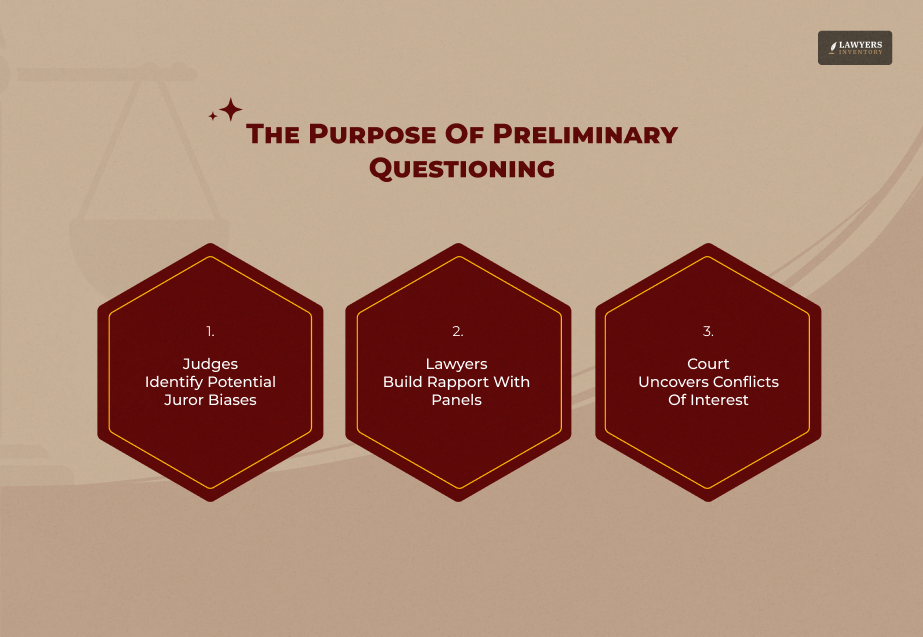
The judge typically starts the process by making general inquiries to the entire group. He/She tries to identify those people whose presence would not be appropriate, such as being familiar with the defendant or having personal interests in the outcome of the trial.
Difference Between Federal And State Court Procedures
In the majority of federal cases, the judge does the bulk of the interrogation without giving lawyers much time to ask questions. In contrast, most states give lawyers the opportunity to talk to potential jurors.
Oath For Truthfulness
Each potential juror takes an oath before undergoing voir dire. The oath entails promising that one will tell the truth while answering the questions asked.
The Legal Mechanics Of Selecting And Striking Jurors
Voir dire involves “striking” jurors who may pose a disadvantage to the lawyer’s client.
For Cause Strikes And Hidden Bias
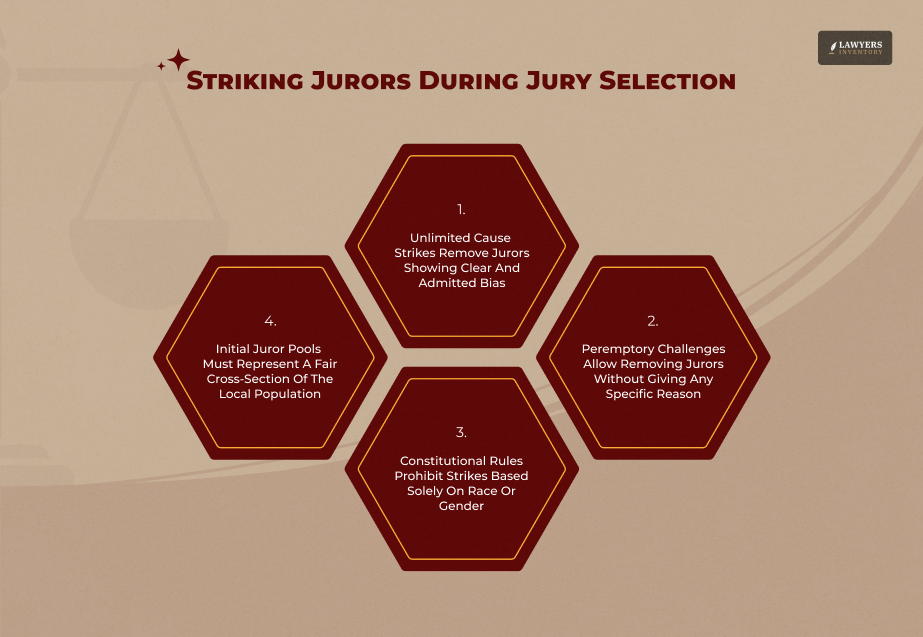
In this situation, a strike for cause happens after a juror has admitted that he has some biases that prevent him from being impartial.
For instance, if a juror acknowledges that he hates all corporations, the defense attorney in the case can request a strike for cause (Source: NYU Law).
Peremptory Challenges
In addition, the lawyers involved have a limited number of peremptory challenges. Under this process, a lawyer can eliminate a juror without providing any reason, as long as the decision is not motivated by race or gender.
The Fair Cross-Section Rule
It is mandatory that the first set of jurors selected must represent a fair cross-section of the population of the area where the trial is taking place.
Should the group not be representative, then the whole process of voir dire may become unconstitutional.
Questioning Tactics of Lawyers
Lawyers use open-ended questions in order to solicit responses from jurors. The purpose is to find out the opinion of the jurors concerning particular subjects in order to determine their vote in the end.
Landmark Supreme Court Cases And Constitutional Rules
Voir dire is not just part of the court system. It is a fundamental right under the Sixth and Fourteenth Amendments. Here are some significant cases that help establish what is allowed during voir dire.
Batson V. Kentucky (1986)
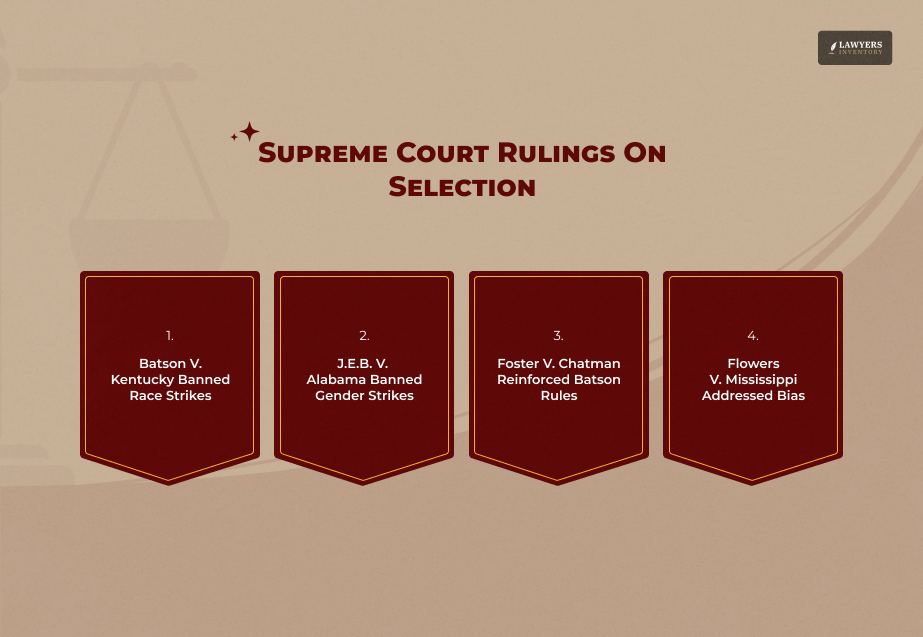
In the landmark case of Batson v. Kentucky (476 U.S. 79), the Court ruled that prosecutors could not make peremptory strikes against potential jurors just because of their race. This has been termed “The Batson Challenge,” US Legal Support explains.
J.E.B. V. Alabama (1994)
The case of J.E.B. v. Alabama (511 U.S. 127) took the Batson challenge one step further and banned discrimination on grounds of gender. Now, no lawyer can disqualify any juror simply because of the sex of the person involved.
Three Steps In A Batson Challenge
The three steps in a Batson challenge begin with proving an intention to discriminate. The second involves the striker giving an excuse while the judge judges whether the excuse is a lie or not.
Implication For Today
Lawyers are expected to keep very good notes. They should be prepared to give either a race-neutral or a gender-neutral reason when removing each juror.
Legislation Governing Jury Trials
The year 2026 brings about new legislation regarding voir dire practices within various jurisdictions.
The federal legislature and each state legislature both hold the power to determine the criteria for jury selection.
The Jury Selection And Service Act
It is a federal law requiring the selection of juries through random methods in order to guarantee equality in favor of all litigants involved in federal cases.
Discrimination based on race, color, creed, gender, nationality, and financial situation are prohibited by this law.
Juror Selection Reform For Individual States
Recent legislation in some states has seen the removal of peremptory challenges because of the threat of partiality on the part of the attorneys.
According to such states, challenges made only for cause should be made in order to achieve a completely impartial panel.
Privacy And Technology
Privacy legislation passed in 2026 prevents any form of digital voir dire practice by banning the use of artificial intelligence programs used to extract information from jurors’ private social networking pages.
The Impact Of The 2025 Jury Fairness Act On Selection Rules
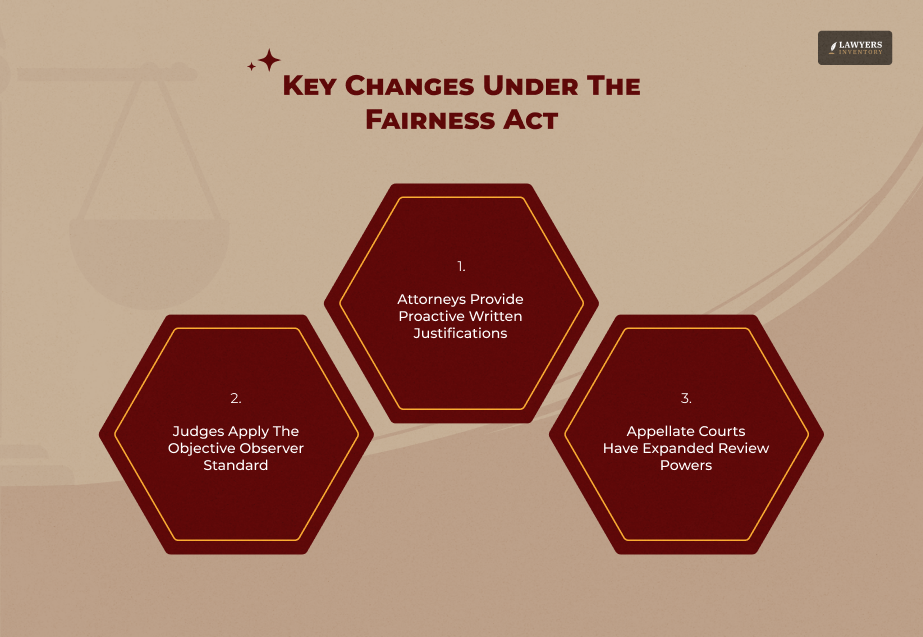
The passage of the 2025 Jury Fairness Act has made huge changes in the way that voir dire takes place at the federal and state levels.
This piece of legislation centers around the issue of removing any implicit biases through greater transparency of the process of peremptory striking in trials.
The Proactive Step Toward Written Explanations
In the past, a lawyer needed only to give an explanation in the case of a Batson challenge from the opposing lawyer.
In 2026, lawyers need to submit a short written statement for each of their strikes before a jury is sworn in.
Cutting Back On Contested Strikes At The Federal Level
This proactive step has saved enormous amounts of time in discussions. Statistics from the early part of 2026 show that there was a 30% reduction in contested strikes because lawyers were more careful with their decisions.
Greater Transparency For Court Records
These explanations have now been moved into a written format so that the courts have an official record of everything that occurs.
Federal Rules And Statutory Standards For Jury Selection
Although there is an assurance of the right to a fair trial in the Constitution, the federal laws provide rules concerning the technicalities of the voir dire procedure.
Analysis Of Federal Rule Of Criminal Procedure 24
This particular rule confers on the court the initial mandate to carry out the voir dire inquiry. It provides for the decision of whether the judge will be asking the questions or allow the lawyers to participate in the inquiry.
Supplemental Questions In Voir Dire Under Rule 24
Where the judge carries out the questioning, according to this rule, he must still allow the lawyers to present their “supplemental questions” in order to address certain issues in their case, such as local prejudice.
Federal Rule Of Civil Procedure 47
For civil cases, this rule addresses the issue of choosing juries for litigation concerning money and property disputes.
This rule applies similarly to the case of criminal law, but with the distinction of using a smaller jury panel ranging from six to twelve jurors.
The Role Of Hard Evidence And Statistical Disparities
It is essential to examine the statistics that are connected to the issue of jury exclusion to comprehend the need for modern reforms of voir dire.
According to Equal Justice Initiative statistics, this is the reason why the “Batson” laws have been established.
Tackling Discrimination Through Statistics
In many historical cases where the death penalty was involved, lawyers struck out more than 75% of the possible black jurors from the case via peremptory strikes. As such, the court had to introduce new regulations.
Objective Observer Standard In 2026
Currently, when examining the strikes, courts rely on what might be considered a “reasonable objective observer” to determine whether the decision was biased or not.
As such, even if the lawyer says it was not, the observer may see otherwise.
Implicit Bias Assessment Among Potential Jurors
One of the steps taken by courts in 2026 includes the “Implicit Association Test” in the jury questionnaire. It helps jurors realize where their hidden biases are located before the trial.
Frequently Asked Questions (FAQs):
The knowledge about voir dire is critical for people who receive the jury summons. These questions will help you understand what kind of things will be asked to you at that stage.
Voir dire is the phase where you get questions from the judge and lawyers to test whether you are unbiased enough to serve as a juror.
It is the only chance when you communicate with lawyers on a one-to-one basis during the trial.
Only if you tell lies under oath, everything else is expected to be truthful and authentic. Otherwise, you would not be chosen as a juror. However, perjury is a felony.
In straightforward cases, several hours will be enough. In complex crimes or capital punishment cases, voir dire may last for many days because each prospective juror has to be questioned individually.
Excuses are personal matters. Strikes are the reasons for disqualification provided by the lawyer for some juror’s particular conduct.
The Judge will instruct you on the procedure when you appear for jury selection at the start of the day. You don’t have to be legally trained in order to qualify. All you have to do is answer the questions asked of you.
Yes, in the normal course of events, all proceedings are recorded in an open court. In some cases where privacy may become an issue, however, the Judge might conduct a private voir dire in chambers.
Dress up professionally since it is important that the court sees you are taking your civic responsibility seriously.
Leave A Reply






Is It Legal To Use True People Search? What Are Its Restrictions?
Read More
Case Is Being Actively Reviewed By USCIS – Meaning And Timelines
Read More
Refund Risk Under Income Tax Demand Notice Section 143(1) Summary Adjustments [A Complete Legal Assessment]
Read More
2026 Rules For The Legal Age Of Marriage In India
Read More
What Is A Wet Signature? Legal Guide And 2026 Rules
Read More
0 Reply
No comments yet.