
The General Data Protection Regulation (GDPR), passed in 2016, has completed its 10th year in 2026.
Even in 2016, it was a landmark that compelled the companies to update their operations and bring changes in branding, product designs, and services.
Then the regulation came into effect on 25th May 2018.
Further, in 2026, the core principles remain the same. However, there have been some sharp updates.
With digital agreement platforms such as clickwrap software, the “consent” part has been stricter, and “fair” cookie banners are in place.
There are also cross-border transfers, AI and transparency updates, and other changes.
So, in this article, I will discuss what is GDPR, the core principles, how the principles can be integrated into operations, and the updates in 2026.
What Is GDPR?
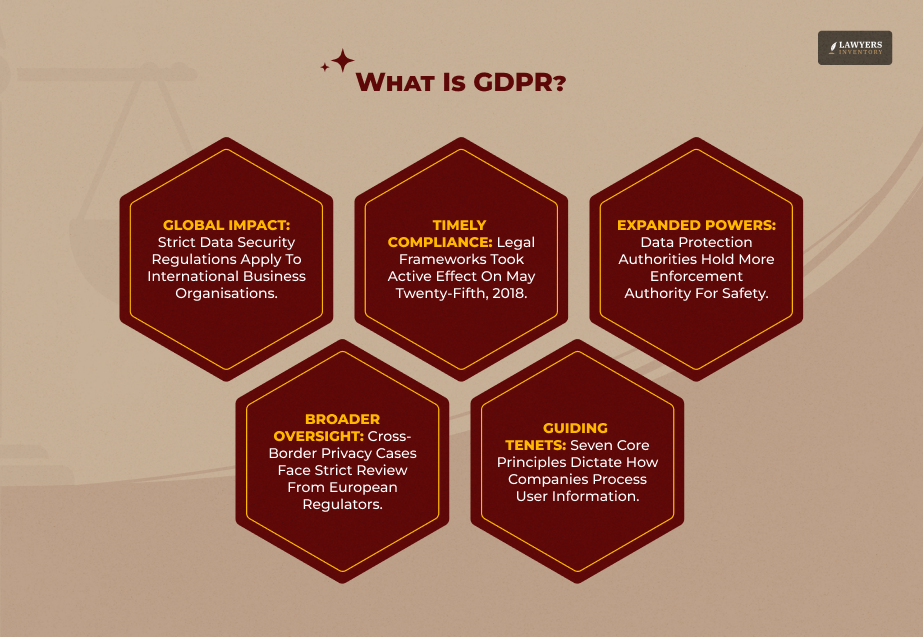
“The General Data Protection Regulation (GDPR) is the toughest privacy and security law in the world.
Though it was drafted and passed by the European Union (EU), it imposes obligations onto organizations anywhere, so long as they target or collect data related to people in the EU.
The regulation was put into effect on May 25, 2018. The GDPR will levy harsh fines against those who violate its privacy and security standards, with penalties reaching into the tens of millions of euros.” (Source: Gdpr.eu).
What The Definition Means In Simpler Terms
Now, what we get from this definition is that GDPR has given the DPAs or data protection authorities more power for a stronger enforcement of the data protection regulation.
Furthermore, there has been an expansion in the scope of protecting personal data and ensuring safe data processing.
The data protection authorities will no longer just focus on national compliance. They will also deal with cross-border cases.
Starting from 2016, the European Data Protection Board (EDPB) and 30 other European DPAs have ensured consistency in the enforcement and harmony in the data protection measures.
To maintain that, it is very important to understand the seven core principles of GDPR.
What Are The Seven Core Principles Of GDPR?
In GDPR, data processing means the action related to data performance. This action can be manual or automated.
The examples include the following.
- Collecting
- Storing
- Structuring
- Recording
- Organizing
- Using
- Erasing, etc.
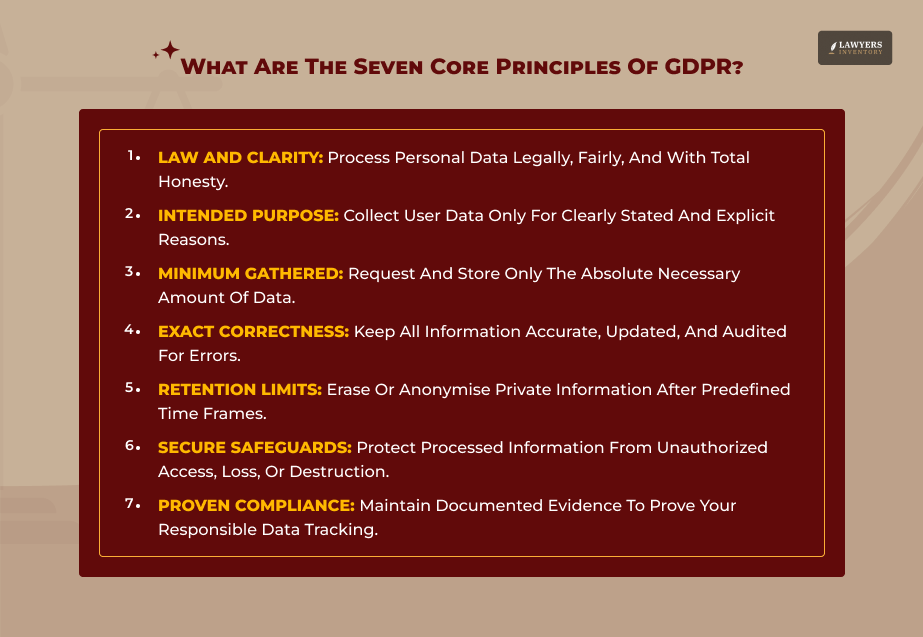
Now, during data processing, one has to follow the seven core principles.
1. Lawfulness, Fairness, And Transparency
You need a good reason to process data, and GDPR refers to that as lawfulness.
Furthermore, the good reasons here mean:
- There is consent from the user regarding the processing of the data.
- Furthermore, there has to be a contract.
- Also, a legal obligation needs to be fulfilled.
- Furthermore, the data processing will protect the vital interests of a natural person.
- Moreover, as a public task, it must take care of the public interest.
Overall, the principle of lawfulness goes well with the concept of Fairness in GDPR.
This further implies that you cannot withhold the purpose for using data purposefully. Also, the information on why the data is being used should not be a surprise to any user.
In addition, fairness means that there will be no mishandling of data collected.
Again, transparency is related to fairness. It means the following.
- Honesty
- Openness
- Clarity with data subjects.
In this context, you must know that data subjects mean the persons whose data is being used. Also, these data subjects mean site visitors and customers.
2. Purpose Limitation
Purpose limitation is the second principle of GDPR, and it means a boundary where an organization states that data is “collected for specified, explicit, and legitimate purposes.”
In other words, you have to establish the specific use of the data you are collecting. However, along with making the statement, the organization has to also ensure that they are using the data only for the said purpose.
Furthermore, if you at all need to use the data for any other purpose than you have stated, you have to seek a fresh consent.
However, you cannot seek a fresh consent if there is already a function or obligation in the law.
3. Data Minimization
You have to ensure that you are collecting just the small amount of data you will actually need for a particular purpose.
For example, you want to send newsletters to your subscribers. Then, you will only need their email ID for sending emails.
You don’t need to collect and store data like their name, address, or phone number, as you will not need them for sending newsletters.
4. Accuracy
You have to be sure about the accuracy of the data you are collecting or storing. Here, it means being careful about the checks and balances.
Now, setting up checks and balances includes the following activities regarding the incorrect data.
- Correct
- Update
- Erase.
Also, you have to perform a regular audit to cross-check the accuracy of the data stored.
5. Storage Limitation
When an organization stores personal data, it has to justify the span for which it will store it.
The span for which you will store the data is called the data retention period. Stating and justifying the data retention periods are crucial for maintaining the storage limitation policy.
Now, the organization will have to create a standard time, post which it will anonymize the data.
6. Integrity And Confidentiality
When you collect, process, or store data, you have to maintain integrity and confidentiality.
In simpler terms, it means that you have to ensure protection of the data you process for internal and external attacks, including:
- Unlawful or Unauthorized Processing
- Accidental Loss
- Damage
- Destruction.
Proactive diligence and planning are the main pillars of maintaining the integrity and confidentiality of private data.
7. Accountability
GDPR regulators are well aware that organizations can claim to comply with the GDPR rules without actually doing so.
That is where accountability becomes important.
If you are a concerned organization, you must have all the records about the compliance measures of data processing in place.
You may have to produce the documented proof to the supervising authorities at any time.
Be careful about the documentation part as it will create an audit trail for the authorities and your organization to prove your responsible behavior.
How To Integrate The Core Principles Of GDPR Into Your Daily Operations?
The seven core principles of GDPR set out the guidelines for the best practices of data processing.
In addition, it sets the guidelines of the data controller and data processor. In this context, a data controller means a person who makes decisions about how and why personal data processing will happen.
A data controller can be the owner or an employee of an organization that manages data.
On the other hand, a data processor, a third-party entity, works for a data controller. As an individual or an organization, a data processor has to follow some special rules, including:
- Microsoft OneDrive
- Proton Drive
- Google Drive
- Proton Mail and Other Email Service Providers.
So, in the place of theoretical guidelines, these core principles set a guideline for business activities and data processing activities.
In other words, from the guidelines, you know about the procedural fairness, enforcement timeliness, and the fairness of a complaint.
What Is GDPR In 2026? Know The Updates
So, if you ask me what is GDPR in 2026? I will say that it is no longer a legal checklist,
In fact, it is now an active process of data governance.
Furthermore, the enforcement of the cookie banner fairness has been stricter. Moreover, there has been AI-driven data utilization to establish stronger transparency.
In addition, according to Article 17 of the Right to Erasure, the European Data Protection Board (EDPB) is strengthening the right to erasure. The deletion requests also have to be within strict guidelines.
Moreover, there have been strong updates on the cross-border transfers.
The EDPB has released updated guidelines on Binding Corporate Rules (BCR-P), standardizing application forms and aligning them with strict data processor requirements.
These updates are important for understanding the compliance of the General Data Protection Regulation.
Leave A Reply








The Motorcycle Was There So Why Didn’t The Driver See It?
Read More

7 Workplace Issues That Can Create Legal Risk For UK Employers
Read More
When Spouses Interpret Stability Differently: Marital Conflict
Read More
0 Reply
No comments yet.