
Quick Answer

A legal representative in a business is an individual who is formally authorized to act on behalf of a company in legal, contractual, and regulatory matters. This person binds the company through their actions and signatures, creating enforceable obligations. They can include corporate directors, appointed attorneys acting under a power of attorney, registered agents, or other authorized signatories - depending on the company's structure and applicable law.
Every business enters contracts, deals with regulators, opens bank accounts, and faces legal proceedings. In every one of these situations, the same question arises: who has the legal authority to act on behalf of the company?
The answer almost always involves a legal representative.
Understanding what a legal representative is, what they can and cannot do, and how they are formally appointed is foundational knowledge for anyone running, owning, or advising a business – regardless of where in the world that business operates.
What Is A Legal Representative In A Business?
A legal representative is a person who, under the law, a company’s articles of association, or by formal appointment, has the power to act for the company and make decisions that are legally binding on the company.
As per the Code of Civil Procedure, this is “a person who in law represents the estate of a deceased person and includes any person who intermeddles with the estate of the deceased and where a party sues or is sued in a representative character, the person on whom the estate devolves on the death of the party so suing or sued.” [Source: Drishti Judiciary]
A legal representative is an authorized representative of the enterprise, who acts on its behalf and carries out the rights and obligations resulting from the company’s activities under the law.
This person represents the company in signing contracts, working with state authorities and business partners, and bears legal responsibility for all legal transactions of the enterprise. [Source: Lexconsult]
When a legal representative signs a contract, that contract binds the company – not the individual personally.
When they communicate with a government agency, that communication is treated as coming from the company itself.
This is what makes the role central to how businesses function: the company, as a legal entity, cannot act on its own. It acts through its authorized representatives.
This global concept remains true everywhere. However, specific rules vary significantly by jurisdiction and business structure.
Consequently, these local laws change who qualifies for the role. Furthermore, they alter how a company appoints them. Finally, regional statutes dictate exactly what liability these individuals carry.
Types Of Legal Representatives

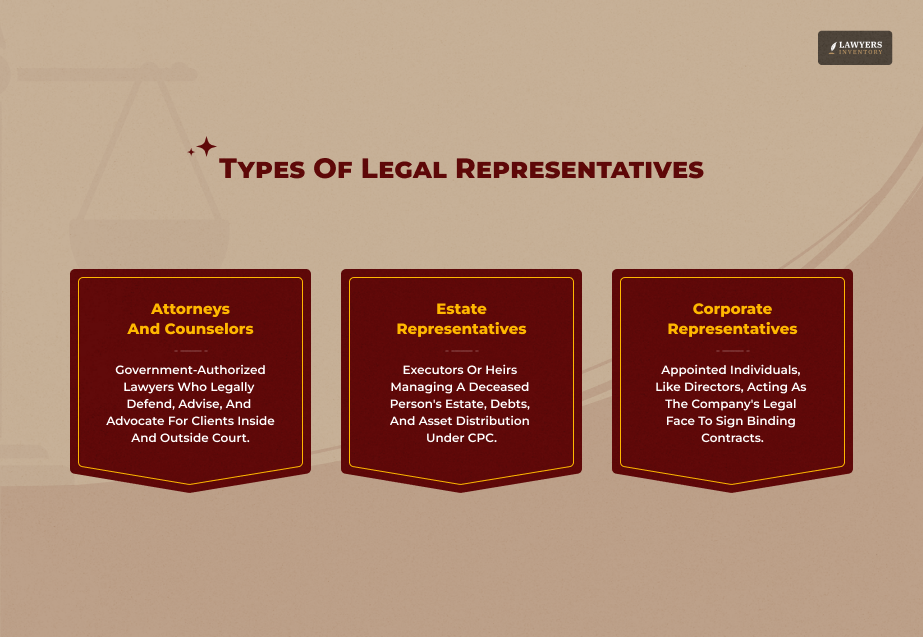
Attorneys and Counselors: Government-authorized lawyers who legally defend, advise, and advocate for clients inside and outside court.

Estate Representatives: Executors or heirs managing a deceased person's estate, debts, and asset distribution under CPC.

Corporate Representatives: Appointed individuals, like directors, acting as the company's legal face to sign binding contracts.
Who Can Act As A Legal Representative For A Company?
Legal representation in a business context is not limited to a single type of individual. Several roles carry the authority to represent a company, each with a different scope.
Directors And Officers
In most corporate structures, the board of directors – or individual members of it – serves as the company’s primary statutory representatives.
Each member of the board of directors generally represents a joint-stock company individually. However, the articles of association can change this rule.
For instance, the charter can explicitly restrict individual power. Consequently, the company may require two board members to sign documents jointly.
Directors derive their authority directly from the company’s governing documents and applicable corporate law.
Their authority to represent the company does not require separate documentation for each transaction. Instead, this power flows directly from their appointment to the role itself.
Consequently, the official appointment serves as permanent proof of their authority. Therefore, third parties can safely rely on this status for everyday business deals.
Appointed Attorneys Acting Under Power Of Attorney
Where a company needs to extend representation rights beyond its directors and officers, it can do so through a power of attorney.
Powers of attorney allow for the flexible assignment of representation rights to specific individuals.
Three types are commonly used:
- Special power of attorney granted for specific transactions only.
- Generic power of attorney that applies to a specific type of transaction.
- General power of attorney that covers all company matters.
An important operational point: powers of attorney are independent of the underlying legal relationships, such as employment contracts.
This means that powers of attorney remain valid until they are actively revoked. When an employee leaves the company, it is essential to revoke any existing powers of attorney to prevent their continued use and potential misuse. [Source: Lexfutura]
Registered Agents
Most countries require unregistered firms to designate a registered agent or a statutory representative. This rule applies in particular to foreign companies working in the area.
Therefore, these businesses cannot operate anonymously in a new territory. Instead, they must establish a formal, local point of contact to handle official notices.
The person or organization acts as the main point of contact for the company in case of official communication, regulatory announcements, and legal procedures.
Their primary role is to ensure the company meets its legal obligations. Normally, they are not empowered to sign agreements for the company.
Authorized Signatories
Beyond formal corporate officers and attorneys, many businesses designate authorized signatories – employees who are permitted to sign contracts, purchase orders, or banking documents up to a certain value or within a defined scope.
If an employee repeatedly concludes contracts on behalf of a company and the company tolerates this action – by accepting the goods and making payments – third parties may reasonably assume that this employee is authorized to act.
This principle, known as apparent authority, means that companies need to be deliberate about which employees interact with third parties in a contractual capacity.
What Powers Does A Legal Representative Have?
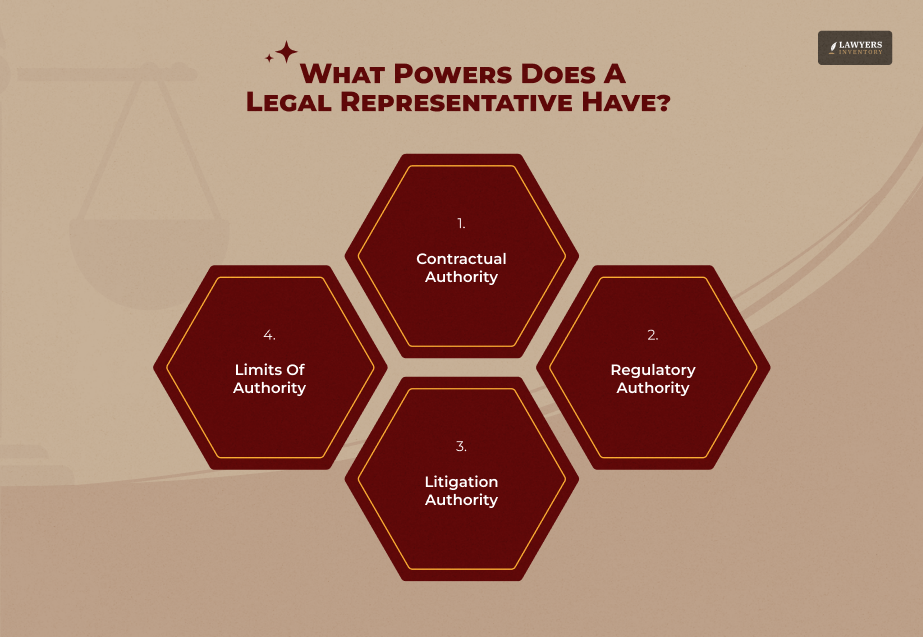
The powers of a legal representative depend on the basis of their authority – whether it flows from statute, from a company’s governing documents, or from a specifically granted power of attorney. Generally, the following powers are commonly held:
Contractual Authority
A legal representative can sign and execute contracts that bind the company. This includes the following:
- Commercial agreements.
- Employment contracts.
- Leases.
- Loan agreements.
- Other legally enforceable arrangements.
Contracts signed by an unauthorized individual may be voidable or unenforceable, which is why third parties routinely verify the authority of the person they are dealing with before finalizing agreements.
Regulatory Authority
Legal representatives interact with government bodies, tax authorities, licensing agencies, and regulators on behalf of the company. In many jurisdictions, regulatory filings and official correspondence must be signed by a formally designated representative.
They can engage in civil activities in the name of the company, and the legal consequences of those activities are borne by the company.
Litigation Authority
When a company is involved in legal proceedings – whether as a plaintiff or defendant – it acts through its legal representative.
This person may appear in court, authorize the appointment of legal counsel, approve settlements, and execute documents related to the dispute.
Limits of Authority
Legal representatives do not have unlimited power.
Most corporate governance frameworks require board approval for major decisions. These include:
- Asset disposals above a defined value.
- Mergers and acquisitions.
- Taking on significant debt.
- Amending the company’s constitutional documents.
Acting outside the scope of authority can expose the representative to personal liability. The representative is personally liable for damages when violating the duty of loyalty or using the company’s assets and information for personal gain.
Liability for compensation also arises if the representative fails to properly perform their assigned rights and obligations, causing losses to the company. [Source: Longphanpmt]
Legal Representative vs. Power Of Attorney: What Is The Difference?
This is one of the most commonly confused distinctions in corporate law, and it is worth addressing directly.
A legal representative derives authority from their position within the company – typically as a director or officer. Their authority exists as long as they hold that position.
It covers the company’s general business activities and is recognized automatically by courts, regulators, and counterparties.
A power of attorney is a document that grants a specific individual – who may or may not be an employee or officer – the authority to act on the company’s behalf, within the scope defined in the document.
A power of attorney can be broad or narrow, permanent or temporary, and it must be formally executed and, in some cases, notarized or registered to be legally effective.
The practical distinction: a director’s authority to represent the company flows from their role.
An attorney’s authority flows from a specific document. Both create binding obligations for the company, but through different legal mechanisms.
How Is A Legal Representative Appointed?
The appointment process for a legal representative depends on the company’s structure and applicable law. In most cases, the following mechanisms are used:
Board Resolution:
The company’s board of directors formally passes a resolution appointing an individual as a legal representative or authorizing them to act in a specific capacity.
Articles Of Association Or Bylaws:
A company’s governing documents may define who holds representative authority by default – for example, that the CEO or Managing Director has authority to bind the company in contracts up to a specified value.
Power Of Attorney Document:
For appointed attorneys, a formal written document grants authority, specifying its scope and duration.
This document may need to be notarized, apostilled, or registered depending on the jurisdiction and the purpose for which it will be used.
Registration:
In many countries, legal representatives must be registered with a commercial or corporate registry.
If a representative is listed in the commercial register, their signing authority is also recorded, specifying whether they have sole or joint signing rights.
Registering a representative provides legal certainty in business transactions, as third parties cannot claim ignorance of their authority.
When Does A Business Need A Legal Representative?
The following situations most commonly require a clearly designated legal representative:
Entering Contracts:
Any counterparty entering a significant agreement will verify that the signatory has authority to bind the company.
Regulatory Filings:
Tax returns, licensing applications, and compliance submissions typically require an authorized signature.
Banking:
Opening corporate accounts, signing loan documents, and authorizing wire transfers require documented representative authority.
Cross-border Operations:
Entering a new market or jurisdiction often requires appointing a local representative to satisfy regulatory requirements.
Litigation:
Courts require companies to be formally represented by an authorized individual or appointed legal counsel.
Employment:
Hiring, terminating, and managing employees involves contracts and decisions that require authorized execution.
Legal Representative Requirements By Business Type
As we know, corporate or business structures are different. And depending on these, the legal representatives also differ.
Here’s what you need to know:
Private Limited Companies and LLCs
Most jurisdictions require limited liability companies to have at least one designated representative – typically a managing director or equivalent officer – whose details are filed with the corporate registry.
Limited liability companies and joint-stock companies are required to have at least one representative, whose information must be recorded in the Enterprise Registration Certificate and updated promptly in the event of any change.
Partnerships
In general and limited partnerships, one or more partners typically hold authority to represent the firm.
The partnership agreement governs who can act and within what scope. In limited partnerships, general partners typically carry full representative authority while limited partners do not.
Branches Of Foreign Companies
Foreign companies operating through a branch in another country almost universally face a requirement to appoint a local legal representative.
This person serves as the official point of contact for local regulators and may be personally liable for certain compliance obligations of the branch.
The EU AI Act’s requirement for non-EU companies to appoint an EU legal representative is a recent and high-profile example of this type of obligation.
Non-Profit Organizations
Non-profits are typically represented by their board of directors or trustees. Depending on jurisdiction, the executive director or CEO may also hold formal representative authority.
The same governance principles – defined scope, board oversight, documented appointment – apply.
Sources:
- Lexconsult & Partners – Procedures for Changing the Legal Representative of a Company (2026)
- LexFutura – Company Representation: Who Can Sign Contracts for Your Business? (2025)
- Dehehantong Law Offices – Legal Representative’s Question: Who Am I? (2024)
- Long Phan Consulting – The Legal Representative Position: Managing Capital Avoids Conflict (2026)
- FDI China – Legal Representative China: Critical Duties for Foreign Investors (2025)
- White & Case LLP – 2026 Horizon Scanning: General Counsel and Company Secretaries
Disclaimer: This article is for general informational purposes only and does not constitute legal advice. Legal representative requirements vary significantly by jurisdiction and business structure. Consult a qualified corporate attorney for guidance specific to your company's situation.
Leave A Reply







CarMax Justice Department Settlement: Why Did The Lawsuit Happen, And The Lessons Learned
Read More
The Ultimate 2026 Guide To The Memorandum Of Association
Read More
Corporate Articles Of Association In 2026 [A Guide]
Read More
23XI Racing NASCAR Lawsuit: Charter Victory, Legal Facts, And 2026 Updates
Read More
Onvoy LLC: What It Is And Why They Are Calling You
Read More
0 Reply
No comments yet.