Quick Answer: Class Action Lawsuit No Proof

You cannot file or win a class action lawsuit with zero legal evidence of wrongdoing. However, consumers can frequently collect money from class action settlements with no proof of purchase (such as receipts). This is because courts allow self-attestation under penalty of perjury, and defendants often already possess the necessary transaction data.
You cannot file or win a class action lawsuit with zero evidence. However, you can frequently collect money from class action settlements with no proof of purchase.
This stark contrast confuses millions of consumers. Search engine results amplify this confusion. If you search for “class action lawsuit no proof,” you will find hundreds of settlement aggregator websites. These sites list open cases where you can claim a payout without a receipt. They treat the issue as a transactional cash grab.
Additionally, they skip the underlying legal mechanics entirely. They fail to explain how a law firm proves a case without individual receipts. They do not mention Federal Rule of Civil Procedure (FRCP) Rule 23. They ignore the legal risks of signing a claim form without documentation.
No Proof Of Purchase vs. No Evidence: What Is The Difference?
To understand “class action lawsuit no proof,” you must separate “proof of purchase” from “legal evidence.” They mean entirely different things. They apply to completely different stages of a lawsuit.
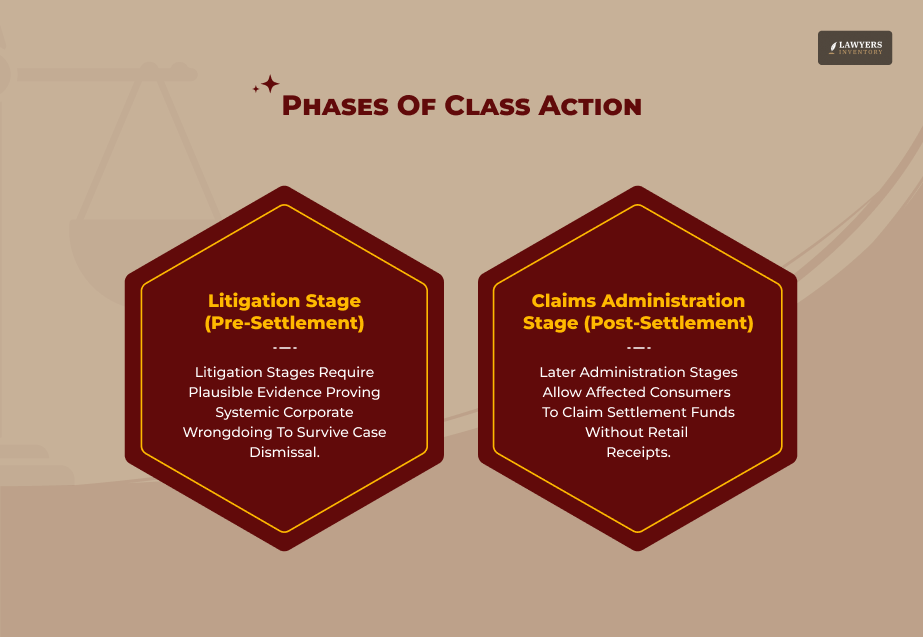
The two core phases of a class action case are:
- The Litigation Stage (Pre-Settlement): Plaintiffs must present plausible evidence of systemic corporate wrongdoing. FRCP 12(b)(6) requires proof to survive dismissal. [Source: Legal Information Institute, Cornell Law School]
- The Claims Administration Stage (Post-Settlement): The court has already approved a financial recovery fund. Class members can often claim funds via self-attestation.
The Litigation Stage: Evidence is Mandatory
You cannot sue a corporation based on a hunch or a rumor. To initiate a class action, the named plaintiff and class counsel must possess plausible evidence. They must prove the defendant broke a law, breached a warranty, or deceived the public.
This stage demands rigorous evidentiary support. Plaintiffs use expert testimony, engineering reports, and internal corporate communications. If a law firm files a class action with zero evidence, the defendant will move to dismiss the case immediately.
Under Federal Rule of Civil Procedure 12(b)(6), a judge will throw out any lawsuit that fails to state a plausible claim. At this phase of the legal process, “no proof” means total failure. The case dies before it begins.
The Claims Administration Stage: Documentation is Optional
The landscape changes completely once a case settles or a jury returns a plaintiff’s verdict. The litigation stage ends, and the claims administration stage begins.
Now, the legal focus shifts. The court no longer needs to determine if the company did something wrong. The company has already agreed to settle, or a judge has found them liable. The goal now is to distribute the money to injured consumers.
At this stage, “no proof” really refers to no proof of purchase – no receipts required, no invoices required, and no store receipts with retail barcodes.
The Court already understands the product was defective or incorrectly labeled, and the Administrator only has to confirm that you are among the people who purchased the product.
How Class Actions Succeed Without Individual-Level Proof
A common myth states that class actions require every participant to bring a receipt to court. This is false. Class actions focus entirely on the conduct of the defendant, not the shopping habits of individual consumers.
Federal Rule of Civil Procedure Rule 23 governs class actions in federal courts [Source: Legal Information Institute, Cornell Law School].
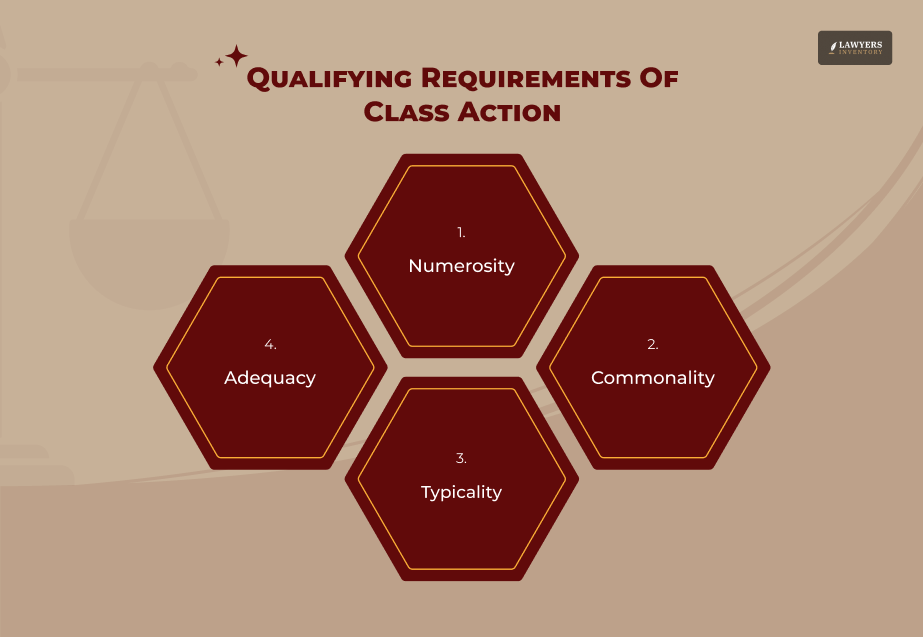
To win class certification, plaintiffs must satisfy four foundational requirements under Rule 23(a):
- Numerosity: The class must be so large that joining every member individually is impracticable.
- Commonality: The lawsuit must share common questions of law or fact across the entire group.
- Typicality: The claims of the named plaintiff must represent the claims of the absent class members.
- Adequacy: The named plaintiff and class counsel must fairly and capably protect the interests of the class. [Source: Legal Clarity]
For damages-seeking lawsuits, plaintiffs must also satisfy Rule 23(b)(3). This requires proving predominance and superiority. [Source: Congressional Research Service Legal Sidebar LSB11317]
Predominance means that shared legal or factual questions matter more than individual differences. Superiority means a class action is better and fairer than thousands of tiny, separate trials.
Class counsel satisfies these strict standards without looking at individual consumer receipts. They use specific litigation tools to achieve this goal:
Internal Corporate Records And Sales Databases
During the discovery phase, plaintiffs’ attorneys issue subpoenas to the defendant. They demand internal databases, sales metrics, and shipping manifests.
These corporate records build the plaintiffs’ case. If a manufacturer ships 10 million units of a mislabeled shampoo to retailers, the corporate invoices prove that fact.
The plaintiff does not need to show your personal receipt because the company’s own records prove the widespread distribution of the product.
Expert Witness Modeling And Statistical Evidence
Plaintiffs hire economists and data scientists to calculate widespread financial harm. These experts do not look at single transactions. Instead, they use advanced statistical tools like conjoint analysis.
This method tests how specific product features affect consumer choices. An expert can isolate a false claim on a juice label, such as “100% Organic.” They calculate exactly how much that false claim inflated the retail price.
If the false claim inflated the price by $0.50, the expert applies that number to the total volume of sales found in the corporate database. This establishes class-wide damages without a single consumer receipt.
The Legal Framework Of The Named Plaintiff
A class action requires at least one named plaintiff, also called a class representative. This person carries the evidentiary burden for the entire group.
The named plaintiff undergoes intense scrutiny. The defendant’s lawyers depose them. They must provide clear proof of purchase, like a receipt, a credit card statement, or an online order confirmation.
The remaining millions of people are “absent class members.” They remain completely passive during the trial. The law allows the named plaintiff’s documentation to stand in for everyone else. If the representative wins, the entire class wins.
Class Action Lawsuit No Proof: Why Some Settlements Don’t Require Proof Of Purchase
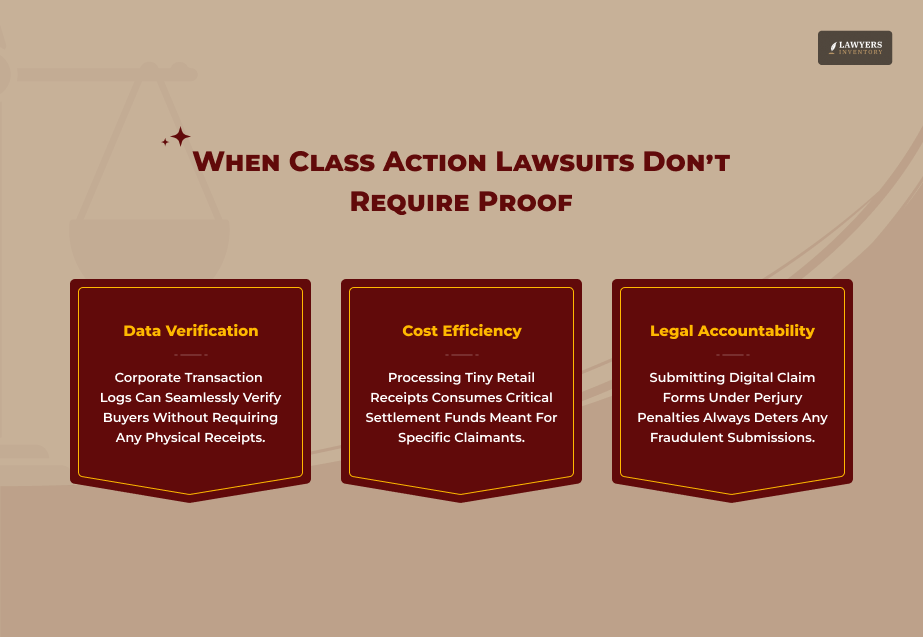
When a judge approves a settlement agreement, the court establishes a clear claims process. Class action administrators routinely waive the requirement for physical receipts. They do this for three specific reasons:
Digital Footprints And Existing Transaction Logs
Modern commerce creates clear digital footprints. For online subscriptions, telecom accounts, gym memberships, and digital apps, physical receipts do not matter. The defendant already holds all the data.
Think about any of the large data breach lawsuits; maybe you heard about the one against Equifax (In re: Equifax Inc. Customer Data Security Breach Litigation) or T-Mobile. [Case: MDL No. 2800, U.S. District Court, Northern District of Georgia]
The company knows that when their servers held the stolen files, because those servers are tracking who those people really were and all the private data those records include. [Source: Federal Trade Commission]
In these cases, the claims administrator uses a direct-pay model. They cross-reference your name, phone number, or email with the compromised database. They send your money automatically via a digital check, Venmo, or an account credit. You do not need to file papers or show proof.
Administrative Efficiency and Proportional Costs
If a company settles a lawsuit over a $4 box of deceptive crackers, individual damages are tiny. Consumers might get $1 or $2 per box.
If the court required everyone to upload a paper receipt, the system would collapse. A claims administrator charges money to review documentation. Checking a single receipt can cost several dollars in administrative labor.
Asking people to provide receipts when they file a small claim is pointless. The costs related to processing would consume the settlement amount, leaving nothing for the community.
To reduce court expenditures, judges often dismiss documentation requirements, which guarantees that funds are distributed to people.
Self-Attestation Under Penalty of Perjury
To replace physical receipts while blocking fraud, courts use self-attestation. When you submit an online claim form without a receipt, you must sign a legal declaration. This text usually sits right above the submit button:
“I declare under penalty of perjury under the laws of the United States of America that the information provided in this claim form is true and correct.”
From a legal standpoint, by checking that box you are essentially changing your digital claim form into a testimonial which will have a legal effect as if you swear an oath in the witness box in court.
If you submit a false claim, you are guilty under federal law 28 U.S.C. § 1746. It constitutes perjury. [Source: U.S. Department of Justice]
Law enforcement agents usually do not go after a person for a fraudulent $5 claim, but if the law is broken, a person is still a person. [Source: U.S. House of Representatives Office of Law Revision Counsel]
Presently, claims administrators use fraudulent activities detection algorithms through which they can pick up automated bots, duplicate IP addresses, and serial claimants who are filing multiple fake claims.
Systematic fraud might mean civil lawsuits, being banned permanently or a referral to the federal prosecutors.
Step-by-Step: How To File A No-Proof Claim
- Locate the official settlement website: Avoid third-party blogs and aggregator sites. Look for web addresses run by established, court-appointed administrators like Kroll, Angeion Group, Epiq, or Rust Consulting.
- Verify the class definition dates: Read the official notice carefully. Ensure you bought the exact product model during the precise date window specified by the court order.
- Select the “No Proof” option tier: Choose the claim category that fits your situation. Note that the no-proof option usually limits the number of products you can claim.
- Input your current personal data: Fill in your legal name, current mailing address, telephone number, and email address for digital payment routing.
- Execute the sworn legal attestation: Read the perjury warning, check the box to confirm your identity and purchase history, and hit submit before the court-ordered deadline.
Are No-Proof Settlements Legitimate, Or A Scam Pattern?
The phrase “get money without a receipt” attracts scammers. Criminal syndicates create fake websites that mimic legitimate settlement portals to steal personal data. Legitimate settlements never charge you money.
Red Flags Of A Class Action Scam
- Upfront Fees: If a site demands a processing fee, a filing fee, or digital currency to release your payout, it is a scam. True class actions deduct attorney fees and administrative costs directly from the gross fund before distribution.
- High-Risk Data Inquiries: Official claims administrators do not need your Social Security Number (SSN), your mother’s maiden name, or your online banking passwords to process a basic consumer product claim.
- Generic Domains or No Case Numbers: Avoid websites that use free web hosts, feature broken links, or fail to name the specific court handling the case.
How To Verify A Settlement Is Real
Every genuine class action settlement links directly to an active lawsuit filed in a state or federal court. You can easily verify any settlement by following these two steps:
- Audit the Public Court Docket: Find the case name and docket number on the settlement website. Search for this information on the official court portal or through PACER (Public Access to Court Electronic Records). If the case does not exist on PACER, the website is fake.
- Verify the Settlement Domain: Check the security certificate of the website. Ensure an established legal notice provider runs the domain. You can cross-reference the case name on major legal news sites or state bar association publications.
Payout Caps And Pro-Rata Reduction
Filing a claim without a receipt directly impacts your final payout. Settling parties protect their funds using tier caps and pro-rata reductions.
The Fund Split: How Claimants Are Categorized
| Category | Documented Tier | No-Proof Tier |
| Requirements | Receipts or proof of purchase provided. | Self-attested claims only; no documents. |
| Payout Cap | Uncapped or true compensatory value. | Capped low-value payout (e.g., maximum $10). |
| Priority | High priority during distribution. | Vulnerable to steep reductions. |
Most class actions use non-reversionary capped funds. The defendant pays a fixed sum, such as $5 million. If the total value of approved claims exceeds that amount, the administrator triggers a pro-rata reduction.
They shrink every payout proportionally to keep the total spend within the fixed fund. Because no-proof tiers attract millions of claims and automated bots, your final check is often much smaller than the initial estimate. A $15 estimated claim frequently turns into a real-world payout of $1.12.
Structural Comparison: No-Proof vs. Documented Claims
| Legal and Operational Attributes | No-Proof Claims (Self-Attestation) | Documented Claims (Receipted) |
| Evidentiary Threshold | Sworn digital statement under 28 U.S.C. § 1746 | Physical receipt, retail invoice, or unique serial number |
| Payout Potential | Low, fixed ceiling (typically $5 – $25 maximum) | Uncapped or true compensatory value of your actual purchases |
| Audit Risk | High; administrators flag serial or bulk claimants | Low; documentation provides validation |
| Pro-Rata Vulnerability | High; heavily impacted by claims volume and bot fraud | Low; often prioritized in distribution frameworks |
| Processing Speed | Slow; requires extensive fraud filtering | Fast; documents provide instant validation |
The Truth About “Class Action Lawsuit No Proof”
You cannot win a class action lawsuit without evidence. The initial litigation phase requires extensive legal proof to survive court scrutiny. The “no proof” phenomenon only exists during the post-settlement claims process.
Courts waive receipt requirements for small consumer claims to cut administrative costs and maximize payout access. They protect the process by requiring self-attestation under penalty of perjury.
While these no-proof settlements offer an easy way to recover money for deceptive corporate actions, they come with low payout caps and remain highly vulnerable to pro-rata reductions.
Sources:
1. Federal Rule of Civil Procedure Rule 23 – Class Actions – Legal Information Institute, Cornell Law School
2. Federal Rule of Civil Procedure Rule 12(b)(6) – Motion to Dismiss for Failure to State a Claim – Legal Information Institute, Cornell Law School
3. 28 U.S.C. § 1746 – Unsworn Declarations Under Penalty of Perjury – U.S. House of Representatives Office of Law Revision Counsel
4. U.S. Department of Justice Criminal Resource Manual § 1759 – Perjury Cases Under 28 U.S.C. § 1746
5. Congressional Research Service Legal Sidebar LSB11317 – Rule 23(b)(3) Class Actions and Article III Standing: Laboratory Corp. of America Holdings v. Davis (May 2025)
6. LegalClarity – Federal Rule of Civil Procedure 23: Class Actions (December 2025)
7. Venio Systems – What Is FRCP Rule 23? A Reference Guide (May 2026)
8. Federal Trade Commission – Equifax Data Breach Settlement
9. T-Mobile Data Breach Class Action Settlement
10. PACER – Public Access to Court Electronic Records
11. Kroll Settlement Administration
12. Angeion Group – Class Action Settlement Administration
13. Epiq Class Action & Claims Solutions
14. United States v. Gomez-Vigil, 929 F.2d 254 (6th Cir. 1991) – cited in DOJ Criminal Resource Manual § 1759 re: prosecutability of 28 U.S.C. § 1746 declarations as perjury
Leave A Reply






Tampax Lawsuit Update 2026: Lead Claims Move Forward As Settlement And Payout Questions Remain
Read More
The Complete ADA Compliance Checklist: Physical, Digital, And Legal
Read More
Why Costco Is Being Sued Over Membership Auto-Renewals – And What The Law Says
Read More
Equifax Breach Settlement: Your Guide To Claims And Payouts
Read More
Herbalife Relaxation Tea Recall: Lot Numbers, FDA Class II Risk, And Consumer Legal Rights
Read More
1 Reply
Costco Auto-Renewal Legal Challenge Explained
August 21, 2026 at 1:57 pm
[…] ARL protections above apply directly to you. If the court certifies this case as a class action, it could eventually cover other California members. That includes anyone with similar renewal […]
Reply