Quick Answer: Legal Assistant Vs Paralegal

Legal assistants perform administrative tasks in a law office. They handle appointment scheduling, filing, and client communication. In contrast, paralegals work directly on substantive legal content. They conduct research, draft legal documents, and prepare cases under an attorney's supervision. Neither professional can give legal advice. They cannot act as lawyers in a court of law. However, clients benefit from knowing who handles their cases. This knowledge clarifies the attorney's process and explains exactly what the firm charges for its services.
I’ve spent enough time around law firm workflows to notice that “legal assistant’ and “paralegal” get used almost interchangeably in everyday conversation.
If you’re the one paying the bills, or trying to understand who’s actually touching your file, that interchangeability isn’t just confusing. It can affect your case and your invoice.
What Is A Legal Assistant?
I think of a legal assistant as the operational backbone of a law office. This role keeps the day-to-day running smoothly so your attorney can focus on your case instead of paperwork.
Typical legal assistant tasks include:
- Managing your attorney’s calendar and scheduling meetings
- Answering calls and emails, and handling routine client communication
- Organizing and maintaining case files, both physical and digital
- Preparing and proofreading correspondence
- Assisting with billing and invoicing
Most legal assistants do not need a law degree. They rarely complete specialized certifications to start their careers. Instead, most candidates begin with a high school diploma. Employers then provide on-the-job training to these new hires. [Source: ZipRecruiter, Clio]
Today, employer preferences are changing.
Many companies now look for applicants with an associate degree. Other employers prefer candidates who completed a college certificate program.
What Is A Paralegal?
A paralegal’s work sits much closer to the legal substance of your case. The American Bar Association defines a paralegal as a person “qualified by education, training, or work experience” who performs delegated substantive legal work for which a lawyer remains responsible.
A paralegal’s day-to-day work usually includes:
- Conducting legal research
- Drafting pleadings, motions, and other legal documents
- Interviewing clients and witnesses
- Organizing evidence and preparing exhibits for trial
- Summarizing depositions and discovery materials
Paralegals typically attend community college to receive an associate degree or a bachelor’s degree. Yet, some students opt for paralegal specialization as well while pursuing their studies.
Then again, numerous paralegals decide to obtain voluntary certifications. They are awarded these certificates from institutions like the National Association of Legal Assistants (NALA) or the National Federation of Paralegal Associations (NFPA). [Source: North Carolina State Bar]
Legal Assistant vs Paralegal: Where The Line Actually Sits
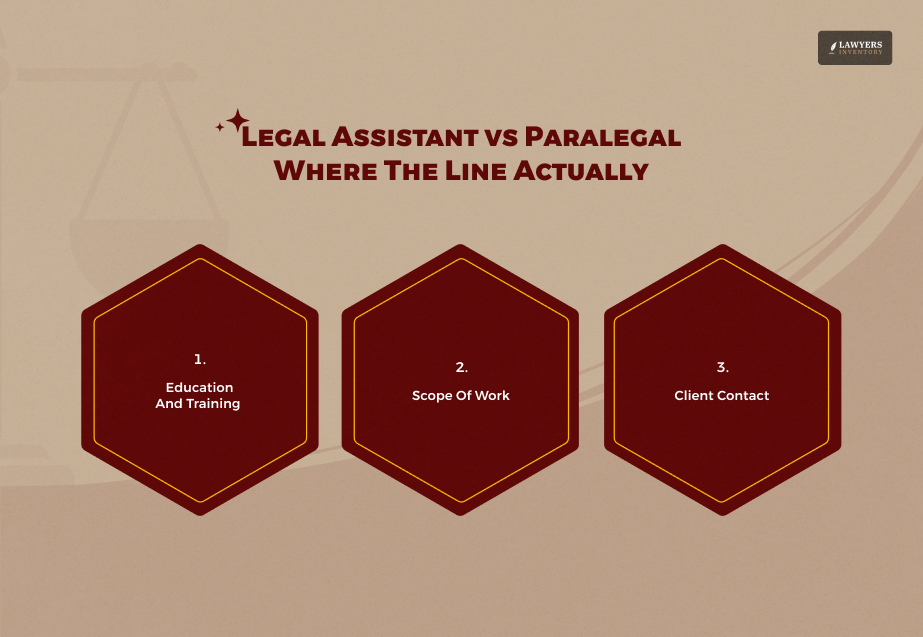
Here’s the clearest way I can put the legal assistant vs paralegal distinction: a legal assistant supports the office, and a paralegal supports the case.
Education And Training
Legal assistants do not need a highly specialized education to enter the field. Most candidates secure jobs with a high school diploma and on-the-job training. [Source: Indeed]
In contrast, paralegals usually finish school with a college degree or a professional certificate. Today, law offices increasingly reject applicants who lack a strong legal background for paralegal positions.
Scope Of Work
A paralegal’s work touches the substance of your case directly, drafting a motion or reviewing discovery, for example. A legal assistant’s work keeps that substance organized and moving on schedule.
Neither is authorized to give you legal advice, sign a pleading on your attorney’s behalf, or represent you in a courtroom.
Client Contact
Paralegals normally communicate with you face-to-face and discuss the matter with you very frequently. This especially happens during the phase where you have to explain or produce the facts and evidence for your case.
On the other hand, legal assistants spend most of their time dealing with calendars and phone-answering tasks. They do not generally engage in a meaningful talk about the details and progress of your case.
Legal Assistant Vs Paralegal: Why The Terms Get Confused
Much of today’s confusion traces back to a specific decision.
The American Bar Association (ABA) changed the official definition of “paralegal” in February 2020. The organization dropped the term “legal assistant” from the definition. This update describes actual paralegal work much better. [Source: ABA]
People used the two job titles as synonyms for decades. Today, many small law firms still use these terms casually. Because of this, internal job titles do not always match official ABA terms.
Does It Matter Who’s Handling Your Case?
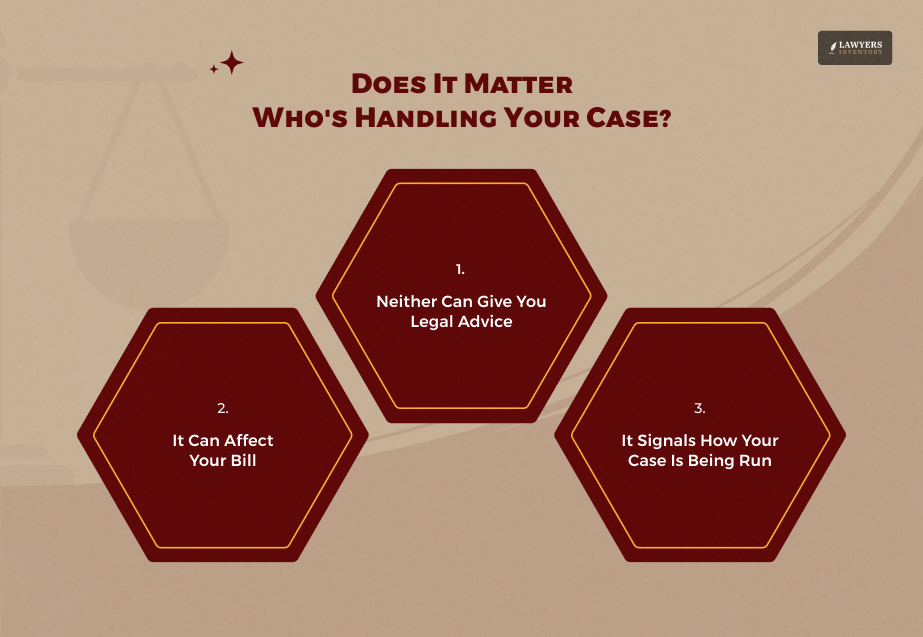
Yes, for a few practical reasons I think most people skips over. Here’s why understanding the difference between a Legal Assistant vs Paralegal matters:
Neither Can Give You Legal Advice:
Regardless of title, only a licensed attorney can advise you on your legal options or represent you in court. If someone identifying as a paralegal or legal assistant offers you legal advice directly, treat that as a red flag.
It Can Affect Your Bill:
Paralegal time is usually billed at a lower rate than attorney time, but a higher rate than legal assistant time, when legal assistant time is billed at all; some firms fold it into overhead instead. Knowing who worked on which task helps you make sense of your invoice.
It Signals How Your Case Is Being Run:
It is a common and even cost-effective practice for paralegals to handle most of your files, such as substantive work like research and drafting. Though, if you want to discuss specific legal matters with an attorney, do so through your attorney, not a support employee. [Source: Thomson Reuters]
What Does This Cost, And How Common Are These Roles?
The U.S. Bureau of Labor Statistics (BLS) combines paralegals and legal assistants into a single occupational category. The agency does not track employment data for these individual roles separately.
The BLS reported a median annual salary of $61,010 for this combined group in May 2024. Economists project very minimal or no job growth in this legal field leading up to 2034. [Source: U.S. Bureau of Labor Statistics Occupational Outlook Handbook]
That double-classification is what explains why we find huge discrepancies when it comes to salary data online.
Most sources will separate the two occupations into two different categories based on their own data sets, whereas the government reports them in the same category.
A Quick Note On Global Variation
Titles and requirements shift by jurisdiction, so it’s worth a brief mention if you’re working with a firm outside the U.S.
In India, there’s no formal, Bar Council-recognized “paralegal” designation. The term gets used informally, often for law graduates or interns working under a licensed advocate. [Source: Lloyd Law College]
Ontario, Canada stands out as an exception in North America: it licenses paralegals to independently represent clients in small claims court and select tribunals, a scope of practice that doesn’t exist for paralegals anywhere in the U.S. [Source: Law Society of Ontario]
If you’re working with counsel outside the U.S., it’s worth asking directly how that firm defines these titles rather than assuming they match the American model.
Legal Assistant Vs Paralegal: How Do You Find Out Who’s Working On Your File?
Seek clarity from your law firm – ask them directly. If they are professional, they will, of course, know how to explain. Here are a bunch of things you can ask:
- Who on my case is a paralegal, and who is a legal assistant?
- Are paralegal hours billed to me, and if so, at what price?
- Who shall I approach about my legal questions first?
An efficient firm will reply all three answers unambiguously. In the event that you get unclear responses or if the administrative staff begin supplying you with legal advice, you may as well bring that up with your lawyer yourself.A legal assistant or paralegal neither substitutes your lawyer. But knowing the actual functions performed by such employees, you will be able to read your bill, understand legal team structure and case status much more easily.
Leave A Reply







How Long Does A Background Check Take? What The Law Allows And What To Expect
Read More
Background Check Basics: What It Shows, What’s Off-Limits, And Your Rights
Read More
How AI-Driven Law Firms Deliver Higher-Quality Representation For Less
Read More
Logikcull Review 2026: The eDiscovery Tool 1,500+ Legal Teams Trust – But Should You?
Read More
0 Reply
No comments yet.