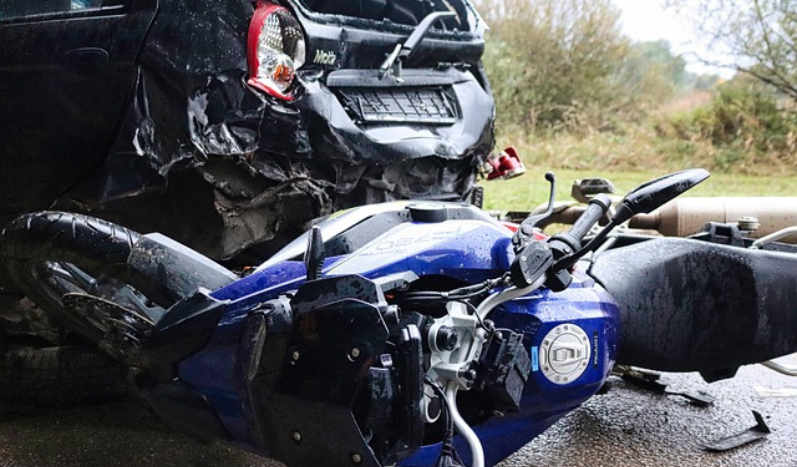
Quick Answer

Drivers overlook motorcycles due to inattentional blindness and the size-arrival illusion, which distort depth perception. However, physical blind spots never excuse negligence. Drivers owe a strict duty of care requiring manual head checks. Attorneys use EDR data and accident reconstruction to dismantle defenses and secure full compensation for catastrophic injuries.
After a collision, drivers frequently repeat a specific, defense-oriented phrase to responding law enforcement officers: “I looked, but I never saw the motorcycle coming.”
This statement often sounds like a poor excuse to injured riders and their legal counsel. However, collision data and cognitive science show that drivers are often telling the truth. Motorists routinely look directly at oncoming or adjacent riders and fail to register their presence.
Motorcycle blind spot accidents do not happen because riders are invisible. They happen because of vehicle design limitations and human cognitive processing failures.
Motorcycle Blind Spot Accidents
To overcome a defense built on the driver’s lack of visual awareness, plaintiff attorneys must dismantle the assumption that looking equals seeing.
Tort liability rests on the breach of a driver’s duty of reasonable care. Cognitive science provides the blueprint to prove that this breach occurs long before a vehicle moves laterally.
Inattentional Blindness And Attentional Hierarchies
Drivers manage heavy cognitive loads by filtering sensory data through an internal “attentional hierarchy.” Because large vehicles pose greater immediate threats, the human brain prioritizes scanning for bigger shapes.
Consequently, drivers overlook motorcycles twice as often as passenger cars in identical traffic scenes. This cognitive filtering triggers inattentional blindness, a documented psychological phenomenon in motorcycle collisions.
The brain routinely drops critical visual data simply because a narrow motorcycle profile fails to match the expected mental blueprint of a standard passenger car or commercial truck. This neurological omission leads directly to severe lane-change and intersection crashes.
The Mechanics Of Visual Omission
The progression from a clear road to a severe side-swipe or left-turn collision follows a documented sequence of physiological and cognitive failures:
- Visual Input: The rider enters the driver’s physical field of view or mirrors.
- Saccadic Suppression: The driver’s eyes jump across the scene. The brain cuts off the visual feed during these rapid movements, creating brief moments of total blindness.
- Inattentional Blindness: The brain processes the remaining images but filters out the non-car shapes to save cognitive resources.
- Motion Camouflage: The narrow profile of the motorcycle limits lateral movement across the driver’s windshield, making the rider appear stationary against a complex background scenery.
- Cognitive Failure: The driver concludes the lane or intersection is completely clear and executes the fatal maneuver.
The Size-Arrival Illusion And Optical Expansion Rate
The physical geometry of a motorcycle further compounds driver error. Human depth perception relies heavily on the optical expansion rate of an approaching object. A large vehicle expands rapidly in a driver’s field of vision as it nears.
Because motorcycles have a narrow profile, their rate of optical expansion is significantly slower. This discrepancy triggers a psychological phenomenon known as the size-arrival illusion.
Motorists consistently misjudge the distance and speed of oncoming motorcycles, incorrectly assuming they have ample time to execute left turns.
Mechanical Blind Spots vs. Judicial Expectations Of Care
While cognitive failures explain why drivers overlook visible riders, vehicle manufacturing designs create physical zones where motorcycles disappear entirely.
A driver cannot escape liability by blaming these structural blind spots. Statutory frameworks and common law hold motorists to strict standards of operational awareness.
Structural Obstructions And The A-Pillar Problem
Modern vehicle safety features sometimes compromise lateral visibility. Thick roof pillars, high door panels, and bulky headrests create permanent blind zones around passenger vehicles.
The front A-pillars – the steel structures framing the windshield – frequently obscure narrow targets. A motorcycle traveling at a specific angle can remain entirely hidden behind an A-pillar throughout a driver’s approach to an intersection.
The Legal Insufficiency Of Mirror Reliance
A primary defense in side-swipe cases is that the driver checked their side-view mirrors before changing lanes.
From a legal standpoint, this defense fails to meet the threshold of reasonable care. Standard vehicle mirrors leave large blind spots along the rear quarters of a passenger car and vast “no-zones” around commercial trucks.
| Vehicle Type | Blind Spot Vulnerability | Legal Standard for Safe Operation |
| Passenger Sedans | Rear quarter panels and wide A-pillars | Mandatory over-the-shoulder physical head checks |
| Commercial Trucks | Large “No-Zones” extending along both sides and directly behind | Extended tracking before lane placement changes. |
| Sport Utility Vehicles | High rear sightlines and thick C-pillars | Dual-mirror calibration combined with manual field verification. |
The failure to perform a physical head check over the shoulder constitutes a direct breach of the duty to maintain a proper lookout. Mirrors are auxiliary tools; they do not replace the necessity of manual visual checks.
Non-Contact Liability and Proximate Cause
In certain situations, a careless driving of the motorist may be a reason for a fatal accident involving a rider who was riding his/her motorcycle and not even there was any direct contact between the vehicles.
At the moment when the car driver runs into the motorcyclist, the latter usually attempts to steer violently so as not to be struck head-on.
This kind of response could cause them to lose the grip over the vehicle which would throw them over the guardrail, into the stream of the opposite direction traffic or just over the road surface at high speed.
Defense insurance adjusters frequently exploit the absence of paint transfer or vehicle damage to deny these claims.
However, tort law recognizes proximate cause through evasive action “even if a motorcyclist was not directly struck but was forced to swerve and crash to avoid a careless driver, the driver can still be held liable.” [Source: Wallace Miller]
If a driver’s negligent lane change or failure to yield forces a predictable, emergency response from a rider, the driver remains fully liable for the resulting damages.
Overcoming The “Invisible Rider” Defense With Forensics
Insurance companies frequently attempt to shift blame onto injured motorcyclists. They leverage public biases and claim the rider was speeding, weaving through traffic, or riding recklessly.
To protect the integrity of a personal injury claim, plaintiff attorneys must compile objective, immutable forensic evidence “in a motorcycle blind spot accident claim, several facts may help determine responsibility. These include whether the driver used a turn signal” [Source: Gallon Law].
Electronic Data Recorders And ADAS Telemetry
Modern passenger vehicles actively log operational data that can instantly dismantle a driver’s testimony.
Electronic Data Recorders (EDRs) capture critical telemetry in the seconds leading up to an event or near-miss. This data includes steering angles, brake application, throttle positions, and exact travel speeds.
Furthermore, many vehicles feature Advanced Driver Assistance Systems (ADAS) or Blind Spot Monitoring (BSM) networks.
Research demonstrates that active BSM systems reduce police-reported lane-change crashes by roughly 14% “crash involvement rates in lane-change crashes were 14% lower (95% confidence limits -24% to -2%) among vehicles with blind spot monitoring than those without.” [Source: PubMed]
If a driver ignores an auditory or visual blind-spot warning light and proceeds to merge into a motorcyclist, the saved system log provides indisputable proof of gross negligence.
Accident Reconstruction And Spatial Photogrammetry
When video evidence is unavailable, forensic engineers recreate the collision sequence using physics and spatial photogrammetry. Reconstruction specialists map out the scene to establish exact sightlines, velocities, and timing windows.
- Debris field analysis
- Asphalt markings
- Gouge mechanics
- Sightline calculations
Exploitation Of Concurrent Violations
A driver’s claim that they did not see a rider loses all legal standing if the driver was violating other traffic laws at the time of the crash. Litigators must systematically investigate the driver’s behavior for concurrent acts of negligence.
Proving these statutory violations establishes negligence per se in many jurisdictions, shifting the legal focus entirely onto the extent of the rider’s damages rather than the mechanics of visibility.
Comprehensive Legal Analysis Of Liability Dynamics
Resolving a motorcycle blind spot claim requires navigating complex liability doctrines. Insurance defense teams routinely rely on systemic prejudice against motorcyclists to devalue claims, making a meticulous legal approach necessary.
Comparative Fault Frameworks
The comparative negligence laws prevail in a number of areas.
If an insurance company is able to convince the court of the cyclist’s own role in his injuries, the compensation amount is reduced proportionally. Rider defense lawyers often refer to lane splitting and filtering as a sign of rider’s negligence.
Litigators must counter comparative fault arguments by proving the rider’s movements were legal, predictable, and steady.
If a rider maintains a consistent path and a reasonable speed, the sole proximate cause of the crash remains the driver’s failure to verify an open lane before merging.
Quantifying The Scope Of Catastrophic Damages
Motorcycle blind spot accidents routinely result in catastrophic, life-altering injuries due to the lack of structural protection for the rider. Legal counsel must carefully build a comprehensive damages profile to secure full compensation.
- Traumatic Brain Injuries (TBIs)
- Spinal Cord Trauma
- Orthopedic Fractures
- Soft-Tissue Destruction
Know The Motorcycle Blind Spot Accidents Liability And Evidence
“I didn’t see the motorcyclist” is no defense in court. Current traffic rules and personal injury law do not accept it.
Cognitive limitations explain how these accidents happen. Physical blind spots explain why drivers make mistakes. However, these factors do not excuse the driver.
A driver commits unlawful negligence when they fail to track their environment. Motorists must confirm a lane or intersection is entirely clear before moving.
Drivers frequently breach this requirement. They cause serious injuries to motorcyclists. When this happens, plaintiff attorneys use detailed forensic examinations. Sound legal strategies hold the negligent driver accountable.
Dismantling the “invisible rider” myth protects motorcyclists’ rights. This legal approach secures full compensation for injured victims. The financial recovery helps them rebuild their lives.
Leave A Reply







7 Workplace Issues That Can Create Legal Risk For UK Employers
Read More
When Spouses Interpret Stability Differently: Marital Conflict
Read More

What Key Evidence Helps Prove Fault In A Serious Car Crash Claim?
Read More
0 Reply
No comments yet.