
Summarize using AI





Prompt copied. Paste it into Gemini.
Quick Answer: What Is A Holding Company?

A holding company is a main business entity that doesn't directly sell products or perform the day-to-day running of the business. Rather, it holds a majority stake in other companies that are called subsidiaries to govern the main strategy, hold assets, and safeguard wealth.
A holding company is a business built to own other companies. It doesn’t sell products. It doesn’t run daily operations either. Instead, it holds controlling stakes in other businesses, called subsidiaries, and manages them from above.
That short definition hides real legal detail, though. How much control actually counts as “control”? Does owning a subsidiary protect the parent from its debts? And does the answer even change depending on where you’re incorporated?
What Is A Holding Company?
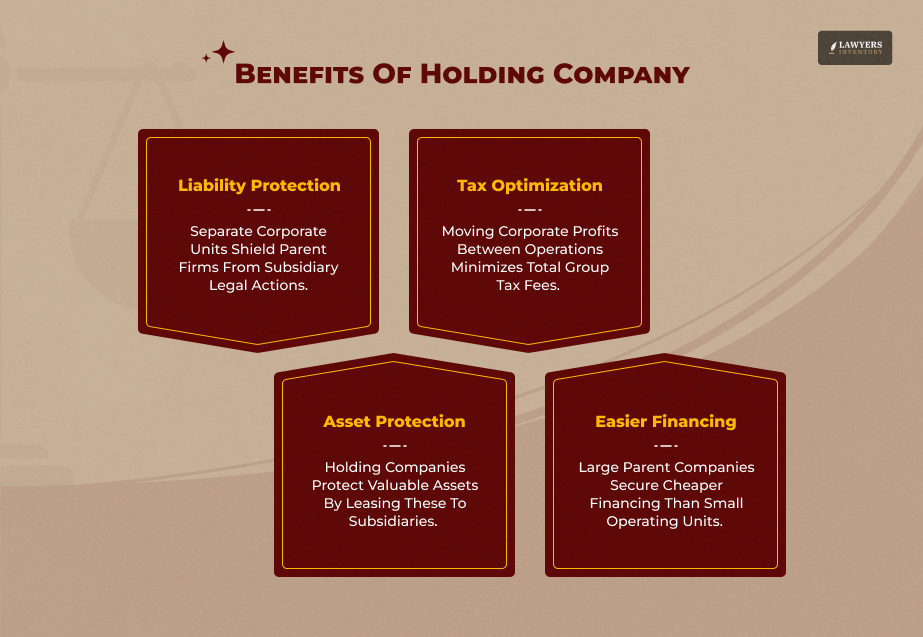
A holding company owns enough stock or membership interest to control another business. Usually, that means a majority stake, or the power to appoint the board. The company being controlled is called the subsidiary.
Meanwhile, the holding company itself typically has no employees running a storefront or a factory floor. Its main asset is simply ownership.
This structure separates ownership from operations. The subsidiary runs the actual business day-to-day. Above it sits the holding company, collecting dividends, setting high-level strategy, and – critically – standing at a legal distance from the subsidiary’s operational risks.
How The Structure Actually Works
Each subsidiary stays its own legal entity. It signs its own contracts, hires its own staff, and can be sued in its own name. So while the holding company owns shares in that entity, the two remain legally separate on paper. [Source: Investopedia]
A holding company can own one subsidiary or dozens. Some hold businesses across completely unrelated industries. Others stick to related businesses inside one sector. Either way, the legal structure works the same: ownership sits at the top, operations sit below.
Holding Company Types: Pure vs. Mixed Holding Companies
A pure holding company only holds ownership stakes. It runs no operations of its own. By contrast, a mixed holding company – sometimes called a holding-operating company – holds subsidiaries while also running some business directly. [Source: Investopedia]
Berkshire Hathaway is a well-known pure holding company: it owns dozens of operating businesses, from GEICO to Dairy Queen, yet doesn’t manufacture or sell anything itself.
The Liability Shield: What It Actually Protects
This is the part most readers researching this topic actually want answered. Yet most existing guides gloss right over it.
Generally, a parent company isn’t automatically liable for a subsidiary’s debts or lawsuits. Each entity’s liability stays contained within itself.
So if a subsidiary faces a lawsuit or goes bankrupt, creditors usually can’t reach the holding company’s other assets. That containment is the core appeal of the whole structure.
Still, that shield isn’t absolute.
When Courts Pierce The Shield
Courts can disregard the separation between parent and subsidiary under a doctrine called piercing the corporate veil. This typically happens in three situations:
- The subsidiary lacked adequate funding from the start,
- The parent mixed funds or ignored corporate formalities,
- Someone used the structure to commit fraud or dodge an existing legal obligation.
Essentially, courts examine whether the subsidiary functioned as a genuinely separate business, or merely as a shell the parent controlled day-to-day.
The practical lesson matters here: a holding company only protects you if you actually maintain that separation. Here’s what you should do:
- Keep separate bank accounts.
- Keep separate books.
- Maintain real governance at the subsidiary level.
Skip any of that, and a court can treat the two entities as one.
How U.S. Law Treats A Holding Company
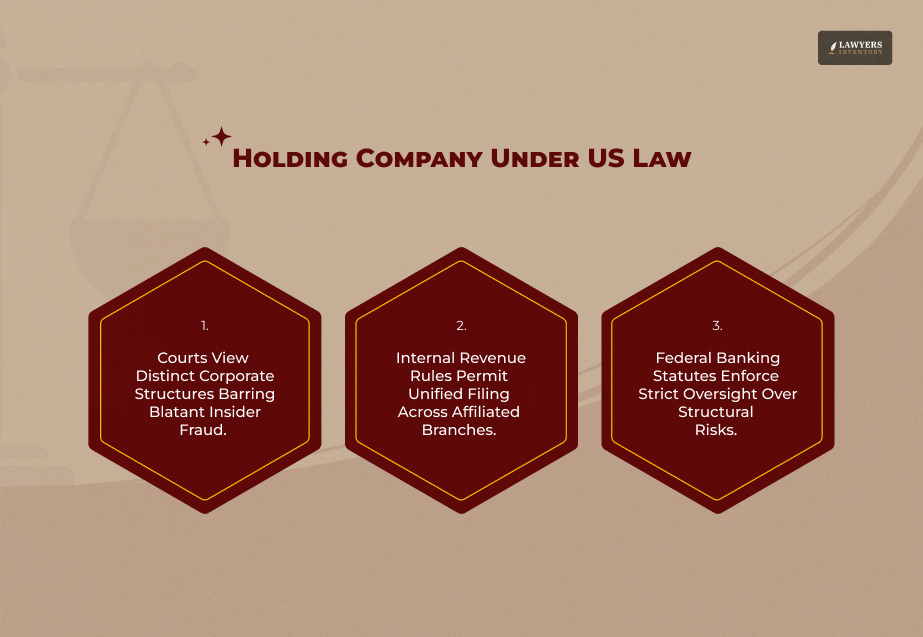
U.S. tax law gives holding companies a specific advantage most explainers describe only vaguely. So I want to be precise about it here.
Under Section 243 of the Internal Revenue Code, a corporation that receives dividends from another corporation can deduct part of that income before tax applies.
The deduction runs at 50% for an ordinary dividend. It rises to 65% once the receiving company owns 20% or more of the paying company.
And if both companies belong to the same affiliated group under Section 1504(a), the dividend can qualify for a full 100% deduction.
In short, that deduction is what lets a holding company collect income from its subsidiaries without taxing the same dividend twice inside the group.
Delaware and Nevada remain common incorporation choices for U.S. holding companies. That’s largely thanks to established corporate law and predictable court precedent, not because either state offers a special holding-company statute.
How Indian Law Treats A Holding Company
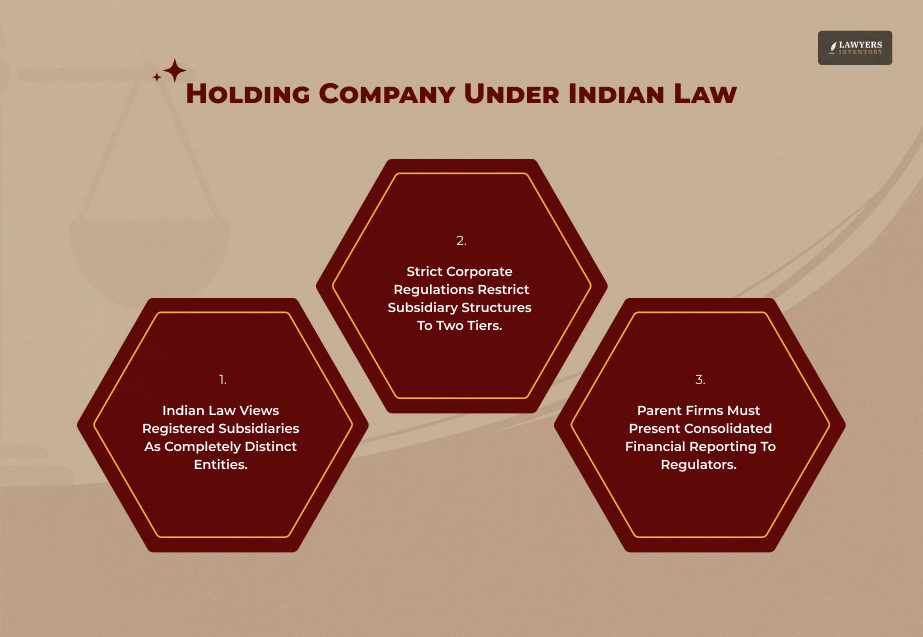
The Indian structure is highly explicit. However, one significant difference exists.
Section 2(46) of the Companies Act, 2013 defines a holding company. It is a company with one or more subsidiaries. These subsidiaries must comply with Section 2(87) of the same Act.
Per Section 2(87), a company is a subsidiary under two conditions.
- First, the holding company controls the composition of its Board of Directors.
- Second, the holding company controls more than one-half of its total voting power.
This control can happen in two ways. The holding company can exercise it directly. Alternatively, it can exercise it indirectly through other subsidiary companies. [Source: Global Advisory Experts]
Additionally, a holding company must prepare consolidated financial statements covering its subsidiaries, per Section 129(3) of the Act.
India also adds a restriction most U.S. states don’t have. Under the Companies (Restriction on Number of Layers) Rules, 2017, most holding companies can’t stack more than two layers of subsidiaries beneath them.
Investment companies and a few other categories get an exemption. Regulators built this rule specifically to prevent deep, opaque pyramid structures – a real compliance detail that trips up companies restructuring across multiple tiers.
Real Examples: How This Looks In Practice
Alphabet uses a mixed holding structure. The parent company controls Google. It also controls separate projects like Waymo and Verily. Each project functions as a separate subsidiary under Alphabet. [Source: Diligent]
Berkshire Hathaway represents a pure holding company. It is a massive holding entity. It owns hundreds of completely unrelated operating companies. The parent company does not manage them directly. [Source: Geeks for Geeks]
Tata Sons is the holding company for the Tata Group in India. It owns major group businesses either fully or partly. These businesses are listed on stock exchanges. Tata Sons holds controlling stakes in major firms. These include Tata Motors, Tata Steel, and Tata Consultancy Services.
Holding companies differ from subsidiaries and operating companies. A subsidiary or operating company remains a separate legal entity. It maintains its own stock listing and legal liabilities.
Common Questions About Holding Companies
Here are some of the most common questions that one should know about a holding company:
Is A Holding Company The Same As A Parent Company?
Functionally, yes. “Parent company” is the broader term for any company controlling a subsidiary. “Holding company” specifically implies the parent’s main purpose is ownership, rather than running its own operating business too.
Does A Subsidiary’s Income Get Taxed Twice?
It can. But the dividends-received deduction under IRC Section 243 significantly reduces, or even eliminates, that effect for U.S. corporate groups. Other jurisdictions build their own mechanisms to reduce double taxation on intercompany dividends.
Can A Holding Company Get Sued For A Subsidiary’s Actions?
Generally, no – unless a court finds grounds to pierce the corporate veil. Undercapitalization, commingled finances, or fraud typically drive that outcome. So maintaining real operational and financial separation is what keeps the shield intact.
Do You Need A Lawyer To Set One Up?
For a genuine multi-entity structure, yes. The paperwork itself isn’t complicated. But getting the liability separation, tax treatment, and – in India – the subsidiary-layering rules right from the start requires jurisdiction-specific legal advice, not a generic template.
Sources:
- 26 U.S.C. § 243 and § 1504(a): Cornell Law School’s Legal Information Institute and the U.S. House Office of the Law Revision Counsel.
- Sections 2(46), 2(87), and 129(3) of India’s Companies Act, 2013: The Ministry of Corporate Affairs.
- Holding Company – Advantages & Disadvantages: Investopedia
- The Companies (Restriction on Number of Layers) Rules, 2017.
- Berkshire Hathaway’s public corporate structure disclosures.
- Alphabet Inc.’s public corporate filings.
- Tata Sons’ public group structure information.
Leave A Reply






Do You Pay Taxes On Lawsuit Settlements? IRC Section 104 Explained
Read More
Non-Disparagement Clause Explained: Requirements, Enforceability, And What Changed Recently
Read More
Best Practices For Successful Trademark Registration
Read More
Understanding Your Rights: A Guide To The Legal Process
Read More
How To Clear A Bench Warrant Without Going To Jail: A Legal Guide
Read More
0 Reply
No comments yet.