
Summarize using AI





Prompt copied. Paste it into Gemini.
Listen to this article
Quick Answer: Larceny vs Theft

Larceny is the old common-law term for physically taking and carrying away another's property. Theft is the modern statutory umbrella that covers larceny and several additional forms of stealing. Roughly two-thirds of U.S. states have consolidated their property crime statutes under "theft," following the Model Penal Code's approach. The remaining states still charge "larceny" as the operative offense.
Theft is the broad statutory category. Larceny is one specific, traditional form of theft – rooted in English common law – that involves physically taking and carrying away someone else’s property without consent and with intent to permanently deprive them of it.
Some states still charge larceny as a distinct crime. Others have abolished the term entirely and consolidated all stealing offenses under a single theft statute.
The charge in a criminal complaint can depend entirely on which state the offense occurred in – even when the underlying conduct is identical.
Larceny vs. Theft At A Glance
| Factor | Larceny | Theft |
| Scope | Specific common-law crime: physical taking and carrying away | Broad statutory umbrella covering multiple ways of stealing |
| Legal Status Today | Still operative in roughly one-third of states | Dominant term in roughly two-thirds of states following MPC consolidation |
| Core Elements | Trespassory taking, asportation, personal property of another, without consent, intent to permanently deprive | Varies by statute – typically covers the same conduct plus embezzlement, fraud, and false pretenses |
| FBI UCR Classification | Used interchangeably with theft in federal crime data | “Larceny-theft” is the FBI’s Part I property crime category |
| Example | Shoplifting a jacket from a store | Shoplifting a jacket from a store (same act, different label depending on state) |
What Is Theft?

Theft is the modern, umbrella statutory term used by roughly two-thirds of U.S. states to describe all forms of unlawful taking of another’s property.
In states that have modernized their criminal codes, larceny has been absorbed into a broader theft statute that covers more types of stealing under one umbrella.
Beyond physical taking, a consolidated theft statute typically covers embezzlement – the fraudulent conversion of property lawfully possessed – false pretenses, extortion, theft of services, and receiving stolen property. [Source: Legal Synopsis]
The consolidation matters practically.
At common law, prosecutors had to identify the precise category of stealing – larceny, embezzlement, or false pretenses – and charge accordingly. A misidentification could produce an acquittal on a technicality even when guilt was clear.
Modern consolidated theft statutes eliminated that problem by making the method of stealing legally irrelevant. What matters is the act of wrongfully depriving someone of their property.
The Model Penal Code’s Consolidated Theft Approach
The Model Penal Code largely inspired the legislative shift from larceny to theft. The American Law Institute published this text to unify property offenses.
The code groups multiple distinct acts under one consolidated framework. It penalizes the unlawful taking of movable property under § 223.2. It addresses theft by deception under § 223.3. Further, it covers the theft of services under § 223.7.
Finally, § 223.8 criminalizes the failure to make required dispositions of funds. A single grading provision, § 223.1, systematically oversees all of these violations.
The consolidated offense was designed to embrace the offenses that were “heretofore known as larceny, embezzlement, false pretense, extortion, blackmail, fraudulent” crimes and other similar offenses.
The MPC’s influence on state legislatures has been significant.
Most states that have revised their criminal codes since the 1960s adopted some version of this consolidated approach – which is why “theft” now dominates American criminal law while “larceny” survives primarily in states that have not modernized their statutes. [Source: Nevada Law Journal]
What Is Larceny?

Larceny originates from traditional English common law. William Blackstone formalized the classic definition in 1769 in his Commentaries on the Laws of England. [Source: Legal Synopsis]
The crime requires three distinct elements. First, a thief takes property without permission. Second, the thief must physically move the item. Third, they must intend to permanently deprive the owner.
Centuries of legal cases refined this exact standard. Many American courts still enforce this definition today. Larceny remains the active, operative charge in multiple states.
The Elements Of Common-Law Larceny
To secure a larceny conviction in a state that retains the common-law framework, the prosecution must prove each of the following elements beyond a reasonable doubt:
- Trespassory taking – The defendant took possession of the property without any legal right or authority to do so. The initial taking must be wrongful from the outset.
- Carrying away (asportation) – The defendant moved the property, even slightly, from its original location. Under strict common-law interpretation, even minimal movement satisfies this element.
- Personal property – The property must be tangible and movable. Real property – land and structures permanently attached to it – cannot be the subject of common-law larceny.
- Belonging to another – The property must be owned or possessed by someone other than the defendant.
- Without consent – The owner or possessor did not authorize the taking.
- With intent to permanently deprive – The defendant intended to keep the property indefinitely, not merely to borrow it temporarily.
Many modern jurisdictions have consolidated larceny-related offenses under overarching “theft” statutes.
While the core elements often remain, statutory reforms frequently expand the types of property that can be “stolen” to include:
- Intangible items.
- Services.
- Electronic data.
Additionally, they modify common law requirements such as “carrying away,” sometimes eliminating asportation as a separate element. [Source: Lexplug]
Is Larceny The Same As Theft? Why Terminology Varies By State
This is the question that matters most practically – and the one most articles answer poorly. The honest answer is: sometimes yes, sometimes no, and it entirely depends on where the offense occurred.
What surprises most people is that many states no longer even use the word “larceny” in their current criminal code. If you’re in California or Texas, you’ll be charged with theft.
If you’re in New York, you’ll be charged with larceny. Same act, different labels, and different legal frameworks behind each word. [Source: Legal Synopsis]
The divide reflects when each state revised its criminal code.
States that updated their penal codes after the Model Penal Code’s publication in 1962 generally adopted consolidated theft statutes. And states that retained older common-law frameworks – or made only partial updates – often kept larceny as the operative charge.
States That Don’t Use Larceny Vs Theft As Operative Charge
States that abolished “larceny” and use “theft” as the sole statutory term:
California
California Penal Code § 484 merges larceny, embezzlement, and fraud into a single theft charge. Because of this, shoplifters and white-collar fraudsters stand trial under the exact same law.
Texas
Texas Penal Code § 31.03 consolidates all illegal property acts under the term “theft.” The text of this statute completely eliminates the word “larceny.”
Maryland
Maryland Criminal Law § 7-102 disregards old forms of property law. Older court cases might still use the historical term “larceny.” However, modern Maryland courts only recognize and prosecute the crime of theft.
States That Use Larceny Vs Theft As Operative Charge
States that still use “larceny” as the operative charge:
New York
N.Y. Penal Law Article 155 is titled “Larceny” and defines the crime broadly, covering the following under the larceny umbrella:
- Physical taking.
- Trickery.
- Embezzlement.
- False pretenses.
The label is “larceny,” but the statutory scope mirrors what other states call “theft.”
North Carolina
N.C. Gen. Stat. § 14-72 retains larceny as the primary property crime charge, with separate thresholds for misdemeanor and felony larceny.
Virginia
Va. Code §§ 18.2-95 and 18.2-96 maintain grand larceny and petit larceny as distinct statutory offenses with separate penalty structures.
Massachusetts, South Carolina, West Virginia
All retain larceny as the operative common-law term in their criminal codes.
State-by-State Terminology Table
| State | Term | Governing Statute | Petty/Grand Threshold |
| California | Theft | Penal Code § 484; § 490.2 | $950 (petty); above $950 (grand) |
| Texas | Theft | Penal Code § 31.03 | Class C misdemeanor under $100 to first-degree felony above $300,000 |
| New York | Larceny | Penal Law § 155.05 | Petit larceny under $1,000; grand larceny above $1,000 |
| North Carolina | Larceny | Gen. Stat. § 14-72 | Misdemeanor under $1,000; felony above $1,000 |
| Virginia | Larceny | Code §§ 18.2-95, 18.2-96 | Petit larceny under $1,000; grand larceny above $1,000 |
| Maryland | Theft | Crim. Law §§ 7-102 to 7-104 | Misdemeanor under $1,500; felony above $1,500 |
| Florida | Theft | Stat. § 812.014 | Petit theft under $750; grand theft above $750 |
| Illinois | Theft | 720 ILCS 5/16-1 | Class A misdemeanor under $500; felony above $500 |
| Massachusetts | Larceny | Gen. Laws ch. 266 § 30 | Misdemeanor under $1,200; felony above $1,200 |
| Georgia | Theft by Taking | Code Ann. § 16-8-2 | Misdemeanor under $1,500; felony above $1,500 |
Grand Larceny vs. Petty Larceny – And Grand Theft vs. Petty Theft
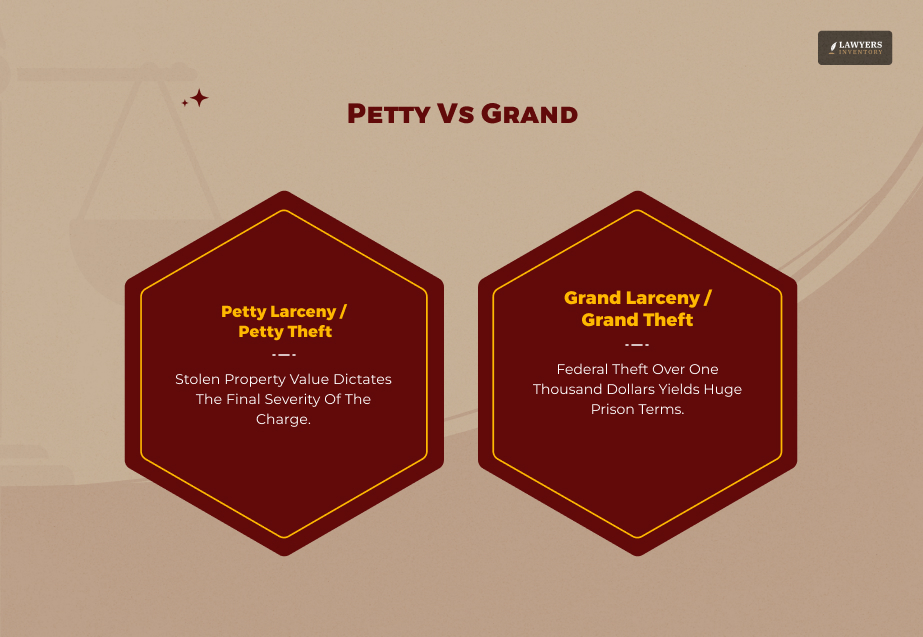
Regardless of whether a state uses “larceny” or “theft,” every jurisdiction grades the offense based primarily on the value of the property stolen. The degree structure exists across all states – only the labels and specific thresholds differ.
Petty Larceny / Petty Theft
Petty theft is normally considered a minor crime. Courts do not issue severe punishments for this offense.
Typical penalties include a short jail sentence, a fine, and probation. Judges might also order community service.
Statutes define a petty offense based on a cash value threshold. According to US Legal Forms, this dollar limit varies by state, but it usually falls between $500 and $1,000.
Grand Larceny / Grand Theft
Grand larceny is a principal felony offense. Convictions carry a possible state prison sentence of one year or longer. This crime is typically a passive, non-violent theft.
The property’s valuation dictates the exact criminal charge. The market or replacement value of the stolen goods determines whether a theft escalates to “grand” larceny. Higher property values yield much harsher state penalties. [Source: Criminal Defense Lawyer]
Stealing government property triggers severe federal charges. Under 18 U.S.C. § 641, taking United States public property worth more than $1,000 is a federal felony. This serious offense carries a penalty of up to 10 years in prison. [Source: Legal Information Institute]
Note: State felony theft thresholds vary drastically. Most limits range between $500 and $2,500. Individual states set their own caps. California sets its grand theft threshold at $950. Both Virginia and New York choose $1,000. Laws change across state borders. You must analyze each jurisdiction individually. Never assume uniformity in multi-state cases.
How The FBI Classifies Larceny vs Theft

The FBI’s UCR program categorizes “larceny-theft” as a property crime. This act involves taking or transporting someone else’s belongings. The thief acts without the owner’s permission or knowledge. Their goal is to permanently deprive the owner of those items.
Larceny vs theft are synonymous in the UCR Program. All thefts and attempted thefts are included in this category with one exception: motor vehicle theft. [Source: Cleveland Heights]
Larceny remains the most common property crime in the nation. FBI statistics show it makes up approximately 70% of all property crimes.
The country records about 4.6 million reported cases every year. This massive volume makes it the most frequent property crime incident. [Source: Lawful]
The UCR Program covers all thefts resulting from pickpocketing, purse snatching, shoplifting, larceny from auto, larceny of auto parts and accessories, bicycle theft, larceny from buildings, and larceny from any coin-operated machines.
Any theft that is not a robbery or any theft that does not result from a breaking and entering shall be scored here.
According to Roseville, the UCR explicitly excludes the following:
- Embezzlements.
- Unlawful conversions.
- Larceny by bailee, frauds, or bad checks.
This statistical classification is important for two reasons.
First, it confirms that at the federal data level, larceny vs theft are treated as synonymous – reinforcing that the distinction is primarily a state-law issue.
Second, it shows that the FBI’s category specifically excludes embezzlement and fraud – crimes that many consolidated state theft statutes do include.
The scope of what counts as “theft” varies not just between states but between state law and federal crime reporting methodology.
Larceny vs. Related Crimes
Several property crimes are frequently confused with larceny vs theft. The distinctions are not merely technical – they carry different elements, different penalties, and different defenses.
Larceny vs. Robbery
Robbery is theft combined with force or the threat of force directed at a person. A pickpocket who removes a wallet without the victim’s awareness commits larceny.
A mugger who demands a wallet at knifepoint commits robbery. Larceny never requires any confrontation with or threat to the victim.
Robbery always does – and carries significantly heavier penalties as a result.
Larceny vs. Burglary
Burglary is an unlawful entry into a building. The person must intend to commit a crime inside. Larceny is the most common intended crime. This happens when a thief breaks in to steal property.
The burglary charge triggers at the moment of illegal entry. It depends entirely on criminal intent. It does not require a completed theft.
An arrest can happen before anything is stolen. However, if police catch someone before they enter – like while breaking a window – the charge is attempted burglary. Even without a completed theft, the person can still be sentenced for a crime.
Larceny vs. Embezzlement
Embezzlement is the fraudulent conversion of the property of another by an individual who is already in lawful possession of that property – essentially, embezzlement covers situations where the defendant’s original possession is consensual but later becomes wrongful.
A bank teller who steals from a customer’s account commits embezzlement, not larceny – because the teller had lawful access to the funds.
A stranger who breaks into the same bank and steals from the vault commits larceny. The initial lawfulness of the possession is the dividing line. [Source: Lexplug]
Note: All larceny is theft, but not all theft is larceny. Embezzlement, for example, is a form of theft but is not larceny, because larceny requires the initial taking to be unlawful. An embezzler has lawful possession of the property they steal. According to Legal Synopsis, a person who steals a wallet from a stranger's pocket does not have any prior lawful possession, making that act a classic larceny.
Penalties For Larceny Vs Theft Convictions
The penalty structure for larceny vs theft tracks the misdemeanor/felony divide established by the value thresholds discussed above. A number of factors can enhance the base penalty regardless of value.
Factors that increase the grade of the offense:
- Theft from a person directly – Taking property from someone’s body or immediate presence is treated more seriously than theft of unattended property
- Prior theft convictions – A second petty theft can be charged as a felony in many states regardless of value
- Theft targeting vulnerable victims – Most states impose enhanced penalties for theft targeting the elderly, disabled, or minors
- Theft of specific property types – Firearms, livestock, and government property often carry enhanced penalties under separate statutes
Typical sentencing ranges:
- Misdemeanor (petty) larceny/theft: Fines, probation, community service, up to one year in a local jail
- Felony (grand) larceny/theft, lower tier: One to five years in state prison
- Felony larceny/theft, higher tier: Five to twenty years, depending on value and circumstances
- Federal theft of government property above $1,000: Up to ten years under 18 U.S.C. § 641
Courts may also impose restitution – requiring the defendant to repay the victim for the value of the stolen property – separately from or in addition to criminal penalties.
Real-World Consequences Beyond Criminal Penalties
A larceny or theft conviction carries consequences that extend well past the courtroom – and these collateral consequences are among the most practically significant aspects of any theft-related charge.
Employment
Almost all employers perform background checks. A felony conviction disqualifies you from handling money or caring for vulnerable people. Licensed professionals like CPAs and attorneys face immediate loss of their licenses
Housing
Finding a rental home also becomes a challenge. Landlords routinely screen potential tenants. A theft record will disqualify you in competitive housing markets.
Immigration
A theft conviction deeply affects non-citizens. The Immigration and Nationality Act § 212(a)(2) categorizes theft as a crime involving moral turpitude. A single conviction can make you inadmissible. It can also trigger immediate deportation proceedings.
Expungement
Expungement laws offer very limited relief. Regulations for sealing public records differ wildly between states. Courts sometimes allow first-time misdemeanors to be erased.
However, felony convictions face massive legal barriers. You must negotiate expungement options during your initial plea bargain.
Common Defenses To Larceny And Theft Charges
Defenses to larceny vs theft charges are more varied than most people assume. Each defense attacks a different element of the offense.
Lack Of Intent To Permanently Deprive
Borrowing property negates specific criminal intent. This defense requires a clear plan to return the item. You must support this intent with real-time, tangible evidence from the moment of the taking.
Claim Of Right
You lack criminal intent if you honestly believe you own the property. This belief must stem from a factual mistake rather than legal ignorance. Model Penal Code § 223.1(3)(b) formalizes this specific affirmative defense.
Consent
No larceny occurs if the owner gives you permission to take the item. However, the owner’s authorization must be genuine. It must also cover your specific, actual actions.
Insufficient Evidence Of Asportation
Common-law jurisdictions require the prosecution to prove you physically moved the item. This element is called asportation. If the object remains untouched in its original location, the completed larceny charge fails.
Entrapment:
You can claim entrapment if the police actively entice you to steal. This scenario happens when law enforcement induces a crime you would not otherwise commit. Retail sting operations frequently trigger this defense strategy.
Disclaimer: This article is for general informational and educational purposes only. It does not constitute legal advice. Larceny and theft laws vary significantly by state, and the applicable charges, elements, thresholds, and defenses depend on the jurisdiction where the offense occurred. If you are facing a larceny or theft charge, consult a qualified criminal defense attorney in your state immediately.
Sources:
- Model Penal Code §§ 223.1, 223.2, 223.3, 223.7, 223.8 – American Law Institute (1962) – ali.org
- FBI Uniform Crime Reporting Program – Larceny-Theft Definition – ucr.fbi.gov/crime-in-the-u.s/2019/crime-in-the-u.s.-2019/topic-pages/larceny-theft.pdf
- Justia – FBI UCR Larceny-Theft Classification (October 2025) – justia.com/criminal/docs/uniform-crime-reporting-handbook/larceny-theft
- California Penal Code § 484 – Theft (Consolidated) – leginfo.legislature.ca.gov
- California Penal Code § 490.2 – Petty Theft Threshold – leginfo.legislature.ca.gov
- Texas Penal Code § 31.03 – Theft – statutes.capitol.texas.gov
- New York Penal Law § 155.05 – Larceny Defined – legislation.nysenate.gov
- North Carolina General Statutes § 14-72 – Larceny of Property – ncleg.net
- Virginia Code §§ 18.2-95, 18.2-96 – Grand and Petit Larceny – law.lis.virginia.gov
- Maryland Code, Criminal Law §§ 7-102 to 7-104 – Theft – mgaleg.maryland.gov
- 18 U.S.C. § 641 – Public Money, Property or Records (Federal Theft) – uscode.house.gov
- Immigration and Nationality Act § 212(a)(2) – Crimes Involving Moral Turpitude – uscode.house.gov
- LegalClarity – What Is Larceny? Elements, Penalties, and Defenses (April 2026) – legalclarity.org
- LegalSynopsis – Larceny vs. Theft: Key Differences Explained (April 2026) – legalsynopsis.com
- SoMD Criminal Defense – Larceny vs. Theft in Maryland (July 2026) – somdcriminaldefense.com
- Congressional Research Service – Federal Criminal Theft Laws (February 2026) – congress.gov
- William Blackstone – Commentaries on the Laws of England, Vol. IV (1769)
Leave A Reply






Do You Pay Taxes On Lawsuit Settlements? IRC Section 104 Explained
Read More
Non-Disparagement Clause Explained: Requirements, Enforceability, And What Changed Recently
Read More
Best Practices For Successful Trademark Registration
Read More
Understanding Your Rights: A Guide To The Legal Process
Read More
How To Clear A Bench Warrant Without Going To Jail: A Legal Guide
Read More
1 Reply
What Is Grand Larceny? Felony Thresholds, Penalties & Options
September 12, 2026 at 7:54 am
[…] Grand larceny builds directly on the elements of common-law larceny. […]
Reply