Summarize using AI





Prompt copied. Paste it into Gemini.
Quick Answer:

A legal framework refers to organized laws and regulations meant to be the system that controls behavior, resolves conflicts, and makes legal decisions for the people in a society or a specific organization. It draws the boundary lines between what is permissible and what is forbidden and lays down the rules to be followed when laws are broken.
A legal framework functions as the foundational skeleton of any organized society, establishing the boundaries of acceptable behavior and providing mechanisms to correct injustices.
It defines how courts interpret agreements, how public institutions execute mandates, and how law enforcement protects your everyday safety.
Understanding how this architecture operates empowers you to navigate personal or professional disputes with absolute confidence.
What Is A Legal Framework?
A legal framework refers to a consistent system of laws, regulations, and judgments. Countries, industries, and individual organizations all set these frameworks. In essence, this legal setup serves as a vital mechanism. [Source: Science Direct]
Here’s what it does:
- Clearly defines the range of permissible human behavior.
- Specifies the exact legal rights of different parties.
- Indicates a clear procedure to execute laws and settle disputes when parties cannot resolve issues themselves.
The legal structure divides its components into four distinct layers.
- Constitutional Provisions: Constitutional laws form the foundation.
- Statutes: Legislative bodies enact statutory laws.
- Regulations: Government agencies issue administrative rules.
- Judicial Decisions: Courts deliver crucial case decisions.
By maintaining these rules, guidelines, and policies at different depths, the legal structure offers assurance and foreseeability.
Consequently, this predictability guarantees that people and businesses behave according to accepted social laws and norms.
Organizations use these systems across various fields. For example, they apply them to the governance of companies. Likewise, they use them to protect data privacy. They even deploy them at the level of international relationships.
As we know, legal theories remain abstract until they enter specific practices. Therefore, authorities design laws, regulations, and treaties to transform abstract concepts into concrete and enforceable operations.
Core Components Of A Legal Framework
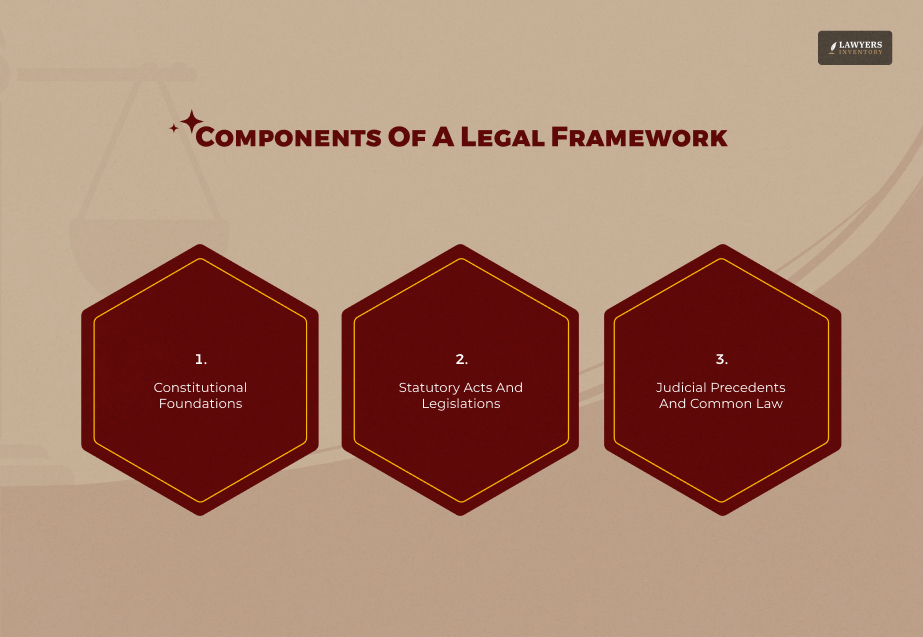
Every legal architecture relies on distinct pillars to maintain institutional balance and protect civil liberties. If you understand these structural components, you can easily identify which tier of law applies directly to your current legal challenge.
The system relies on a strict hierarchy to ensure that rules remain uniform and fair across jurisdictions.
Let us look closer at the three primary layers that dictate your legal rights.
1. Constitutional Foundations
The constitution stands not only as the supreme law of the country but also the document through which the structure of the government and the freedoms of the people are clearly stated.
It is a matter of principle that no local rule, federal law, or government order shall contradict or violate it
Suppose a state legislature enacted a law denying you your constitutional guarantees of fair trial or freedom of expression. In such a case, the courts will still have the power to annul that particular law in its entirety.
2. Statutory Acts And Legislations
Secondly, statutes are formal written laws enacted by a legislative body, such as Congress in the United States or Parliament in India. These bills address the following:
- Specific societal needs.
- Criminal behaviors.
- Commercial realities.
When you deal with real estate transactions, copyright filings, or contract disputes, you are operating directly within statutory parameters.
3. Judicial Precedents And Common Law
Judges perform the fundamental function of interpreting written laws. Additionally, they determine how these laws apply in different human situations. They execute these duties with a very high level of accuracy.
Appellate court rulings set the legal standard for lower courts. Consequently, lower courts must follow rulings from previous appellate cases. They apply these precedents whenever they deal with similar legal issues.
This versatile mechanism enables laws to change dynamically. As a result, the legal system successfully adapts to novel technologies and social evolution. Ultimately, the legal framework grows without relying purely on new parliamentary laws.
Legal Framework vs. Regulatory Framework: What Are The Differences?
I frequently observe people mixing up legal requirements with regulatory rules. While these systems overlap to maintain societal order, they feature distinct operational scopes, enforcement entities, and real-world consequences for non-compliance.
| Feature | Legal Framework | Regulatory Framework |
| Definition | Broad statutes passed by elected lawmakers | Sector-specific rules created by agencies |
| Enforcement Oversight | Managed by courts, police, and prosecutors | Overseen by specialized board inspectors |
| Scope of Application | Applies universally to all citizens | Focuses narrowly on specific industries |
| Violation Consequences | Can result in criminal prosecution or prison | Leads to license loss or financial fines |
A legal compliance structure lays down the general ethical baseline that every individual and corporation must follow, covering areas like contract execution, basic property rights, and criminal acts.
A regulatory compliance framework adds narrower, technical operational guidelines to address specific operational risks within a single sector.
Examples Of Sector-Specific Regulations
To see this distinction clearly, consider how specialized administrative boards regulate technical industries to prevent public harm:
The Financial Domain:
Lawmakers first enact general fraud laws. Next, independent regulators produce detailed disclosure rules.
These regulators include the U.S. Securities and Exchange Commission (SEC) and the Securities and Exchange Board of India (SEBI). Consequently, companies must follow these specific rules when they sell stocks.
The Healthcare System:
Legislation gives patients general protection. However, specific laws like the Health Insurance Portability and Accountability Act (HIPAA) provide detailed regulations. Specifically, these rules dictate how healthcare providers must manage digital records.
Environmental Oversight:
Legislation aims to preserve nature. Nevertheless, government bodies set the exact allowable concentration levels in parts per million (ppm).
These bodies include the Environmental Protection Agency (EPA) and the Central Pollution Control Board (CPCB). Ultimately, these precise limits control emissions from manufacturing industries.
Global Framework Architectures: US, India, And Transnational Systems
The historical background of a country, its governance characteristics, and geographical features all contribute to the unique character of its system of laws.
When it comes to international commercial issues resolution or inter-state conflicts, you will need to understand the differences in how the powers are distributed across the two types of federal systems and which one fits best for your situation.
The Constitutional Federalism Of The United States
The American political system effectively compartmentalizes the government at the federal level and states at the local level. The central government is only concerned with interstate commerce, national defense, and intellectual property rights.
However, the states remain sovereign powers in the areas of family law, property transfers, personal injury cases, and estates. Meaning a situation that is totally legitimate in one state can cause serious penalties in another.
Codified Centralization And Local Codes In India
India’s Constitution establishes a parliamentary democracy that centralizes powers in the federal government while allowing for state legislation.
Some major commercial affairs, like bankruptcies of companies, are handled uniformly across India through laws like the Insolvency and Bankruptcy Code that are passed by the central authority. [Source: IBC, Government of India]
However, state governments have their roles in developing and administering laws that cover local public security policies, land tenure systems, and rules for farming in their respective local areas.
Transnational Treaties And Digital Identity Systems
Machines and software can easily cross territorial borders so, they have compelled global organizations to put up cross-border cooperative structures.
The World Bank has launched Identification for Development (ID4D) as a global initiative to assist developing countries in creating accessible digital legal identities while at the same time ensuring data protection.
These international standards aid national governments in safeguarding human rights, dealing with cybercrimes, and securing international data transfers.
Strategic Navigation: Resolving Personal And Business Legal Challenges
When you face an active legal dispute or need to ensure business compliance, running blindly into court actions often proves costly.
Experts advise utilizing a methodical approach to evaluate your situation and secure a favorable outcome.
- Map the Jurisdiction
- Review Relevant Statutes
- Check Agency Rules
- Audit Existing Contracts
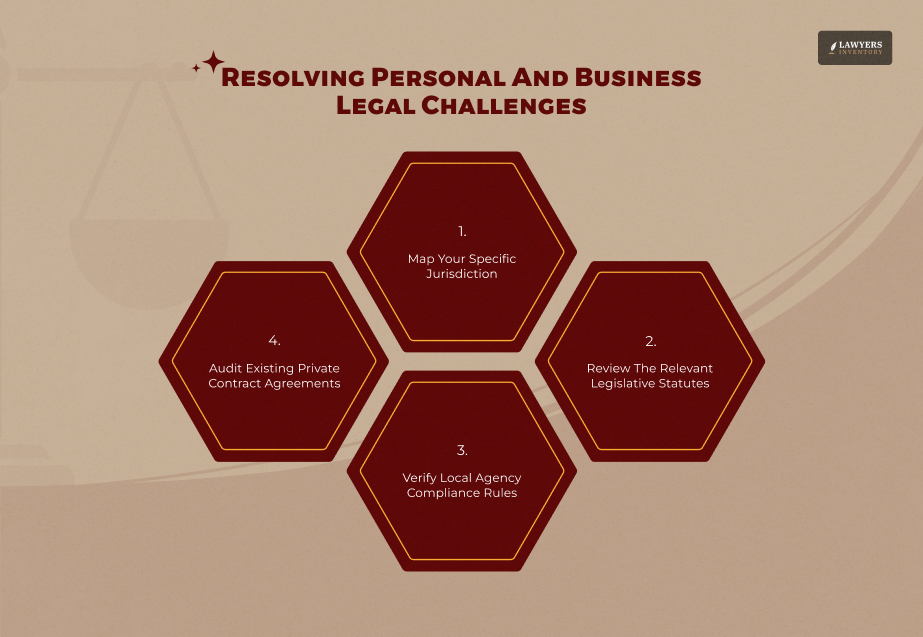
You can systematically minimize liabilities and protect your legal interests by following this four-step strategy:
1. Map Your Specific Jurisdiction
Always identify the exact geographical and institutional boundaries that govern your issue. Determine whether your legal dispute falls under municipal courts, state laws, or overarching federal statutes.
2. Review The Relevant Legislative Statutes
Locate the primary written acts that govern your situation. If you deal with a business partnership dispute, study your region’s formal Partnership Act or Uniform Commercial Code to learn your baseline obligations.
3. Verify Local Agency Compliance Rules
Check if a specialized administrative board or regulatory commission oversees your professional field. Ensure you file all required reporting disclosures to prevent sudden administrative fines or license suspensions.
4. Audit Existing Private Contract Agreements
Review your signed private contracts, as courts heavily respect valid agreements between individuals. A well-drafted contract functions as a customized legal framework that dictates how parties must resolve business or personal disagreements.
Leave A Reply






Do You Pay Taxes On Lawsuit Settlements? IRC Section 104 Explained
Read More
Non-Disparagement Clause Explained: Requirements, Enforceability, And What Changed Recently
Read More
Best Practices For Successful Trademark Registration
Read More
Understanding Your Rights: A Guide To The Legal Process
Read More
How To Clear A Bench Warrant Without Going To Jail: A Legal Guide
Read More
1 Reply
What Is Public Policy? How Governments Make Rules [Explained]
August 29, 2026 at 12:32 pm
[…] These categories help explain what a policy is trying to accomplish. They do not, by themselves, determine whether a particular government measure is lawful. That question requires analysis of the governing legal framework. […]
Reply