Summarize using AI





Prompt copied. Paste it into Gemini.
Listen to this article
Quick Answer: How Long Does It Take To Get A Law Degree?

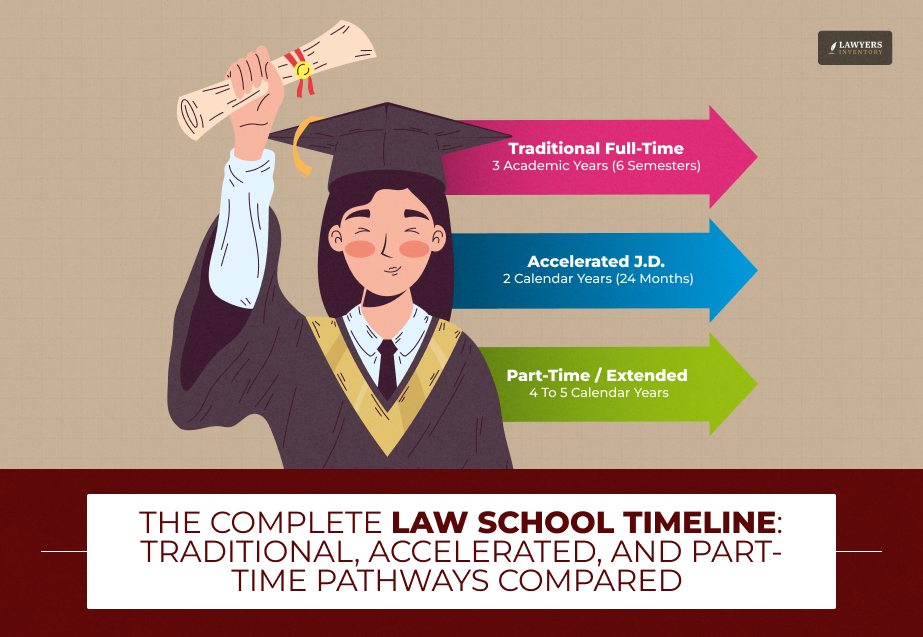
A law degree will generally take three years to complete as a full-time student following completion of a bachelor's degree (4 years). According to the ABA Standard 311, this can however be shortened through an accelerated learning pathway to complete within two years. Alternatively, a part time option is available to complete your Juris Doctor over up to four or five years.
How long does it take to get a law degree?
Many people will look at the amount of time they would need to invest into getting a law degree and also ask what can I do with a law degree.
Today there are many different career paths you can go down ranging from high pressure commercial litigation to niche regulatory law.
Choosing the correct route in education will help determine how long you will be studying and how much you will be investing.
The Pre-Law Phase: Admissions Gating And Strategic Timelines
Before you even start your law course you will have to complete your undergraduate degree.
You will need to complete a 4 year bachelor’s degree from an accredited university before starting your ABA approved law school.
You will also have to manage your time efficiently while completing the intense entrance exams and application processes.
Standardized Exams
You will have to complete many standardized exams in order to get into your desired law school.
Many aspiring students will spend months researching how to revise for the LSAT so they can beat the competition.
Top candidates will often invest between 150-300 hours over 6 months to prepare for the analytical and reading sections of the exam.
Many people are shocked by the difficulty of the LSAT exam.
You have to consider how difficult the LSAT is compared to standard graduate exams. You will need to think logically throughout the exam under extreme time pressures.
Additionally, you will also have to complete the argumentative writing section of the LSAT.
This is a proctored online exam which will be reviewed by law school admissions to give an indication of your logical structure and writing style.
University Entrance Requirements
Entrance requirements are extremely high for top universities. For instance, many students often ask “what LSAT score do I need for Harvard?”
It is typically necessary to achieve a score between 174-180 in order to match the average score of top universities. [Source: Harvard Law School]
However, a few law schools have started to drop their entrance requirements.
There are a few law schools which don’t require the LSAT. Instead they allow students to complete other graduate exams such as the GRE.
How Long Does It Take To Get A Law Degree?
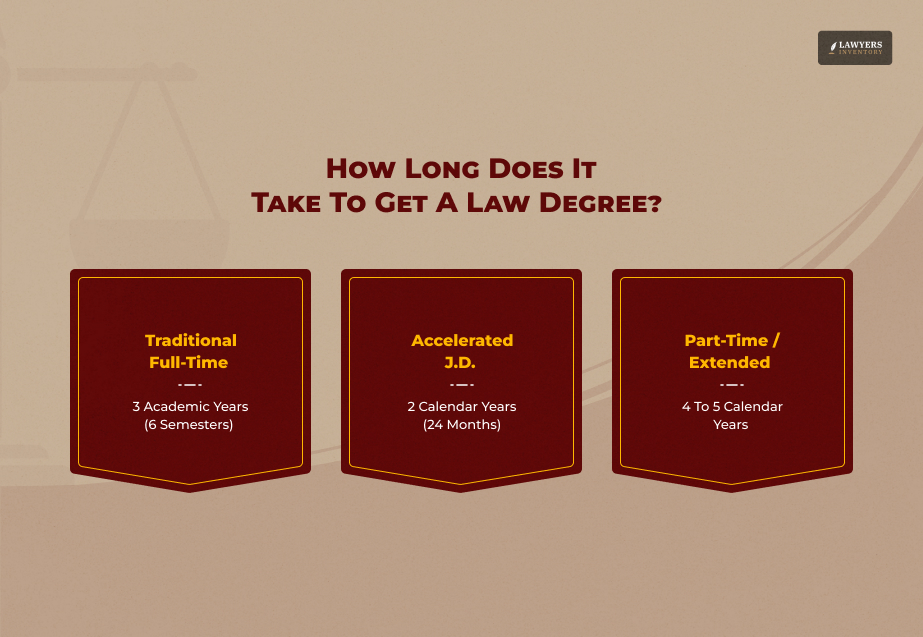
While traditionally it takes 3 years to complete a law degree there are many different options depending on which program you choose.
Below shows a comparison of the 3 main routes.
| Law School Pathway | Typical Duration | ABA Credit-Hour Framework | Best Option For |
| Traditional Full-Time | 3 Academic Years (6 Semesters) | Distributed across 15–16 credits per semester | Standard applicants prioritizing summer clerkships |
| Accelerated J.D. | 2 Calendar Years (24 Months) | Heavily condensed across consecutive summer terms | Professionals looking to reduce opportunity costs |
| Part-Time / Extended | 4 to 5 Calendar Years | Reduced semester loads (8–11 credits) | Working individuals and corporate professionals |
Traditional 3 Year Route
The traditional full-time route is the most common route for the majority of law students in the US.
This allows students to complete their degree requirements over 3 years. This means students will have set academic periods and summer breaks.
This also allows students to participate in campus interviews (OCI) during their summer between the 2nd (2L) and 3rd (3L) years of study.
These interviews allow students to interview large law firms for high paying summer associate roles.
If you are looking to become a partner at a traditional law firm then this route will match the hiring seasons of most corporate law firms.
Fast Track 2 Year Route
The accelerated J.D. route is ideal for students wanting to enter the workforce as soon as possible.
This route allows students to complete their entire law degree in just 24 months. This uses summer semesters to complete the same number of credit hours as traditional students. However, students will not have any summer breaks.
This route isn’t ideal if you want to complete traditional summer clerkships, as you won’t have any summer breaks. However, if you have a clear career plan or your own networks, then this route will help save you a year of living costs.
Part-Time And Extended Options
The part-time route is ideal for working professionals. This route will take between 4-5 years to complete. This allows students to still work full time.
Classes will usually be held in the evenings or at weekends.
This route is ideal for corporate professionals, risk analysts and government workers.
Students will be able to apply their knowledge from work to understand complex legal concepts such as corporate governance.
By extending the time frame professionals can balance their family, careers and legal studies without becoming burnt out.
Financial Considerations And Educational Investment
Thinking about the cost of studying law you will have to consider the debt you will incur over the years.
Law school can be one of the most expensive courses to study in America. Costs have been increasing faster than inflation.
You will have to think realistically about the costs of the law school. Many students will want to know how much is law school?
On average, private law schools charge over $54,000 per year, while public in-state tuition sits near $27,000 per year, according to ABA Standard 509 Information Reports.
Once you include living costs, books and healthcare costs it can often exceed $200,000 over the 3 years. [Source: 7Sage]
A key factor to consider as a competitive applicant would be to obtain a merit scholarship for law school. Law schools will offer financial packages to attract students with high GPAs and exam scores.
By reducing the initial debt, you will not have the pressure of large financial commitments. This will allow you to look outside of traditional big law.
The Post-Graduation “Licensure Lag”: The Hidden Six-Month Timeline
You will not automatically be able to practice law once you graduate from an ABA-accredited law school.
For many people, figuring out how long it takes to earn a law degree means considering the time needed after graduating.
In the United States, you won’t be able to act on behalf of clients and sign legal documents until you pass the state bar exam and are admitted to the bar.
This means the time between graduating and being able to work professionally in the industry is extended by 6 months. This means it takes 3 and a half years to get started in the industry.
The Post-Graduation Exam Window And Grading Delays
The licensing pipeline is divided into three consecutive phases that require significant time and emotional energy.
First, right after graduating in May, you must spend two full months studying for forty to fifty hours per week to prepare for the rigorous exam.
Second, you sit for the formal exam over two grueling days in late July. Finally, you face a lengthy waiting period while state bar examiners process and grade your written answers.
Character, Fitness, And The Swearing-In Milestone
Depending on your jurisdiction, it can take between 10-14 weeks to be graded (New York State Board of Law Examiners).
For example, the New York State Board of Law Examiners usually releases July results in late October, and the State Bar of California often keeps candidates updated in November [Source: State Bar of California].
You’ll also have to pass a strict character and fitness test. This will include checking your financial history, driving record, and behavior. You will then need to go to an official swearing-in ceremony.
Once you’ve taken the oath, you can become a licensed lawyer. This means that you’ll have invested 3 years of your education into becoming a lawyer, but you’ll actually have invested between 36-38 months of your life to be paid a full-time lawyer’s salary.
The NextGen Bar Curriculum Shift: How 2026 Reshapes Your Classroom Hours
Professional licensing has changed dramatically, so law students’ time in the classroom has been transformed.
Previously, students had to attend 3L lecture courses to learn the content required to pass the multi-state UBE Bar exam.
However, the National Conference of Bar Examiners (NCBE) is introducing a new form of Bar exam called a NextGen Bar. The first set of states will be running the new exam in July 2026.
As the NextGen Bar tests practical skills rather than knowledge, many law schools across the country are changing how they allocate their 3rd-year credits.
Transitioning From Rote Memorization To Experiential Learning
What does this actually mean for you and how you get your degree?
Law schools are increasingly moving away from theory-based elective modules during your third year. And instead, are requiring you to take compulsory skills-based modules, such as client counseling exercises, contract drafting, and more [Source: American Bar Association]
Practical Skill Integration In The 3L Curriculum
Additionally, these programs are incorporating bar exam prep and skills testing into the graduation curriculum.
This reduces the amount of time you will spend listening to professors break down past court cases and instead places the focus on performing the tasks of a practicing attorney.
The new curriculum aligns your final year of study to reflect the practical skills tested in the NextGen Bar exam. This ensures you graduate as a practicing attorney, ready to hit the ground running.
Disclaimer: The information provided in this article is for general informational purposes only. It does not, and is not intended to, constitute legal advice.
Source:
- Program Timelines & Credit Framework: ABA Standards and Rules of Procedure for Approval of Law Schools
- Harvard Admission Percentiles: Harvard Law School J.D. Incoming Class Profile
- Official Tuition Disclosures: ABA Standard 509 Required Disclosures Database
- Tuition Trends & Cost Data: LawHub Tuition & Financial Aid Trends
- Total Cost of Attendance Data: 7Sage Law School Tuition & Cost Database
Leave A Reply







What Is The True Cost Of A JD: Tuition Sticker Price Vs. Hidden Living And Interest Traps
Read More
Constitutional Requirements Vs. State Rules: How Laypersons Sit On The Bench
Read More
How To Use A Law Degree Outside The Courtroom [Top High Earning Alternatives]
Read More
How To Build A World-Class Law Firm Intake Engine: The Definitive Platform Guide
Read More
Legal Case Management Software Explained: How To Choose, What To Avoid, And The Best Tools In 2026
Read More
0 Reply
No comments yet.