
Summarize using AI





Prompt copied. Paste it into Gemini.
Listen to this article
Quick Answer: What Can You Do With A Law Degree?

A law degree can open many doors to high-paying non-traditional jobs, such as compliance roles within corporations, investment banking, legal infrastructure and litigation fund analysis. As these roles make use of your law skills they offer competitive pay packages and mean you can earn a good salary after your Juris Doctor without ever having passed your bar exam.
Prospective law students frequently ask what can you do with a law degree if they decide not to practice traditional litigation.
The classic image of a lawyer arguing before a judge represents only a fraction of the modern legal market.
Driven by macroeconomic shifts and technological disruption, a growing cohort of Juris Doctor (J.D.) graduates is turning away from the billable-hour grind of law firms. [Source: National Association for Law Placement (NALP)]
They are choosing instead to deploy their analytical skill sets in the following:
- Corporate suites.
- Tech startups.
- Financial institutions.
This professional pivot requires a cold calculation of value and risk.
Given the rising tuition fees and the multi-year commitment required to graduate, candidates must ask a fundamental question: Is a law degree worth it?
The answer depends heavily on how strategically you leverage the credential outside public courtrooms.
For individuals possessing exceptional skills in risk mitigation, contract construction, and structured advocacy, a J.D. serves as an elite business asset.
Evaluating The Capital Investment Of A Juris Doctor

Getting a law degree is a serious consideration.
While you will gain a number of specific skills that help solve problems, the initial cost can be prohibitive.
Understanding what costs are involved within your institution will help.
According to data provided by the American Bar Association (ABA), legal education has increased dramatically within the US.
Applicants need to understand what proportion of their money will go towards law school at different levels of public and private universities.
On average, top private universities can cost more than $50,000 per year. This can leave you with large amounts of debt.
However, most individuals will not actually pay the full price as they will be highly qualified. Getting a good law school scholarship can change the overall return on investment when applying to law school.
Most institutions offer merit scholarships to those who are above the median of the university. This would include those with higher undergraduate grades and tests.
By limiting the amount you have to borrow initially, you can enter high paying alternative industries without having to worry about large monthly payments.
The Timeline And Modern Testing Benchmarks
Knowing how long does it take to get a law degree will help you understand what they entail.
Typically, to earn your J.D. you have to complete several years of intensive studying and practical training.
And how long does it take to get a law degree? Well, most full time courses take exactly three years to complete within the U.S.
However, before you even step foot into the classroom you will need to pass through the main gateway. Many aspiring students spend months researching how to study for the LSAT.
This usually includes:
- completing many practice tests under timed conditions,
- practicing logical reasoning patterns,
- analyzing reading.
Navigating Standardized Admissions Hurdles
However, the exam can be an intimidating obstacle for many.
When discussing the admissions process, most candidates will openly discuss how difficult the LSAT is compared to other graduate level exams.
It does not measure factual recall, it instead tests your ability to think logically and systematically under time pressure.
Recent changes have been made to the exam format.
The LSAT argumentative writing section has been added meaning you must write a coherent thesis statement based on evidence using a digitally proctored system. [Source: The Law School Admission Council (LSCA)]
This section allows admissions committees to gain insight into your writing style.
Alternative Paths To Legal Education
In recent years, entry requirements have changed.
Some law schools (although few) that don’t require an LSAT score now also accept the GRE.
This is to help widen the intake, bringing in people with high scientific, technological, engineering and mathematical backgrounds.
However, if you want to be at the very top of corporate life then traditional routes still dominate.
If you are applying to Ivy League universities you will need to know what LSAT score do you need for Harvard or similar.
Traditionally you will need to have scored in the top 99th percentile, usually between 170-180.
What Can You Do With A Law Degree?
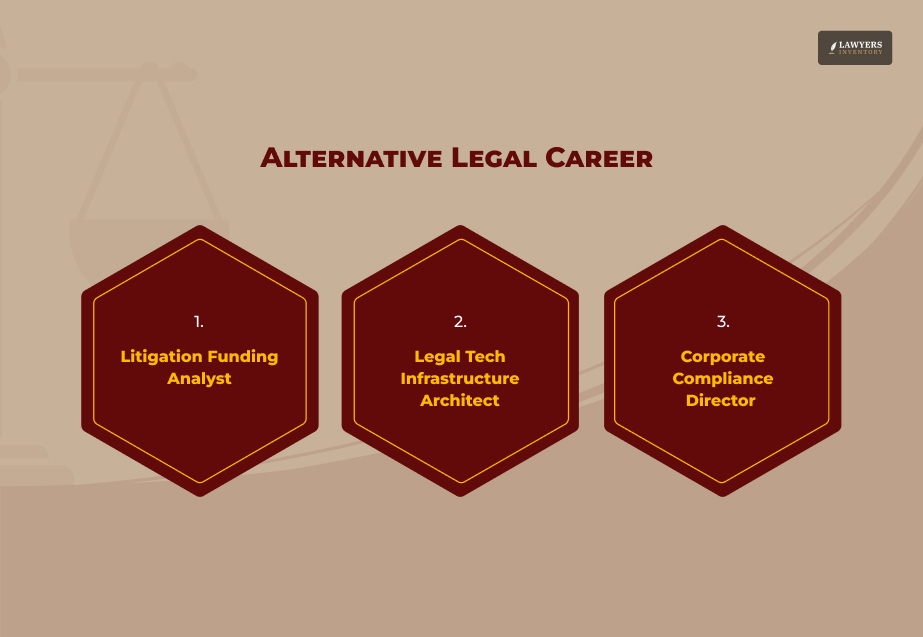
Businesses are increasingly seeking legal professionals to work within non-litigious roles.
Having a strong legal background provides you with many skills a business might want including:
- Logical thinking
- Risks assessment
- Deductive reasoning
Many new lucrative opportunities open up to you in the business industry.
Many people when considering their future wonder what you can do with a law degree apart from becoming a traditional lawyer.
There are many fulfilling and well-paid non-litigious roles within the business industry. These roles will use your skills to help you within your business.
| Alternative Legal Career | Value Proposition | Industry Benefit |
| Litigation Funding Analyst | Evaluates case strength, judicial history, and damages to treat pending lawsuits as financial assets. | Maximizes hedge fund ROI by backing high-probability commercial disputes. |
| Legal Tech Infrastructure Architect | Focuses on generative AI prompt engineering, contract lifecycle automation, and digital compliance. | Builds strict guardrails for corporate large language models to limit regulatory drift. |
| Corporate Compliance Director | Manages cross-border regulatory changes, internal audits, and structural governance protocols. | Prevents multi-million dollar institutional fines through systemic operational oversight. |
High-Earning Corporate And Advisory Roles
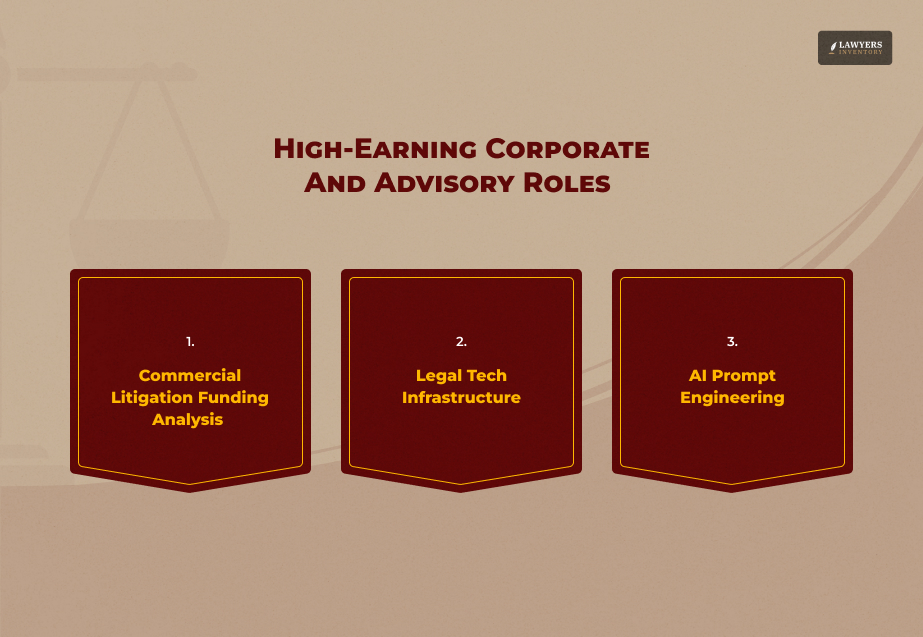
In the corporate space, there are many lucrative opportunities to earn a comparable or better salary than traditional law firms.
There are a variety of different types of work available in areas such as investment banking, risk management and strategic corporate governance.
Professionals will have influence on large commercial transactions but won’t be drawing up legal briefs.
Many business professionals will discover what can you do with a law degree without passing the bar by working within the corporate space.
JD holders are employed in advisory roles by corporations due to their ability to interpret complex regulations and identify potential liabilities.
These roles often come with options, performance related bonuses and a clear route to leadership.
Commercial Litigation Funding Analysis
An interesting development within alternative legal careers is the growing field of commercial litigation funding.
Multi billion pound hedge funds and private equity companies regularly employ law graduates to work as investment analysts.
These analysts do not actually get involved with any case work but look at active court cases as an investment opportunity. They will look at how strong the structure of the case is and what return they can make from it.
The analyst will look through complicated documents and case law to determine if they should invest millions of pounds into a court case on behalf of a third party.
According to industry statistics gathered by the National Association for Law Placement, top analysts within major financial cities such as New York and San Francisco can earn high salaries with performance based bonuses.
This role looks at law from both a legal and corporate finance perspective and does not involve working on an hourly basis.
Legal Tech Infrastructure And AI Prompt Engineering
Another lucrative option has emerged at the intersection of generative AI and compliance.
J.D.’s are being snapped up by enterprise software firms, major consultants and tech start-ups to form legal tech infrastructure and legal knowledge of architects.
These roles help oversee the building of AI driven large language models to help with accurate processing of regulatory information, contract creation and automated discovery. [Source: NALP]
A computer science degree does not provide the depth of knowledge required to train an AI in understanding the intricacies of statutes or contractual liability.
Law graduates provide this with creating prompting, checking outputs and creating compliance barriers within corporate environments.
This has expanded the opportunities available with a law degree in the financial sector, allowing individuals to utilize their technical skills alongside their legal knowledge.
Judicial And Regulatory Pathways Outside Private Practice

The public sector and regulatory bodies can offer excellent opportunities for legal professionals looking to pursue a career in government.
Not only will you get to shape policy, but they will also give you an opportunity to enforce regulation.
Government agencies look for people with a legal background as they bring many valuable skills such as fairness, attention to detail and constitutional law.
The American judicial system also requires many non-litigation legal experts. Many people ask if you need a law degree to become a judge in the United States.
While high level state and federal courts require judges to have a J.D. and many years of experience in law, there are some local or municipal courts in certain areas that offer alternative routes. [Source: American Bar Association]
However, having a law degree will still make you the most valuable asset for progression.
Read Also: Can You Take the Bar WITHOUT Going to Law School?
Staying Ahead Of Evolving Licensing Standards
There are some major changes coming to the rules that govern legal professionals. For decades the UBE BAR exam has been used as the main licensing exam throughout over 40 jurisdictions.
It tests examinees on a wide variety of general legal knowledge using a combination of multiple choice questions and essays.
However, the NCBE are introducing their new NextGen BAR Exam. This basically aims to replace the older system.
This new exam focuses on fewer memory based questions and more practical skills required of a lawyer – including giving advice to clients and basic legal research.
It is very important for legal professionals to keep up to date with these changes to licensing, as they really define what you can do with a law degree.
Disclaimer: The information provided in this article is for general informational purposes only. It does not, and is not intended to, constitute legal advice. Please consult an attorney for legal help.
Source:
- Law School Tuition, Financial Aid, & GPA/LSAT Medians: ABA Required Disclosures Portal
- Law School Admission Tracking & Tuition Trends: LSD.Law School Database Profiles
- Non-Litigious “JD-Advantage” Employment & Salary Trends: NALP Graduate Employment Outcomes Guide
- Accredited Law Programs Accepting the GRE: ETS GRE Law School Program Registry
- Ivy League Admissions & 99th Percentile Benchmarks: Harvard Law School 1L Profile and Facts Page
- Digitally Proctored LSAT Writing Specifications: LSAC LSAT Argumentative Writing Hub
- NextGen Bar Exam Skills & Format Changes: NCBE NextGen Bar Exam Portal
Leave A Reply







How To Build A World-Class Law Firm Intake Engine: The Definitive Platform Guide
Read More
Legal Case Management Software Explained: How To Choose, What To Avoid, And The Best Tools In 2026
Read More
Logikcull Review 2026: The eDiscovery Tool 1,500+ Legal Teams Trust – But Should You?
Read More
Legal Assistant Vs. Paralegal: The Real Difference And Why It Matters
Read More
How AI-Driven Law Firms Deliver Higher-Quality Representation For Less
Read More
0 Reply
No comments yet.