
Summarize using AI





Prompt copied. Paste it into Gemini.
Listen to this article
Quick Answer: How Hard Is The LSAT?
The LSAT is a very challenging skill based test. In order to achieve a top score of 170 you must outperform approximately 97% of people across the nation. Since the removal of Logic Games in August 2024 the test has become incredibly strict to test your ability to read in an overly literal way and understand complex logical reasoning questions involving language.
How hard is the LSAT? This is a common question asked by those wishing to become lawyers. The LSAT, unlike typical Undergraduate exams, does not test your knowledge of facts, dates and laws.
Instead, it assesses your ability to carry out complex processes involving formal logic, comprehension and psychometric testing.
This can be very challenging for those who struggle with revision. However understanding this can help you if you’re hoping to enter the profession.
Overall, understanding how difficult this exam really is can be done by looking at the overall purpose of the exam.
Becoming an attorney is a lengthy process, so many people will consider how long it takes to get a law degree. Usually, obtaining your Juris Doctor (JD) will take 3 years of full time study.
However, the LSAT serves as an important gateway for this challenging process. The Law School Admission Council (LSAC) created the LSAT to test the reading and reasoning skills required for law school.
Core Cognitive Mechanics: Why Rote Learning Fails LSAT
To understand how hard is the LSAT, you must look at what is being tested by the Law School Admission Council on the assessable sections.
After a major reform was introduced in August 2024, the Analytical Reasoning section (commonly referred to as Logic Games) has been entirely removed from the LSAT.
According to the LSAC Official Test Format Update, the test now consists of:
- Two Logical Reasoning sections.
- One Reading Comprehension section.
- An experimental section which is not assessable.
This means the only section where students can use templates and shortcuts to assist them has been removed.
The new format of the LSAT focuses entirely on critical thinking. There is no way that rote learning can help you in this section.
The other sections are much more precise than most college courses would require.
In the two Logical Reasoning sections, you are required to analyze complex arguments, identify underlying assumptions, logical fallacies, and argument flaws within a strict 35 minutes.
Furthermore, the Reading Comprehension section requires you to read abstract academic texts from subjects such as Philosophy, Physical Sciences, and Legal History.
You will be asked questions that require you to analyze the authors’ stance, analyze arguments, and make inferences.
Rote learning quickly consumes your time and tempts you to choose logically invalid answers.
The Myth Of Legal Content On The Examination
Many people enter the test-prep phase thinking they need to know legal terms or understand constitutional law. This can make people wonder how hard is the LSAT without any knowledge of politics or pre-law.
The truth is, there is no benefit to knowing anything about legal matters. All the information you will need to answer an LSAT question will be provided within the question.
This exam is specifically testing how well you can interpret completely new information. Using any previous knowledge or jumping to conclusions is one of the quickest ways to reduce your score.
The LSAT rewards a very literal approach to reading. Words such as “some,” “many,” most,” and “all” possess rigid, distinct logical boundaries.
Those who learn by rote will struggle, as they will look for something they recognize rather than analyze the logic behind the premises.
The Role Of Writing And Expressive Logic
There is also an untimed essay section that you must complete, which is another part of the LSAT. This section is known as the LSAT argumentative writing.
You will be presented with a complex question in which you must make a decision using multiple factors.
Now, while this section doesn’t contribute to your 3-digit score, the essay will be sent directly to admissions committees by the LSAC.
Law schools use this writing sample to ensure you have strong analytical skills and can effectively use them to write coherent, structured, and persuasive text. This is an effective way to combat AI and ghostwritten personal statements.
If you have a full score in the multiple-choice questions but a confusing and poorly structured argumentative essay, then this can cause problems for you.
Understanding The Psychometric Curve: How Equating Works
One of the main reasons how hard is the LSAT to score well on is because of the way LSAC calculates the scores. It is out of 120-180.
However, this score does not reflect the percentage correct. Instead, they use a complex method called raw-to-scaled score equating.
Psychometricians process raw data points through standard score-equating formulas to ensure the proficiency scale remains identical across different test forms, neutralizing structural differences in question difficulty. [Source: LSAC Research & Data Portal]
This means that if you score 165 on a very difficult test, it will be worth the same amount as scoring 165 on an easier test. Your score is a reflection of how you performed compared to other test takers.
The conversion process moves sequentially through distinct phases:
- Raw Score Tally: LSAC counts how many questions you got right in the 3 scored sections. You do not lose any marks for guessing incorrectly.
- Statistical Equating: Psychometricians apply statistical analysis to equate the tiny variations in difficulty.
- Scaled Score Conversion: Your raw score is converted into the standardized score of 120-180.
- Percentile Rank Assignment: Your score is then converted to a percentage showing how many people you performed better than.
As your scaled score is based on where you fall on the distribution curve, even a small improvement will cause a large change in your percentile. The majority of people will score around the median score of around 152.
As the bell curve is at its steepest in the middle, getting 3-4 extra questions right will move you ahead of thousands of people.
However, when you get higher up the scale, the bell curve becomes much flatter, meaning you have to fight for the top spots.
The Steep Climb To Elite Status
If you are working towards getting into one of the most prestigious law schools in the country, you will likely be aware of just how competitive the statistics really are.
According to the LSAC Standard Percentile table, to get a 170 on the LSAT, you generally need to be in the 97th percentile and above. This means that you have to perform better than 97% of people taking the test.
If the test you are sitting has around 76-78 marked questions, you can only afford to get between 7-9 questions wrong.
This can lead to a huge amount of pressure when taking the test. In order to consistently achieve this score you must know the test inside out. You need to be able to answer questions without even thinking about it.
If you want to reach this top tier you have to move from having to think about every question to being able to answer them quickly using patterns.
The Psychometric Shift Post-August 2024
A major change that often goes unmentioned in typical test prep resources is how this change has affected the psychometrics of the test.
Historically, Logic Games were universally considered the easiest section on the test to improve at. By simply practicing diagramming over and over, students could consistently improve from missing half of the questions to scoring a perfect raw score.
This made it a great way to guarantee a certain number of points, so thousands of applicants could try their best to get into the high 160s and 170s.
However, now that there are no more Logic Games, the LSAT has become a test that heavily relies on reading and language-based logic. Consequently, this has changed how much the raw score varies.
Since Logical Reasoning and Reading Comprehension take a long time to develop and have more variance, the conversion charts for raw to scaled scores have also changed.
Therefore, the psychometricians at LSAC have to constantly adjust the equating formulas to make sure that getting a 170 still holds its historic value. As a result, getting an elite score on the LSAT is completely different now.
The Financial And Educational Stakes Of The LSAT
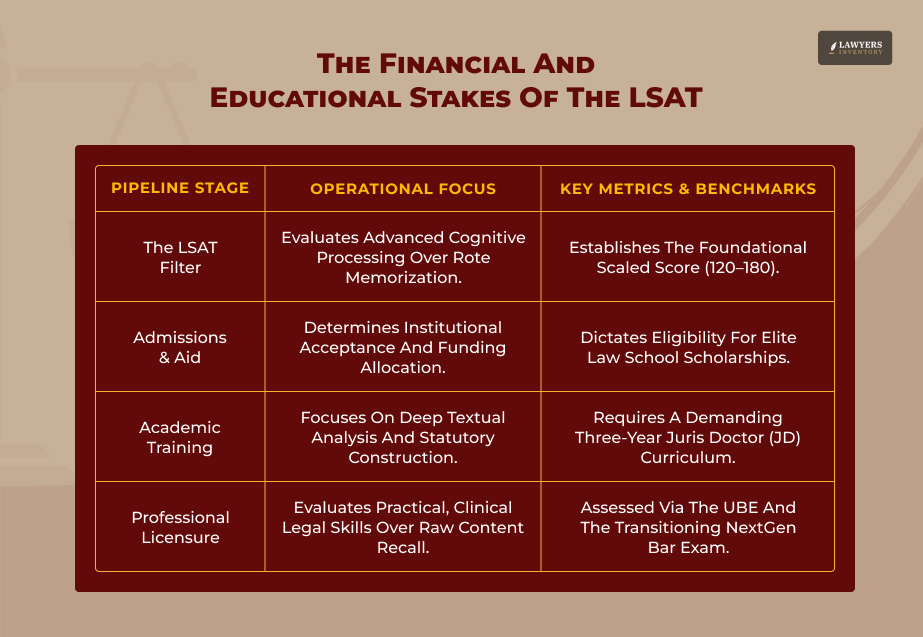
There is a massive amount of pressure for students taking the LSAT.
Law schools heavily use index calculations using your undergraduate GPA and LSAT score to help predict how you will perform in your first year of law school.
If you are hoping to get into a top law school, a couple of points difference can drastically affect your career. Consequently, applicants often calculate exactly how high of an LSAT score they need for Harvard.
Generally, the top law schools maintain a median LSAT score between 173 and 175. Therefore, there is very little room for error.
| Pipeline Stage | Operational Focus | Key Metrics & Benchmarks |
| The LSAT Filter | Evaluates advanced cognitive processing over rote memorization. | Establishes the foundational scaled score (120–180). |
| Admissions & Aid | Determines institutional acceptance and funding allocation. | Dictates eligibility for elite law school scholarships. |
| Academic Training | Focuses on deep textual analysis and statutory construction. | Requires a demanding three-year Juris Doctor (JD) curriculum. |
| Professional Licensure | Evaluates practical, clinical legal skills over raw content recall. | Assessed via the UBE and the transitioning NextGen Bar exam. |
Your score can have a huge impact on your application. Candidates will need to consider the cost of attending law school when applying.
With annual costs at top private law schools routinely exceeding $75,000, graduating with a JD can easily result in a total debt load of over $250,000, according to data from the American Bar Association.
A high LSAT score is the main way to reduce this. It can act as the golden ticket to receiving funding from the institution.
Unlocking Merit-Based Aid
The best way to earn a large amount of law school scholarships is to do well on the exam. Law schools offer scholarships to encourage high scorers to enroll. This will improve the school’s median and help it rank higher nationally.
Many scholarships are merit-based, meaning they can pay for a portion, all, or the whole of your tuition fees, plus a stipend.
Increasing your LSAT score by 3 points can save you over $100,000 in tuition debt. This means that investing in quality study resources is actually a great investment.
Alternative Paths To Admission
Many people will look for alternative routes due to the difficulty of the exam. Some people will look to see if there are any law schools that don’t require an LSAT score. More and more law schools now accept the GRE instead of the LSAT under current ABA Standards.
Some institutions also have specific waivers for undergraduates wishing to apply to their law school.
However, it is very rare to get into a law school without an LSAT score and can severely reduce your options when looking for competitive merit scholarships at multiple institutions.
Science-Based Study Plan
As the exam is skill-based, you will need to completely change your study habits. You won’t be able to succeed by highlighting textbooks, creating vocabulary flashcards, or reading summaries of logical principles.
Additionally, you will need to train like an elite athlete or classical musician. You are building new neural pathways to help you perform quickly and accurately.
A good study plan will involve lots of practice questions using official LSAC materials. You will need to learn how to deconstruct every question you get wrong using a detailed blind review method.
This means you need to spend as much time as you want going through the questions you got wrong.
After that, check the answer key. This will help you identify whether you were rushing or didn’t understand the concepts. You can then work on improving your mistakes.
Alignment With The Evolving Licensure Landscape
The mental skills learned by taking the LSAT are the very skills required by the future professional legal licensing examinations.
In the past, legal professionals in the United States had to take the UBE Bar exam (Uniform Bar Examination). This exam requires students to know vast amounts of black letter law on a range of topics.
However, this has led to students who have taken this exam being rewarded for the very skills the LSAT penalizes. The National Conference of Bar Examiners (NCBE) is now implementing the NextGen Bar exam to correct this issue.
Jurisdictions are now beginning to implement this exam in July 2026. The NextGen Bar exam has shifted the focus away from testing heavy content knowledge and requires students to have the practical skills of a legal professional.
This exam includes tasks such as drafting contracts, conducting legal research, giving legal advice to clients, and analyzing arguments. This exam tests the same logical thinking and reading accuracy that the modern LSAT tests.
Therefore, preparing for the LSAT provides you with the fundamental skills needed for your career.
Career Horizons: The True Value of Legal Reasoning
You’ll find that the analytical skills you acquired during your LSAT prep can be used throughout your career.
Many people entering legal studies have a very narrow perspective on what you can do with a law degree and often ask: do you need a law degree to become a judge in the United States?
This depends on where you are practicing. Federal judges and appellate courts require a JD and plenty of experience.
However, some states allow non-lawyers to become magistrates. Regardless, to reach a position of real authority in the judicial system, you’ll likely need to know the law inside out.
The mental clarity needed to assess judicial arguments also allows you to explore a variety of different career options within the legal field.
Businesses now value good legal reasoning, and there is a huge demand for JD-qualified individuals to work in compliance, risk management, venture capital, and consulting.
As soon as you finish your degree, you’ll quickly realize that having a law degree will accelerate your career in many industries.
The ability to analyze complex text, find flaws in logic, and argue persuasively is one of the highest-paid skills in the world. By mastering the LSAT, you’re essentially building your brain to succeed in the long term.
Disclaimer:
The information provided in this article is for general informational purposes only. It does not, and is not intended to, constitute legal advice.
Sources:
- LSAT Test Format & Rules: Law School Admission Council (LSAC) Test Overview
- LSAT Score Percentiles & Curves: LSAC Official Score Data Table
- Law School Costs & Scholarships: American Bar Association (ABA) Consumer Disclosures
- The New NextGen Bar Exam: National Conference of Bar Examiners (NCBE) Updates
Leave A Reply






Which Programs Allow Alternative Admissions Metrics? [The Test-Optional Law School Trend]
Read More
How To Structure The New LSAT Writing Sample Under Time Constraints
Read More
How To Study For The LSAT? The Exact Study Protocol Used By Top LSAT Test-Takers
Read More
The Complete Law School Timeline: Traditional, Accelerated, And Part-Time Pathways Compared
Read More
What Is The True Cost Of A JD: Tuition Sticker Price Vs. Hidden Living And Interest Traps
Read More
0 Reply
No comments yet.