Summarize using AI





Prompt copied. Paste it into Gemini.
Listen to this article
Quick Answer: How To Study For The LSAT?
The LSAT evaluates cognitive and text analysis abilities, not memorized knowledge. Since August 2024, it excludes Logic Games, featuring two Logical Reasoning sections, one Reading Comprehension section, and an unscored experimental section. To succeed, you must study 3–12 months, master the official LawHub interface, and test in person at a Prometric center.
Figuring out how to study for the LSAT starts with a reality check: your college study habits won’t work here.
This test isn’t about memorizing facts or cramming the night before; it’s about changing how your brain processes information, which takes real, daily training.
It can feel incredibly overwhelming, but since this score opens the doors to your entire legal career, putting in the work now is the ultimate investment in your future self.
Economics Of Admission And The Testing Framework
Deciding to pursue a legal profession should be an honest consideration to whether you can afford it.
Many aspiring law students will consider how much law school costs and whether they’ll make a good return on investment with their Juris Doctor. With annual fees exceeding $60,000 at top private institutions, you must get a top score.
Most law schools will use your score to award merit scholarships.
According to 2026 LSAT Scholarship and Admission Data, roughly 90% of applicants with a 166+ score receive significant merit aid, and data shows that even a small 5-point score increase can lead to over $50,000 in additional scholarship funding over 3 years. [Source: Test Ninjas LSAT]
This means you could clear your debt by getting a competitive scholarship. If you’re aiming for the very top of the academic ladder, many people will ask: What LSAT score do I need for Harvard?
The median score for top law schools is between 174 and 180. A few law schools will accept the GRE rather than the LSAT to help increase diversity in their intake.
| Step in Legal Pipeline | Typical Time | Target |
| LSAT Preparation | 3 – 12 Months | Get target score to gain the most merit scholarships |
| Law School Enrollment | 3 Academic Years | Receive top grades (1L) to get into law review |
| Professional Licensure | 2 – 6 Months | Pass the state bar exam on the first attempt |
What Is The LSAT?
Before attempting any practice material, you must understand what the LSAT is. It is a standardized exam consisting of 4 multiple-choice sections.
Each section should be completed within 35 minutes. Only 3 sections are marked, and your score will sit between 120 and 180.
The final section will be an experimental section. This is unmarked and consists of multiple-choice questions that the LSAC will use to trial questions for future exams.
While this section isn’t marked, you must stay focused throughout. The total exam will take 2 hours and 20 minutes to complete.
Format Of The LSAT Exam
The exam is now purely based on text analysis and cognitive ability. With the removal of the analytical reasoning section (Logic Games), the exam now consists purely of reading and complex logical reasoning.
According to the Law School Admission Council (LSAC) Official Blog:
“Starting August 2024, LSAT replaces Analytical Reasoning (logic games) with a second scored Logical Reasoning section… format comprises two scored Logical Reasoning sections, one scored Reading Comprehension section, and one unscored section.”
Many people underestimate how difficult the LSAT is. The exam writers will create tricky answers for fast readers. This means you must treat every sentence like a logical contract.
| Evaluated Section | Focus | Time Limit | Question Volume |
| Logical Reasoning | Evaluate arguments, identify flaws and logical reasoning | 35 Minutes | 25 Questions |
| Reading Comprehension | Identify main point and tone from complex statutory text | 35 Minutes | 27 Questions |
| Argumentative Writing | Compose a clear and logical essay within a tight time frame | 45 Minutes | 1 Essay Prompt |
There is also a writing section which must be completed under supervision. The current LSAT writing section consists of 15 minutes of planning time and 30 minutes of writing. Although this section isn’t marked, admissions will look at your essay to see how clear your writing is.
How To Study For The LSAT?
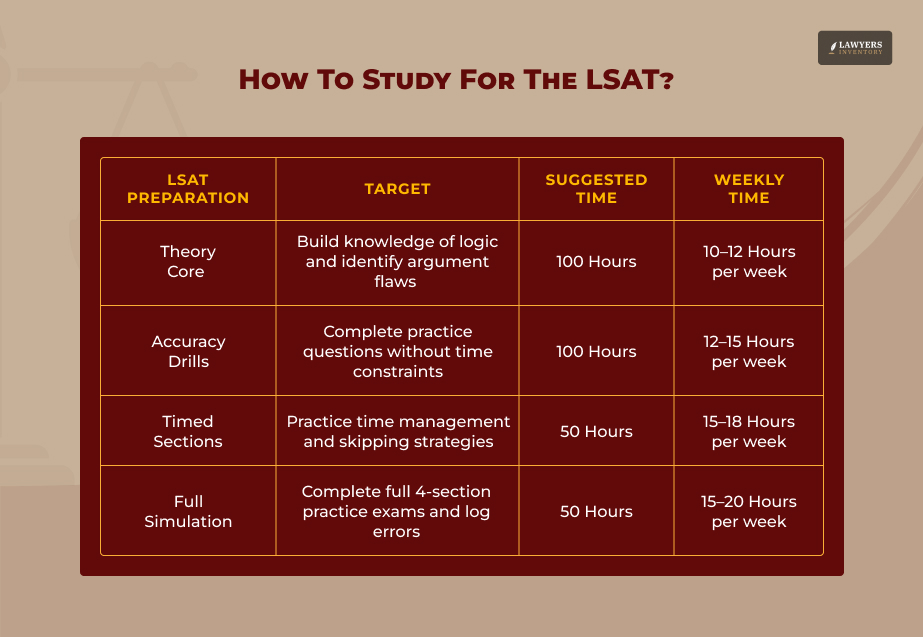
To create a top study regimen, you must have a structure. Top scorers will not simply complete hundreds of questions.
They will complete 4 stages of their study to ensure they have a strong foundation and then apply time constraints. This will help you create repeatable skills.
Your study should consist of a balance between daily logic practice and full practice exams. By logging your mistakes, you will be able to identify and rectify any small mistakes you’re making.
| LSAT Preparation | Target | Suggested Time | Weekly Time |
| Theory Core | Build knowledge of logic and identify argument flaws | 100 Hours | 10–12 Hours per week |
| Accuracy Drills | Complete practice questions without time constraints | 100 Hours | 12–15 Hours per week |
| Timed Sections | Practice time management and skipping strategies | 50 Hours | 15–18 Hours per week |
| Full Simulation | Complete full 4-section practice exams and log errors | 50 Hours | 15–20 Hours per week |
The consensus across major LSAT prep experts is that a competitive score requires a commitment of 150 to 300 total hours of focused preparation across 3 to 4 months.
Furthermore, standard tutor diagnostics map to a benchmark rule of roughly 10 hours of rigorous study per 1-point increase in the mid-scoring bands, as per StudyCards AI.
In-Center Mandatory Shift and User Interface Rules
An issue with many older guides is that they do not account for the mandatory in-center exam.
All students, whether in the US or internationally, must complete the exam at a physical Prometric center. Unless there are extreme circumstances, you cannot complete the exam from home.
LSAC has also completely redesigned the exam interface on the LawHub. If you want to know how to study for the LSAT, you must practice using the interface.
If you’re practicing on paper or using older interfaces, you will be at a great disadvantage. You must get used to using the marking tools, changing font sizes, and different screen options.
Taking your study out of a quiet room and simulating the environment of a real exam will prevent you from panicking.
NextGen Bar Exam Skills
Many aspiring law students don’t consider that the admission process is directly linked to their future licensing requirements.
The National Conference of Bar Examiners officially launched the NextGen Bar Exam in July 2026 across 10 initial jurisdictions (including Connecticut, Maryland, and Oregon).
The legacy Uniform Bar Exam (UBE) will be permanently phased out and replaced by July 2028 across more than 50 adopting states.
This removes the need to memorize essays and instead focuses on practical skills such as client counseling, text analysis, and contract analysis. [Source: NextGen Bar Exam Portal]
This means you’re developing the skills required for the post-2024 exams. Getting to grips with how to study for the LSAT will give you the skills needed for the NextGen standard.
The reading comprehension and fallacy-identification skills you develop will form the foundation of your future. Thinking about your study plan as the beginning of your training will keep you motivated.
How To Create A Top Study Regime?
The core of your whole study plan will be using the blind review technique. Once you’ve completed a timed practice exam, do not look at the answers straight away.
Print off a fresh copy of the questions you got wrong and complete them in your own time. This will help you identify if you’re having issues with timing.
If you got the correct answer, you’re having timing issues. If you still got it wrong, you have an issue with your logical theory. To prevent burnout, spread your practice throughout 5 days a week.
- Theory: Spend the first month learning the theory behind logical reasoning, identifying premises and common fallacies.
- Accuracy: Complete questions without the time constraint to ensure you can find the correct answer using logical structure.
- Timing: Move on to timed 35-minute sections. Learn how to skip extremely difficult questions to gain easy points.
- Full Practice: Complete full 4-section practice exams on the official interface. This will help build your stamina.
- Error Log: Keep a journal of why you got the question wrong. This will help improve future performance.
Long Term Career Considerations
The journey to enter the legal industry can take a long time. Many students will ask how long does it takes to get a law degree in the US.
To get a law degree, you’ll have to complete 4 years at university and 3 years of full-time legal studies.
After you’ve graduated, you’ll have to pass your state licensing exam before you can practice. This long process means you must consider your true ambitions. Many professionals will ask whether you need a law degree to become a judge.
While there are a few small exceptions for laypersons at local municipal courts, state appellate and federal courts require you to have a J.D., pass your bar, and have years of trial experience. Getting a top score on your entry exam is the most important step.
Disclaimer: The information provided in this article is for general informational purposes only. It does not, and is not intended to, constitute legal advice.
Sources:
- Law School Admission Council (LSAC) Official Announcement: What to Expect Starting with the August 2024 LSAT.
- Official Testing Engine & Practice Prep: LSAC LawHub Portal.
- Prometric Center Requirements and Test Delivery Updates: LSAC In-Person Testing Policies.
- Writing Sample Requirements and Structural Layout: LSAC LSAT Argumentative Writing Guide.
- National Conference of Bar Examiners (NCBE): NextGen Bar Exam Foundational Skills & Transition Timeline.
Leave A Reply






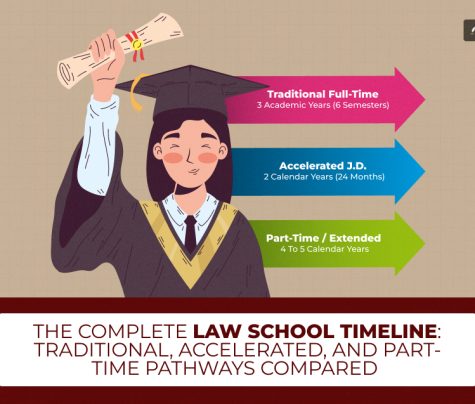
The Complete Law School Timeline: Traditional, Accelerated, And Part-Time Pathways Compared
Read More
What Is The True Cost Of A JD: Tuition Sticker Price Vs. Hidden Living And Interest Traps
Read More
Constitutional Requirements Vs. State Rules: How Laypersons Sit On The Bench
Read More
0 Reply
No comments yet.