Summarize using AI





Prompt copied. Paste it into Gemini.
Listen to this article
A law school scholarship can be one of the most important factors that goes on to determine whether your degree has paid off financially.
Let us give you an example: Two students can get the same JD degree, pass the same bar exam, and do the same job. But one can graduate with $16,000 in debt and the other with $135,000. Their salaries may match. Their financial lives will not.
This case study uses new data to show the difference between the two. Using the Class of 2024 salary data, the 2024-25 debt data, and the latest Federal loan regulations (which came into effect on 1st July, 2026), we will compare top-tier schools (Tier-1) with schools outside of the top 100 (Tier-3).
With this, we ask only one question: which path leaves a graduate better off?
Five Things To Understand When Thinking About A Law School Scholarship
While researching this case study, we saw that most of the information that is available online for law school scholarships often repeats the same advice: take the money or take the prestige.
But what about the data? How to decide which scholarship to actually take that would make the career sustainable?
Here are five findings that change the decision:
1. New Federal Caps
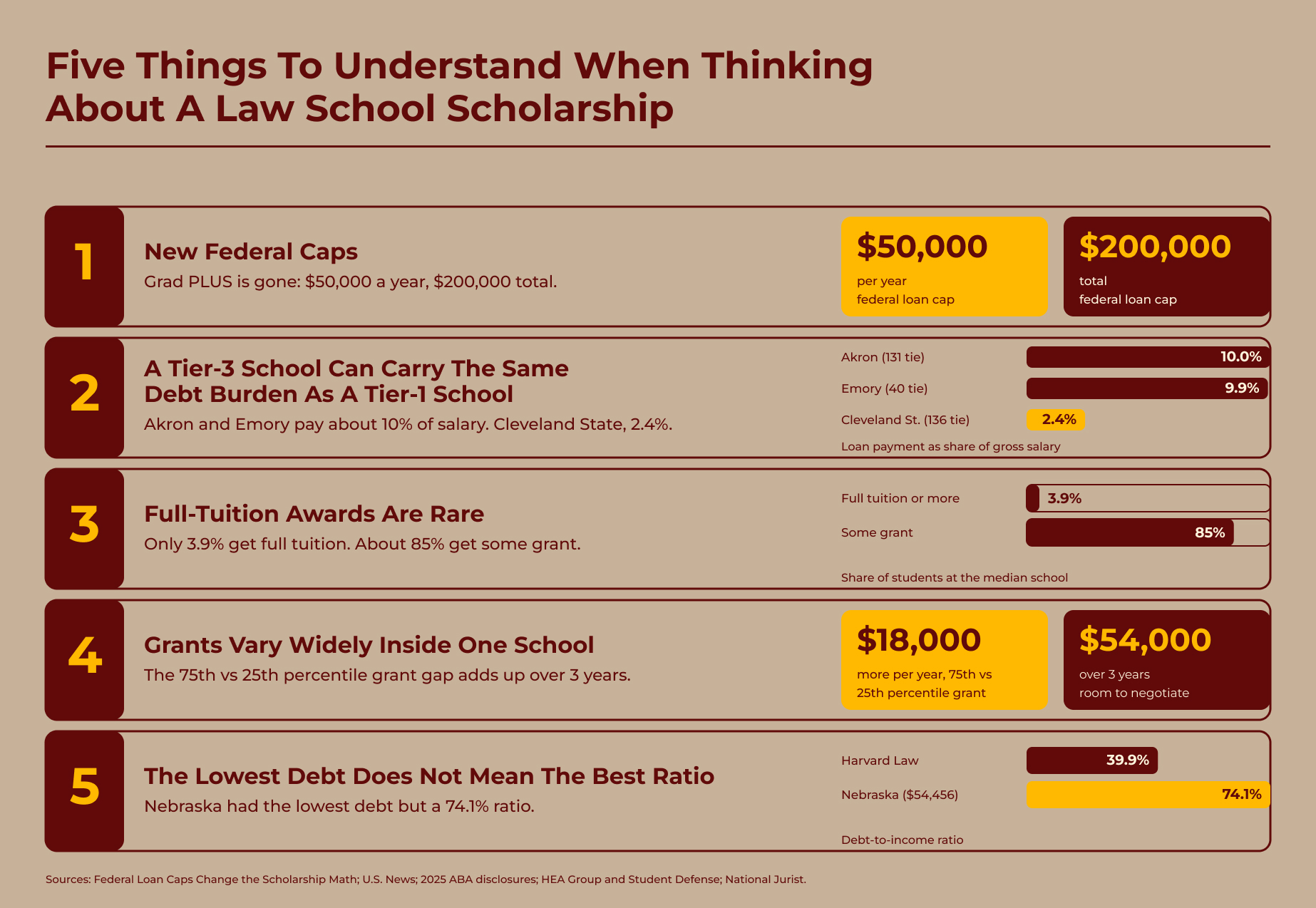
As of July 1, 2026, Grad PLUS is no longer available. Law students will now have caps of $50,000 annually and $200,000 total for their federal loans.
This means students previously able to borrow the whole cost of attendance will now have limits placed upon them. This can leave a large gap for schools with high living costs and low grants. [Source: Federal Loan Caps Change the Scholarship Math]
2. A Tier-3 School Can Carry The Same Debt Burden As A Tier-1 School:
According to U.S. News data, if you take out a 10-year loan at 8.07% interest, then you are looking to pay back about 10.0% of your gross salary at University of Akron (ranked 131 tie) and 9.9% at Emory (ranked 40 tie).
However, as per the Debt-Service Test, at Cleveland State (ranked 136 tie), you would only be paying back 2.4%. Your rank doesn’t matter, but your debt and salary does.
3. Full-Tuition Awards Are Rare:
Thirdly, only 3.9% of students at the median ABA-approved law school receive a full tuition grant or higher. This was found by analyzing the 2025 ABA disclosures.
However, 85% of students at an average school will receive some form of grant. Most grants are partial.
4. Grants Vary Widely Inside One School:
At the median school, the 75th percentile grant is $18,000 more than the 25th percentile grant. This can add up to $54,000 over 3 years. You may need to negotiate with the school.
5. The Lowest Debt Does Not Mean The Best Ratio:
A study carried out by The HEA Group and Student Defense showed that Harvard Law graduates had a debt-to-income ratio of 39.9%.
The University of Nebraska had the lowest median debt, $54,456, but had a ratio of 74.1%. Your salary will affect this just as much as your loan amount, according to National Jurist.
What A Law Degree Really Costs
The sticker price is only the start. The expenses of a law school include:
- Tuition.
- Fees.
- Books.
- Health insurance.
- Living costs.
The ABA requires each school to publish these figures in its Standard 509 report.
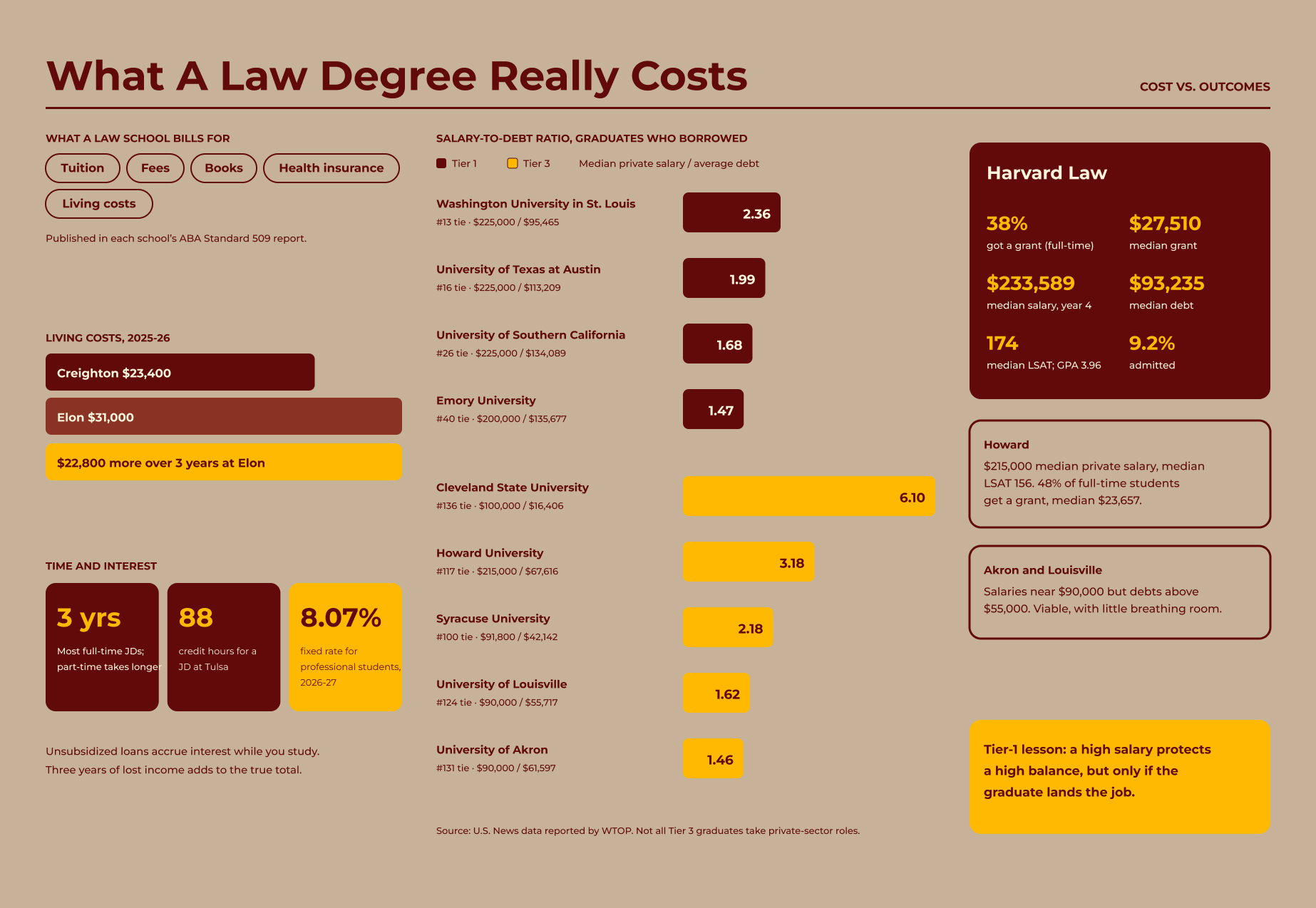
Living costs can vary greatly. Creighton states an expected living cost of $23,400 for one person in their 2025-26 report. Elon states a living cost of $31,000. This means over 3 years there will be an overall difference of $22,800.
Time is another factor.
Many applicants will ask how long does it takes to gain a law degree. Most full-time JDs will take 3 years to complete. However, part-time courses will take longer.
The more semesters you take, the higher your tuition will be and the longer you will have to wait to earn a salary. Different schools will require different amounts of credits to complete. The University of Tulsa requires 88 credit hours to obtain a JD.
Interest will also be added to your bill. Unsubsidized graduate loans will accrue interest while you are studying. In 2026-27, the fixed rate for professional students is 8.07% (College Aid Pro). Check the current rate on the Federal Student Aid website.
Overall, adding the 3 years of lost income will increase the total cost of obtaining a JD. An honest comparison starts with the overall total.
Tier-1 Case File: High Debt, High Salary
Tier-1 schools carry high debt. They also deliver high salaries to many graduates. The numbers below come from the U.S. News list reported by WTOP. They cover graduates who borrowed and took private-sector jobs.
| School (U.S. News Rank) | Median Private Salary, 2024 | Average Debt, 2024–25 | Salary-to-Debt Ratio |
| Washington University in St. Louis (13 tie) | $225,000 | $95,465 | 2.36 |
| University of Texas at Austin (16 tie) | $225,000 | $113,209 | 1.99 |
| University of Southern California (26 tie) | $225,000 | $134,089 | 1.68 |
| Emory University (40 tie) | $200,000 | $135,677 | 1.47 |
All four schools offer similar salaries to larger firms. However, there are differences in the salaries between each school. WashU graduates will have around $40,000 less debt and earn $25,000 more than Emory graduates.
The most selective schools show different results. Only 38% of students who are full-time received a grant. This is shown by Harvard Law’s 2025 disclosure. There were no students who received full tuition. The median amount was $27,510.
However, Harvard graduates still do well. They had a median salary of $233,589 after four years of work, according to the HEA Group study cited by National Jurist. They also had a median debt of $93,235.
Admission can be tough for many people looking for the LSAT score for Harvard. The median score for the 2025 intake was 174. The middle range was 171-176. The median GPA was 3.96, per the Harvard Law School profile and its ABA report. Harvard had very low admission rates – only 9.2% of students were accepted.
Tier-1 Lesson: A high salary protects a high balance, but only if the graduate lands the job. Not all do.
Tier-3 Case File: Low Rank, Wide Range of Outcomes
Schools ranked outside the top 100 show the widest spread. Some leave graduates with heavy debt and modest pay. Others produce strong ratios.
| School (U.S. News Rank) | Median Private Salary, 2024 | Average Debt, 2024–25 | Salary-to-Debt Ratio |
| Cleveland State University (136 tie) | $100,000 | $16,406 | 6.10 |
| Howard University (117 tie) | $215,000 | $67,616 | 3.18 |
| Syracuse University (100 tie) | $91,800 | $42,142 | 2.18 |
| University of Louisville (124 tie) | $90,000 | $55,717 | 1.62 |
| University of Akron (131 tie) | $90,000 | $61,597 | 1.46 |
Source: U.S. News data reported by WTOP.
Now, there are three points that stand out.
First, Cleveland State had the highest debt-to-student ratio of all 127 ranked institutions. The average total amount borrowed by graduates was $16,406.
Second, Howard shows that having a high rank does not always mean you will get paid more. They have a median salary of $215,000 in the private sector, which compares well to many top 20 schools.
However, the median LSAT score for entrants was only 156, according to 2025 ABA data, which is much lower than Harvard’s 174. They also have a large percentage of full-time students receiving grants (48%) with a median amount of $23,657 (LSAC).
Third, both Akron and Louisville have a median salary of around $90,000 but leave borrowers with debts of over $55,000. They are viable options but offer little breathing space.
Note: Not all Tier 3 graduates will go into private sector roles. Therefore, this table may not reflect that. This next section will test the burden.
The Debt-Service Test
Ratios are useful. Monthly payments are real. This section converts debt into the share of gross salary a graduate would pay on a standard 10-year plan.
Assumptions: fixed 8.07% interest, 10-year level payments, the listed average debt as the starting balance, and no undergraduate loans. This is our own calculation. Actual payments depend on the plan, the rate, and the interest accrued during school.
| School | Monthly Payment | Annual Payment | Share of Gross Salary |
| Cleveland State (T3) | $200 | $2,396 | 2.4% |
| Howard (T3) | $823 | $9,874 | 4.6% |
| Washington University (T1) | $1,162 | $13,941 | 6.2% |
| Syracuse (T3) | $513 | $6,154 | 6.7% |
| Texas (T1) | $1,378 | $16,533 | 7.3% |
| USC (T1) | $1,632 | $19,582 | 8.7% |
| Louisville (T3) | $678 | $8,137 | 9.0% |
| Emory (T1) | $1,651 | $19,814 | 9.9% |
| Akron (T3) | $750 | $8,995 | 10.0% |
This table shows us that even Tier-1 schools aren’t always so easy. Emory and Akron are similar, with similar amounts of debt. Both are around 10%. However, Tier-3 schools can be very cheap if they have low debt – an example of this being one from Cleveland State.
The cleanest Tier 1 schools offer a salary of $225,000 and debt of $115,000 or less. Whereas the cleanest Tier 3 schools are those offering debt of less than $20,000.
Both are heavily influenced by the law school scholarship. If the law school scholarship is high, then the percentage of payments decreases rapidly.
How A Law School Scholarship Really Works
A law school scholarship is mostly a merit award tied to your LSAT score and GPA. They are used by schools to increase the median score of their students. This gives applicants some negotiation power.
The data shows what to expect. The median school out of all 196 ABA-approved schools offered grants to 85% of their students in 2024-25. Only 3.9% received full funding.
Around 41% received under 50% of tuition. The median amount of full-time funding was $24,176 a year, per Katalyst Prep’s compilation of ABA data.
There is a wide variance between schools. 89% of students were given grants as full time students at Creighton (13% received full funding).
However, in Tulsa, 99% received grants, but nobody received full funding. According to ABA reports, the median amount of funding was $12,500. Harvard offers grants to 38%.
Three practical rules follow.
Read The Grant Table:
Every school has a standard 509 report showing the 25th, 50th, and 75th percentile grants. Check where your offer falls.
Check For Conditions:
Some schools will offer reduced grants after your first year based on your ranking in class. Creighton says they do not offer any scholarships that can be reduced due to academic performance, except if you do not maintain good standing. On the other hand, Tulsa has a table showing conditional scholarships. It is best that you ask for yours in writing.
Negotiate:
The difference between the 25th and 75th percentile grant was $18,000 a year at the median school. This is 35% of a year’s tuition.
If you have a better offer from a peer school, mention this. Assuming that the amount stays constant, over 3 years, this would be an additional $54,000.
Note: Test scores drive each law school scholarship, so preparation pays back. LSAT is not the easiest exam, and few students raise their score without a plan. Anyone asking how to study for the LSAT should start with the current test format, not older materials. Each point can move an offer. The next section explains what changed.
LSAT Changes And Test-Optional Paths That Affect Your Law School Scholarship Offer
The LSAT has been modified twice recently, with a further change coming soon.
The Law School Admission Council removed the logic games section in August 2024. This means that there are two scored logical reasoning sections, one scored reading comprehension section, and one unscored experimental section. An argumentative writing section exists for the LSAT. This is not scored. However, first-time test-takers will be required to sit this section. The LSAC has indicated that the scoring may change in the future.
On October 26th, 2026, the LSAC announced that the test format will change again. Effective August 2027, the test will have three sections with unscored questions. Please make sure to check with the LSAC for more information.
Some applicants will be hoping to avoid taking the test. However, the ABA requires a valid and reliable admissions test, as per ABA Standard 503. The ABA acknowledged the GRE as an alternative in 2021.
In 2023, the ABA’s accreditation council voted to move forward with a change to allow schools to choose whether they require the test. This will apply to the 2026-27 class. Due to the changes to the rules, please ensure you check each school’s admissions pages.
If you are looking to apply to law schools that do not require the LSAT, most schools still require you to sit a test. Usually this would be the GRE. Even elite schools require both tests. Harvard reported that they had admitted 37 students based on their GRE scores. Yale reports that 8% of their Class of 2028 had submitted GRE scores.
What this means is rather simple: A high score will still open the most doors for you when applying for scholarships. A test-free path often means a smaller merit award.
Federal Loan Caps Change The Scholarship Math
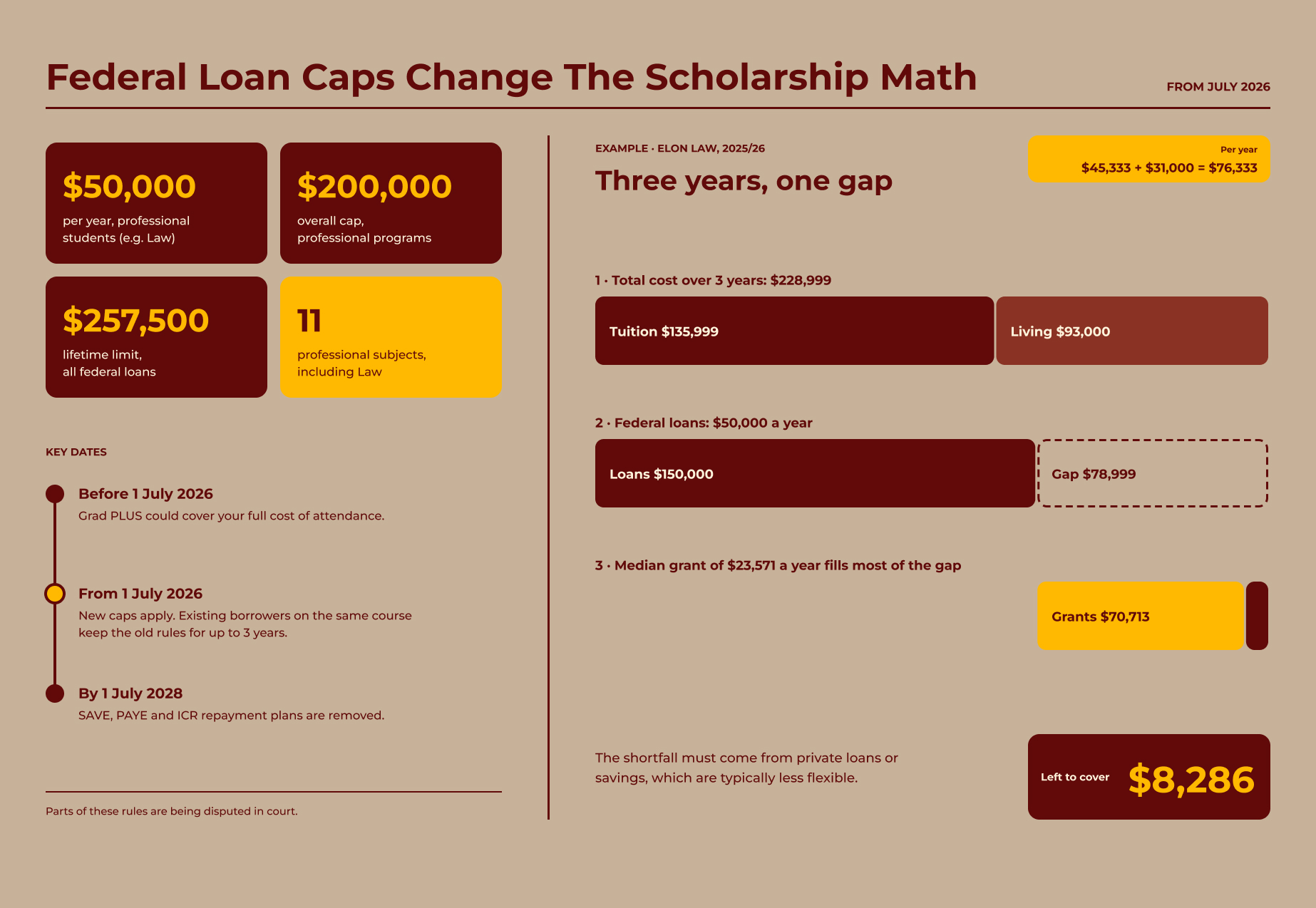
The rules have changed. From July 2026 onwards, Graduate Students and Professional Students cannot borrow their full cost of attendance using Grad PLUS. Prior to July 1st 2026, they were able to do so.
You can borrow the higher professional student amount of $50,000 per year and $200,000 overall if you’re studying one of 11 subjects, including Law. There is also a max loan limit of $257,500 over your lifetime for all Federal Loans.
If you were borrowing before July 1st 2026, you can continue to borrow under the previous rules for up to 3 years. This will only apply to those continuing on the same course. Some parts of these rules are being disputed in court.
So how much will you be able to borrow?
For example, you can look at Elon Law. Their 2025/26 transparency statement shows you have $45,333 in tuition fees and an estimate of $31,000 in living costs. This means you would have a total of $76,333 to pay each year, which is $228,999 over 3 years.
If you take out Federal Loans, you’ll get $50,000 each year. The gap is $78,999. Elon offers a median grant of $23,571 – over 3 years, you’d have $70,713. This still leaves you with a shortfall of roughly $8,286.
This means law school scholarships now help reduce the overall amount you need to pay and fill the gap federal loans can’t. Those who don’t reach the loan limit will need to take out private loans or use savings. These are typically less flexible.
Repayment rules are changing. The SAVE, PAYE, and ICR repayment plans are being removed by July 1st 2028, as per College Aid Pro.
Bar Exam Risk Is Part Of The Financial Plan
A scholarship that comes with a failed bar exam is a bad deal. Bar passage unlocks the salary that pays the debt.
Now students have to look at their plans, as the UBE bar exam has been used for a while with portable scores.
However, the NextGen bar exam started in July 2026. A total of 10 jurisdictions ran this on 28 July and 29 July 2026, with 2,640 people sitting the examination at 16 different locations, as per NCBE press release.
According to UWorld, the first states to run it were Connecticut, Idaho, Maryland, Missouri, Oregon, Washington, and several U.S. territories. However, there were technical issues with the exam in Maryland, Missouri, and Washington on day one.
NCBE later called the early results encouraging, per its September 25 release.
The new exam is 9 hours long and will be rolled out to more jurisdictions until July 2028. The last UBE will be sat in February 2028, and from July 2028 only the NextGen will be available.
Additionally, the passing mark varies depending on the location. For example, Oregon had a passing mark of 615 in July 2026 and 620 after (NCBE jurisdiction table).
To decide if you should pay for it, you will need to consider:
- What exam will your target state be using in the year you graduate?
- How does your school prepare you for this exam?
- Will you still get the award if you have to retake?
This is because a delay in getting your license will mean a delay in your first full paycheck.
Public Service And The Judge Question
Although you won’t earn as much in the public sector, you will incur less debt. Those wishing to go into government or public sectors should have a low debt amount.
Judgeships Often Draw Interest:
Lots of people ask if you need to be a law graduate to become a judge. The U.S. Constitution does not require federal judges to be lawyers, according to Duke’s Judicature. In practice, most are lawyers.
Some states will allow non-lawyers to act as judges in certain lower-level courts. 32 states allow non-lawyers to act as judges in some lower-level courts, according to the National Conference of State Legislatures.
High-Paying Higher-Level State Judgeships
The average and median salary for higher-level state court judges is over $180k in 2024, reports the National Center for State Courts. These positions will generally take years of experience to get to, and therefore having a low debt amount is beneficial.
How To Decide On A Law School Scholarship? Practical Checklist
Checklist:
- Identify the role you want to go into. Ensure the debt amount matches the salary of the role, not the maximum salary for graduates from the school.
- Look up the ABA 509 and NALP for the school. Compare the grant amount, median salary & bar pass rate.
- Calculate the 3 year difference. Add the tuition and living costs. Minus the Federal Loans ($50k per year) and total grant amounts.
- Do a debt servicing check. Try and ensure the amount you are paying is something you can afford on the low peak salary.
- Conditions: Ask whether the scholarship can shrink
- Negotiate: If there is an alternative offer, negotiate. Use the grant differences to help you.
- Plan for the Bar: Ensure you know what exam you will be taking in your state and how the school will help you prepare.
Key Takeaway
The data that we have presented in this case study shows that the path is rather plain if you have a clearer idea of the nitty-gritty.
- Ranking will give you an indication of the salary you’re likely to be earning.
- Price will show you how much of a percentage you’ll be paying back.
- Even a Tier 1 school with a small award can provide a manageable debt.
- A Tier 3 school with high aid can surely beat this.
- A Tier 3 school with high debt and a $90k salary will leave very little room.
So, the best way to get the most out of your law school scholarship is to have a specific plan. Identify the role you want to go into. Check the real numbers for the school. Do the debt-servicing check. And then decide.
Disclaimer:
This article gives general information. It is not legal or financial advice. Check every figure against each school's current ABA disclosure and the federal student aid site before you commit.
Sources:
- U.S. News law school salary-to-debt data, as reported by WTOP (updated July 21, 2026)
- NALP Bulletin+, September 2025 (Class of 2024 salary findings)
- LawHub (LSAC), job outcomes and salaries
- National Jurist, HEA Group and Student Defense debt-to-income study
- Katalyst Prep, analysis of 2025 ABA Standard 509 grant data
- ABA Standard 509 reports: Creighton, Tulsa, Harvard
- LSAT Lab, ABA 509 summaries for Harvard, Howard and Elon
- Harvard Law School JD Class of 2028 profile
- Yale Law School class profile
- LSD, Howard Law 2025 ABA data
- ETS, federal student loan changes 2026
- States Newsroom via KCUR, July 1 loan changes
- University of Washington Student Financial Aid, 2026-27 loan updates
- College Aid Pro, Grad PLUS elimination summary
- NCBE press releases on the NextGen UBE, July 31
- NCBE press releases on the NextGen UBE, September 25, 2026
- The Bar Examiner, NextGen transition
- NCBE help center, NextGen jurisdiction table
- UWorld Legal, NextGen UBE dates
- Manhattan Review, LSAT sections
- Magoosh, new LSAT format
- Legal News, ABA council vote on Standards 501 and 503
- The Daily Pennsylvanian, ABA testing vote
- Vanderbilt Law employment data
- Michigan Law employment statistics
- Duke Judicature, judicial qualifications
- National Conference of State Legislatures, non-lawyer judges
- ABA Journal, “Judges Without JDs”
- BARBRI, scholarship vs. prestige
- JD Journal, NALP Class of 2024 summary
Method Note: Debt-service figures, the Elon funding gap and the $54,000 negotiation estimate are original calculations from the cited inputs. They are illustrations, not predictions.
Leave A Reply





Which Programs Allow Alternative Admissions Metrics? [The Test-Optional Law School Trend]
Read More
How To Structure The New LSAT Writing Sample Under Time Constraints
Read More
Skills vs. Memorization: Why The LSAT Fails Rote Learners And How The Curve Works
Read More
How To Study For The LSAT? The Exact Study Protocol Used By Top LSAT Test-Takers
Read More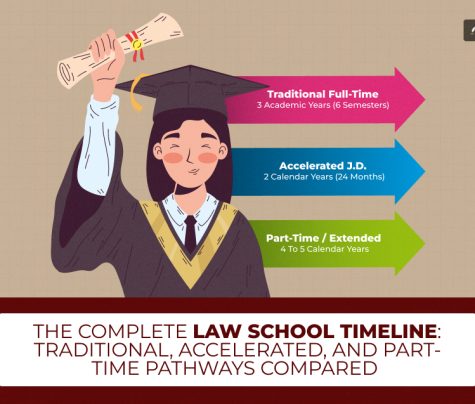
The Complete Law School Timeline: Traditional, Accelerated, And Part-Time Pathways Compared
Read More
0 Reply
No comments yet.