Summarize using AI





Prompt copied. Paste it into Gemini.
Quick Answer
Work hard to win your personal injury case by proving the defendant’s liability with solid scene evidence, pulling together long histories of your medical records, and monitoring all of your financial losses. Do not accept premature insurance lowball offers, and negotiate following your maximum medical recovery.
Knowing how to win your personal injury claim gives you power and the ability to obtain the reparations due to you. Physical injury leaves lasting effects that alter life dramatically.
The legal process you engage in immediately after the accident determines your future financial and medical security. Insurance companies operate under a financial model that lets them deny as many injury claims as possible.
A strategic, well-organized legal campaign counteracts corporate maneuvering and wins compensation.
Seeking the expertise of a Richmond personal injury lawyer enables you to secure competent legal representation and win your injury claim.
Understanding The Legal Burden Of Proof
Learning to prove negligence and legal fault under U.S. civil law is crucial in achieving compensation.
The burden of proof always falls on the plaintiff. To win your injury claim, you must prove the defendant owed you legal responsibility.
Proving Negligence And Liability
Proving legal negligence requires you to establish a factual and legally sufficient connection between the defendant’s actions and injury. The burden of proof remains with you throughout the litigation process.
In a motor vehicle accident case, for example, prove that the other driver broke the speed limit or used a cellphone at the time of the accident.
If you slipped on a wet floor, establish that the building’s management knew about the hazard and failed to address it.
Documenting The Full Scope Of Damages
Establish every element comprising damages that apply to your injury. Proving damages requires you to itemize all economic and non-economic losses you experienced because of the incident.
Categorize all losses as either economic or non-economic damages. Your pain and suffering fall under the category of non-economic loss. Economic damages include all forms of out-of-pocket expenses.
Create a comprehensive list of all physical therapy bills, loss of income or employment, and medical treatment costs.
How To Win Your Personal Injury Claim Through Evidence
Physical evidence and factual information dominate the personal injury litigation landscape. Insurance professionals routinely disregard accident testimonials from claimants.
The presence of voluminous documentary evidence becomes decisive and can force settlements.
Gathering Immediate Scene Evidence
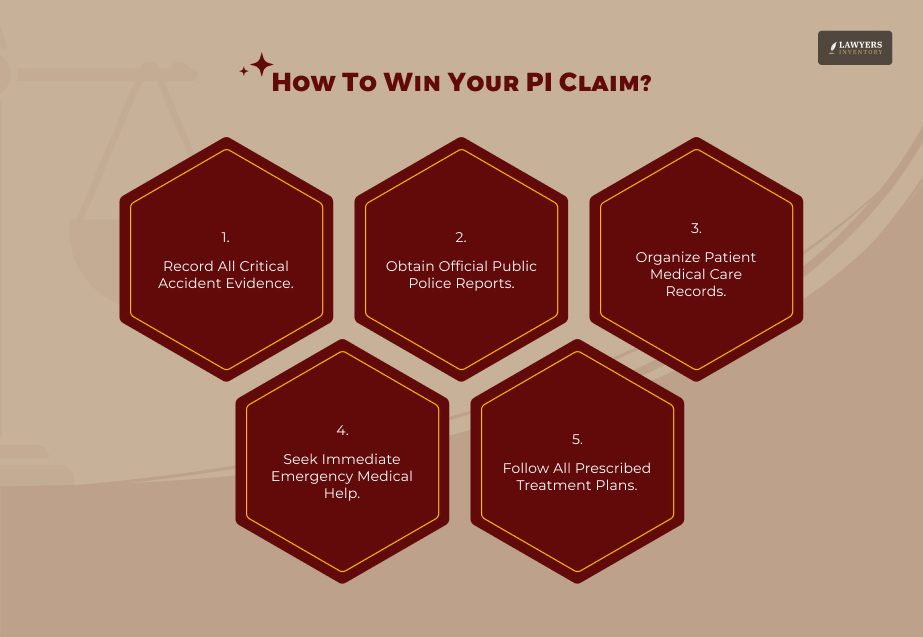
Photo-document the accident scene by taking pictures and recording videos of damaged vehicles and the road conditions.
Capture photographs of missing road signs or any other road hazards. Collect eyewitness contact information from bystanders who witnessed the accident.
Securing Official Public Records
Leverage access to public databases and documents to obtain objective information. Report the accident to the relevant authorities immediately.
Notify the police department of a car accident so that they can generate police reports. File an incident report if you sustained injury at a place of business or while visiting a public facility.
Police offer investigative resources such as emergency response dispatch records and body cam videos. Accessing dashcam or bodycam footage can yield incriminating visuals of the defendant’s reckless driving.
Managing Medical Care And Treatment Records
Organize medical records pertinent to the accident.
Medical documentation becomes the most crucial category of documents in your evidentiary arsenal. During litigation, the opposing counsel actively seeks ways to minimize financial liability.
Your failure to provide extensive post-accident treatment records creates openings for arguing that your injuries were not severe.
Seeking Immediate Medical Evaluation
Schedule a medical evaluation immediately after the incident. Even if you feel well after the accident, it is advisable to seek emergency room evaluation.
Leave no stone unturned in your quest to obtain a comprehensive diagnosis and treatment. Minor injuries often conceal mild head trauma, internal bruising, or whiplash.
Following Prescribed Treatment Plans
A physician provides you with the appropriate medication and recommends a course of physical therapy exercises for rehabilitation. Stick to the treatment regimen by attending all physical therapy sessions.
Physician’s directives become legal obligations. The insurance adjuster expects you to report directly to the emergency room.
If you fail to appear for a recommended physician visit, they assume that you are not seriously injured. Show up wherever the recommended post-accident treatment plan directs you.
How Does Personal Injury Claims Process Work?
Insurance principles dictate that the instant the adjuster accepts your injury claim, the company creates an internal budget called a reserve for the anticipated payout.
Understanding the relationship between your personal injury claim and reserve helps you obtain fair compensation.
Explaining How Reserve Windows Impact Insurance Settlement Offers
An insurance company creates an estimated budget for your injury claim. By default, the adjusting professional determines the amount of the initial estimate.
After considering your initial treatment costs and reviewing police reports, insurance professionals determine your reserve window.
The insurance company utilizes the budget to control litigation expenses. The corporation employs cost-control measures if the payout exceeds the initial reserve.
Insurance Professionals Receive Pressure After Setting A Reserve Window For A Claim
A company’s ability to keep the payout within the projected budget defines the adjuster’s job performance.
Insurance professionals become hesitant to increase the budget after determining the initial reserve.
A company uses various mechanisms to compel the adjuster to keep the payout within the budget.
Force The Adjuster To Accept Your Demand By Providing Earlier Proof Of Expenses
Provide copies of diagnostic test results from approved specialists and any accrued treatment costs as early as possible.
Submit all pertinent financial information to the insurance company to prevent them from denying further treatment expenses.
Such information enables the adjuster to determine the exact amount of compensation to award.
Impacts Of Medical Lingo Legal Documents On Subsequent Treatment
The primary contributing factor to denied or low personal injury settlements involves victims failing to seek compensation for future treatment.
Most accident victims submit claims containing extensive detail concerning past treatment.
At the same time, insufficient information regarding anticipated future treatment costs appears in the documents.
Interpreting A Physician’s Notes For The Injury Litigation
When you submit a medical document, adjusters disregard statements regarding the patient’s expected needs.
Instead, they utilize medical terminology associated with treatment to assess the nature and severity of the injury.
Discuss with the physician of your choice how they assess the connection between the diagnosed condition and the accident.
Requesting specific language to describe the injury aids the legal team in obtaining substantial compensation.
Specific Medical Documentation Requirements
The medical documents should explicitly reveal whether the injury resulted in permanent impairment.
The file must include a physician’s directives indicating the specific treatment regimen.
Further, the documents should illustrate the need for repetitive surgery, injections, or radiation.
Establish The Connection Between The Injury And Loss Of Employment
After your physician confirms that you cannot physically or mentally perform your previous occupation, you must connect the injury to reduced earnings.
Combine medical documents with economic reports. Calculating the percentage of reduced earning capacity enables you to obtain the compensation you deserve.
Settlement Negotiations – How To Negotiate a Fair Payout
Insurance companies settle most personal injury cases amicably instead of engaging in litigation. Settlements empower you to maintain control of the process.
A patient’s best course of action involves rejecting an unsatisfactory early payout and requesting the release of personal health records.
The low-ball settlement offer limits your ability to pursue justice. Reject the initial settlement payment and obtain a formal demand letter from your legal representative.
Wait until you have achieved maximum medical improvement (MMI) before submitting a demand. MMI means your condition has stabilized as much as possible.
The medical professional indicates when you enter the MMI stage, when you experience little or minimal improvement in your condition.
After the MMI, a medical professional evaluates whether additional treatment will improve your health. At this point, the physician generates a formal medical report.
Your legal team utilizes the documents to build a strong case against the defendant. A demand letter gives the defendant an ultimatum to accept your settlement proposal.The insurance company views the threat of a lawsuit with a demand letter as credible and may alter its position.
Leave A Reply







Most Popular Yet Weirdest Lawsuits In The Past 5 Years
Read More
Crypto Casino: The Future Of Online Gaming With Digital Currency
Read More
What Role Does Medical Evidence Play in a Strong Car Accident Claim?
Read More
0 Reply
No comments yet.