
Summarize using AI





Prompt copied. Paste it into Gemini.
Quick Answer

The key federal features of Indian Constitution include dual government at the central and state levels, a written and supreme constitution, division of legislative powers through the Seventh Schedule, bicameralism, a rigid amendment process for federal provisions, and an independent judiciary.
As a close analyst of constitutional jurisprudence and a frequent reviewer of expert commentary in this field, I find few topics spark as much intellectual debate as the true structural nature of the Indian polity.
Legal scholars worldwide continually re-evaluate whether India fits into the traditional mold of a federal state.
When analyzing the text of the Constitution of India, a striking paradox emerges right from the first page.
Article 1 explicitly states that India is a “Union of States,” deliberately avoiding the word “Federation.” To understand this deliberate semantic choice, we must dissect the formal federal framework alongside its inherent structural variations.
Federal Features Of Indian Constitution At A Glance
For those seeking immediate legal clarity on this structure, the entire framework can be synthesized into three foundational principles:
- Quasi-Federal Framework: Legal experts have classified India as an “almost federative” system – a blend of a solid federal structure with also a dominant, centralized unitary spirit.
- 7th Schedule Standard: Power is clearly divided by the Seventh Schedule, leaving the Union, State, and Concurrent Lists to define the scope of operation of each arm.
- Basic Structure Doctrine: Based on the Supreme Court of India, federalism is part of the unchangeable constitutional “basic Structure.” And that means it cannot be removed or amended by legislation.
Core Federal Features Of Indian Constitution
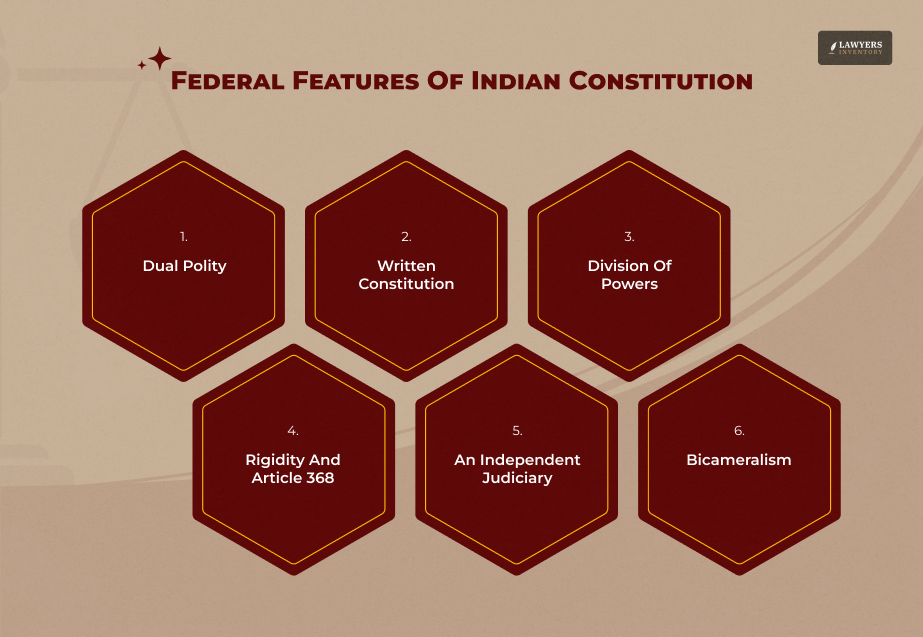
To accurately assess the system, we must examine the tangible features that firmly anchor the Indian Constitution within federal theory.
In my assessments of expert analyses, six structural characteristics stand out as incontrovertible proof of India’s federal design.
1. Dual Polity
The Constitution does not establish a single, monolithic command structure.
Instead, it creates a dual polity consisting of the Union Government at the center and State Governments at the periphery.
Each tier is equipped with sovereign powers to be exercised within its constitutionally demarcated sphere.
2. A Written And Supreme Constitution
A federal system cannot survive on mere administrative understandings. The Indian Constitution is a meticulously codified document. More importantly, it maintains absolute supremacy.
Every executive action and legislative enactment – whether passed by the central Parliament or a state assembly – must conform to its text. If a law violates this supreme code, it is struck down.
3. Division Of Powers Via The Seventh Schedule
True federalism requires clear boundaries. The Seventh Schedule precisely executes this by establishing three distinct legislative tracks:
- The Union List: Contains subjects of national importance like defense, foreign affairs, and banking.
- The State List: Houses regional priorities such as public order, police, and public health.
- The Concurrent List: Covers shared domains like education and marriage, where both tiers can legislate.
4. Rigidity And Article 368
If the central government could unilaterally alter the rules of engagement, federalism would be an illusion.
Under Article 368, amendments that alter the federal core require a rigid, multi-layered process.
They demand not only a special majority in Parliament but also formal ratification by at least half of the state legislatures.
5. An Independent Judiciary
In any dual-government setup, territorial disputes are inevitable.
The Constitution resolves this by establishing an independent judiciary with the Supreme Court serving as the ultimate arbiter.
Under its original jurisdiction, the apex court resolves direct legal battles between the central government and the states.
6. Bicameralism
The composition of the Indian Parliament is in line with the standard federal provision of having a bicameral legislature.
First, the members of the Lok Sabha are elected directly by the people of India; But, the Rajya Sabha is known as the Council of States.
This is something that ensures that the views and needs of the various regions are taken into account at the stage of central legislation.
What Makes The Indian Constitution Unitary?
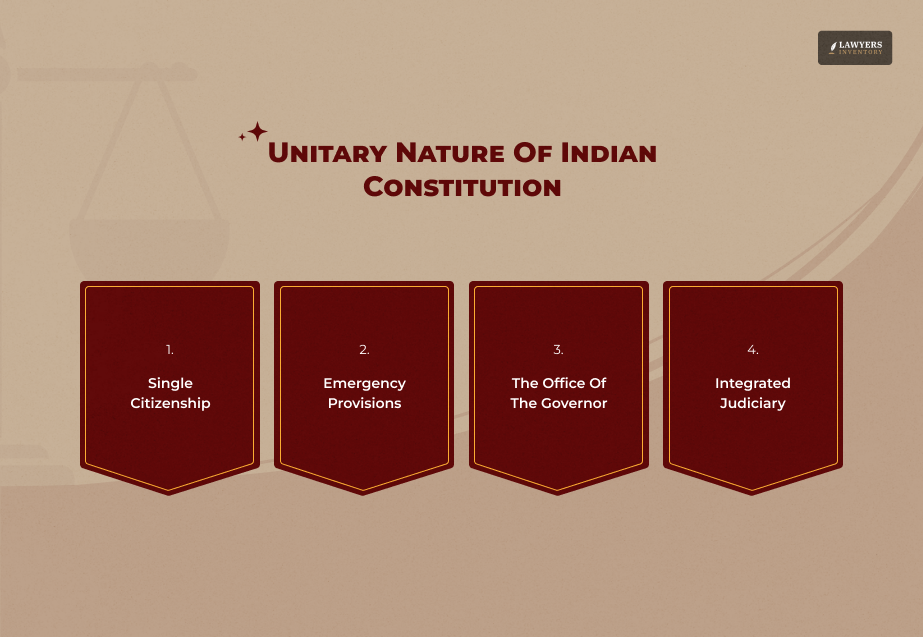
While the features above form a classic federal blueprint, my analysis of expert consensus reveals that the system intentionally leans toward a strong center.
Many scholars agree with Professor K.C. Wheare’s famous designation of India as a “quasi-federal” state. This centralizing bias manifests through several distinct constitutional mechanisms:
Single Citizenship:
Unlike the United States, where citizens owe allegiance to both their specific state and the federal government, India recognizes only a single, overarching national citizenship.
Emergency Provisions:
Under Articles 352, 356, and 360, the President can declare emergencies that radically alter the system. During these periods, the federal structure can be legally suspended, temporarily granting the center sweeping unitary control over state administrations.
The Office of the Governor:
Appointed directly by the President, the Governor functions as a central representative within the state. This position can lead to significant friction when a Governor stalls state bills or recommends the imposition of President’s Rule.
Integrated Judiciary:
While the legislative power is divided, the judicial system remains completely unified.
Indeed, a single hierarchy of courts – from local magistrates up to the Supreme Court – enforces both central and state laws uniformly across the country.
A great example of this particular feature would be the landmark case of State of Punjab v. Tehal Singh (2002). [Source: CaseMine]
Core Concepts Of The Federal Features Of Indian Constitution

Residuary Powers: The authority to legislate on matters or areas not included explicitly in or covered by the Seventh Schedule. In India, these powers lie only in the central Parliament, exclusively.

Cooperative Federalism: The central governing philosophy which involves both the central and the state governments in implementing national programs, policies, etc., not as strictly separate competing institutions.

Asymmetric Federalism: Basically refers to an adjustment or flexibility of the federal structures such that particular states are granted special constitutional rights or autonomous powers based on distinct historical/cultural needs.
Judicial Boundary Markers: Vital Precedents
The true operational boundaries of Indian federalism are defined by judicial interpretation. Two landmark Supreme Court judgments serve as essential guideposts for evaluating how these boundaries function in practice.
| Landmark Judicial Rulings | Core Legal Outcomes And Federal Impact |
| S.R. Bommai v. Union of India (1994) | • Explicitly declared federalism to be a part of the unamendable Basic Structure Doctrine. • Made the central imposition of President’s Rule (Article 356) subject to strict judicial review. • Mandated that a state ministry’s majority must be tested openly via a parliamentary floor test, limiting arbitrary central dismissals. |
| Govt. of NCT of Delhi v. Union of India (2023) | • Evaluated the unique constitutional status of Delhi as a Union Territory with an elected assembly. • Confirmed that the elected Delhi government holds administrative control over civil services (except public order, police, and land). • Reaffirmed that democratic accountability and the representative will of the states/territories are essential components of federal governance. |
Modern Friction Points In Contemporary Federalism
Looking at how these laws apply today, Indian federalism is a continuously evolving political reality. Modern debates center less on constitutional text and more on fiscal and administrative friction points.
Fiscal Federalism And The GST Council
The introduction of the Goods and Services Tax (GST) fundamentally reshaped state finances.
By pooling indirect taxation powers into a singular, nationwide GST Council, states surrendered significant fiscal autonomy in exchange for a unified market.
Managing delays in state compensation allocations remains a frequent point of friction in contemporary fiscal discussions.
The Struggle For Regional Autonomy
The current administrative disagreements between Union Territories and representatives of the center emphasize the fragile balance of asymmetric federal arrangement.
The struggle over constitutional power, as revealed with the NCT of Delhi, indicates an ongoing structural problem: reconciling local democratic will with the central government’s operational necessities.
Leave A Reply







Do You Pay Taxes On Lawsuit Settlements? IRC Section 104 Explained
Read More
Non-Disparagement Clause Explained: Requirements, Enforceability, And What Changed Recently
Read More
Best Practices For Successful Trademark Registration
Read More
Understanding Your Rights: A Guide To The Legal Process
Read More
How To Clear A Bench Warrant Without Going To Jail: A Legal Guide
Read More
1 Reply
Is Gerrymandering Legal? What Latest Ruling Means for States
August 24, 2026 at 2:07 pm
[…] The commission follows the Delimitation Act of 2002. It also follows Articles 82 and 170 of the Indian Constitution. [Source: Indian […]
Reply