Summarize using AI





Prompt copied. Paste it into Gemini.
Listen to this article
Quick Answer

You can get a DUI on a bicycle only if specific legislative conditions exist in your state. In these jurisdictions, the law defines a human-powered bicycle as a "vehicle." This classification allows police to charge impaired cyclists with a standard DUI without exceptions. A conviction will end up on your permanent criminal record. Furthermore, the state can suspend your driver's license. Finally, this criminal conviction can restrict your international travel in the future.
Cycling while intoxicated triggers severe legal problems. Yet, many riders mistakenly believe that riding a bicycle protects them from criminal prosecution. So, can you get a DUI on a bike?
The answer depends entirely on your state’s laws. The legal landscape remains fragmented because states independently define what qualifies as a “vehicle.”
Some jurisdictions integrate bicycles directly into their standard traffic codes. In these areas, intoxicated riders face traditional DUI charges.
Other states do not recognize bicycles as motor vehicles. Instead, these jurisdictions penalize drunk cyclists through specialized bicycle ordinances, general public drunkenness laws, or public intoxication infractions.
Ignoring these legal boundaries can carry heavy consequences. A conviction can quickly jeopardize your driver’s license, ruin your financial stability, and create a permanent criminal record.
The Constitutional And Statutory Core: What Counts As A Vehicle?
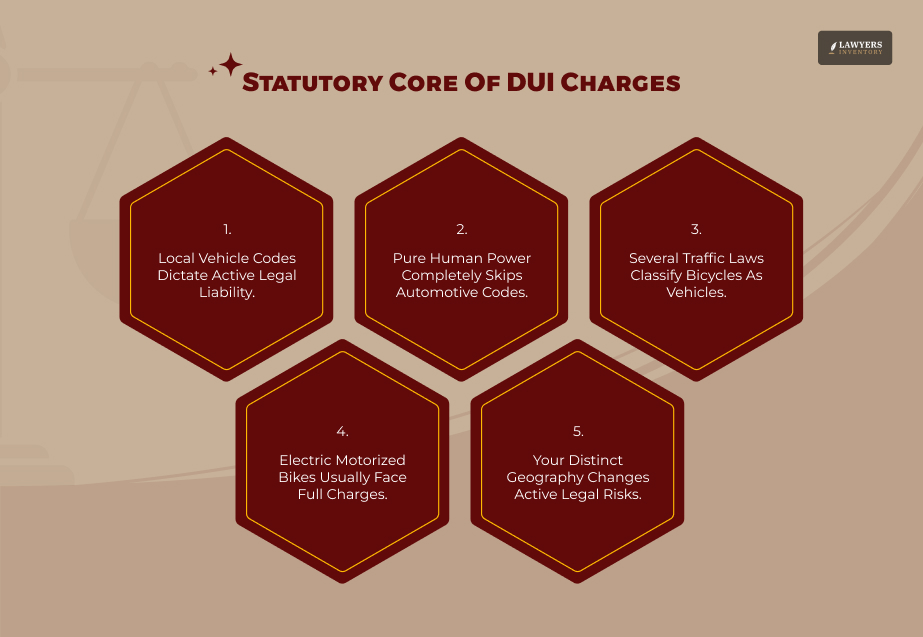
State codes dictate if you face criminal charges for cycling drunk. Traditional DUI laws target “motor vehicles.” Because of this, human-powered bicycles remain exempt in states with strict motor requirements.
However, many states now define traditional bicycles as “vehicles.” Cyclists in these areas have the same responsibilities as drivers. They must obey identical blood alcohol concentration limits and face standard traffic stops.
Electric bikes and motorized scooters further complicate your legal liability. Intoxicated e-bike riders frequently face full motor vehicle DUI charges, even where regular bikes are exempt. Courts view mechanical motors as severe hazards to public safety.
States Excluding Traditional Bicycles From DUI Laws
Several states maintain clear boundaries between motor vehicle codes and human-powered devices.
For example, the Illinois Vehicle Code explicitly excludes traditional bicycles, and any other transportation devices moved solely by human power, from its core DUI prosecutions.
Similarly, New York State Vehicle and Traffic Law dictates that prosecutors cannot charge an individual riding a traditional bicycle with a standard DUI, as the charge requires a motor vehicle.
Virginia law aligns with this approach, explicitly defining a motor vehicle as a machine powered by an internal engine or train system, thereby exempting standard cyclists from its strict DUI penalty tiers.
Jurisdictions With Broader Vehicle Classifications
In several states, the difference between a car and a bicycle is considered not very different in legal terms for the state. Colorado law states that a vehicle is any wheeled device used for the transportation of people or goods.
Based on this, bicycles, e-bikes, and electric scooters are under the law’s DUI provisions. Florida and Oregon also adopt the same approach, giving cyclists the same obligations as drivers.
Like that, in Georgia, DUI law applies to any moving vehicle, so an impaired rider has no option but to follow DUI provisions.
Evaluating Dedicated Drunk Biking Statutes And Alternative Charges: Can You Get A DUI On A Bike?
Cyclists can still face criminal charges even if their states do not outlaw drunk biking. As per the information available on Law Info, police officers use alternative laws to punish intoxicated riders.
Prosecutors rely on different legal avenues when states lack separate bicycle DUI laws. They frequently utilize public order offenses. These charges preserve peace and safety on streets and public walkways.
The penalties are usually less severe than standard motor vehicle violations. However, these offenses still create a permanent criminal record.
Specialized Vehicle Code Provisions
California is mainly taken as an example of a state that has implemented a dedicated and separate law on bicycle riding.
California Vehicle Code Section 21200.5 defines it as an explicit crime to operate a bicycle on any public way or street under the influence of alcohol or drugs. [Source: FindLaw]
The maximum fine that this specific law allows is $250. But at the same time, such a law is quite forgiving. That is because, as per Griffin Law Office, it does not include severe jail sentences or loss of licenses, which are part of standard automobile DUI convictions.
Public Intoxication And Disorderly Conduct
If an officer encounters an impaired cyclist in a state with strict vehicle exclusions, the cyclist can be arrested for public intoxication or disorderly conduct.
These charges center on the individual becoming a clear danger to themselves or others within a public space.
Reckless driving citations are also frequently issued if the cyclist’s erratic movements force oncoming cars to swerve or create an immediate threat of property damage.
Legal Standards, Chemical Testing, And The Implied Consent Conflict
Law enforcement applies strict criteria to build a legal case against an impaired cyclist. Unlike automotive DUI laws, most jurisdictions do not enforce a ‘per se’ 0.08% Blood Alcohol Concentration (BAC) limit for traditional bicycles.
Instead, a chemical test reading is merely supporting evidence. The state prosecutor must present concrete proof of actual physical or mental impairment to secure a conviction.
Officers begin their field verification by administering Standardized Field Sobriety Tests, reports Super Lawyers.
During these exercises, the officer detects alcohol-induced impairment through physical signs. They look for specific indicators, such as erratic eye movement (nystagmus) or a loss of balance during the walk-and-turn test.
However, implied consent rules present a complex constitutional hurdle for cyclists. The consequences of refusing a breathalyzer or blood test depend entirely on how your state defines a “vehicle.”
In states like Pennsylvania, the implied consent statute covers any generic “vehicle.” Refusing a roadside test in these jurisdictions automatically triggers a one-year driver’s license suspension, matching the penalty for motorists.
Conversely, many states explicitly restrict implied consent laws to “motor vehicles.”
In those jurisdictions – including Florida, Maryland, and even California under the recent ruling in Beale v. DMV (2026) – the law exempts traditional and electric bicycles from implied consent suspensions.
Refusing a chemical test on a bicycle in those states will not trigger an automatic driver’s license suspension.
Penalties, License Suspensions, And Long-Term Record Implications
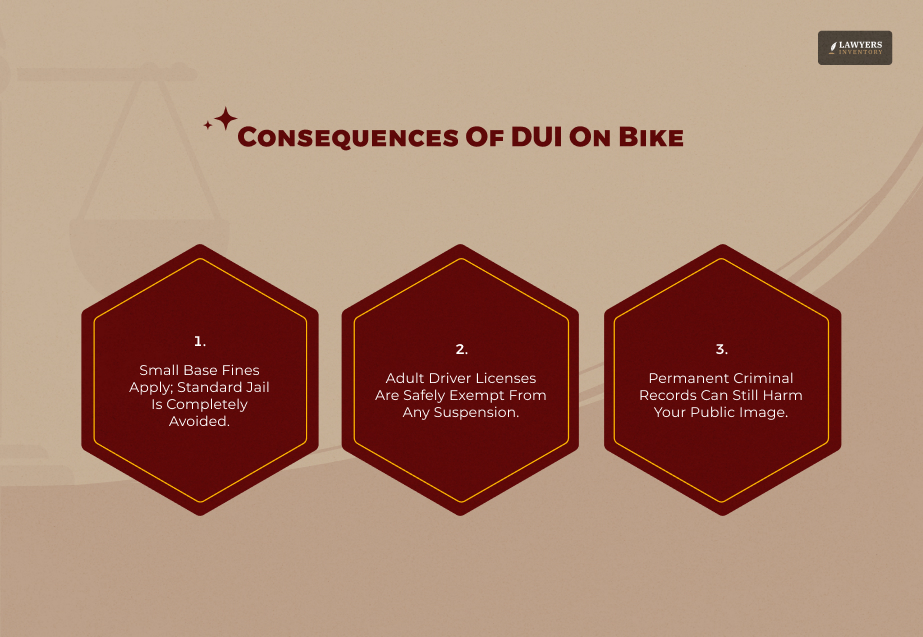
Impaired cycling punishments vary wildly by location. Lenient states with standalone bicycle laws limit penalties to minor misdemeanor fines.
Conversely, strict vehicle-integration states punish drinking and biking as severely as driving a car under the influence.
In these strict regions, the court can suspend your standard driver’s license. Judges can also force you to install an ignition interlock device on your personal automobile.
Furthermore, pleading guilty creates a permanent criminal record. Standard background checks will display this conviction.
This formal DUI record can severely damage your employment options, visa applications, and international travel approvals.
Strategic Defenses: How Legal Counsel Challenges Bike DUI Charges
If you are facing an active prosecution for a bicycle-based DUI or alternative intoxication charge, securing specialized legal representation is essential.
Experienced defense attorneys rely on distinct procedural and constitutional challenges to systematically dismantle the state’s case.
Because bicycle stops often lack the structured evidence typical of automotive investigations, these charges frequently have unique legal vulnerabilities.
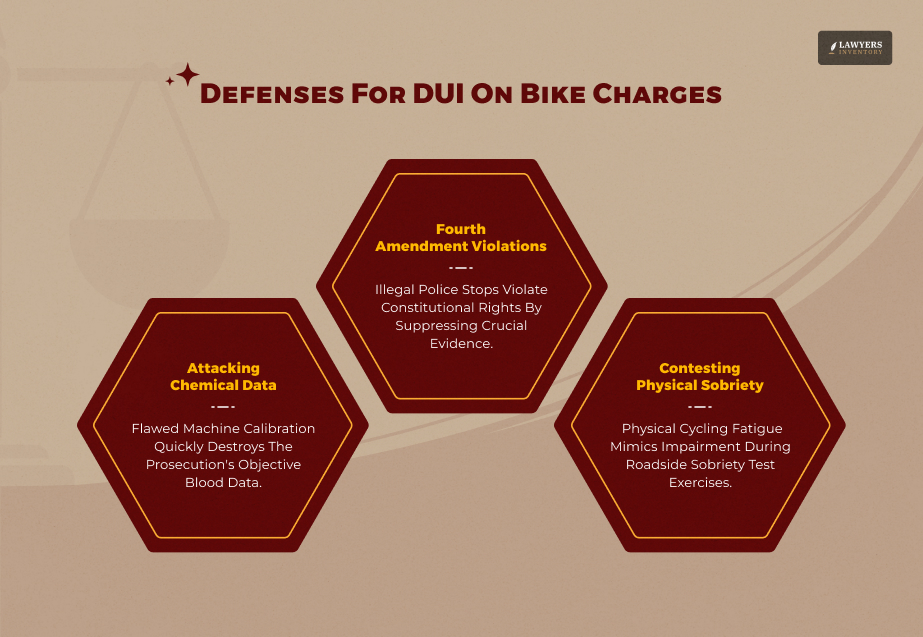
Challenging The Legality Of The Initial Stop:
According to the National DUI Authority, the Fourth Amendment of the U.S. Constitution strictly regulates police encounters.
To justify a temporary investigative stop, officers must possess a reasonable, articulable suspicion – backed by specific facts – that a traffic violation or criminal offense has occurred.
I have covered more on this in my previous article on reasonable suspicion vs probable cause. You can check that out for better clarity.
Defense lawyers can challenge these stops in court. A lawyer might prove that law enforcement relied purely on guesswork or profiling rather than actual evidence of a crime.
Under the exclusionary rule, the court will then step in. The judge will exclude all evidence that stems from that illegal stop, preventing the prosecutor from using it at trial.
Contesting Field Sobriety Test Validity:
Standardized field sobriety tests are scientifically validated exclusively for individuals operating motor vehicles on flat surfaces.
A defense lawyer can successfully argue that physical exhaustion from cycling, uneven road topography, or stiff cycling footwear artificially inflated the officer’s indicators of physical impairment.
Attacking Chemical Calibration And Sample Preservation:
Breathalyzers and blood analysis instrumentation require precise, routine maintenance and calibration to remain admissible in court.Legal counsel will carefully audit logbooks, machine error codes, and sample preservation chains to uncover flaws that can render the state’s BAC data completely unreliable.
Leave A Reply






Do You Pay Taxes On Lawsuit Settlements? IRC Section 104 Explained
Read More
Non-Disparagement Clause Explained: Requirements, Enforceability, And What Changed Recently
Read More
Best Practices For Successful Trademark Registration
Read More
Understanding Your Rights: A Guide To The Legal Process
Read More
How To Clear A Bench Warrant Without Going To Jail: A Legal Guide
Read More
0 Reply
No comments yet.