Summarize using AI





Prompt copied. Paste it into Gemini.
Quick Answer: What Is An Operating Agreement

An operating agreement is the internal legal document that decides how a Limited Liability Company (LLC) is owned, managed, and operated. It sets out each member's ownership percentage, capital contributions, voting rights, profit and loss distribution, and what occurs if a member leaves, dies, or the business dissolves. Only five states: California, Delaware, Maine, Missouri, and New York, where you legally require LLCs to adopt one. No state requires you to file it with the Secretary of State; it stays an internal record between the members. Without one, state default rules govern the LLC instead, and those rules ae not written with your business in mind.
Most people forming an LLC focus on the Articles of Organization, the document the state requires to create the company.
They treat the operating agreement as an afterthought, or skip it entirely. That is a mistake. The Articles of Organization tell the state your LLC exists.
The operating agreement tells everyone else. This includes your co-owners, your bank, a court, and eventually maybe a judge, and how it actually runs.
Read this article to find out what is an Operating Agreement and how exactly it works to protect your business and ownership.
The Legal Foundation: Why This Document Exists At All
An LLC is a hybrid entity which derives its characteristic features from corporations and partnerships.
Whereas the former provides strong liability shielding for its shareholders, the latter allows a flexible, pass-through taxation scheme.
Unlike a corporation, which follows a well-defined statutory structure of shareholders, a board of directors, and officers, an LLC lacks a substantial default structure.
Instead, state LLC statutes provide a general default framework.
For an LLC without an operating agreement, the state’s default statutory provisions apply to issues such as profit distribution, the LLC’s binding nature, and member withdrawal.
These rules reflect general norms and rarely reflect the specific needs of an enterprise or a group of business owners.
Moreover, they are not susceptible to reinterpretation based on an alternative default rule.
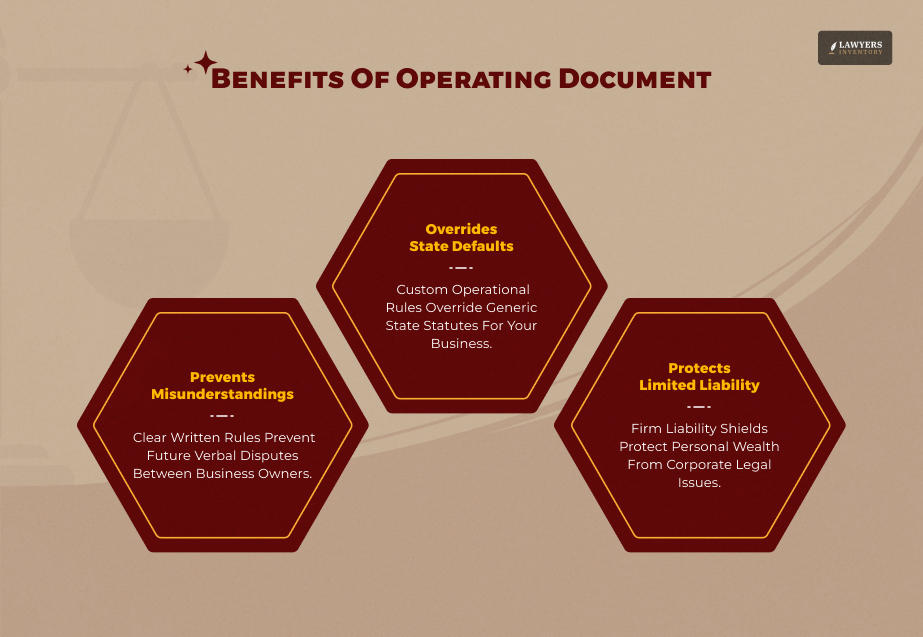
An operating agreement, by contrast, lets members tailor these default provisions to their expectations.
Is An Operating Agreement Legally Required?
The answer depends on the state in which an LLC is formed.
Thus, whereas the majority of states do not require such an agreement, there are five states that have a statutory requirement for such an agreement:
- California: This is required under Cal. Corp. Code §§17701.02 and 17701.10; oral or written
- New York: This state requires it under NY LLC Law §417 and is the only state that specifically requires a written agreement adopted within 90 days of filing
- Missouri: This state required under Mo. Rev. Stat. §347.081
- Maine: This state required under 31 M.R.S.A. §1521, adoptable before, during, or after formation
- Delaware: Finally, this state is often cited as a fifth, since the Delaware LLC Act formally defines an operating agreement and permits it to be adopted “before, after, or at the time of” formation.
Even though its statute is arguably more permissive than a hard requirement.
In any case, even in the five states mentioned above, an operating agreement is not filed with the state, though it is an internal company record.
In most of these states, an oral or implied agreement technically satisfies the requirement, except New York, which requires it to be in writing.
Moreover, in all other states, including large states including Texas and Florida, there is no legal requirement.
This does not mean it is optional. It just means that the state does not hold you accountable if you do not have one.
What Is An LLC Operating Agreement?
Stripping away the legal aspects, an LLC operating agreement is a private contract among the company’s members.
This document proves business ownership, exact equity percentages, initial start-up investments, key decision-makers, and profit distribution rules.
Courts typically view it as primary evidence of how the founders intended to run the LLC.
When members disagree on a decision, or a dispute ends up in litigation, a judge will first check the operating agreement before falling back on the default statute of the state.
What Is An Operating Agreement For An LLC, In Practice?
In practice, operating agreements answer the questions that members don’t think of asking until it’s too late:
- What happens if one partner stops contributing?
- Can a member sell their stake to an outsider without the others’ consent?
- What happens to the business when a member dies, gets divorced, or files for bankruptcy?
- Who has the authority to sign a lease or take out a loan in the company’s name?
Without written answers to these questions, members end up arguing over what they assumed, while the court falls back on whatever generic rule the state statute provides.
What A Well-Drafted Operating Agreement Actually Covers
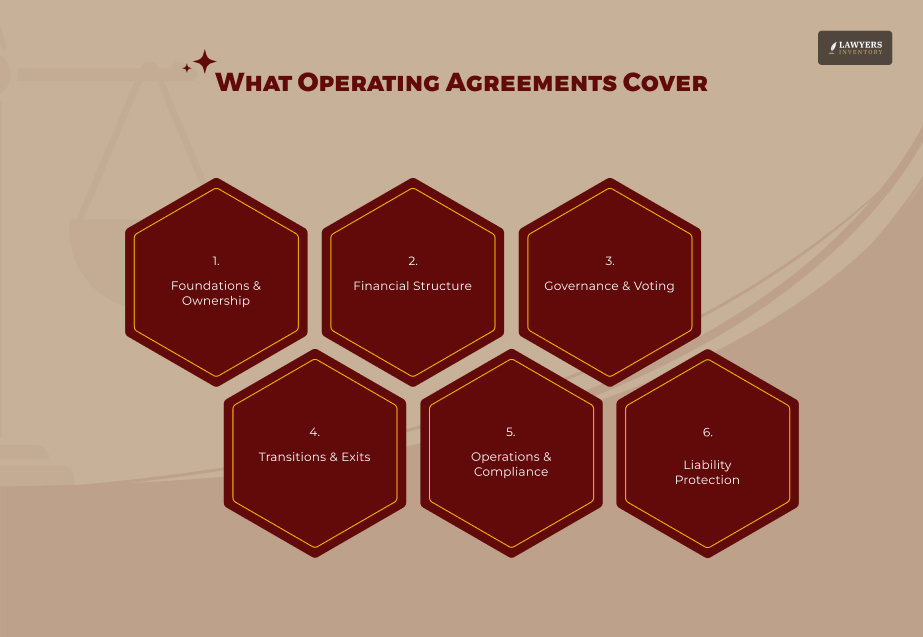
An effective LLC operating agreement must address twelve core areas to keep control in one’s hands.
If you exclude any of these, a state judge or statute will dictate your business rules:
Foundations & Ownership
This includes the company name, the agreement’s effective date, and the company’s registered agent, along with all members’ names and exact ownership percentages.
Financial Structure
This includes initial capital contributions (in cash, property, or services) and future funding rules. This explicitly defines how profits and losses are allocated.
Governance & Voting
This chooses a member-managed or manager-managed structure and defines voting thresholds for decisions and deadlock-resolution mechanisms.
Transitions & Exits
This sets strict transfer restrictions and rights of first refusal, as well as clear protocols for member withdrawal or company dissolution.
Operations & Compliance
This defines record-keeping requirements, tax elections (partnership, S-corp, or C-corp), and procedures for amending the agreement itself.
Liability Protection
This includes indemnification clauses to protect managers and members from personal liability in the course of routine, good-faith operations.
Leaving out any of these points means the law dictates the rules for your business.
Do Single-Member LLCs Need One?
Yes, and this is one of the most common omissions. An owner might even think that there is nobody to sign a contract with.
However, an operating agreement for a single-member LLC still has a very critical function.
This document provides solid proof that your LLC operates as a separate legal entity, independent of your personal life and finances.
Courts and creditors sometimes try to pierce the corporate mold and hold an LLC owner personally liable for the LLC’s debts.
Moreover, they argue that the business was never actually run as a completely different entity.
An operating agreement, even a short one, is one of the strongest pieces of evidence against that argument.
It is also important for practical reasons that have nothing to do with lawsuits.
Most banks will not open a business account for an LLC without reviewing an operating agreement, along with outside investors or lenders typically ask for one before investing money in a business.
What Happens If You Never Create One
Operating without an operating agreement does not put the LLC in legal jeopardy with the state, since nobody is actually checking. The risk usually comes out later.
The risk shows up at the worst time: mid-dispute, mid-divorce, or after a member dies, when the people involved most need answers, but only find whatever generic rule the state statute provides.
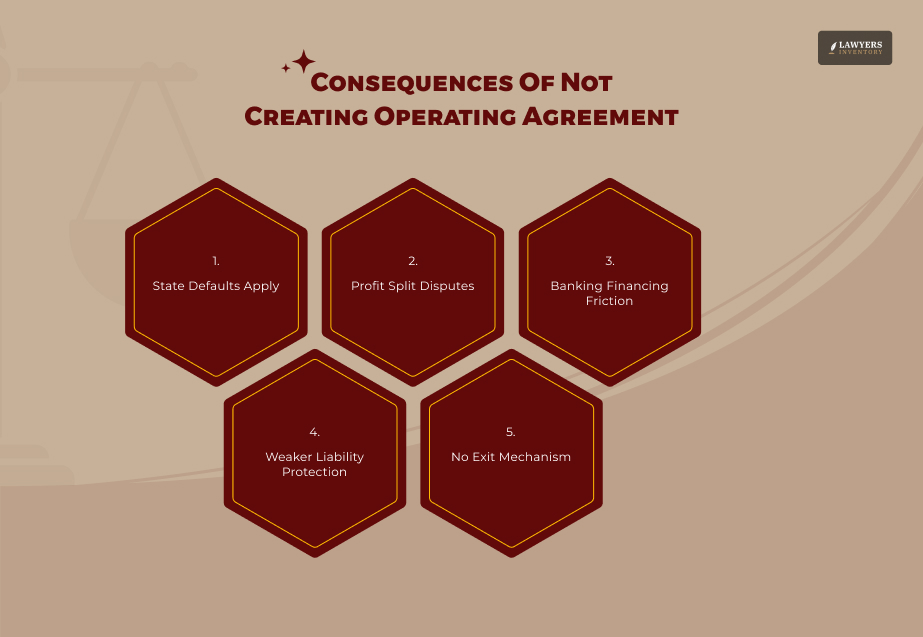
Common consequences include:
- Default rules applying by force, even if they clearly contradict the members’ expectations
- Partners often dispute profit splits, especially when they assume equal ownership despite making unequal contributions (or vice versa).
- Banking and financing friction, where the banks and investors routinely decline to move forward without seeing one
- Single-member LLCs face weaker liability protection when they fail to prove that they operate the business as a separate legal entity.
- No clear exit mechanism if a member wants to leave, forcing costly negotiation or litigation to sort out what should have been a two-page clause.
Creating Or Updating An Operating Agreement
You can create an operating agreement whenever you want. Some owners write it before filing official state paperwork, some do it right after, and others wait years until they realize they actually need one.
However, you must update the document whenever the business changes.
Don’t let it sit on a shelf if you bring in a new partner, change who runs the company, shift ownership percentages, or take on outside funding.
To make the agreement official, you do not need a notary. No state requires one.
Moreover, the document becomes legally binding the exact moment all members sign it.
If you are a single-owner LLC, a simple online template works perfectly fine. But if you have business partners, things get complicated.
You will need clear rules for breaking vote deadlocks, valuing the company during a buyout, and asking for more investment cash.
For multi-member setups, it is smart to pay an attorney to handle these complex clauses.
A little legal help now prevents a simple argument from turning into an expensive lawsuit later.
Disclaimer: This article is for general informational and educational purposes only and does not constitute legal advice. Operating agreement requirements vary by state, and business structures vary in complexity. If you are forming or restructuring an LLC, consult a licensed attorney in your state before finalizing your operating agreement.
Leave A Reply






Do You Pay Taxes On Lawsuit Settlements? IRC Section 104 Explained
Read More
Non-Disparagement Clause Explained: Requirements, Enforceability, And What Changed Recently
Read More
Best Practices For Successful Trademark Registration
Read More
Understanding Your Rights: A Guide To The Legal Process
Read More
How To Clear A Bench Warrant Without Going To Jail: A Legal Guide
Read More
0 Reply
No comments yet.