Quick Answer

Malicious prosecution is a civil tort claim that arises when a party initiates a criminal or civil proceeding against another person without probable cause and for an improper purpose, which ultimately results in the plaintiff’s favor. It requires proof of six elements, and it is not enough that the case filed against has been dismissed or that they have been wrongly accused.
Navigating the legal system becomes a nightmare when someone weaponizes the law against you.
Malicious prosecution is a civil wrong. This tort protects individuals when someone starts a baseless court case or criminal charge. The wrongdoer acts simply to threaten, retaliate, or bully.
Courts must always remain open to legitimate disputes. Because of this, plaintiffs face a high bar to win a malicious prosecution case.
You must prove three things:
- First, the original lawsuit lacked a real cause.
- Second, malice motivated the filer.
- Third, the case ended in your favor.
Significant cases have cleared the path for victims.
In Thompson v. Clark, the Supreme Court removed substantial barriers. The ruling helps individuals sue government officials under Section 1983.
You can take your first steps toward justice today. Know your legal rights, learn the exact requirements, and separate malicious prosecution from a false charge.
Here’s how to work out whether what happened to you actually fits the legal definition, and what a case built on it looks like.
What Is Malicious Prosecution?
Malicious prosecution is a civil wrong, not a crime. It exists to give people a way to recover damages when someone else weaponizes the legal system against them – filing charges or a lawsuit not to win on the merits, but to intimidate, punish, or harass.
Cornell Law School’s Legal Information Institute defines it as filing a lawsuit for an improper purpose and without grounds or probable cause, and notes that the underlying case can be either civil or criminal in nature.
Malice is not an element under a malicious prosecution claim, which is why you can have a legitimate claim that fails because a court decided the case is without merit.
So, for example, if you sued someone and lost the case, it does not automatically mean that you did something malicious.
Malicious prosecution applies only to a narrow group of cases in which a legitimate legal basis was always lacking and in which the person who brought forth the matter knew this and persisted regardless.
Malicious Prosecution vs. Abuse of Process
These two terms get confused constantly, and they’re not the same thing. Malicious prosecution attacks how a case started – it argues the filing itself was improper from day one.
Abuse of process attacks how an otherwise legitimate case was used – misusing subpoenas to intimidate someone, or placing an improper lien to force a quick settlement, for instance.
According to FindLaw, a lawsuit can be entirely valid on paper and still involve abuse of process partway through. Malicious prosecution, by contrast, means the case should never have been filed at all.
The Elements You Have To Prove
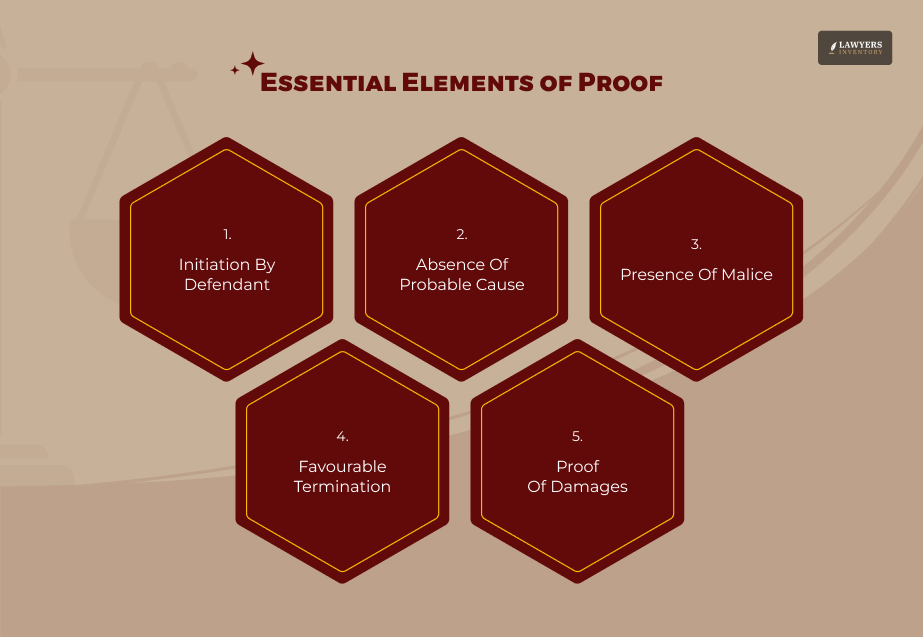
Courts generally require six things to establish malicious prosecution, though states vary slightly in how they define or combine them.
- A legal proceeding was brought or continued against you. This covers both criminal charges and civil lawsuits.
- The person you’re suing was actively involved in bringing it. This could be a private plaintiff, a corporation, or in some cases, a police officer or prosecutor.
- The case ended in your favor. It doesn’t need to end with a declaration of innocence – more on that below.
- There was no probable cause for the case. No reasonable person in the defendant’s position would have believed there were legitimate grounds to bring it.
- Malice was the primary motive. The person filing wasn’t genuinely trying to win on the merits – they were pursuing some other goal, like harassment or intimidation.
- You were harmed as a result. This can include financial loss, reputational damage, emotional distress, or the cost of defending yourself.
Missing even one of these elements typically sinks the claim.
This is why malicious prosecution cases are notoriously difficult to win, and why an early, honest assessment from an attorney matters more here than in most other tort claims.
How Thompson v. Clark Changed The “Favorable Termination” Rule
For years, federal courts disagreed on what “the case ended in your favor” actually required.
Some circuits demanded that the dismissal come with some affirmative sign of innocence – a judge’s statement, an acquittal, something on the record.
Other circuits accepted any ending that simply wasn’t a conviction.
The Supreme Court resolved that split in April 2022 with Thompson v. Clark, 596 U.S. 36. The plaintiff, Larry Thompson, had been charged with resisting arrest and obstruction after police entered his apartment on a false report.
The charges were dropped before trial, with no explanation from the prosecutor or judge. Lower courts said that wasn’t enough to prove a favorable termination.
As per Justia’s record, the Supreme Court disagreed, ruling 6-3 that a plaintiff only needs to show the prosecution ended without a conviction – no formal declaration of innocence required.
The ruling applies specifically to Fourth Amendment malicious prosecution claims brought under 42 U.S.C. § 1983, the federal statute that lets people sue government officials for constitutional violations.
It doesn’t touch the other elements of the claim – you still have to prove the absence of probable cause and malice, and government defendants can still raise qualified immunity as a defense.
But it removed a major hurdle that had quietly killed a lot of otherwise legitimate claims before they got anywhere near a jury.
Bringing A Malicious Prosecution Claim Against The Police
Individuals whose constitutional rights have been infringed by government workers may take legal action against the latter via Section 1983 of the U. S. Code.
To succeed in the litigation, it must be established that the workers committed the act while in the discharge of their official capacity.
To allege that there was an act of the State of malicious prosecution based on this law simply means that the Fourth Amendment has been violated, as one could view this case as a prolonged unreasonable seizure of property that continued after a futile criminal investigation.
Apart from the usual defenses for private-party malicious prosecution claims, the person bringing the lawsuit against malicious prosecution claims has to contend with the defense of qualified immune, which is a legal doctrine that protects State officials from being held liable unless their actions were clearly violative of a constitutional right established at the time.
Thompson made the favorable-termination element easier to clear, but qualified immunity remains a significant obstacle in these cases.
And it’s a large part of why claims against police departments take longer and cost more to litigate than claims against a private plaintiff or company.
What You Can Recover If You Win A Malicious Prosecution Claim?
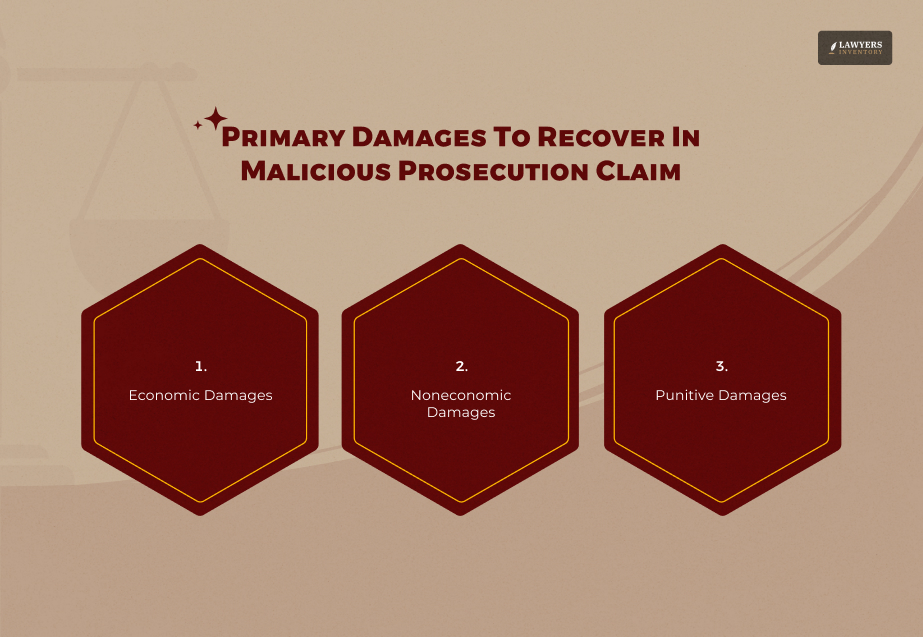
Damages in a successful malicious prosecution claim generally fall into a few categories.
Compensatory damages cover the direct financial cost of defending yourself – attorney’s fees, lost wages, bail costs.
Emotional distress damages account for the psychological toll, which courts tend to weigh more heavily in cases involving criminal charges, given the added stress of facing possible jail time.
Reputational harm can factor in too, particularly when the case affected your job, business, or standing in your community.
In cases involving especially egregious conduct, some jurisdictions allow punitive damages, meant to punish the wrongdoer rather than simply compensate the victim.
Average Settlement For Malicious Prosecution
There is no fixed average settlement for malicious prosecution because payouts vary wildly. A case can settle for a few thousand dollars or spike into millions of dollars.
The total value depends directly on the severity of your damages. Criminal defense costs, bail fees, and lost income establish a concrete baseline.
However, the largest payouts usually stem from non-economic harm. Juries award massive sums for the following:
- Emotional distress.
- Reputational damage.
- Wrongful imprisonment.
If the defendant acted with extreme misconduct, courts may also add punitive damages to heavily punish the behavior.
The Deadline: Statute Of Limitations In Malicious Prosecution Cases
Malicious prosecution claims are subject to a filing deadline like any other civil tort. And it typically starts running once the court resolves the underlying case in your favor, not when the original charges were filed.
Deadlines vary significantly by state – commonly falling somewhere between one and three years – and Section 1983 claims generally borrow the personal injury statute of limitations from the state where the case is filed.
The exact window depends entirely on your jurisdiction and the type of underlying case. As a result, confirming the deadline with an attorney early is essential. Missing it can end an otherwise valid claim before it starts.
How To Know If You Actually Have A Claim?
A few questions can help clarify whether your situation fits the malicious prosecution definition legally, rather than just feeling unfair.
Did The Case Against You Actually End, And In Your Favor?
A pending case can’t yet support a malicious prosecution claim – you need a resolution first.
Was There Ever A Legitimate Basis For The Case?
If the evidence, even weak evidence, gave the other side some reasonable belief in their claim, this likely isn’t malicious prosecution, however aggressively they pursued it.
Can You Point To A Motive Beyond Winning The Case?
Courts look for evidence of intent. This can include a business rival using litigation to bankrupt you, a personal grudge, or a pattern of retaliation.
Did You Suffer Real, Demonstrable Harm?
Legal fees, lost income, and documented emotional distress all count; general frustration typically doesn’t meet the bar on its own.
Is Your Filing Deadline Still Open?
Check this early, since it can eliminate an otherwise strong claim.
What To Do Next In Malicious Prosecution?
If your situation looks like it might meet these elements, gather everything connected to the original case:
- the complaint or charging documents,
- the dismissal or acquittal order,
- correspondence that hints at motive,
- records of what the ordeal cost you.
Most attorneys who handle these claims offer an initial consultation. This helps to assess whether the facts support a case before you commit to anything.Given how narrow and fact-specific this claim is, that early conversation is worth having before you assume – or rule out – that you have one.
Leave A Reply






What Is An Operating Agreement? LLC Requirements, Key Provisions, And Why You Need One
Read More
Intentional Infliction Of Emotional Distress Explained: Elements, Evidence, And What Makes A Claim Win
Read More
What Is A Preliminary Hearing? Core Procedures, Timeline, And What To Expect
Read More
What Is Grand Larceny? Felony Thresholds, Penalties, And Your Legal Options
Read More
Larceny vs. Theft: What’s The Real Legal Difference?
Read More
0 Reply
No comments yet.