Summarize using AI





Prompt copied. Paste it into Gemini.
Quick Answer
The emergency provisions in Indian Constitution are in Part XVIII (Articles 352 – 360). They let the central government turn into a powerful single unit during major crises. The three types are National Emergency (Article 352), State Emergency or President’s Rule (Article 356), and Financial Emergency (Article 360).
I have been analyzing expert opinions in the legal field for a while now. And as someone who spends a lot of time doing that, I find the balance of power in a democracy fascinating. The most critical test of this balance happens during a national crisis.
The framers of the Indian Constitution learned deeply from historical experiences and global events. To safeguard the nation, they incorporated a robust set of emergency provisions. These tools handle extraordinary situations that threaten the security, integrity, and stability of India.
Dr. B.R. Ambedkar characterized the Indian federal structure as unique.
He noted its ability to transition seamlessly into a unitary system when the administrative apparatus fails. These specialized powers are outlined from Article 352 to Article 360 under Part XVIII of the Constitution.
They empower the central government with unique authority during crises. Historically, these provisions drew direct inspiration from Germany’s Weimar Constitution.
Emergency Provisions In Indian Constitution
Emergency provisions in Indian Constitution are the subject matter of Part XVIII, from Article 352 to Article 360.
These emergency provisions have been put in place as a sort of safeguard mechanism that can be activated by the Central Government in times of extreme crisis. These enable it to assume control as a single powerful entity.
There are three emergency provisions in the Indian Constitution:
- National Emergency (Article 352)
- State Emergency / President’s Rule (Article 356)
- Financial Emergency (Article 360)
Let us take a closer look at each of these:
1. National Emergency (Article 352)
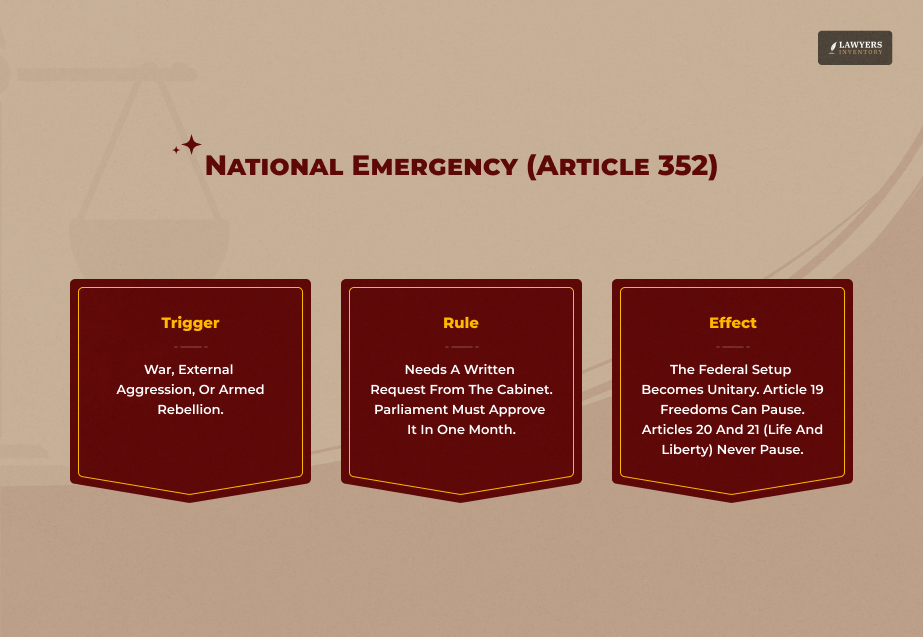
Article 352 of the Indian Constitution deals with the proclamation of a National Emergency. This provision empowers the President to declare an emergency across India or a specific part of it.
This occurs if they are satisfied that security is threatened by war, external aggression, or armed rebellion.
The declaration grants the Executive vast powers to suspend fundamental rights. This allows the government to take necessary measures to address the crisis effectively.
However, the utilization of Article 352 is an extraordinary measure. My review of legal scholarship shows that its application always raises concerns about the potential abuse of power and the erosion of democratic principles.
How Many Times Has India Proclaimed A National Emergency?
India has declared a national emergency three times in its history. I have broken down these three instances below:
- The Indo-China War (1962): The first national emergency was declared during the Sino-Indian War. It stayed in force due to subsequent security threats.
- The Indo-Pak War (1971): The second national emergency was declared during active military hostilities with Pakistan.
- Internal Disturbance (1975-1977): The third and most controversial emergency was declared by President Fakhruddin Ali Ahmed on the advice of Prime Minister Indira Gandhi. This period, known simply as “The Emergency,” saw a widespread suspension of civil liberties and intense political suppression.
Grounds For The Proclamation
To understand this provision, we must look at the specific legal definitions of its three grounds:
- War: This refers to a situation where India is officially at war with another country. It involves formal, state-sanctioned armed conflict and hostilities between nations.
- External Aggression: This occurs when a foreign power attacks or invades India without a formal declaration of war. It involves military force that endangers the sovereignty and integrity of the country.
- Armed Rebellion: This involves an active uprising or violent resistance against the established government within the country. This ground implies the use of force or weapons by a domestic group to challenge state authority.
Duration And Approval Process
Only the President can declare a National Emergency. However, this can only happen when the Union Cabinet gives a written recommendation. Once announced, the proclamation must be endorsed by both Houses of Parliament within exactly one month.
If the Lok Sabha is dissolved when the emergency is declared, or gets dissolved within that month without approving it, special rules apply. The emergency stands until 30 days after the reassembly of the Lok Sabha, provided the Rajya Sabha has already approved it.
If both houses approve, the emergency lasts for six months. According to statutory rules verified on the comprehensive iPleaders Legal Blog Emergency Guide, it can be extended indefinitely. However, Parliament must grant permission through a new resolution every six months.
| Emergency Type | Primary Constitutional Article | Maximum Allowable Duration | Parliamentary Approval Deadline |
| National Emergency | Article 352 | Indefinite (Requires 6-month renewals) | Within 1 Month |
| President’s Rule | Article 356 | 3 Years Maximum | Within 2 Months |
| Financial Emergency | Article 360 | Indefinite (No renewal required) | Within 2 Months |
The Critical Mechanics: Article 358 vs. Article 359
The Constitution uses two distinct legal pathways for this:
- Article 358 (Automatic Suspension): When a National Emergency is declared due to war or external aggression, individual rights under Article 19 are suspended automatically. No separate executive order is necessary for this. However, if the emergency is based on an armed rebellion, Article 19 remains fully intact and protected.
- Article 359 (Suspension by Presidential Order): This article does not automatically suspend any rights. Instead, it empowers the President to issue a specific order. This order suspends the right to approach any court to enforce specific fundamental rights.
The Legislative Imbalance: Approving vs. Revoking
When evaluating parliamentary control, I noticed a deliberate imbalance in the legislative thresholds for managing an emergency:
- Approval High-Bar: To initiate or extend a National Emergency under Article 352, both the Lok Sabha and Rajya Sabha must pass a resolution by a special majority. This requires a majority of the total membership of each house, plus a two-thirds majority of members present and voting.
- Revocation Low-Bar: Ending an emergency requires a much lower threshold. The Lok Sabha can bypass the Rajya Sabha completely. It only needs a simple majority of members present and voting to pass a resolution of disapproval. This instantly forces the President to revoke the proclamation.
The Role Of Judicial Review
Earlier, a National Emergency declaration was largely immune to judicial oversight. This protective insulation changed permanently with the 44th Amendment Act of 1978.
Later, the Supreme Court delivered a landmark ruling in the foundational case of Minerva Mills Ltd. v. Union of India (1980). The Court held that a National Emergency can be directly challenged in a court of law. The judiciary can examine whether the President’s satisfaction is based on valid, bona fide grounds or if it stems from malice.
Effects On Fundamental Rights And Legal Precedents
During a national emergency, fundamental rights under Article 19 can be suspended depending on the grounds.
However, rights under Article 20 (protection against conviction for offenses) and Article 21 (protection of life and personal liberty) can never be affected.
I must point out that this was not always the case.
In the infamous case of ADM Jabalpur v. Shivkant Shukla (1976), the Supreme Court originally held that the writ of habeas corpus could not be availed during an emergency because Article 21 was suspended. [Source: Indian Kanoon]
Legal experts widely condemned this decision, and modern jurisprudence has officially overruled it. [Source: Vedantu]
Read Also: The Tenth Amendment to the US Constitution Changed the Fate of the Country!
2. State Emergency / President’s Rule (Article 356)
Article 355 places a strict duty on the Center. It must ensure that the government of every state complies with the provisions of the Constitution.
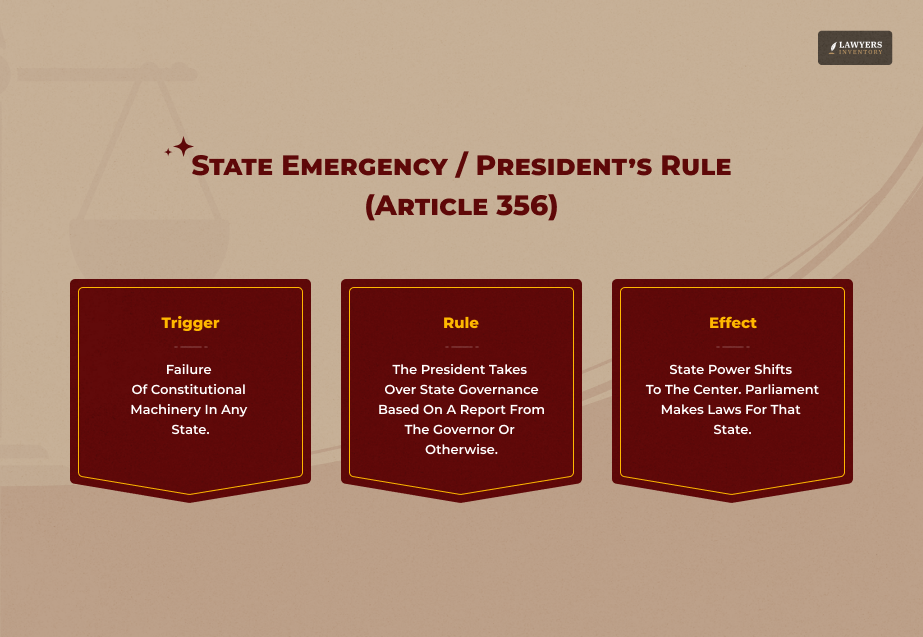
If a state fails, Article 356 empowers the President to impose President’s Rule. This occurs if the President is satisfied, via a report from the Governor or otherwise, that the state government cannot function in accordance with constitutional norms.
This provision handles the breakdown of constitutional machinery. It allows the Union executive to take over governance.
Historically, the use of Article 356 has been a major subject of political controversy. Critics often argue that central governments misuse it to dismiss opposition-led state ministries.
To curb this arbitrary use, the Supreme Court set strict guidelines in the monumental case of S.R. Bommai v. Union of India (1994). The Court emphasized that President’s Rule should be a last resort in extreme cases after exhausting all other alternatives.
Implementation Process For Article 356
- Constitutional Breakdown: A failure of the constitutional machinery occurs within a specific state.
- Executive Review: The Governor of the state sends an official report to the President, or the President receives independent information.
- Proclamation: The President officially issues a proclamation of President’s Rule over the state.
- Legislative Approval: Both Houses of Parliament must approve the proclamation within a strict two-month deadline.
- Operational Duration: The emergency initially remains valid for six months, with a maximum cap of three years total.
Jurisprudential Update: The “Reasonable Nexus” Principle
In my tracking of recent legal milestones, I paid close attention to the Supreme Court’s ruling on Article 356 during the historic Article 370 abrogation challenge.
As detailed in The Hindu’s Constitutional Law Coverage, this judgment added an essential layer to the jurisprudence of President’s Rule:
- The Principle of Reasonable Nexus: The Supreme Court expanded judicial review over central interventions. The Court held that when Article 356 is active, any subsequent material actions taken by the President or the Center must share a “reasonable nexus” with the ultimate purpose of the emergency proclamation. The executive cannot use a temporary state breakdown to push unrelated, permanent structural changes.
- Shifting Burden of Proof: The ruling clarified that a challenger must first establish a prima facie case showing that the central action was malicious or based on irrelevant facts. Once that threshold is cleared, the burden of proof shifts to the Center to justify its constitutional actions. [Source: The Hindu]
Legal Effects Of A State Emergency
When Article 356 is active, the governance model changes fundamentally. Durng this time, the President:
- Assumes all powers exercisable by the state Governor.
- Declares that the state’s legislative powers will be exercised by or under the authority of Parliament.
- Can suspend specific provisions of the Constitution relating to any authority in the state to serve the purpose of the proclamation.
Read Also: Basic Structure Doctrine: Definition, Evolution, And Current Legal Debates
3. Financial Emergency (Article 360)
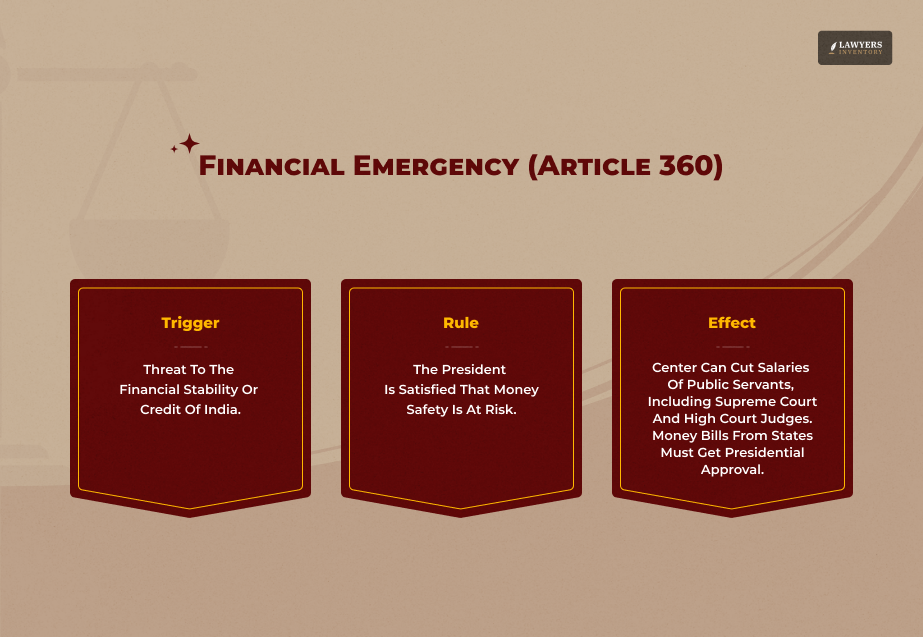
Article 360 deals with the proclamation of a Financial Emergency. This provision allows the President to declare an emergency if they are satisfied that the financial stability or credit of India, or any territory within it, is severely threatened. [Source: Drishti IAS]
Parliament must approve this proclamation within two months. Once approved, it continues indefinitely until it is explicitly revoked.
Unlike the other two types of emergencies, a Financial Emergency has never been proclaimed in India to date. Even during the severe economic crisis of 1991, the government avoided invoking Article 360.
During a Financial Emergency, the central government gains sweeping control over economic resources:
- The President can direct the reduction of salaries and allowances for any class of persons serving the Union or a State.
- This reduction explicitly includes the judges of the Supreme Court and High Courts.
- The Center can order states to reserve all money bills for the President’s consideration. [Source: Drishti IAS]
The emergency provisions of the Indian Constitution reflect a delicate structural design. They arm the state with necessary powers during external or internal crises. However, as the Supreme Court noted in Minerva Mills, S.R. Bommai, and recent landmark rulings, these extraordinary powers must always bow to judicial review to prevent tyranny.
Leave A Reply






Do You Pay Taxes On Lawsuit Settlements? IRC Section 104 Explained
Read More
Non-Disparagement Clause Explained: Requirements, Enforceability, And What Changed Recently
Read More
Best Practices For Successful Trademark Registration
Read More
Understanding Your Rights: A Guide To The Legal Process
Read More
How To Clear A Bench Warrant Without Going To Jail: A Legal Guide
Read More
0 Reply
No comments yet.