Quick Answer

A maritime lawyer (also known as an admiralty attorney) specializes in resolving disputes, injuries, and commercial activities that take place on navigable waterways. Unlike lawyers practicing on land who deal mostly with state legislation, maritime lawsuits are heard in federal jurisdiction and governed largely by international maritime law.
The shipping industry operates under a unique legal framework. Standard state laws rarely apply to accidents on navigable waters. Instead, these incidents fall under federal maritime law. This system is also called admiralty law.
Individuals facing maritime disputes need specialized legal counsel. Maritime law involves complex international treaties and federal statutes. Navigating this system requires an understanding of marine jurisdiction.
Maritime Claim Classification Framework At A Glance
| Incident Category | Affected Party Type | Governing Legal Framework | Key Eligibility Threshold |
| Commercial Shipping | Seaman / Crew Member | The Jones Act | Spends upto 30% of work time on a navigating vessel |
| Harbor & Port Operations | Dockworker / Shipbuilder | LHWCA | Meets maritime role (Status) and water-adjacency (Situs) tests |
| Fatal Offshore Accidents | Representative of Deceased | DOHSA Act | Fatality occurs beyond 3 nautical miles from US shores |
| Recreational Boating | Passenger / Vessel Owner | General Maritime Torts | Incident occurs on navigable waters with a maritime connection |
What Is The Role Of A Maritime Lawyer?
A maritime lawyer specializes in laws governing navigable waters. These lawyers handle commercial shipping disputes and marine insurance claims. They also litigate serious personal injury cases. [Source: Maritime Injury Guide]
Admiralty attorneys manage complex federal court procedures. Their practice covers commercial industry issues and worker protection. They represent cargo owners, vessel underwriters, and offshore laborers. Their daily work requires deep knowledge of international maritime treaties.
Core Legal Responsibilities In Commercial Shipping
- Drafting Commercial Agreements: Lawyers draft complex charter party agreements for shipping companies. They negotiate large-scale shipbuilding contracts.
- Resolving Cargo Disputes: They resolve cargo damage claims under federal shipping acts.
- Enforcing Maritime Liens: Attorneys file maritime liens against vessels to secure payments.
- Managing Salvage Operations: They manage salvage operations after mid-ocean accidents.
- Ensuring Regulatory Compliance: They advise clients on international environmental mandates. Their work prevents costly vessel detentions at international ports.
Advocacy For Injured Maritime Workers
- Securing Financial Recovery: Injury attorneys secure financial recovery for medical bills. They recover lost wages and fund long-term rehabilitation.
- Representing Offshore Laborers: They advocate for harmed offshore workers. Heavy machinery and unpredictable seas cause catastrophic injuries.
- Managing Cruise Line Claims: They represent passengers injured on commercial cruise liners. Cruise ship litigation features strict contractual filing windows. A skilled maritime lawyer protects clients from these hidden legal traps.
Understanding Maritime Jurisdiction And Applicable Laws
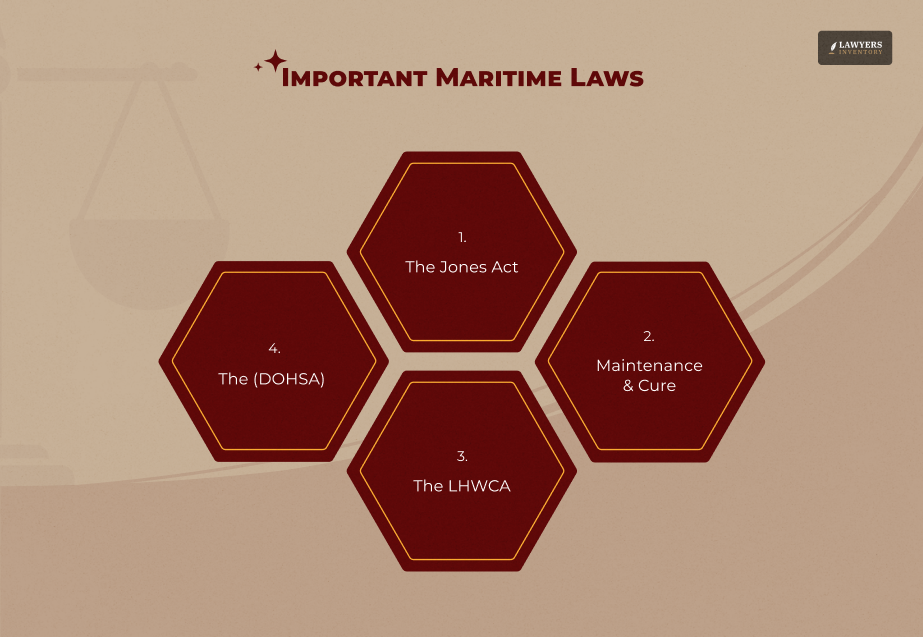
Establishing admiralty jurisdiction is the first step in every case. The United States Constitution places maritime cases under federal jurisdiction. To trigger federal jurisdiction, an incident must pass two tests.
- The Locality Test: The incident must occur on navigable waters.
- The Nexus Test: The activity must relate to traditional maritime work.
Unique federal acts govern these cases instead of land-based laws.
The Jones Act And Rights Of Seamen
The Jones Act protects crew members injured at sea. To qualify as a seaman, a worker must pass a time threshold. The worker must spend at least 30 percent of their work time on a vessel. The vessel must be active in navigation.
The Jones Act allows injured crew members to sue employers for negligence. This differs completely from land-based workers’ compensation laws.
Employers must provide a reasonably safe work environment. The burden of proof for negligence is very low. Any employer negligence that contributes to the injury creates clear liability.
Maintenance And Cure Obligations
General maritime law guarantees seamen the right to maintenance and cure.
- Maintenance: A daily living allowance for food and housing. Modern courts calculate it based on the actual, reasonable living expenses of the seaman on land, not the cost of their shipboard berth. It is usually paid as a fixed daily rate (e.g., $30 to $50+ per day, though it can be argued higher based on localized living costs. [Source: Morrow & Sheppard LLP]
- Cure: The employer’s duty to provide medical care. Employers pay for surgeries, medications, and therapy sessions.
This obligation lasts until the worker reaches Maximum Medical Improvement (MMI). MMI means the condition cannot improve with further treatment. [Source: Steamship Mutual]
In the 2009 U.S. Supreme Court case Atlantic Sounding Co. v. Townsend, the court ruled that if a shipowner willfully, wantonly, or callously denies maintenance and cure benefits without a valid reason, they can be held liable for punitive damages and the seaman’s attorney’s fees. [Source: CaseMine]
The Longshore And Harbor Workers’ Compensation Act (LHWCA)
Land-based harbor workers do not qualify as seamen. Instead, the LHWCA protects dockworkers, shipbuilders, and longshoremen.
The LHWCA is a federal workers’ compensation program. It provides medical benefits and partial wage compensation. [Source: U.S. Department of Labor]
Workers must satisfy a status test and a situs test.
- The Status Test: Requires an active maritime employment role.
- The Situs Test: Requires the injury to happen near navigable waters.
Covered areas include piers, wharves, dry docks, and marine terminals.
The Death on the High Seas Act (DOHSA)
DOHSA applies when fatal accidents occur in international waters. The act covers deaths caused by wrongful acts or neglect. It takes effect beyond three nautical miles from United States shores. [Source: House.gov]
The personal representative of the deceased files the lawsuit. The suit benefits surviving spouses, children, or dependent relatives.
DOHSA limits financial recovery to pecuniary damages. Pecuniary damages include funeral expenses and lost financial support. The act excludes non-pecuniary damages like emotional grief.
Resolving Practical Realities For Claimants
Claimants frequently ask identical questions about their maritime cases. Understanding these operational details helps protect your legal rights.
| Recovery Feature | Standard Land-Based Workers’ Compensation | Jones Act & General Maritime Law Settlements |
| Recovery Limits | Restricted by strict statutory caps. | No statutory caps limit settlements. Payouts match the true scope of damage. |
| Compensation Scope | Covers fixed medical expenses and partial wages. | Covers full past and future lost earnings and complete medical costs. |
| Pain & Suffering | Completely excluded from recovery. | Fully included in final awards. Covers physical pain and mental suffering. |
| Employer Lawsuits | Barred under standard state laws. Workers give up the right to sue. | Explicitly permitted if employer negligence contributed to the injury. |
| Vessel Condition Claims | Not applicable to land-based operations. | Workers can file claims based on the absolute doctrine of unseaworthiness. |
Maritime workers can also file unseaworthiness claims. Vessel owners owe an absolute duty to provide a safe ship. The ship, its equipment, and its crew must be fit for work. A broken winch or slippery deck creates strict liability for the shipowner.
Essential Steps Immediately Following An Offshore Injury
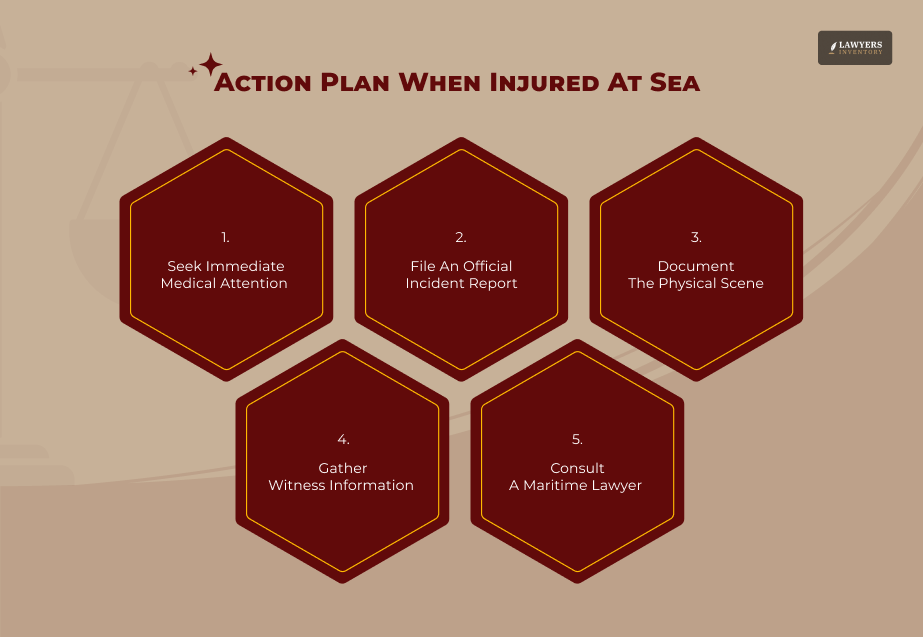
Your actions immediately following an injury dictate your case’s success. Maritime companies deploy risk managers to minimize corporate liability. You must take proactive steps to protect evidence.
Seek Immediate Medical Attention:
Report the injury to your supervisor instantly. Visit the ship doctor or an onshore clinic. Ensure the medical report notes every physical symptom.
File An Official Incident Report:
Write a detailed report before leaving the facility. Review the wording of the report carefully. Never sign a document that blames you for the accident.
Document The Physical Scene:
Take clear photographs of the equipment and safety hazards. Capture the weather conditions and lighting at the scene. Ask a coworker for help if you are badly hurt.
Gather Witness Information:
Record the names and titles of everyone nearby. Collect contact details for crew members who witnessed the incident.
Consult A Maritime Lawyer:
Avoid giving recorded statements to company insurance adjusters. Never sign settlement offers before speaking with independent legal counsel.
Evaluation Standards For Choosing A Maritime Lawyer
Choosing a lawyer requires looking for specific professional attributes. General injury lawyers lack experience in federal admiralty courts.
Federal Litigation Experience:
Verify the lawyer’s record in United States District Courts. Look for active memberships in the Maritime Law Association of the United States (MLA).
Case Specialization:
Evaluate the firm’s history with your specific claim type. A cargo dispute lawyer might lack the skills needed for a Jones Act injury trial.
Contingency Fee Structure:
Confirm the firm handles injury claims on a contingency basis. This ensures you pay no upfront legal fees. The lawyers only get paid if they win your case.
Disclaimer: The information provided in this article is for general informational purposes only. It does not, and is not intended to, constitute legal advice. Please consult an attorney for legal help.
Sources:
- The Merchant Marine Act of 1920 (The Jones Act): 46 U.S.C. § 30104.
- The Longshore and Harbor Workers’ Compensation Act (LHWCA): 33 U.S.C. § 901.
- United States Constitution: Article III, Section 2 (Admiralty Jurisdiction).
- The Death on the High Seas Act (DOHSA): 46 U.S.C. § 30301.
- Carriage of Goods by Sea Act (COGSA): 46 U.S.C. § 30701.
Leave A Reply







How Wrongful Death Claims Help Families Seek Accountability Today
Read More
How To Get A Public Defender: Eligibility, Application, And What Happens Next
Read More
When Schaumburg Business Owners Should Hire Litigation Attorneys
Read More

0 Reply
No comments yet.