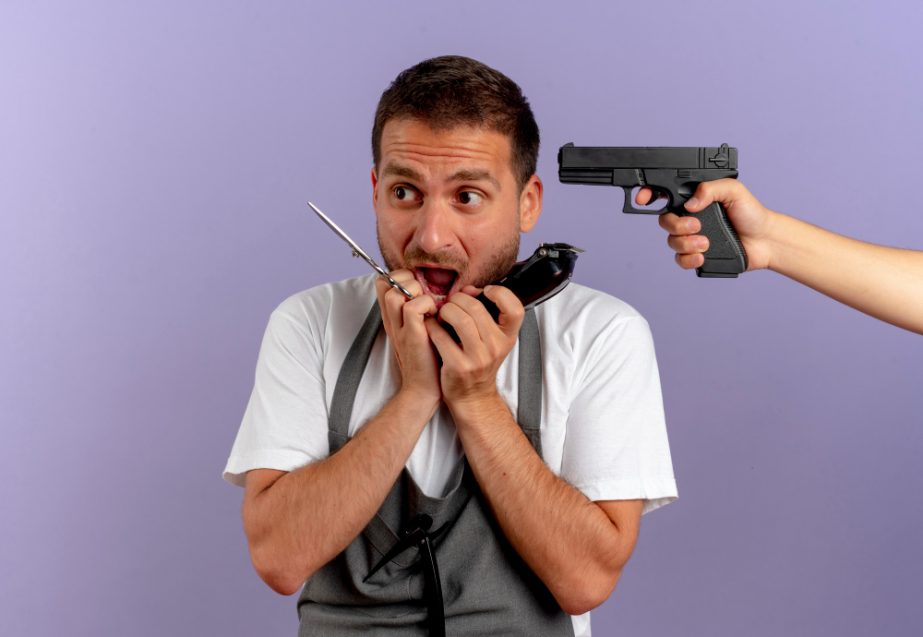
Today’s topic: Assault with a firearm charges!
In criminal law, there are not many things that change a case as significantly as the presence of a gun.
An assault that might have been charged at a lower level without a gun can be immediately elevated to a felony with harsh and long-lasting consequences.
This is not about public perception or political framing. Rather, it reflects how the legal system deals with items that have the potential to cause irreversible harm in a matter of seconds.
Gun owners, especially those who carry legally, have to understand that charges for assault with a deadly weapon change significantly when a gun is present. This knowledge is not non-essential.
It is a part of the burden that is associated with possession. The law entails the assumption of higher risk, more careful consideration, and greater accountability when a gun is in question.
What Is Assault With A Deadly Weapon Under Nevada Law?
Fundamentally, assault with a deadly weapon is statutory language-based, but Nevada law is unequivocal in its purpose and thus very clear.
According to the Nevada Revised Statutes, the gravity of an assault offense increases considerably when there is the involvement of a weapon that can cause death or serious injury. Firearms are the most common example, and there is rarely any disagreement about that.
The assault with a firearm charges does not require that the weapon be fired. In Nevada, it may be enough for charges to be brought if a person does the following:
- Points a firearm at someone else.
- Threatens with it.
- Frightens the victim to a reasonable level that harm is about to occur.
The main point is that it is the weapon’s capability and the surrounding circumstances that matter, not the result of the act.
This differentiation is important. A gun is a weapon capable of causing death that can be introduced into any situation, whether the trigger is pulled or not.
The courts in Nevada are aware of this factand they hold the person responsible accordingly.
Why Firearms Change The Legal Equation
When a firearm is involved, prosecutors are no longer arguing about hypothetical danger. They are addressing acknowledged lethal force. As a result, assault with a firearm charges often involve:
- Elevated assault with a firearm charges are frequently classified as felonies.
- Higher bail amounts or restrictive release conditions.
- Increased scrutiny of intent and justification.
- Reduced tolerance for claims of impulsive or emotional behavior.
In jurisdictions such as Las Vegas and Clark County, assault with a deadly weapon, Nevada cases involving firearms are commonly treated as high-risk offenses from the outset.
The presence of a gun alone can influence charging decisions, bail determinations, and prosecutorial strategy.
In many firearm-related cases, sentencing exposure can include state prison time rather than county detention – even for first-time defendants – depending on the facts alleged and any aggravating factors.
The system assumes that when a firearm appears, the margin for error disappears.
Lawful Ownership Does Not Equal Lawful Use
One of the most common misconceptions among responsible gun owners is that lawful possession provides legal insulation. It does not.
A legally owned firearm, carried under a valid permit or constitutional carry framework, can still form the basis of assault with a firearm charges if used improperly.
Brandishing, threatening gestures, or attempting to “win” an argument through intimidation can all cross legal lines – especially in public spaces or emotionally charged environments.
Courts do not evaluate firearm cases in isolation. They examine behavior, judgment, escalation, and available alternatives.
The question is not “Did you have the right to own the gun?” but “Did you have the legal justification to introduce deadly force into this moment?”
Self-Defense Claims Face A Higher Bar
Self-defense remains a lawful justification – but when there is an involvement of a firearm, the bar rises.
To successfully assert self-defense in assault with a firearm charges and cases, the defender must generally show:
- An immediate and credible threat of death or serious bodily harm
- Proportional response to that threat
- No reasonable avenue of retreat, where required by law
- Clean hands – meaning the defender did not provoke the encounter
Firearms compress time. A decision that you make in seconds can take years for the court to dissect. Investigators will analyze:
- Body language.
- Witness statements.
- Video footage.
- Post-incident behavior.
In firearm cases, hesitation or poor articulation after the fact can be as damaging as the event itself.
Bail Realities In Assault With A Firearm Charges
The consequences of a firearm-related assault charge begin immediately, not after conviction. Arrests frequently result in elevated bail or temporary no-bail holds.
In these situations, assault bail bonds and weapons bail bonds become a practical necessity rather than a theoretical concern.
In metropolitan areas like Las Vegas, firearm-related assault cases often require bond providers familiar with weapon-enhanced charges and local court practices.
Services such as 8ballbailbonds operate in this space because standard bail assumptions often do not apply when firearms are involved.
This stage is not about avoiding accountability – it is about preserving the ability to work with counsel, maintain employment, and prepare a defense while the legal process unfolds.
Long-Term Consequences Extend Beyond The Courtroom
A conviction for assault with a deadly weapon involving a firearm can permanently alter a person’s rights. Loss of firearm ownership, restrictions on future carry, and federal prohibitions are common outcomes.
Even cases that the court reduces or dismisses can carry professional and personal consequences long after court proceedings end.
Beyond legal penalties lies an ethical dimension. There are a few things that shape responsible firearm ownership. They are:
- Restraint.
- Judgment.
- An understanding that avoidance is often the highest form of competence.
Many experienced firearm owners reach the same conclusion: the goal is not to win a confrontation – it is to ensure one never escalates to the point where a firearm becomes relevant.
Experience Teaches What The Law Enforces
Many firearm-related legal disasters do not originate with criminal intent. They begin with impatience, ego, or the belief that displaying a weapon will end a conflict. In reality, it often escalates one.
Training develops proficiency. Experience develops discretion. The law enforces consequences when discretion fails.
A Responsibility That Never Switches Off
Weapons do not take a break for feelings, stress, or anger. The law doesn’t either.
A weapon involved in a scuffle immediately, and often forever, changes the legal landscape. The stakes get higher, there is more scrutiny, and the choices made in a few seconds can decide years of consequences.
Being a responsible gun owner is not about how fast someone can react, but more about how regularly they show restraint, good judgment, and planning.
Knowing how the law treats firearms should be part of the decision to carry, and not merely something that is good to know.
The best gun owners are those whose self-control prevents the gun from ever figuring into the incident at all.
Leave A Reply








What Is A Business Entity? A Simple Guide For New Business Owners
Read More
When Should You Take A Criminal Charge Seriously?
Read More
Who Is Responsible For Pest Problems In Dallas Rental Properties
Read More
Considering A Sexual Abuse Claim? Know What Legal Support Offers
Read More
0 Reply
No comments yet.