Summarize using AI





Prompt copied. Paste it into Gemini.
Quick Answer

A business litigation law firm is a team of specialized trial attorneys. They legally represent companies during commercial disputes, arguments, and lawsuits. These firms protect corporate financial interests, operational assets, and brand reputations.
Business litigation resolves corporate disputes. It covers contracts, partnerships, intellectual property, and regulatory compliance. Modern market complexities drive this legal process.
A Norton Rose Fulbright survey reveals a major trend. Over 60% of businesses experienced rising litigation matters recently. This sharp upward trend affects all companies. It impacts small startups and massive global corporations alike.
Consequently, specialized litigation law firms play an increasingly critical role. These skilled legal teams protect corporate bottom lines during courtroom battles.
Furthermore, they proactively draft stronger contracts. They advise executives on complex compliance matters. Ultimately, the right law firm prevents costly disputes. It safeguards your brand reputation.
Types of Commercial Litigation
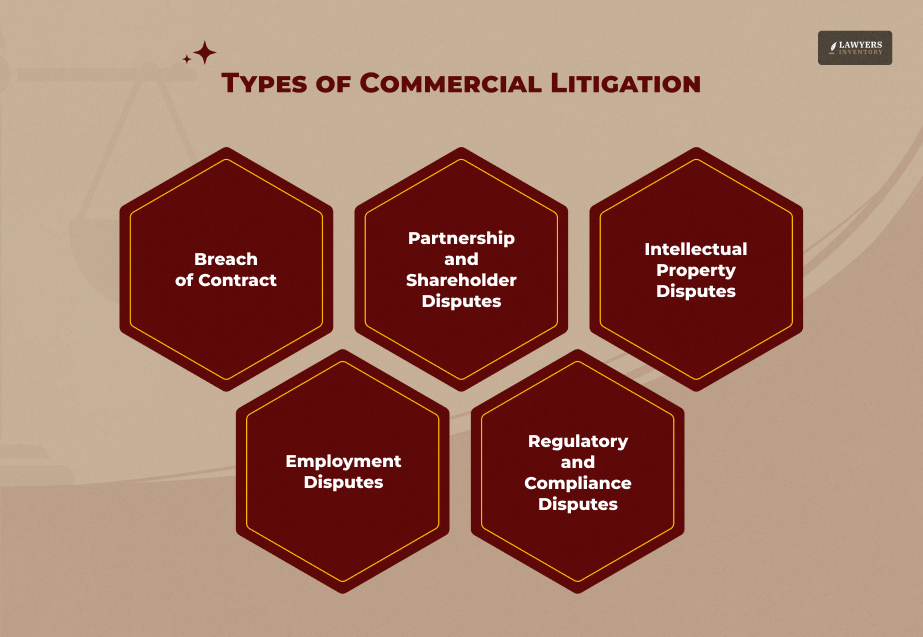
Commercial or business litigation encompasses a wide range of disputes that businesses may face. Understanding the most common types can help you identify where your business might need legal support.
Here’s a breakdown of key categories:
Contract and Regulatory Risks
Commercial litigation involves diverse legal disputes. Companies use these lawsuits to manage daily operational risk.
Breach of contract stands out as the most common business dispute, according to data from the American Bar Association.
This issue occurs when suppliers or partners fail to fulfill their agreed obligations. Externally, firms also navigate regulatory and compliance issues.
Government agencies penalize businesses for violating industry-specific laws, tax regulations, or consumer protection rules.
Internal and Property Disputes
Internal conflicts also disrupt operations. Partnership and shareholder disputes happen when owners disagree on the corporate vision. These cases frequently involve executives who breach their fiduciary duties.
To protect operational assets, companies must also defend against intellectual property (IP) disputes. Competitors often infringe upon valuable trademarks, copyrights, or patents.
IP lawsuits have risen sharply as digital assets become more critical to corporate value, notes the World Intellectual Property Organization.
Employment Law and Strategy
Finally, employment disputes heavily impact business stability. Workers regularly file legal claims over wrongful termination, workplace discrimination, or unpaid wages.
The U.S. Equal Employment Opportunity Commission handles thousands of these employment charges annually, requiring companies to retain specialized legal counsel.
Ultimately, leaders who identify these five legal areas protect their most treasured assets and maintain long-term stability.
Why Is Business Litigation Important?
Business litigation is a key tool for corporate governance, risk management, and strategic planning.
Commercial tort costs exceed $347 billion per year, according to the U.S. Chamber Institute for Legal Reform. This massive figure highlights the scale of legal risks that modern businesses face daily. [Source: Kolmogorov Law]
Litigation directly secures financial assets and protects supply chains. Research shows that contract disputes are the leading cause of corporate lawsuits. In fact, approximately 12 million of these contract cases are filed each year.
However, legal battles remain a major driver of corporate financial instability. Statistics from ACC and Rocket Lawyer highlight this exact vulnerability. A single commercial dispute costs a small business a median of $91,000.
New threats are also emerging very quickly. Data breaches and AI deployments are rapidly escalating corporate risk, according to the Norton Rose Fulbright Litigation Trends Survey.
Court action preserves brand reputation and ensures regulatory compliance. Even so, firms must still combine litigation with Alternative Dispute Resolution (ADR). This dual approach is essential to safeguard vital working capital.
BEST Business Litigation Law Firms in the US Right Now!
Getting assistance from a good lawyer is crucial when you are stuck in a legal dispute. Similarly, it also ensures that the lawyer you are hiring to fight your case is associated with a reputed law firm. This will allow for having strong legal support in your case.
Therefore, let us explore some of the best business litigation law firms in the US.
1. Cravath, Swaine & Moore LLP
| Headquarters | New York City |
| Other Practice Area | General Corporate, M&A, Securities and Banking, Tax, and Trusts and Estates |
First, Cravath has an illustrious history that dates back to 1819. It has maintained its small firm structure with its headquarters in New York. Moreover, it also operates in London, UK.
However, it has newly launched its operations in Washington, D.C. One of the notable factors for Cravath is its lack of billable hour requirements, yet it tends to bill the highest hours compared to other law firms.
2. Kirkland & Ellis
| Headquarters | Chicago, Illinois |
| Other Practice Area | Transactional, Intellectual Property, Restructuring |
Secondly, there is Kirkland and Ellis. This is one of the legal giants, both in reputation and size. Kirkland is known to drive legal professionals who are best at dealing with business litigation matters.
Moreover, one of the reasons Kirkland & Ellis keeps its spot on top is its capacity to train its associates rigorously. This allows for the creation of the best lawyers to handle complex legal matters within businesses.
3. Wachtell, Lipton, Rosen & Katz
| Headquarters | New York City |
| Other Practice Area | Corporate, Restructuring and Finance, Antitrust, Tax, Real estate, M&A |
Third on the list is Wachtell. It is known as the leader of M&A within New York’s legal market. Moreover, this law firm is also an elite institution within the legal industry.
One of the distinguishing factors of Watchell is its capacity to maintain its sole operations in New York while expanding globally. Similarly, the institution must meet BigLaw standards and maintain a small firm structure.
4. Skadden
| Headquarters | New York City |
| Other Practice Area | Transaction and Regulatory |
Skadden is known as a legal powerhouse and one of the most prestigious law firms in the US. Moreover, it is a law firm that has a global presence from New York to Shangai.
Similarly, it has the presence of 1700 lawyers across 8 offices in the US and 13 international offices. So, you can rely on this law firm to have strong legal support for your complex business litigation.
5. Latham & Watkins
| Headquarters | Los Angeles |
| Other Practice Area | General corporate, M&A, Banking and Finance, and Antitrust |
Latham & Watkins is a global leader in various practice areas, including business litigation. Furthermore, it has more than 3000 lawyers across 14 nations, and it recruits the best of the best lawyers.
6. Davis Polk & Wardwell LLP
| Headquarters | New York City |
| Other Practice Area | Antitrust Securities, Tax, Energy, Intellectual Property, Real Estate, Healthcare, and Environmental |
Davis Polk & Wardwell LLP is one of the oldest law firms in the US, and it is based in New York. It also boasts its premiere presence with offices in London, Madrid, Tokyo, Hong Kong etc.
Besides, it is renowned for its capacity to handle complex business litigation matters. So, you can easily trust its lawyers to handle your business disputes and fight them in court.
7. Simpson Thacher
| Headquarters | New York City |
| Other Practice Area | Private Equity, M&A, Banking and Credit, Private Funds, Energy Infrastructure, Finance, Healthcare, Technology |
Simpson Thacher is one of the elite business litigation law firms in the United States. Moreover, it has a robust training program that includes exceptional lawyers who are ready to assist you with your legal matters.
8. Sullivan & Cromwell LLP
| Headquarters | New York City |
| Other Practice Area | General Practice, Estate and Personal, Tax, and Finance, Energy, Healthcare, Digital Assets, Cybersecurity, and Environment |
Sullivan & Cromwell LLP is a well-known law firm dealing with business litigation. This firm has more than 800 legal professionals who are experts in dealing with complex legal matters.
Make sure to talk with the lawyers in the firm regarding your case. This will help the lawyer to have a better understanding of your case.
9. Paul | Weiss
| Headquarters | New York City |
| Other Practice Area | Artificial Intelligence, Corporate, Antitrust, Financial Services, Real Estate, Private Equity, Restructuring, and Tax |
Established in 1875, Paul has established itself in both the US and in other global regions. Additionally, it has approximately 1000 lawyers at its bay.
Moreover, Paul, Weiss, Rifkind, Wharton & Garrison LLP are known to have multiple practice areas.
Amongst these, business litigation is one of their practice areas. Therefore, it is assured that you will be in the right hands by choosing this firm.
10. Cooley
| Headquarters | California |
| Other Practice Area | Corporate, Intellectual Property, and Regulatory |
Finally, Cooley can be your go-to law firm if your business is a start-up. It is one of the most reputed business litigation law firms in the US, and it has a new approach to dealing with business disputes.
So, if you are willing to have your own business or within the initial stages of your business, Cooley will be your go-to law firm.
How To Choose A Business Litigation Law Firm (For Businesses Like Yours)
Most businesses researching this topic aren’t hiring a Fortune 500 BigLaw firm – they’re a small or mid-size company facing a real, immediate dispute. Here’s what actually matters when evaluating a firm at that scale:
Experience With Your Specific Dispute Type
A firm that handles a wide range of commercial matters isn’t the same as one with a track record in your exact issue – breach of contract, partnership disputes, IP infringement, and employment claims each call for different strategy and expertise. Ask directly: “How many cases like mine have you handled in the last two years, and what were the outcomes?”
Firm Size and Fit
A large national firm may have more resources, but a smaller regional or boutique litigation firm often provides more attorney attention, faster response times, and lower overhead costs – which usually means lower fees. Match the firm’s size to the size and complexity of your dispute, not the other way around.
Local Knowledge Matters
Business litigation is heavily shaped by state law and local court procedure. A firm with attorneys who regularly appear before the specific court or judge handling your case brings practical advantages that an out-of-state firm can’t easily replicate.
Fee Structure Fit
Confirm upfront how the firm bills, what triggers additional costs (expert witnesses, depositions, court filing fees), and whether they can give you a realistic budget range for your type of case. See the fee breakdown below.
Communication and Responsiveness
Litigation can stretch over months or years. Ask who your primary point of contact will be, how quickly they typically respond to client questions, and whether you’ll be working directly with a partner or primarily with associates.
Trial Record vs. Settlement Approach
Some firms are built around aggressive courtroom litigation; others prioritize negotiated settlements to control cost and time. Neither approach is inherently better – but you want a firm whose default philosophy matches your business’s risk tolerance and goals
Business Litigation Fee Structures and Realistic Costs
Legal fees are one of the biggest unknowns for businesses considering litigation – and one of the most commonly searched follow-up questions. Here’s how firms typically bill, and what fits different situations:
| Fee Model | How It Works | Best Fit |
| Hourly billing | Typically $250–$450/hr for solo and small-firm litigators; $450–$800+/hr at large regional or national firms. Billed monthly against a retainer. | Disputes with an uncertain scope or unclear early trajectory – most standard business litigation matters |
| Contingency fee | Attorney takes a percentage of the recovery (commonly 25–40%) instead of hourly billing; firm advances costs. Rare in pure business-to-business disputes; more common when the case seeks monetary damages and liability is fairly clear. | Cases with a strong likelihood of a monetary award, where the business is the plaintiff and cash flow for legal fees is tight |
| Flat fee | A single fixed price for a defined scope – e.g. sending a demand letter, drafting and filing a specific motion, or handling matters through mediation only. | Narrow, well-defined tasks rather than open-ended litigation |
| Hybrid / blended | Reduced hourly rate combined with a success bonus or smaller contingency percentage if the case resolves favorably. | Businesses that want to share risk with the firm without going fully contingency |
| Retainer | An upfront deposit the firm draws down against as hourly work is billed; replenished as it’s depleted. | Standard requirement alongside hourly billing for most litigation engagements |
What Drives Cost Up or Down
- Complexity and number of legal issues involved in the dispute
- Volume of discovery – documents, depositions, and written discovery requests
- Whether expert witnesses are required (common in IP, financial, or technical disputes)
- Whether the case settles early or proceeds to trial – trial preparation is typically the single largest cost driver
- Opposing counsel’s approach – an aggressive opposing firm can significantly increase costs regardless of your own strategy
Rough Cost Ranges by Outcome
- Resolved via demand letter or early negotiation: roughly $2,000–$10,000
- Resolved through mediation or settlement before trial: roughly $10,000–$75,000, depending on complexity
- Litigated through trial: often $75,000–$500,000+, particularly with expert witnesses or extensive discovery.
Statute of Limitations by Dispute Type
Missing a filing deadline can bar a valid claim entirely, regardless of its merits — which makes understanding your rough timeline important before you delay reaching out to an attorney. The ranges below are general and vary by state; always confirm the exact deadline for your situation and jurisdiction with an attorney.
| Dispute Type | Typical Range (Varies by State) | Notes |
| Written contract breach | 3–6 years | Most common business dispute category; clock generally starts at the date of breach, not discovery |
| Oral contract breach | 2–4 years | Typically shorter than written contracts; harder to prove terms, which adds urgency to acting early |
| Fraud / misrepresentation | 2–4 years | Often starts from date of discovery rather than date of the act, under the “discovery rule” in many states |
| Breach of fiduciary duty (partnership/shareholder) | 3–5 years | Can also follow a discovery-based clock depending on the state and relationship |
| Trademark infringement | No fixed federal deadline, but “laches” can bar delayed claims | Acting promptly still matters even without a hard statutory deadline |
| Copyright infringement | 3 years | Federal statute under the Copyright Act; generally runs from discovery of the infringement |
| Patent infringement | No filing deadline, but damages generally limited to 6 years before filing | Delay doesn’t bar the claim but shrinks the recoverable damages window |
| Employment disputes (wage, discrimination, wrongful termination) | 180 days–3 years | Often has the shortest and most rigid deadlines, especially for administrative charges (e.g. EEOC) before a lawsuit can even be filed |
Why this matters: many business owners wait to “see how things play out” before consulting a litigation attorney, which can unintentionally run out the clock on an otherwise strong claim. If you’re unsure whether a deadline applies to your situation, that uncertainty alone is a reason to get a consultation sooner rather than later.
Read Also:








0 Reply
No comments yet.