Ever wondered if using True People Search is actually legal, or if it crosses the line? This thought, it seems, is rather common among US citizens.
You are definitely not alone.
While it is completely legal to use the site to browse public records, how you use that data is heavily restricted by federal law. If you use it for high-stakes decisions like employment or housing, you can land in hot legal water.
What Is True People Search?
Basically, True People Search is a free data broker platform. Essentially, it aggregates public records into searchable, centralized individual profiles. Thus, the site greatly simplifies public records retrieval for the general public.
To do this, it scrapes open data sources like property deeds and court documents. Additionally, it pulls information from marriage licenses and voter registries. As a result, users can easily search the database by entering a:
- Name.
- Phone number.
- Address.
- Email address.
Once searched, the platform then displays sensitive personal identifiers. These include past addresses, phone carriers, age, and known relatives. Furthermore, it requires no user registration or payment to access these details.
Is True People Search Legal?
Yes, it is entirely legal to use True People Search to view public records. However, severe federal restrictions strictly govern how you can legally use that data.
Collecting open records from different sources is allowed under US consumer laws yet repurposing the aggregated info for making critical decisions on persons’ backgrounds is a direct federal law violation. This is particularly relevant to background checks for jobs, waiting tenants, and credit ratings.
Fundamentally, True People Search functions as a massive directory.
To build profiles, it continually scrapes:
- Court documents.
- Social media.
- Phone registries.
- Property deeds.
This factual information comes from public records, so looking it up is not unlawful. The big question of who is legally responsible comes down entirely to the use of the extracted data.
That’s why, the exploitation of these data can make you liable for paying hefty fines, damages in a civil court, or the execution of a criminal law.
Federal Legal Framework: The FCRA Limitation
The primary legal restriction governing the platform is the Fair Credit Reporting Act (FCRA). Crucially, True People Search is legally classified as a data broker, not a Consumer Reporting Agency (CRA).
Under federal law, only certified CRAs can legally compile official background checks. Importantly, these official checks are required to establish eligibility for credit, insurance, employment, or housing.
Moreover, the platform lacks rigorous identity-verification processes. It also lacks official dispute-resolution systems. Therefore, its raw data cannot legally be used for commercial decisions.
Specifically, you cannot use it for hiring or leasing determinations. Because of this, the platform explicitly states it is not a CRA. Consequently, this disclaimer shifts 100% of the legal liability onto the end user.
Permitted vs. Prohibited Uses Under Federal Law
Here is a breakdown of what is legal and what is not when it comes to using the platform:
| Permitted Uses (Legal) | Prohibited Uses (Illegal) |
| Reconnecting with estranged family or friends. | Screening job applicants or current employees. |
| Verifying the identity of an online seller. | Evaluating prospective tenants for housing. |
| Reviewing your own public digital footprint. | Determining eligibility for personal credit. |
| Checking a neighbor’s public contact info. | Assessing an applicant’s insurance eligibility. |
State-Level Restrictions And Evolving Privacy Laws
Currently, data broker legality is shifting rapidly due to new state privacy laws [Source: California Consumer Privacy Act]. True People Search faces strict operational boundaries. Naturally, these boundaries depend entirely on where the searched individual resides:
1. California Consumer Privacy Act (CCPA) / CPRA:
First, California residents hold the absolute legal right to opt-out. Therefore, they can stop the sale or sharing of their personal information. Accordingly, platforms must provide an accessible mechanism for data deletion.
2. State Data Broker Registries:
Second, states like California, Vermont, and Connecticut require data brokers to register annually. Under current rules, companies face heavy daily fines for compliance failures.
Additionally, they must promptly process deletion requests and cannot sell raw consumer metrics without consent.
3. The Right To Be Forgotten:
Finally, True People Search primarily targets U.S. citizens. However, it must still navigate global frameworks.
For instance, the European Union’s General Data Protection Regulation (GDPR) protects EU citizens. Thus, processing their data without a lawful basis carries steep global penalties.
FTC Penalties And Data Broker Court Cases
In response to violations, regulatory agencies regularly enforce strict actions against data brokers. Specifically, they penalize platforms that fail to safeguard data or market records deceptively.
Key precedent-setting cases include:
1. FTC v. LeapLab LLC:
First on the list is the famous Federal Trade Commission v. LeapLab LLC case. In this case, the Federal Trade Commission secured a $5.7 million monetary judgment. [Source: FTC]
Specifically, LeapLab sold sensitive consumer details like Social Security numbers and bank routing numbers. Subsequently, malicious third parties used the information to run financial scams.
2. FTC v. Kochava Inc.:
Similarly, the FTC initiated enforcement actions against Kochava. In this instance, the ad-tech data broker sold precise consumer geolocation data.
Ultimately, the FTC established that selling tracking data creates massive consumer safety risks, constituting an unfair business practice under Section 5 of the FTC Act. [Source: LII, Lexology]
3. CPPA Enforcement Actions:
The California Privacy Protection Agency actively penalizes out-of-state data brokers. In fact, enforcement triggers simply for failing to register with the state registry. Therefore, regulators do not even need to show explicit consumer harm to issue steep penalties.
Civil And Criminal Legal Consequences Of Misuse
Misusing information from True People Search exposes you to legal liability:
FCRA Statutory Lawsuits:
Firstly, rejecting an applicant based on a True People Search report is illegal. Consequently, the applicant can file a civil lawsuit for unauthorized screening. As a result, courts can award statutory damages, punitive damages, and attorney fees.
Stalking And Harassment Charges:
Secondly, tracking someone using identifiers from the platform is a crime. Specifically, contacting an individual against their will immediately elevates a basic search into criminal harassment.
Cyberstalking And Doxxing:
Likewise, weaponizing aggregated data is strictly illegal. For instance, publishing an individual’s private contact info online violates cyber-harassment statutes. Thus, it can trigger immediate civil restraining orders.
How To Remove Your Data From True People Search?
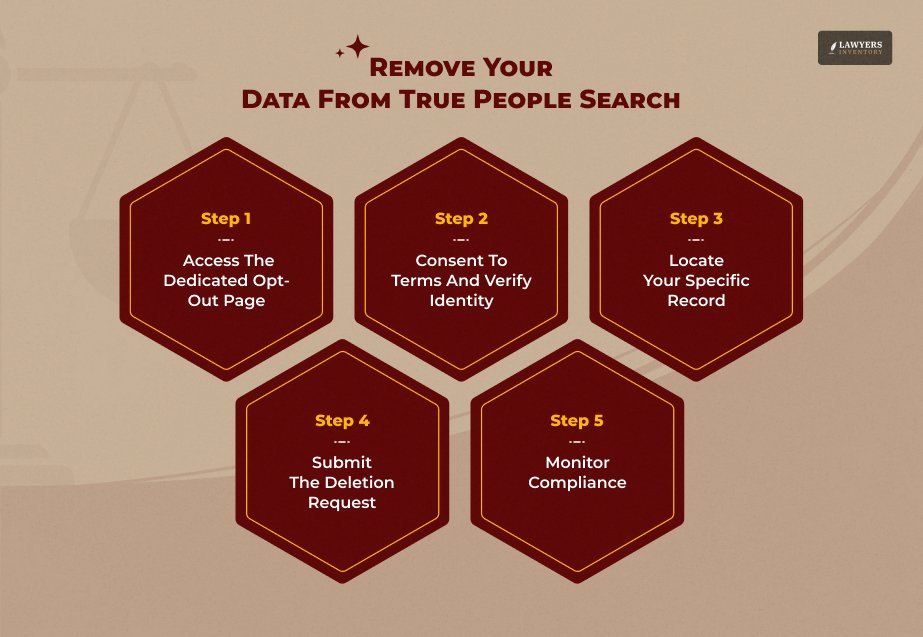
Fortunately, consumers have the legal right to opt-out under the CCPA. To comply, True People Search provides a manual removal process.
Follow these exact legal opt-out steps to scrub your records:
Step 1: Access The Dedicated Opt-Out Page
First, do not use the standard homepage search bar. Instead, navigate directly to their official compliance page.
Step 2: Consent To Terms And Verify Identity
Now, you should go through the disclosure statements about data removal. After that, ticking the checkbox will be your step to confirm that you are the one, then you must finish the reCAPTCHA test, and lastly, press the “Begin Removal” button.
Step 3: Locate Your Specific Record
After that, you’ll have to provide the following information:
- First and last names.
- City.
- State.
When examining the outcomes, you should be super cautious because data brokers often mix up the records of people with similar names. Once you find yours, click on “View Details” to get into your file.
Step 4: Submit The Deletion Request
Next, drag yourself down to the lowest part of your profile page. Click the “Remove This Record” button, then double-check that the screen changes to show submission success.
Step 5: Monitor Compliance
On the one hand, True People Search claims that they can handle the removal request within 72 hours. On the other hand, data brokers have the habit of re-scraping records.
This is why you should do a follow-up search after 14 days to make sure that the profile has been entirely removed.
Where To File Complaints If True People Search Ignores Your Opt-Out?
By law, data brokers must purge your data within legal timeframes. If they fail to comply, you should immediately file formal complaints with these agencies:
California Privacy Protection Agency (CPPA):
California residents can utilize the official CPPA Consumer Complaint Portal. Specifically, this addresses direct violations of the CCPA and the California Delete Act.
Federal Trade Commission (FTC):
Alternatively, you can submit reports at the official FTC Report Fraud Portal. Use this channel to flag deceptive corporate practices or non-compliance with removal requests.
State Attorneys General Offices:
Last, but not least, people outside California who are living in those states can reach out to the Attorney General Consumer Protection Division in their area.
Virginia, Colorado, Connecticut, and Texas are some of the states that carry out most of the investigations of these aspects at the state level.
Protect Your Legal Interests
In conclusion, businesses requiring background checks must completely bypass free data aggregates. Instead, you must contract an FCRA-compliant, certified consumer reporting agency.
By doing so, you successfully shield your entity from class-action liabilities. Meanwhile, private citizens can follow the manual removal steps listed above.
Alternatively, you can use automated privacy software to systematically scrub your data from hundreds of data brokers simultaneously.
Disclaimer: The information provided in this article is for general informational purposes only. It does not, and is not intended to, constitute legal advice. Please consult an attorney for legal help.
Leave A Reply






Power Stick Deodorant Recall FDA: Your Complete Safety Guide
Read More
Case Is Being Actively Reviewed By USCIS – Meaning And Timelines
Read More
Refund Risk Under Income Tax Demand Notice Section 143(1) Summary Adjustments [A Complete Legal Assessment]
Read More
2026 Rules For The Legal Age Of Marriage In India
Read More
PO Box 1280 Oaks PA – What It Is And How To Respond
Read More
0 Reply
No comments yet.