Summarize using AI





Prompt copied. Paste it into Gemini.
Quick Answer: What Is A Non Compete Agreement

A non compete agreement is a contract that restricts an employee from joining or starting a competing business for a defined period after leaving a job. Employers use these agreements to protect trade secrets, client relationships, and proprietary strategies. Enforceability depends on state law and varies dramatically - from a complete ban in California, Minnesota, North Dakota, and Oklahoma to broad enforcement in Florida and Texas. The FTC's attempted nationwide ban was struck down in 2024, formally removed from federal regulations in February 2026, and replaced with case-by-case enforcement. Non-compete law is, and will remain, state law for the foreseeable future.
When I first started researching this topic, I expected to find a settled body of law with predictable rules. What I found instead was one of the most rapidly shifting areas of employment law in the United States – reshaped by a failed federal ban, a wave of state legislation, and a federal agency that pivoted its entire enforcement strategy within eighteen months.
If you have been handed a non-compete agreement to sign – or if you are an employer trying to understand what you can legally require – what was true in 2023 may not be true today.
What Is A Non Compete Agreement?
A non-compete agreement – also called a non-competition agreement, covenant not to compete, or restrictive covenant – is a contract or clause that limits one party’s ability to engage in activities that could directly compete with another party for a specific period or within a defined area.
During an employment contract, employers often require workers to sign restrictive covenants. First, these contracts limit an employee’s options to join a rival company or launch a new startup.
Then, they stop former workers from using company-created intellectual property for personal gain to the detriment of the employer.
Finally, these restrictions remain in place for a specific period after the job ends, applying even if the employer terminates the worker at their discretion or for good reason.
Nearly 1 in 5 American workers – approximately 30 million people – are bound by non-competes. These agreements are no longer limited to senior executives. [Source: The Federal Trade Commission (FTC) Economic Analysis (2024 Rulemaking Record)]
They appear in contracts for hairstylists, security guards, and sandwich makers – roles where the rationale for restriction is difficult to justify.
Non-compete agreements also appear outside employment entirely. In business sales, a seller agrees not to launch a competing business after the transaction closes.
In partnership agreements, departing partners face similar restrictions. Each context operates under different legal rules – a distinction most general articles overlook. [Source: Uniform Partnership Act (UPA)]
The Core Elements Courts Evaluate
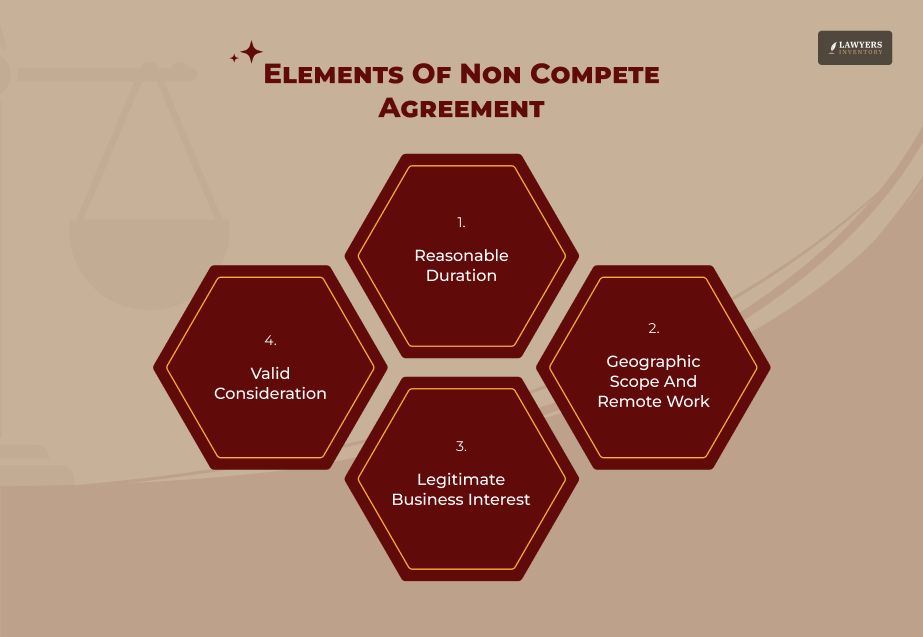
Not all non-compete agreements survive legal challenge. Courts assess enforceability against a consistent set of factors regardless of which state’s law applies. Understanding these elements is crucial to understanding what is a non compete agreement.
Reasonable Duration
Most courts consider six to twelve months reasonable for rank-and-file employees and up to two years for executives or senior sales roles. Anything beyond two years faces heavy skepticism.
Some states cap the maximum by statute – Massachusetts limits non-competes to twelve months. Florida’s 2025 CHOICE Act (Fla. Stat. §§ 542.41-542.45) moved in the opposite direction, permitting up to four years for high earners – the most employer-friendly framework in the country.
Geographic Scope And Remote Work
The geographic restriction must match the employer’s actual market footprint. A nationwide non-compete for a company that operates in three states is likely overbroad.
Remote work has complicated this analysis significantly. When an employee works from home in a ban state for an employer headquartered elsewhere, geographic restrictions carry little practical meaning. [Source: California Labor Code § 925, Employment Law Worldview]
For remote workers and digital businesses, courts are shifting toward industry-based restrictions rather than geographic ones, since location matters less when work happens online.
A clause prohibiting work for direct competitors in the same industry for twelve months is now more defensible than one drawing a geographic radius around a physical office. [Source: Reuters, DLA Piper]
Legitimate Business Interest
A non-compete is not enforceable simply because an employer wants one. The employer must demonstrate a genuine, protectable interest – typically trade secrets, confidential business information, or substantial investment in specialized training.
A blanket non-compete for a junior data entry clerk who had no access to proprietary information won’t survive judicial review. The restriction must match the actual interests at stake.
Valid Consideration
For a non-compete to be enforceable, the employee must receive something of legal value in exchange.
At the start of employment, the job offer typically constitutes sufficient consideration in most states. The situation becomes more complex when an employer asks an existing employee to sign one mid-employment or at departure.
After starting work, enforceability usually requires additional consideration – a raise, bonus, or promotion. Courts are skeptical of last-minute non-competes presented just before an employee leaves.
Types Of Non-Compete Agreements
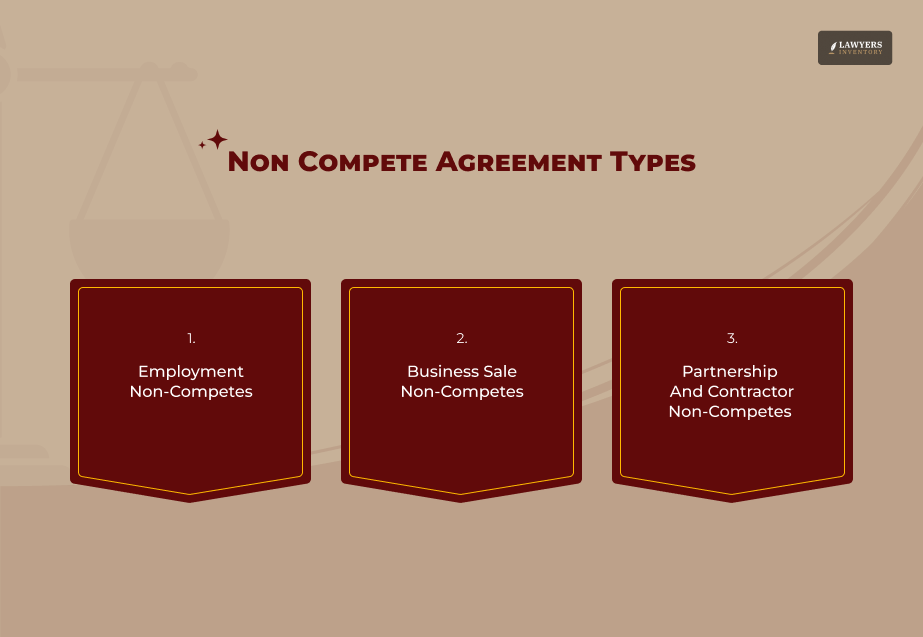
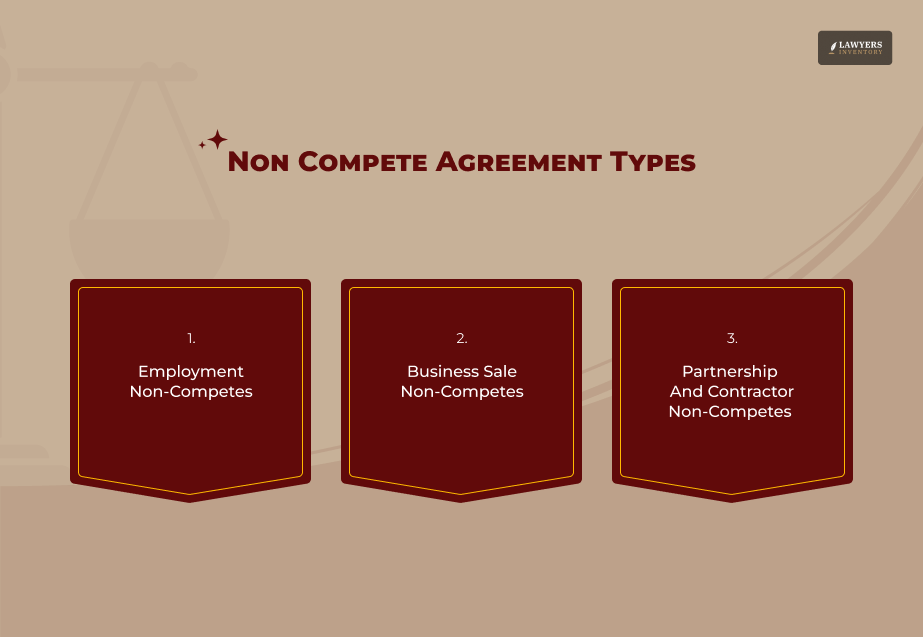
Now that you know what is a non compete agreement, here are some common types that you should know:
Employment Non-Competes
The most common form. These appear in offer letters, employment agreements, and standalone restrictive covenant agreements. They restrict where the employee can work and what business they can operate after employment ends.
Business Sale Non-Competes
These operate under fundamentally different legal rules. When someone sells a business, the buyer has a legitimate interest in ensuring the seller does not immediately start a competing operation. Courts recognize this as a genuine protectable interest and apply a more permissive standard.
California bans employment non-competes – but enforces non-competes in the sale of a business. The same geographic restriction that would be void in an employment context may be entirely enforceable when the same parties are on either side of a business transaction. [Source: Justia]
Anyone buying or selling a business cannot assume that their state’s employment non-compete rules tell the whole story.
Partnership And Contractor Non-Competes
Departing partners in law firms, medical practices, and professional service businesses frequently encounter non-compete provisions in partnership agreements. [Source: ABA Model Rule 5.6(a)]
The enforceability analysis tracks the same core factors as employment non-competes – but applicable professional ethics rules can shift the outcome, particularly in regulated industries like law and medicine.
Non-Compete vs. Related Agreements
Non-competes are one of three types of post-employment restrictions that frequently appear together. Understanding how they differ matters practically.
| Agreement | What It Restricts |
| Non-compete | Where you can work and what business you can operate |
| Non-solicitation | Which clients and colleagues you can contact |
| Non-disclosure (NDA) | What confidential information you can share |
A non-compete focuses on the work you perform. A non-solicitation focuses on the people or businesses you can contact. These are independent obligations. Signing one does not limit the enforceability of the others.
This difference is very practical for employees in ban states.
In California, non-compete agreements are invalid, but non-solicitation agreements protecting clients are enforceable, and NDAs protecting trade secrets are also enforceable.
An employee leaving employment in California who is not restricted by a non-compete will be subject to the provisions of a valid non-solicitation agreement.
The FTC Non-Compete Ban: The Complete Story
This is the section most articles either skip or cover incompletely. Here is the full arc.
- April 23, 2024: The FTC votes to issue a final rule banning almost all employee non-competes nationwide, with limited exceptions for senior executives earning above $151,164 in policy-making roles.
- August 20, 2024: The U.S. District Court for the Northern District of Texas vacates the rule nationwide in Ryan LLC v. FTC, finding the FTC exceeded its statutory authority. The rule never takes effect for any employer or employee.
- November 2024: The Fifth Circuit Court of Appeals upholds the vacatur.
- September 5, 2025: The FTC votes 3-1 to dismiss its appeals and formally accept the vacatur, ending any realistic prospect of a federal administrative ban for the foreseeable future.
- February 12, 2026: The FTC formally removes the non-compete rule from the Code of Federal Regulations. The rule is not coming back absent a new rulemaking or an act of Congress.
The FTC’s New Approach: Section 5 Case-by-Case Enforcement
The FTC did not walk away from non-compete enforcement. It pivoted to individual enforcement actions under Section 5 of the FTC Act.
The FTC issued a proposed consent order that prohibited Rollins – the parent company of Orkin – from applying non-competes to around 18,000 of its workers. The order becomes final on June 22, 2026. [Source: FTC Rollins Inc. Case Docket]
The FTC sent a non-compete warning letter to mortgage services company Mortgage Connect on May 8, 2026, and a public email for reporting competitive non-competes and created an FTC tip line for reports about noncompete.
The practical implication: broad, low-wage, or blanket non-competes now carry FTC enforcement risk even without a federal rule. The agency is targeting exactly the agreements that would have been banned under the vacated rule – one company at a time. [Source: Butzel, McDermott Will & Emery]
State Law Is Now Everything: The Current Landscape
Enforceability varies totally on where the worker works. States can be ordered into four categories:
- outright bans,
- heavy restrictions with income thresholds,
- reasonableness tests,
- employer-favorable frameworks
Based on this, here are a few things you should know:
- Prohibitive States (no non-competes allowed): California, Minnesota, North Dakota, Oklahoma (Washington in an ongoing sense effective 6/30/27 per HB 1155 signed in 2026).
- States with Income Restrictions (above income threshold): Colorado ($123,750 wage floor; criminal offenses to present a void agreement), Illinois ($75,000 wage floor), Oregon, Massachusetts (12-month limit; must provide garden leave; etc.) District of Washington, DC.
- States that broadly enforce: Florida (CHOICE Act effective July 1, 2025 allows up to four years for high earners – most employer-friendly in the country) and Texas (enforceable if tied to valid consideration and reasonable in scope).
Most remaining states apply a multi-factor reasonableness test weighing duration, geographic scope, and legitimate business interest.
The Blue Pencil vs. Red Pencil Doctrine
This is one of the most practically consequential distinctions in non-compete law – and one most articles explain poorly.
The Blue Pencil doctrine allows courts to modify an overbroad non-compete – crossing out unreasonable provisions and enforcing what remains. The Red Pencil doctrine treats any unreasonable provision as fatal to the entire agreement. [Source: Seyfarth Shaw Trade Secrets Analysis]
For employees in red pencil states, an overbroad clause provides the employer no protection at all – the entire agreement is void. For employers, this is a powerful incentive to draft narrowly. [Source: Fair Competition Law]
An aggressive clause in a red pencil jurisdiction eliminates all protection. A narrowly drafted, defensible clause provides actual protection.
Florida’s CHOICE Act (Fla. Stat. §§ 542.41-542.45) moved the state firmly into the blue pencil category – courts there are statutorily instructed to reform rather than void. [Source: Florida Statute § 542.335(1)(c)]
What Employees Should Know Before Signing
Most employees sign non-competes on their first day without reading them. That is a significant mistake.
- Read it before you need it. The time to understand a non-compete is before accepting the job – not when you want to leave it.
- Ask for a narrowed version. Employers who genuinely need protection will frequently accept a narrowed clause rather than lose a hire. Request a shorter duration, a more limited geographic scope, or a narrower definition of competing business.
- Check your state’s current law. If you live in a ban state, the clause may already be void. If your state has an income threshold, verify whether you fall above or below it.
- Consult an employment attorney for significant restrictions. For senior roles or any situation involving a meaningful restriction on your livelihood, an hour of attorney time before signing is worth far more than the cost of litigation after.
What Employees Can Do After Signing
Here are a few things that employees can do once they have signed the non compete agreement:
Challenge Enforceability:
Have an employment attorney review the clause against your state’s current law before assuming it is binding. A clause enforceable five years ago may be void today under new state legislation.
Negotiate A Carve-Out Or Geographic Limitation:
Many employers will negotiate post-employment restrictions, particularly if the departure is amicable. A request to carve out a specific employer or geography is often granted when the alternative is costly litigation.
Negotiate A Buyout:
Some employers will release a non-compete in exchange for something they value – a longer notice period, a structured client transition, or assistance training a replacement.
Weigh The Costs Honestly:
The cost of not fighting – lost wages, career damage – may exceed legal fees. But litigation over a non-compete is expensive and uncertain.
The decision requires an honest assessment of the clause’s enforceability in your specific state, the employer’s likely enforcement history, and the actual career impact of compliance.
What Employers Need To Know In 2026
The landscape has shifted decisively against overreach. Broad, blanket non-competes now carry risk on multiple fronts – judicial, regulatory, and reputational.
Use Them Sparingly:
Non-competes make the most sense where the employee has unusual access to strategy, trade secrets, or highly sensitive market relationships. For much of the workforce, narrower restrictions create less friction and hold up better in court.
Segment By Role And Jurisdiction:
The same clause cannot lawfully apply to a senior engineer in Texas and a customer service representative in Colorado. Templates that ignore jurisdictional variation create serious compliance exposure.
Document The Legitimate Business Interest:
Courts want to see a specific, articulable reason why this employee, in this role, needs this restriction. Generic language about protecting business interests is insufficient in most courts.
Watch The FTC’s Section 5 Enforcement:
The Rollins consent order signals continued federal attention on exactly the agreements that resemble the vacated rule. Companies with broad, low-wage non-competes remain at risk even without a federal rule on the books.
In Red Pencil States, Draft Narrowly Or Lose Everything:
An overbroad clause does not get reformed – it gets voided. Narrow drafting is both better legal strategy and better risk management.
Disclaimer: This article is for general informational and educational purposes only. It does not constitute legal advice. Non-compete law changes frequently and varies significantly by state. If you have been asked to sign a non-compete or are considering leaving a job where you signed one, consult a qualified employment attorney in your jurisdiction before taking action.
Sources:
- Federal Trade Commission – Non-Compete Clause Rule, 16 CFR Part 910 – ftc.gov/legal-library/browse/rules/noncompete-rule
- Ryan LLC v. Federal Trade Commission, 746 F. Supp. 3d 369 (N.D. Tex. 2024)
- OpenAgreements – Where the Federal FTC Non-Compete Ban Stands (2026) – openagreements.org
- LegalClarity – Non-Compete Agreement Ban Update: What’s the Status Now (May 2026) – legalclarity.org
- LegalClarity – Non-Compete Laws by State: What’s Banned, What’s Allowed (June 2026) – legalclarity.org
- Katz Banks Kumin LLP – Noncompete Agreements: What’s the Status of Laws Restricting Them Nationwide? (March 2026) – katzbanks.com
- Loio – Non-Compete Laws by State: 2026 Tracker (June 2026) – loio.com
- Vaquill – Non-Compete Law Updates 2026: New State Laws and the FTC’s Exit (June 2026) – vaquill.ai
- Expert Zoom – FTC Non-Compete Ban 2026: Know Your Rights (May 2026) – expert-zoom.com
- Halstonberg – Non-Compete Agreement Enforceability Overview (May 2026) – halstonberg.com
- EmploymentLawAid – Non-Compete Agreements: What Workers Need to Know (2026) – employmentlawaid.org
- White & Case – Global Non-Compete Resource Center – whitecase.com
- California Business and Professions Code § 16600 – Non-Compete Ban
- Minnesota Statutes § 181.988 – Covenants Not to Compete Void in Employment Agreements
- Oklahoma Statutes 15 O.S. § 219A – Noncompetition Agreements
- North Dakota Century Code § 9-08-06 – Contracts Restraining Business
Leave A Reply






Do You Pay Taxes On Lawsuit Settlements? IRC Section 104 Explained
Read More
Non-Disparagement Clause Explained: Requirements, Enforceability, And What Changed Recently
Read More
Best Practices For Successful Trademark Registration
Read More
Understanding Your Rights: A Guide To The Legal Process
Read More
How To Clear A Bench Warrant Without Going To Jail: A Legal Guide
Read More
0 Reply
No comments yet.