Summarize using AI





Prompt copied. Paste it into Gemini.
Quick Answer

Yes, adultery WhatsApp chat evidence is admissible in family courts, but it rarely serves as conclusive proof on its own. Modern courts view digital messages as circumstantial evidence that must be strictly authenticated and backed by supporting facts. Simple screenshots are easily forged, meaning your digital trail must survive rigorous compliance frameworks before a judge will consider it.
One thing I had no idea about was that chat records from WhatsApp can work as proof of an act of adultery to be submitted in the family courts.
In many cases, the biggest reason for introducing such proof can be either challenging the claim for monthly maintenance or support to the divorce petition.
Recent Indian High Court judgments make it clear that even if privacy is considered or there is a lack of proper electronic certification to start with, if the court feels that a fair trial and truth-finding are involved, then evidence in the nature of a digital chat should not be excluded.
But isn’t adultery WhatsApp chat evidence a violation of the right to privacy of an individual? If so, how can one produce such chats to court as evidence for divorce cases?
Admissibility vs. Sufficiency In Adultery WhatsApp Chat Evidence
Many litigants mistake “admissible” for “sufficient.” Admissibility means the judge allows the document into the court record. Sufficiency dictates whether that document is strong enough to win the case.
In matrimonial law, adultery demands a high standard of proof because it fundamentally alters marital obligations, child custody, and alimony distributions.
The Isolated Chat Flaw:
A message stating “I miss last night” hints at intimacy but does not explicitly prove voluntary sexual intercourse – the strict statutory definition of adultery under personal laws like the Hindu Marriage Act, 1955 [Source: The Matrimonial Lawyers]
The Circumstantial Chain:
Courts require an unbroken sequence of corroborative facts. A WhatsApp chat only becomes legally devastating when it is explicitly paired with external, verifiable data anchors.
The Evidentiary Chain Equation
To build legally sufficient proof of adultery, your evidence package must follow this cumulative chain:
• Primary Digital Foundation: Certified WhatsApp Chat Logs
• Physical Tracking Layer: Hotel Check-in Data & Mobile Tower Locations
• Financial Intent Layer: Shared Financial Records or Credit Card Transactions
The Legal Framework: BSA 2023 Update
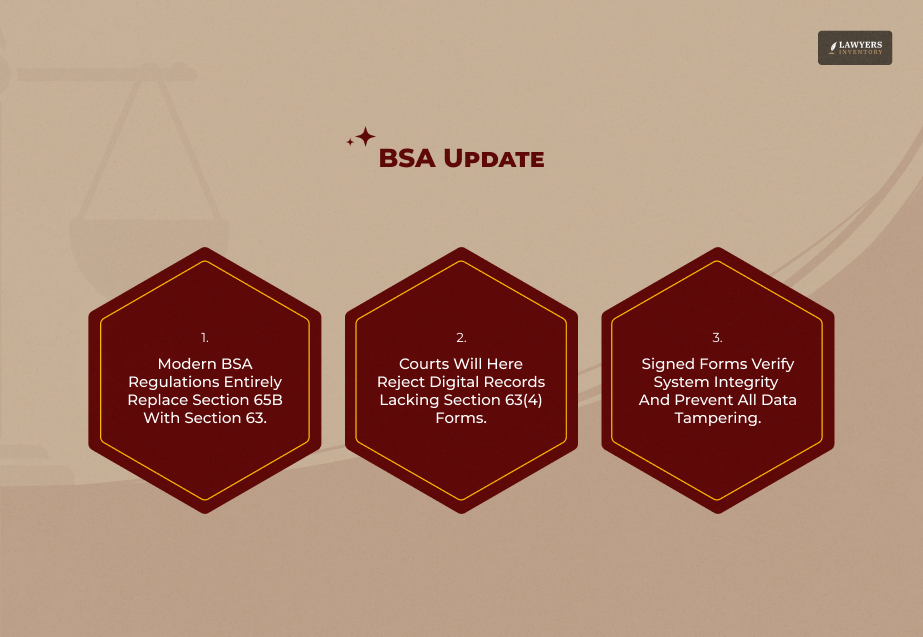
The legal landscape for electronic evidence evolved rapidly with the enforcement of the Bharatiya Sakshya Adhiniyam, 2023 (BSA). This completely overhauled the old Indian Evidence Act, transforming how electronic records are processed.
The Death Of Section 65B:
If your lawyer references a “Section 65B Certificate,” your legal strategy is dangerously outdated. Under the modern BSA framework, electronic certification is governed exclusively by Section 63.
The Mandatory Section 63(4) Certificate:
The court will entirely reject any secondary evidence – such as a printed chat, exported PDF, or flash drive submission – unless a signed Section 63(4) certificate accompanies it.
This certificate confirms the integrity of the device, verifies that no data tampering occurred, and details the operating system and hardware specifications used during extraction.
Screenshots Vs. Forensic Images: Which Is Stronger As Adultery WhatsApp Chat Evidence?
How you present your digital files determines their legal weight. The table below shows the hierarchical evidentiary value of digital information in modern courtrooms:
| Evidence Format | Preservation Level | Main Vulnerability | Court Acceptability |
| Cropped Screenshots | Captures visible text only. | High risk of AI fabrication; lacks context. | Very Low (Highly Objected) |
| Exported Chat Thread | Captures chronological text and timestamps. | Can still be altered if the certificate is missing. | Medium to High (Requires BSA Cert) |
| Forensic Image + Hash | Bit-for-bit device clone with deep metadata. | Requires specialized cyber forensic extraction. | Excellent (Virtually Unassailable) |
The Right To Privacy Paradox
A major legal battleground in divorce proceedings is how chat evidence was collected. If you install spyware on your spouse’s phone or crack their password without permission, you trigger a direct constitutional conflict.
The Fair Trial Balance
The landmark judgment by the Madhya Pradesh High Court in Anjali Sharma v. Raman Upadhyay (June 16, 2025) drastically altered this dynamic.
The court ruled that while the Right to Privacy under Article 21 is a fundamental pillar, it is not absolute. [Source: Cyber Privilege]
In matrimonial disputes, the right to a fair trial takes precedence. This means a family court can admit privately intercepted chats if they are highly relevant to proving infidelity.
The Section 14 Shield
Under Section 14 of the Family Courts Act, family court judges enjoy broad discretion. They can receive any evidence that helps resolve a marital dispute effectively, bypassing the rigid restrictions found in standard civil and criminal trial procedures.
Critical Warning: While the family court may accept your illegally obtained chats to assess adultery, you are not immune to outside liability. Your spouse retains the right to file separate civil or criminal lawsuits against you under data privacy laws or the Information Technology Act for unauthorized data access.
The “Selective Deletion” Defense
On facing an incriminating set of WhatsApp chats, the most likely defense for the other spouse is to allege that the messages have been tampered with or that they have been edited and are not in the context of the whole conversation of the party.
The court ruling of 2026 at the Bombay High Court in Supriya Gaurav Devare v. Gaurav Jitendra Patil has given a new vigor to this defense. In this judgment, the court annulled the divorce decree which was solely supported by isolated WhatsApp messages. [Source: Law Beat]
The court clearly reasoned that proving facts like mental cruelty or adultery requires more than a few selective chat fragments.
The evidence from a conversation should be complete to maintain the context. This is a necessary condition as the other party must be given a chance to oppose the version that has been presented by the opposite party.
How To Correctly Preserve WhatsApp Chats For Legal Use
To ensure your digital evidence stands up to scrutiny under modern legal guidelines, you must follow a strict, standardized preservation workflow:
Step 1: Halt All Active Deletion:
The moment a legal dispute becomes a reality, stop clearing chats, formatting devices, or deleting attachments.
Any abrupt gap in your backup history gives opposing counsel room to claim evidence tampering.
Step 2: Use The Native Export Feature:
Do not rely on screenshots. Use WhatsApp’s built-in “Export Chat” utility found in the settings menu.
This generates an unedited, continuous .txt file that captures the exact sequential text alongside accurate server timestamps.
Always choose the “Include Media” option to anchor linked images or voice notes to their corresponding timestamp markers.
Step 3: Extract And Document Metadata:
Record the core identifier details of the conversation. This includes the following:
- Complete phone numbers with country codes.
- Saved contact names.
- Exact network transmission timestamps.
Step 4: Calculate The Cryptographic Hash Value:
Run the exported .txt file through a cryptographic algorithm, such as SHA-256, to generate a unique digital fingerprint.
Document this exact hash value in your records. This proves to the court that the underlying data file remained unaltered from the moment of export to its formal submission in the trial.
Step 5: Draft The Mandatory Section 63 BSA Certificate:
Work alongside your legal team to prepare the required statutory certificate.
The Evidentiary Lifecycle Of Adultery WhatsApp Chat Evidence
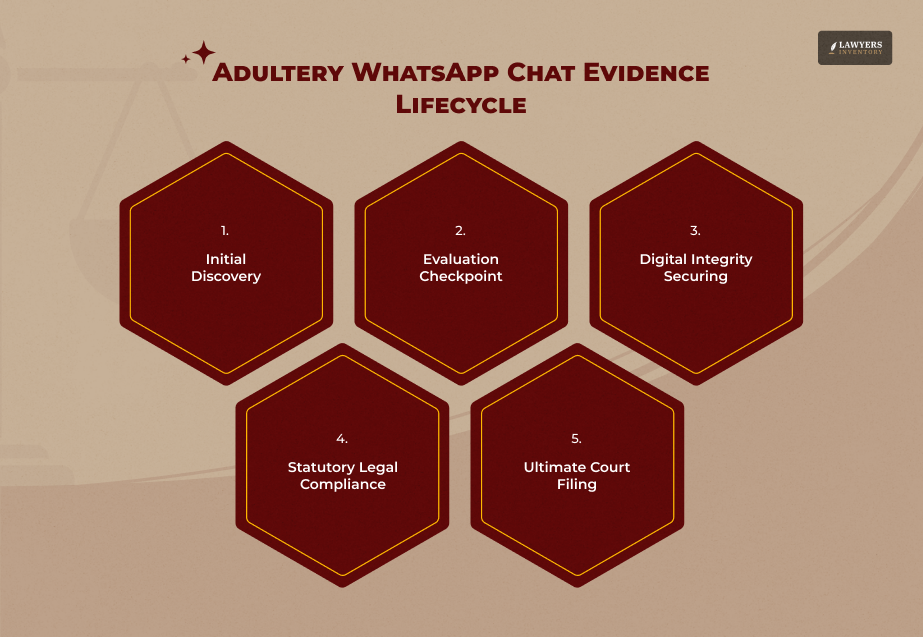
When building your legal strategy, your digital proof moves through distinct phases depending on its handling:
- Phase 1: Initial Discovery – Spousal suspicion arises, or incriminating messages are discovered.
- Phase 2: Evaluation Checkpoint – If evidence consists only of screenshots, the risk of court rejection is extremely high due to low evidentiary weight. Using native export routines ensures a safe workflow
- Phase 3: Digital Integrity Securing – The native .txt file is exported with all accompanying media. A unique SHA-256 Hash value is generated immediately to lock the data file from future modification claims.
- Phase 4: Statutory Legal Compliance – A comprehensive Section 63 BSA certificate is drafted to legally validate the hardware and software extraction process.
- Phase 5: Ultimate Court Filing – The validated digital record is introduced into the family court dossier alongside supporting physical evidence like hotel logs, tower records, and banking histories.
Common Fatal Pitfalls (What NOT To Do)
When litigants panic, they often make critical legal errors that destroy their case or turn them into criminals under data privacy laws:
Logging Into Web WhatsApp Without Consent:
Peeking at a phone is one thing; installing their WhatsApp account onto your laptop via QR code scanning without consent constitutes illegal hacking under Section 66 of the Information Technology Act.
Baiting The Spouse Into Coerced Confessions:
Sending aggressive, threatening, or highly manipulative texts to force your spouse to say “Fine, I am seeing someone else!” backfires. Judges dismiss text message statements obtained under heavy emotional or physical coercion.
Modifying Contact Names For Shock Value:
Changing the third party’s contact name to a provocative insult or false profile alias right before exporting screenshots will cause your evidence to fail verification checks under forensic cross-examination.
Disclaimer: This document is designed strictly for educational awareness regarding digital evidence rules. It does not constitute formal legal counsel. Matrimonial laws vary significantly across jurisdictions. Always consult a licensed family law advocate to evaluate your specific case.
Source:
- iPleaders – The Bharatiya Sakshya Adhiniyam, 2023 (BSA)
- Indian Express – The Family Courts Act, 1984
- The Information Technology Act, 2000
- Indian Kanoon – Supriya Gaurav Devare v. Gaurav Jitendra Patil (Bombay High Court, 2026)
- Wife’s WhatsApp Chats v. Husband (Madhya Pradesh High Court, 2025)
- Times of India – Vibhor Garg v. Neha (Supreme Court, 2025)
- LexSpeak Law Review – Sachin Arora v. Manju Arora / Tanvi Chaturvedi v. Smita Shrivastava (Supreme Court, 2026)
Leave A Reply







Do You Pay Taxes On Lawsuit Settlements? IRC Section 104 Explained
Read More
Non-Disparagement Clause Explained: Requirements, Enforceability, And What Changed Recently
Read More
Best Practices For Successful Trademark Registration
Read More
Understanding Your Rights: A Guide To The Legal Process
Read More
How To Clear A Bench Warrant Without Going To Jail: A Legal Guide
Read More
0 Reply
No comments yet.