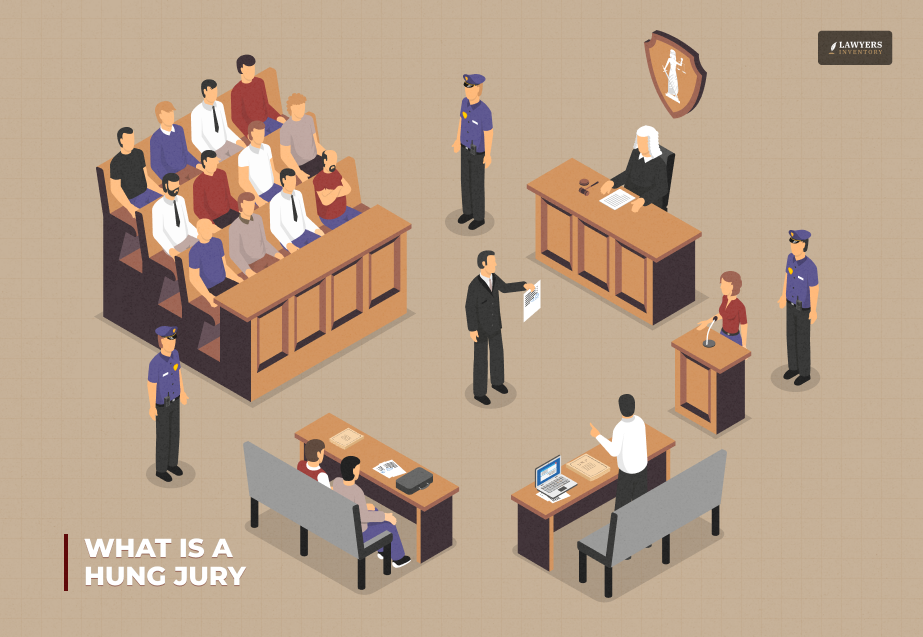
Quick Answer: What Is A Hung Jury?

A hung jury occurs when jurors cannot agree on a verdict. Although the law requires a unanimous decision, the jury sometimes deadlocks. Consequently, they fail to reach a verdict, and the judge declares a mistrial.
A jury walks into a courtroom after days of deliberation. The foreperson hands a note to the judge: “We cannot agree.” The judge reads it. The attorneys exchange glances. The defendant holds their breath.
That moment – quiet, procedural, consequential – is a hung jury.
Most people assume a hung jury means the defendant goes free. That is rarely true. The case does not end. The charges do not disappear.
What actually happens next depends on the prosecutor, the strength of the remaining evidence, and decisions made in the weeks that follow.
Understanding what is a hung jury matters whether you are a defendant, a juror, a victim’s family member, or simply a citizen trying to make sense of a high-profile trial.
What Is A Hung Jury?
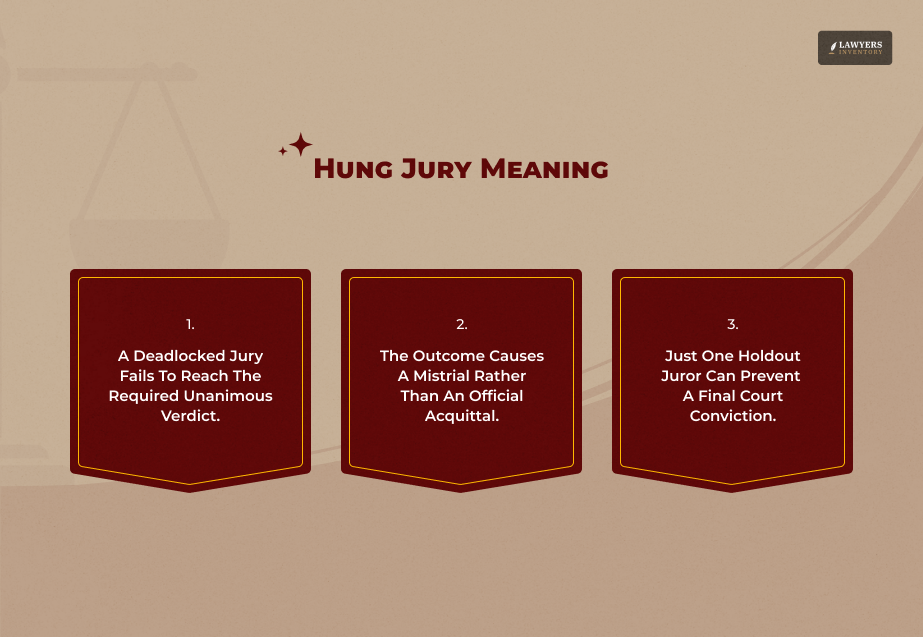
When a hung jury – also referred to as a deadlocked jury – happens, it means that the jury has failed to come up with a unanimous verdict. According to the Legal Information Institute, this happens when the jury is “unable to reach a verdict by the required voting margin.”
In that case, it will be dismissed as a mistrial and, if there is a retrial, the case may have to begin once again [Source: Jacquelinescottlaw].
Now, there is no federal statute that includes the phrase “hung jury.” However, Federal Rule of Criminal Procedure 31(b)(3) allows partial verdicts.
For instance, in Ramos v. Louisiana (2020), the Supreme Court upheld the requirement for convictions, i.e., a vote of the entire jury, to prevent a single holdout from preventing the decision [Source: Supreme Court].
Understanding what is a hung jury also requires distinguishing it from what it is not. So, unlike what a lot of people might sometimes think, a hung jury is not an acquittal.
An acquittal is a legally binding decision by the court that the accused is not guilty. A deadlocked jury does not result in such a verdict, and the case remains open.
This constitutional requirement is what gives the hung jury its legal significance: a single holdout juror – one person who maintains reasonable doubt – can prevent a conviction entirely.
The Verdict Requirement: Why Hung Juries Exist
The American constitutional structure creates hung juries on purpose. Specifically, criminal trials require completely unanimous verdicts for both convictions and acquittals.
Therefore, just one juror can block a final decision. This strict requirement reflects a deliberate choice by the legal system. The state must convince every single juror before stripping a citizen of liberty.
Consequently, the law sets an intentionally high standard. The system demands total agreement because the consequences of a conviction are permanent; a defendant might face decades in prison. Before the trial, cases must pass several legal checkpoints.
Prosecutors choose to charge a suspect directly, or a grand jury issues an indictment based on probable cause. Ultimately, the unanimity rule serves as the final safeguard against government overreach.
What Is The Purpose Of A Unanimous Jury Verdict?

One of the U.S. Constitution's key features is that a unanimous vote of the jury is needed for the final conviction of a criminal defendant so that the defendant is not wrongly convicted. As the burden is on the state to convince all of the twelve jurors of the defendant's guilt beyond a reasonable doubt, a vote of even one juror against the majority would prevent the jury from returning a verdict. Because of this, no finding of guilt or innocence of the defendant will result from such a hung jury.
Common Causes Of Hung Juries
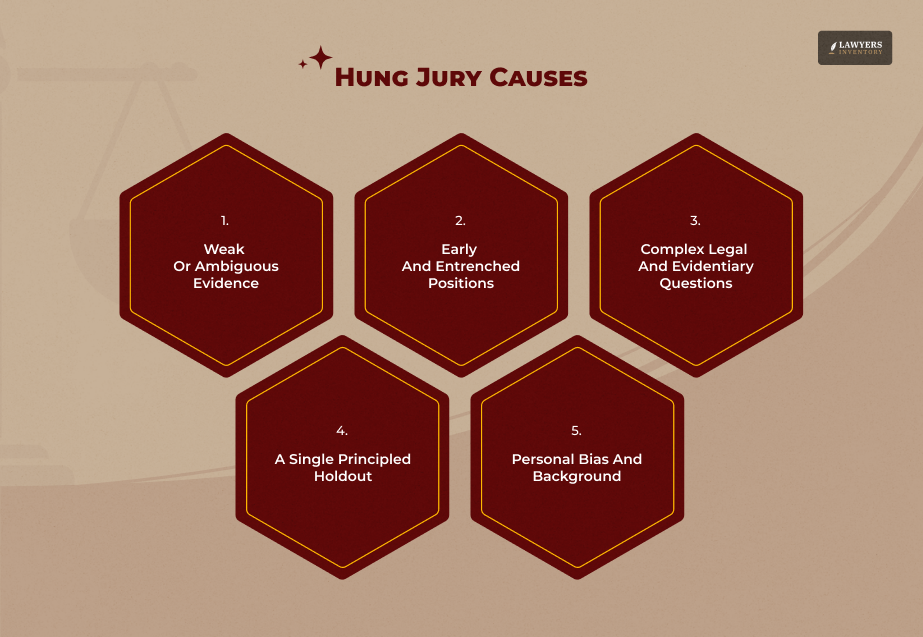
Hung juries do not happen randomly. Research into jury deliberations has identified consistent patterns that make deadlock more likely.
Weak Or Ambiguous Evidence
Weak evidence is a significant factor in cases that result in a hung jury. When the prosecution’s case relies on circumstantial evidence, conflicting testimony, or gaps in the chain of evidence, individual jurors may reach different conclusions about what the evidence actually proves.
Early And Entrenched Positions
Jurors usually hold onto their early opinions about a defendant’s guilt or innocence in a criminal trial.
Also, if the jurors are evenly split on the first vote, the jury is more likely to end up as a hung jury.
Jurors that focus on reaching a verdict in deliberations tend to end up as hung juries more often than do jurors who emphasize evaluating the evidence.
Complex Legal And Evidentiary Questions
Some cases involve multiple charges, technical scientific evidence, or intricate legal instructions that different jurors interpret differently. Complexity breeds disagreement.
A Single Principled Holdout
Sometimes the deadlock reflects not confusion but conviction. One juror who maintains genuine reasonable doubt – regardless of pressure from the other eleven – is exercising exactly the right the law grants them.
Personal Bias And Background
Despite the screening process in jury selection, jurors bring their life experiences, values, and perspectives into the deliberation room. In some cases, these differences prove irreconcilable.
What Happens When A Jury Is Hung?
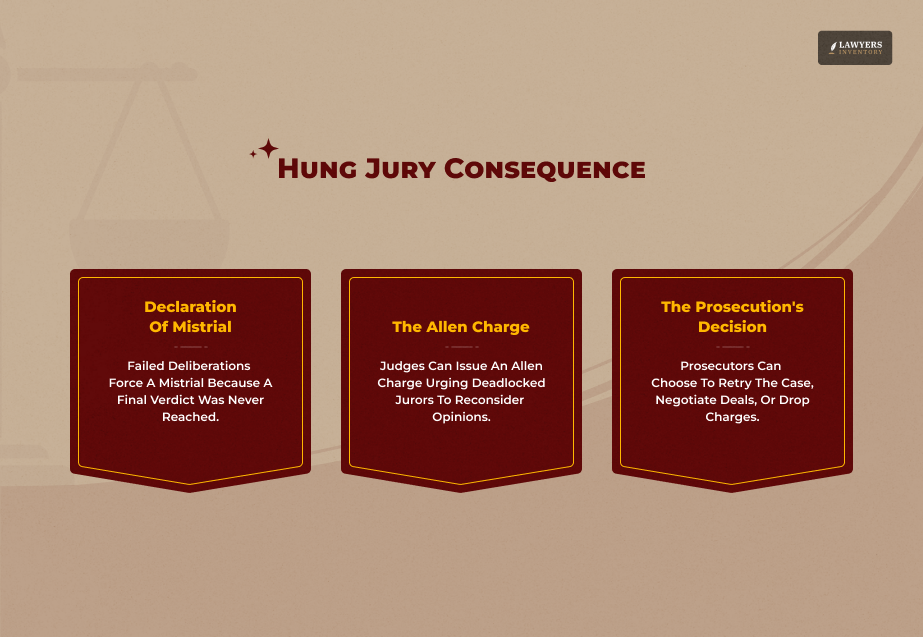
The procedural sequence following a hung jury is well-established, though judges retain discretion at several key steps.
The Allen Charge
When a judge becomes aware that a jury has reached an impasse, their initial reaction is normally not to order a mistrial.
In certain areas, courts are allowed to issue a jury with an ‘Allen charge.’ Sometimes labeled as a ‘dynamite charge,’ it encourages the dissenting jurors to revisit their thinking after a final attempt to prevent the jury from hanging.
The jury is told through the Allen charge that they should try to reach an agreement on the issue, that it is their duty even if they can conscientiously manage to do so, and that in case they see that their previous view is incorrect, they should reconsider their opinions.
Judges usually do not go too far: if an order is issued to jurors to abandon a genuinely held belief, this can be grounds for an appeal.
Declaration Of Mistrial
If the Allen charge fails or the judge determines the jury is hopelessly deadlocked, the judge declares a mistrial.
Understanding what is a mistrial in this context is important: a mistrial due to a hung jury is not a finding for either side. It simply means the trial has ended without a verdict. The case does not disappear – it is reset.
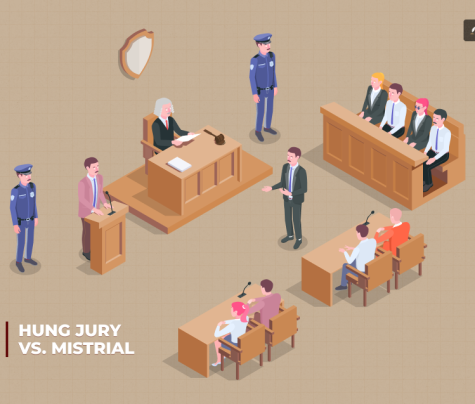
A hung jury vs mistrial distinction is worth clarifying precisely. A hung jury is one specific cause of a mistrial.
But mistrials can also arise from juror misconduct, attorney misconduct, inadmissible evidence being presented, or other procedural failures that compromise trial integrity.
A good example of this would be the Karen Read case. I have covered that in depth in one of our previous articles – check that out for a better idea.
Nevertheless, keep one thing in mind: Not all mistrials involve a hung jury – but all hung juries result in mistrials.
The Prosecution’s Decision
When a mistrial is declared, the prosecution has a few options. They can either retry their case, work out a plea deal with the defendant, or simply drop the charges.
Making this choice is probably the most important decision to take following a situation where the jury was unable to reach a verdict.
Usually, whether or not the decision to retry is made, it is a matter of how bad the crime was, what the evidence was like, and how the jurors disagreed with each other.
A vote of 11-1 in favor of conviction implies a powerful case that may well succeed with a new jury. But a vote of 6-6 leads one to question whether the defendant and defense attorney want to invest their resources in a new jury and trial.
And, a mistrial gives room for the defendant to plead guilty and accept a lesser sentence through a plea bargain.
The situation is such that a failure on the part of the jury in their duty does not mean there will be an inability on any future aspect of a defendant appearing in Court again.
On the positive side of this situation, a mistrial may provide a way for the defense to reach a plea arrangement if the prosecutor is willing to reduce the defendant’s charge(s) or sentence.
What Is A Partial Hung Jury?
Not every hung jury involves deadlock on all counts. A partial hung jury occurs when the jury agrees on some charges but deadlocks on others.
Federal Rule of Criminal Procedure Rule 31(b)(3) explicitly authorizes partial verdicts. Most states have parallel provisions. The judge accepts the counts where agreement exists and declares a mistrial on the remaining counts only. [Source: US Courts]
For example: a defendant faces three counts – armed robbery, assault, and weapons possession.
With regard to the jury’s verdict, there is complete consensus on the conviction for possession of weapons and complete freedom from blame about the charge of assault. On the other hand, the decision on the armed robbery charge divides into a 10-2 deadlock.
Somewhere, the judge will record a conviction against the accused for the possession of weapons, a finding of acquittal for the assault, and pronounce a mistrial with the armed robbery charge.
This time, the prosecutor will have a go at the defendant by bringing the accused to trial on the charge of armed robbery only.
What Happens If A Jury Is Hung Twice?
This is one of the most commonly searched questions following high-profile hung jury cases – and the answer is less definitive than most people expect.
A second hung jury does not legally block a third trial. Double jeopardy only applies after a final acquittal or conviction.
However, what happens if a jury is hung twice?
This double deadlock heavily shifts the prosecution’s strategy. The second split jury signals that the evidence cannot convince twelve people beyond a reasonable doubt. Consequently, prosecutors often drop the charges entirely.
Alternatively, they offer a highly favorable plea bargain. This shift gives the defense massive leverage during negotiations. Ultimately, the law allows a third trial, but the prosecutor makes the final choice.
Hung Jury, Sequestration, And Deliberation Dynamics
The environment of deliberations can itself influence whether a jury hangs. In high-profile cases where a sequestered jury is ordered – where jurors are isolated in a hotel, cut off from media and outside communication – the psychological pressures of prolonged confinement can affect deliberation dynamics in both directions.
Sequestration can deepen divisions by keeping jurors in close quarters under stress. It can also accelerate agreement if jurors simply want to go home. Neither outcome is ideal from a justice standpoint. Courts weigh these trade-offs carefully when deciding whether sequestration is necessary.
Does Double Jeopardy Apply After A Hung Jury?
Many people mistakenly believe double jeopardy protects a defendant from a retrial after a hung jury.
However, the Fifth Amendment only triggers this protection when a case concludes with a formal conviction, an acquittal, or a court-ordered judgment of acquittal. [Source: Crist v. Bretz, 437 U.S. 28 (1978)]
When a jury cannot reach a decision, the judge declares a mistrial, leaving the matter legally pending. Because the first trial never produced a final judgment, the constitutional safeguard does not apply.
Consequently, the prosecutor can immediately schedule a second trial without violating double jeopardy rules. [Source: The Defenders]
Hung Jury Rates In The United States
Hung juries are less common than public attention to high-profile cases might suggest. Criminal juries deadlock more often than civil juries.
This is explained in part because the burden of proof in civil cases – preponderance of the evidence – is lower than the beyond-a-reasonable-doubt standard in criminal cases.
Federal courts have a much lower rate of hung juries than state courts. Federal juries often consist of six jurors rather than twelve in criminal cases, and federal prosecutors typically bring only cases with strong evidence.
Research suggests that the overall hung jury rate in felony trials is roughly 5-6% at the state level. In high-profile cases – those involving politically charged facts, extensive pretrial publicity, or deeply divisive social questions – the rate is considerably higher.
Hung Jury: Advantages And Disadvantages For The Defendant
A hung jury is not a straightforward win for the defense, but it carries real strategic value.
Advantages For The Defendant:
- Avoids immediate conviction
- Creates an opportunity to negotiate a more favorable plea deal
- Gives defense counsel time to refine strategy and address weaknesses before any retrial
- Signals genuine reasonable doubt among at least some jurors
- May prompt the prosecution to drop charges if evidence is marginal
Disadvantages For The Defendant:
- Does not end the case – the threat of retrial continues
- Prolongs legal proceedings, stress, and cost
- Does not result in formal exoneration or record clearing
- Leaves the defendant in legal limbo, often with continued pretrial conditions
Hung Jury In The Broader Criminal Justice Context
Criminal proceedings are initiated when a defendant is charged by a prosecutor or a grand jury delivers an indictment.
The legal procedures after that include arraignment, pre-trial motions, and the trial itself. If a jury in the trial phase is a hung jury, it means the jury was unable to reach a consensus.
Also, if a jury fails to agree in the sentencing phase of a capital case, the law has to be followed, to be exact.
For federal death penalty cases and death penalty states, when a hanging jury occurs, the defendant automatically gets a life sentence instead of an execution.
If the court’s decision leads to a conviction, it is possible for the defendant to pursue executive clemency.
But there is a critical difference between a commutation and a pardon here. If a person is commuted, they get a reduced term without erasing their criminal history.
Whereas a regular pardon removes the conviction entirely. Given that state laws often differ, offenders require the help of well-versed lawyers to understand and go through these clemency processes.
Any prior hung jury is part of this case’s jurisprudent record. The evidence that caused the first jury to disagree might become very useful in later stages after conviction if the person is challenging the conviction.
In essence, the whole system seeks to find the right balance between ensuring convictions are correctly made and protecting the individual rights of the defendants.
Disclaimer: This article is for general informational and educational purposes only. It does not constitute legal advice. If you are involved in a case that has resulted in a hung jury, consult a qualified criminal defense attorney immediately to understand your rights and options going forward.
Sources:
- Legal Information Institute, Cornell Law School – Hung Jury (law.cornell.edu/wex/hung_jury)
- Wikipedia – Hung Jury (en.wikipedia.org)
- LegalSynopsis – Hung Jury Meaning: What It Is and What Happens Next (April 2026)
- The Defenders – Understanding Hung Jury: Implications, Options, and Strategies (2024)
- Law Offices of John W. McKendree – Hung Juries
- Study.com – Hung Jury: Definition, Procedure and Reasons
- Perry Tribune – Views from the Bench: Hung Juries (September 2025)
- Ramos v. Louisiana, 590 U.S. 83 (2020)
- Federal Rule of Criminal Procedure, Rule 31(b)(3)
- U.S. Constitution, Fifth Amendment – Double Jeopardy Clause
Leave A Reply






Hung Jury vs. Mistrial: What Is The Difference And Why It Matters
Read More
NarodniyDimUkraina: An Overview Of The Kyiv-Based Brand Preserving Ukrainian Craftsmanship
Read More
What Is A Mistrial? Legal Definition, Causes, And What Happens Next
Read More
What Is A Sequestered Jury? Legal Definition, Process, And Everything You Need To Know
Read More
Commute Vs. Pardon: What Is The Difference And Which One Do You Need?
Read More
0 Reply
No comments yet.