Every so often, a headline announces that a president or governor has “commuted” someone’s sentence.
The news cycle moves quickly, and most people absorb the phrase without fully understanding what it means legally – or how significantly it differs from a pardon, parole, or expungement.
Understanding what it means to commute a sentence matters beyond headline comprehension.
For individuals navigating the criminal justice system, for families of the incarcerated, and for anyone seeking to understand how executive power intersects with the courts, commutation is one of the most consequential – and most misunderstood – tools in American law.
So, wondering what does it mean to commute a sentence in law? Keep reading!
Quick Answer: What Does It Mean To Commute A Sentence
To commute a sentence means to substitute a sentence imposed by the judiciary for a lesser sentence – in other words, to reduce or lessen a sentence resulting from a criminal conviction. [Source: Legal Synopsis] The conviction itself remains intact. Only the punishment changes. This power belongs exclusively to the executive branch – the President for federal sentences, and governors for state sentences – and cannot be exercised by any court.
Legal Definition: What Does It Mean To Commute A Sentence?
A commuted sentence is a criminal sentence that has been reduced or cut short by an executive authority, typically the president or a state governor.
In legal contexts, it refers to the official act of lowering a penalty already imposed by a court, without reversing the underlying conviction.
The word itself comes from the Latin commutare, meaning to change or exchange. In legal practice, it almost always appears in the context of criminal sentencing – though it carries a parallel meaning in contract and financial law, which is addressed later in this guide.
Three elements define every act of commutation:
- A court has already imposed a sentence following a criminal conviction
- An executive authority intervenes and reduces or replaces that sentence
- The underlying conviction remains on the person’s record
A commuted sentence does not erase what happened in the courtroom. The conviction stays on the record. But, according to US Legal Forms, the punishment itself changes, and that person may walk out.
This distinction – conviction unchanged, punishment reduced – is the most important thing to understand about what it means to commute a sentence. It separates commutation from every other form of post-conviction relief.
Who Holds The Power To Commute A Sentence?
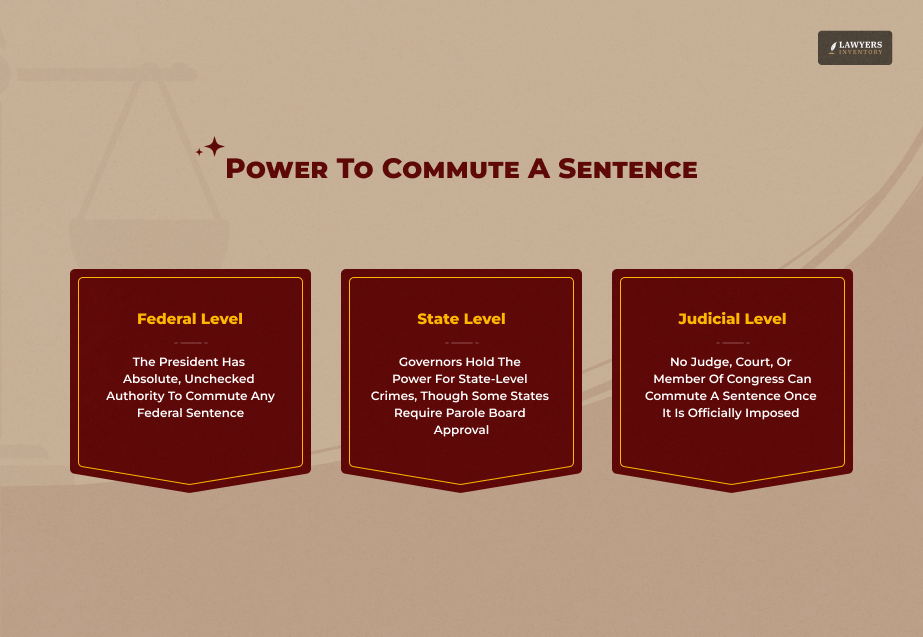
Who can commute a sentence depends entirely on jurisdiction and whether the case involves federal or state charges.
For federal crimes, only the President of the United States holds commutation power. This comes directly from Article II, Section 2 of the U.S. Constitution.
For state crimes, the governor typically holds this power. As per Law Definer, some states require a recommendation from a Board of Pardons or a Parole Board before the governor can act.
Judges cannot commute sentences. This power belongs exclusively to the executive branch. Presidential commutation power is one of the broadest unchecked authorities in U.S. law.
The President can commute any federal sentence at any time, for any reason. Congress cannot override it. Courts cannot block it. There is no approval process required.
This exclusivity is significant.
No matter what new evidence emerges after sentencing, no matter how compelling the circumstances, a judge cannot reduce a sentence already imposed through commutation.
The only judicial avenue after sentencing runs through appeal or post-conviction motions – and those are distinct legal processes with narrow grounds. The executive branch remains the sole gateway to commutation.
This principle connects to the broader concept of legal precedent – the body of past decisions that defines the boundaries of judicial authority.
Courts have consistently upheld the executive’s exclusive commutation power, even in cases where judges themselves believed a sentence was excessive.
Key Points:

The power to commute a sentence depends on whether the crime is federal or state.:

• For federal crimes, only the President of the United States holds commutation power under Article II of the Constitution.
• For state crimes, the state governor typically holds this authority, often working alongside a state Board of Pardons.
Grounds For Commutation: What Justifies It?
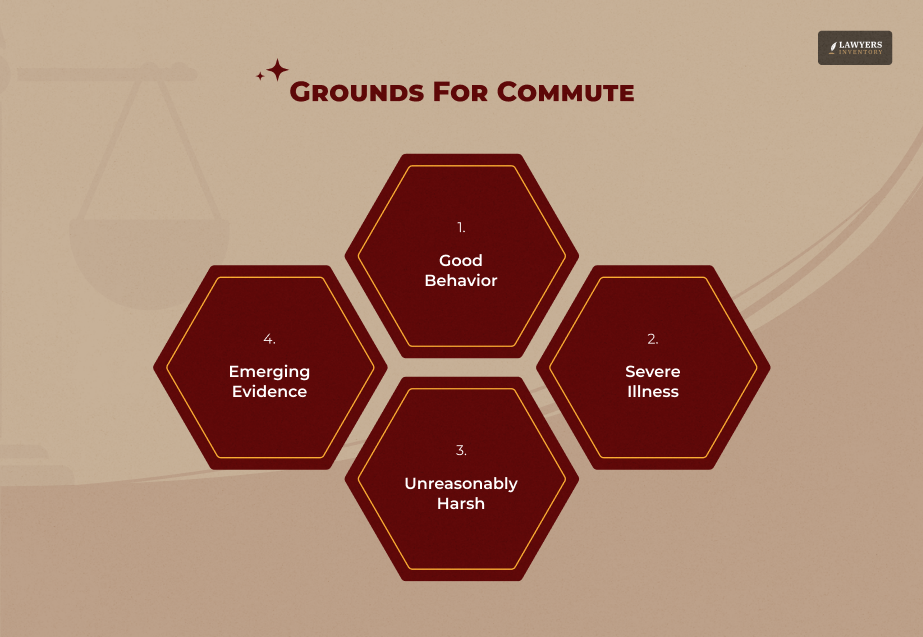
Some grounds for commutation of a sentence are good behavior, illness, old age, or when the sentence is unreasonably harsh in comparison to other similar cases.
In federal practice, the Office of the Pardon Attorney evaluates petitions based on several factors, including:
- Post-conviction conduct.
- Nature of the offense.
- Length of sentence already served.
- Any disparity between the sentence and current federal sentencing guidelines.
Changes in law – particularly retroactive sentencing reforms – are a significant driver of modern commutation petitions.
For instance, a prisoner serving a lengthy sentence for a non-violent crime may request commutation due to deteriorating health. If granted, their sentence could be reduced to time served, allowing for earlier release.
A person convicted of theft might seek commutation after demonstrating good behavior in prison and completing rehabilitation programs.
The most high-stakes application of commutation power involves death sentences. Commutation of a death sentence means replacing an execution order with a lesser punishment, most commonly life imprisonment without parole.
This most often happens when new evidence emerges, when questions about mental competency arise, or when a governor or president decides the circumstances warrant mercy.
From what I analyzed from the resource by Cornell Law School, the conviction stands. The death penalty does not.
Key Points:

• Good behavior and rehabilitation efforts often justify a sentence reduction.
• Severe illness or old age can prompt compassionate early release.
• Unreasonably harsh or outdated sentencing guidelines warrant executive review.
• Emerging evidence or mental incompetency can stop a death execution.
How The Commutation Process Works
When it comes to understanding the process of commutation, you need to look at it from two ways – Federal and State.
Here’s what you need to know:
Federal Commutation
Federal commutation applications go through the Office of the Pardon Attorney (OPA), a component of the U.S. Department of Justice. The applicant must complete specific forms, provide personal history, and explain why commutation is warranted.
An attorney is not required but strongly recommended. The OPA reviews the petition and sends a recommendation to the President. The President makes the final call. There is no hearing. The applicant does not appear before anyone.
Practical considerations include letters of support from family members, community figures, employers, and in some cases victims – where willing.
The strength of a commutation petition often depends as much on the quality of supporting documentation as on the underlying legal arguments.
State Commutation
For state sentences, the process varies by state. Many states use a pardon board or clemency board that reviews petitions before passing a recommendation to the governor.
Hiring an attorney experienced in clemency petitions significantly improves the quality of the application.
Some states require that a minimum portion of the sentence has been served before a commutation petition is eligible for consideration. Others allow petitions at any point.
The variance across jurisdictions is significant, and anyone pursuing state commutation should consult a criminal defense attorney familiar with their specific state’s process.
Is A Commutation Reversible?

If the commutation was obtained through fraud, such as bribery or misrepresentation of facts, a court might consider invalidating it. But this is extremely rare and legally complicated. A future president or governor also cannot reverse a commutation granted by a predecessor. The power only works in one direction. You can grant mercy, but you cannot retract it once delivered.
Commute vs. Pardon: The Critical Distinction
The comparison between commute vs. pardon is one of the most commonly confused distinctions in clemency law – and one of the most practically significant.
Commutation is different from pardon in that pardon nullifies the conviction and forgives the individual for the crime, whereas commutation is a reduction of a punishment.
In concrete terms:
| Commutation | Pardon | |
| Conviction removed? | No | Generally yes |
| Punishment reduced? | Yes | N/A – conviction addressed |
| Criminal record cleared? | No | Often yes |
| Civil rights restored? | Not automatically | Often yes |
| Requires admission of guilt? | No | Traditionally yes |
Think of it this way: commutation changes what happens to you physically – time in prison. A pardon changes your legal standing going forward. [Source: Federal Criminal Defense Attorney]
Both are forms of executive clemency. Both are unilateral acts by the executive. But they address fundamentally different problems.
Someone whose primary concern is getting out of prison sooner needs commutation. Someone whose primary concern is clearing their record and restoring civil rights needs a pardon.
Commutation Vs. Other Legal Concepts
Here is a detailed breakdown of how commutation of a sentences differs from other legal concepts:
Commutation vs. Parole
Parole is conditional early release granted by a parole board after a portion of a sentence has been served.
It does not reduce the sentence – it permits serving the remainder in the community under supervision, subject to conditions. Violating parole can result in return to prison.
Commutation actually reduces the sentence itself. A person whose sentence is commuted to time served is released unconditionally – they are not on parole, they have no supervision requirements, and they cannot be returned to prison for that offense.
Commutation vs. Expungement
Commutation reduces the punishment being served. Expungement removes or seals the conviction from public records.
Someone who has their sentence commuted still has a visible criminal record. Employers, landlords, and background check services can still see the conviction. [Source: Uslegalforms]
Commutation and expungement are independent processes. Receiving one does not trigger or guarantee the other.
Commutation vs. Reprieve
A reprieve temporarily postpones a sentence – most commonly an execution – without changing or eliminating it. A reprieve buys time. A commutation changes the outcome for good. Commutation is permanent. A reprieve is temporary. [Source: Cornell Law School]
What A Commuted Sentence Does And Does Not Do
Understanding what commutation leaves unchanged is as important as understanding what it changes.
What changes after commutation:
- The length or type of sentence being served
- Release date – potentially immediate
- In death penalty cases, the nature of punishment entirely
What stays the same:
- The criminal conviction on the person’s record
- Restrictions on voting, firearm ownership, and certain employment, depending on jurisdiction
- Visibility on background checks
- The factual finding of guilt by the court
A commuted sentence does not mean the person was found innocent. It means the state decided the original punishment was too harsh, given new information or changed circumstances. [Source: Federal Criminal Defense Attorney]
This is why legal experts and lawmakers often describe commutation as an act of mercy rather than an act of justice. It does not revisit the question of guilt. It revisits the question of whether the punishment fits the circumstances.
Commutation In Civil And Financial Law
In the context of workers’ compensation or other civil matters, commutation means the replacement of one form of payment for another – specifically, substituting a single payment for several periodic payments, or settling on a lump-sum payment. [Source: Law definer]
This usage appears in:
- pension law,
- insurance settlements,
- structured payment agreements.
A retiree might commute monthly pension payments into a single lump-sum payout.
An insurance settlement might be commuted from structured annual payments into a one-time settlement. The underlying principle is the same as in criminal law: one obligation is formally substituted for another.
Commutation And The Broader Criminal Justice Context
Commutation does not exist in isolation. It sits within a broader ecosystem of criminal justice concepts that legal readers frequently encounter together.
When someone is first brought into the criminal justice system, the distinction between being indicted vs charged is the first major legal threshold – an indictment involves a grand jury finding probable cause, while a charge can be brought directly by a prosecutor.
Both initiate the formal prosecution process, long before sentencing and commutation become relevant.
During trial, procedural questions arise that can affect outcomes significantly. A sequestered jury – isolated from outside information during deliberations – is used in high-profile cases to prevent prejudicial exposure.
If that jury cannot reach a unanimous verdict, the result is a hung jury, which may lead to a mistrial – a formal termination of the trial without a verdict. A mistrial does not automatically result in acquittal; the prosecution may retry the case.
These trial-phase concepts are distinct from post-conviction relief like commutation – but they are part of the same legal journey.
Understanding how cases proceed from indictment through trial and into sentencing is essential context for understanding when and why commutation becomes relevant.
Notable Historical Examples Of Commutation
Commutation has been used throughout American history. It applies to cases ranging from political controversy to humanitarian relief.
For instance, President Abraham Lincoln authorized death-row commutations to hundreds of Civil War deserters. Similarly, President Obama commuted the sentences of over 1,700 people. Consequently, this became the highest number of commutations by any US President.
Most of these individuals had been subjected to harsh mandatory minimum terms. This happened because of guidelines that had recently changed. In most cases, these terms were related to non-violent drug crimes.
Furthermore, in 2003, Illinois Governor George Ryan abolished all 167 death penalties in his state. He took this drastic step because he feared wrongful convictions at the whole judicial system level. [Source: PubMed Central]
Ultimately, the essence of each ruling is that they are all rooted in commutation. Additionally, they are basically executive decisions.
These decisions came into being because of the belief that justice demands a fix. This fix applies to either a particular case or a whole category of cases. Furthermore, it corrects issues that the judicial system alone cannot provide.
Disclaimer: This article is for general informational and educational purposes only. It does not constitute legal advice. If you or someone you know is seeking commutation of a sentence, consult a qualified criminal defense attorney experienced in clemency petitions.
Sources
- Legal Information Institute, Cornell Law School – Commute a Sentence (law.cornell.edu/wex/commute_a_sentence)
- Legal Information Institute, Cornell Law School – Commutation (law.cornell.edu/wex/commutation)
- U.S. Department of Justice – Office of the Pardon Attorney – Commutation of Sentence Guidelines (justice.gov)
- LawDefiner – Commuted Meaning in Law: Full Legal Guide (2026)
- LegalSynopsis – Commuted Sentence: What It Means in 2026 US Law
- US Legal Forms – Commutation: Understanding Its Legal Definition and Implications
Leave A Reply






Hung Jury vs. Mistrial: What Is The Difference And Why It Matters
Read More
NarodniyDimUkraina: An Overview Of The Kyiv-Based Brand Preserving Ukrainian Craftsmanship
Read More
What Is A Mistrial? Legal Definition, Causes, And What Happens Next
Read More
What Is A Sequestered Jury? Legal Definition, Process, And Everything You Need To Know
Read More
What Is A Hung Jury? Legal Definition, Causes, And What Happens Next
Read More
0 Reply
No comments yet.