Summarize using AI





Prompt copied. Paste it into Gemini.
A Court marriage provides a secular and lawful mechanism through which individuals can marry without going through any religious rituals.
It comes under the ambit of the Special Marriage Act, 1954, thereby ensuring a uniform legal process across the country.
It is one of the best options available to couples who want to marry without any involvement from religion or caste.
The Indian Supreme Court has taken a keen interest in ensuring the privacy rights of couples in the notice period stage in cases like Supriyo v. Union of India (2023). However, even today, there is controversy regarding the 30-day notice period.
In this article, we will elaborate on the following:
- The statutory legal framework and landmark judicial rulings.
- A practical walkthrough of the application and solemnization stages.
- The essential paperwork and identification requirements for 2026.
- A clear breakdown of government fees and professional costs.
What Is Court Marriage?
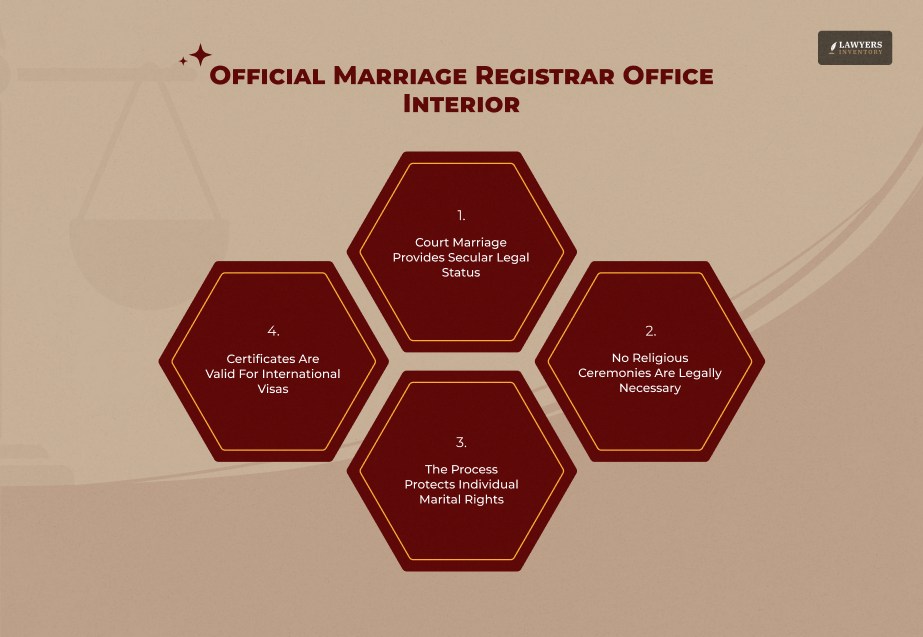
Court marriage is an arrangement of a couple that has taken place in the presence of a Marriage Officer appointed by the government, instead of a priest from any religious organization.
Legal Recognition Nationally
The marriage has been recognized by the state throughout its territory in India. There is no need for any religious rituals to be performed. It is a purely secular form of marriage available to all individuals regardless of religion.
Practical Advantage For Couples
The process can prove advantageous for couples belonging to different faiths or castes who want to enter into wedlock without any interference from personal laws.
Laws Behind Court Marriage
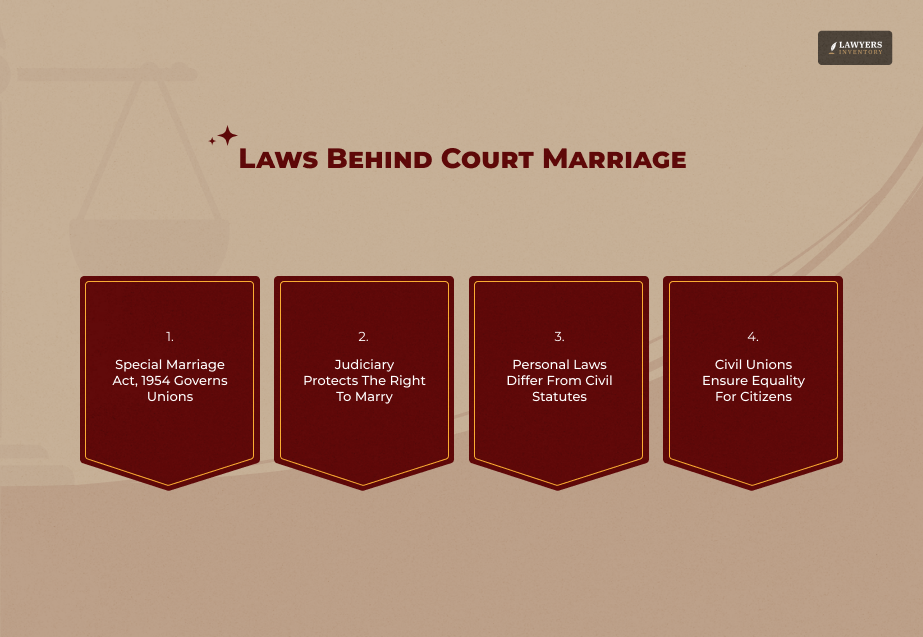
These are some statutory regulations governing this process in order to ensure that there is a unified civil law for marriage.
In doing so, it ensures that the government is an impartial party when it comes to unions of individuals.
Relevant Statutes And Judicial Precedents
The legal structure of a civil marriage in India rests on two major acts. While both involve the coming together of individuals, their roles are totally different within the ambit of a civil marriage.
The Special Marriage Act, 1954
This is a fundamental statute that governs civil marriage in India. The outdated one enacted in 1872, stipulated that couples had to renounce their individual religious affiliations prior to marriage.
However, the 1954 act has made it easy for couples to retain their faith. It requires a 30-day notice prior to marriage for the purpose of verifying the suitability of the parties involved in the marriage process.
Hindu Marriage Act, 1955
Contrary to the Special Marriage Act, this act is applicable to Hindus, Sikhs, Jains, and Buddhists. Unlike the Special Marriage Act, this act does not contain any provision that allows couples to marry under court auspices in a secular manner.
This act demands the conduct of some rituals like Saptapadi (seven steps).
After the rituals, the couples have to register their marriage legally with the government authorities. This act is considered to be the most widely followed law in the country for the purpose of legal domestic registration.
Judicial Decisions And Precedents
The courts have been playing an instrumental role in safeguarding the rights of couples who are getting married under the court marriage ceremony, in case social customs violate individual freedoms.
Lata Singh V. State Of UP (2006)
In this crucial case, the Supreme Court of India decided that an adult woman had the freedom to marry whomever she pleased.
The court took note of the harassment inter-caste couples face and issued instructions for stringent measures against those who engage in violence or make threats based on “honor.” The verdict thus serves as legal protection for individuals undergoing the court marriage procedure.
“The recent tragic incident of honour killing in Maharashtra has brought the struggles of inter-caste and inter-faith couples back into the spotlight. In the latest edition of Frontline Conversations, Ashutosh Sharma speaks with Lata Singh, rights activist and petitioner in the landmark 2006 Supreme Court judgment Lata Singh vs State of Uttar Pradesh—a milestone in establishing guidelines that protect such couples in distress.” (Source: Frontline)
Shafin Jahan V. Asokan K.M. (2018)
Popularly known as the Hadiya case, this verdict upheld the Right to Marry as one of the elements of the “Right to Life” in Article 21.
The court stated that the government had no place in interfering in the marriage between two consenting adults.
Neither the judiciary nor parents had any say in matters of individual choice when selecting a partner. This means that the court marriage procedure cannot be nullified on grounds of parental objections or social ethics.
Court Marriage Compared To Personal Law Marriages
Personal law marriages usually differ from each other due to religious and cultural factors. The court marriage system provides an organized solution that treats all citizens as equals before the law.
The Complete Court Marriage Process
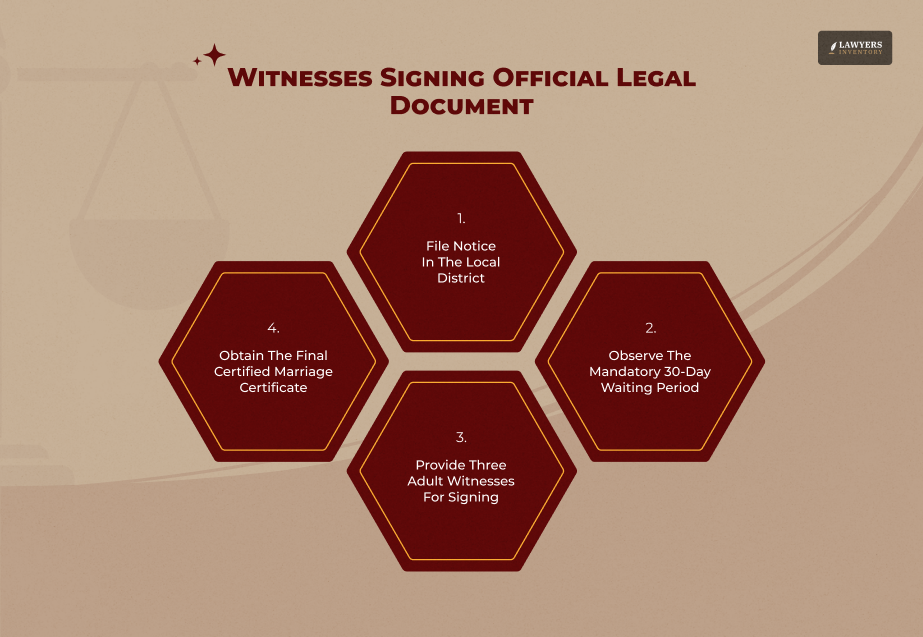
The true court marriage procedure includes several administrative stages that need to be carefully scheduled. The couple should follow these procedures to make sure their marriage is officially valid.
Step 1: Notice Of Intended Marriage
First, the couple needs to file an application for a court marriage in the Marriage Officer’s office. One of the two people involved should reside in that district for 30 days prior to filing the application.
Step 2: Publication Of Notice And Objections
The Officer publishes the notice in a conspicuous place for a 30-day period. This allows the public to raise legal objections regarding the age or existing marital status of the parties.
Step 3: Declaration And Solemnization
Within 30 days, the two people involved along with three witnesses need to make a declaration in the office.
The Marriage Officer will then solemnize the wedding ceremony with these witnesses being present.
Step 4: Issuing Of Marriage Certificate
In the official Register, the Marriage Officer makes an entry. After signing the entry by both the parties involved and the witnesses, they get the marriage certificate.
Detailed Witness Requirements For Court Marriage
Though the bride and groom are central figures on that day, the court marriage procedure is not complete unless the presence of three witnesses confirms the same.
As per the law in 2026, it would be compulsory for these witnesses to meet certain criteria to legitimize the marriage.
Who Is Legally Allowed To Be A Witness?
Any individual can be a witness to a court marriage ceremony. It could be from one’s immediate family, best friends, or colleagues. The witnesses need not have any blood relations with the bride and groom as well. Many newlyweds opt to get friends as witnesses for this very reason.
Criteria For Eligibility As A Witness
The eligibility criteria for a court marriage are as follows.
Age Limit
Each of the witnesses has to be a minimum of 18 years of age and a competent adult under Indian law.
Sound Mind
They should be of sound mind and understand the importance of signing the papers.
Identification
The witnesses will have to produce a government identification proof.
It can either be an Aadhaar card, Voter ID, or passport.
Along with that, we will need two photographs.
Witnesses Signing The Official Marriage Register
Thus, these are the requirements of the Witness criterion.
- Three witnesses are mandatory for SMA marriages.
- Relationship to the couple is not restricted.
- Original ID proofs must be physically presented.
- Witnesses must be present during the final solemnization.
List Of Court Marriage Documents
It is important that you prepare a list of the documents required at court marriage because the government officials will cross-check these records through their database systems.
Proofs Of Age & Identification
The individuals should have scanned copies of either their birth certificate or marks obtained in class tenth along with a valid identification document, like passport or voter ID card.
Residential Proof & Photographs
One needs residential proof for their respective districts and a couple of passport-size photographs for both individuals and their witnesses.
Privacy Rights – Opting Out Of The 30-Day Notice
One of the most notorious “trouble zones” in marriage was the mandatory public notice. In the old system, the court marriage procedure involved a requirement of a notice period of thirty days on the notice board of the registrar’s office, which used to attract unnecessary trouble from relatives and vigilant individuals.
Allahabad High Court Case (2021-2026 Update)
A landmark judgment by the Allahabad High Court ruled (Safiya Sultana v. State of UP) that the mandatory publication of the notice under Sections 6 and 7 of the Special Marriage Act would be only directory and not mandatory.
This implies that the marriage officer can only publish the notice if both parties seek its publication in writing form. (Source – The Print)
How To Avoid Public Notice Publication
There are various ways through which couples may protect themselves from the unnecessary trouble caused by the publication of their notice in the registrar office.
You have the option to request non-publication while filling up the application form for marriage. This allows you to retain your fundamental right to privacy.
Digital Revolution – Video KYC For Marriage Registration
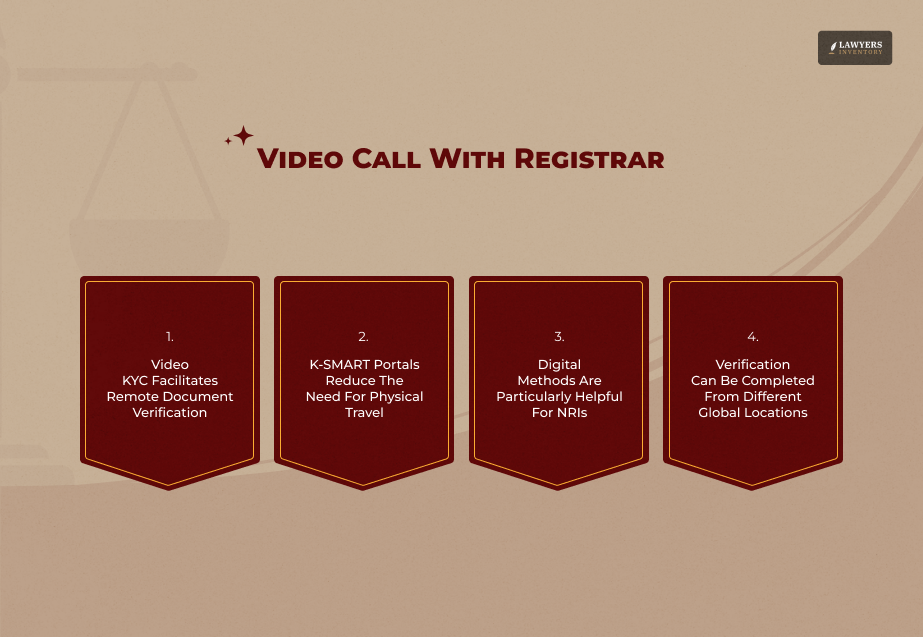
Court marriage process has by 2026 gone digital in India, especially through K-SMART in Kerala State.
It becomes easier for NRIs (Non-Resident Indians) and those people in other cities who struggle with frequent traveling for doing paperwork in marriage.
Remote Identity Verification Through Video KYC
In addition, the inclusion of the Video KYC feature permits the Marriage Officer to verify the identity of the bride, groom, and witnesses via video call.
That way, the legal condition of appearance before the officer has been met in the early application stage, even if the couple does not have to go personally to the Marriage officer’s office. (Source – Hindustan Times)
E-Registration – K-Smart And Others Portals
Through K-SMART and other e-registration portals, it becomes possible to upload a list of court marriage documents.
You can also make payment for registration and complete the KYC process remotely.
This is the case even if the finalization of the ceremony usually happens in person.
Thanks to technology, couples no longer need to visit offices four times. Thus, just one more visit will be needed.
Court Marriage Registration Fees And Cost Structure
Court marriage registration fees are usually inexpensive, yet costs may increase in case of hiring an attorney to assist with the process. Understanding the cost structure will help you plan your finances accordingly.
Fees Charged By The Government And State Discrepancies
General government fees normally fall between ₹500 and ₹1,500 based on different states. Recently, some states have implemented an online payment facility for their services.
Extra Expenses For Professional Consultation

In case of hiring an expert for the process, legal fees could be between ₹5,000 and ₹15,000. The cost would include document preparation and management.
Special Cases And Situations
Some cases demand additional legal procedures for the court marriage ceremony to be completed. This typically concerns cases involving foreigners or people who have been previously married.
Court Marriage Ceremony With A Foreigner

In case one party is a foreigner, then he/she will need to submit a legal visa and "No Objection Certificate." The certificate should be issued by their respective governments or embassies, certifying that they are single.
Legal Objections To Court Marriage
Any objections raised against a couple applying for a court marriage should be looked into by the Marriage Officer within 30 days.
Common Myths And Mistakes To Avoid In The Court Marriage Process
A lot of individuals think that the process of court marriage is complicated or involves a lawyer. Such myths discourage couples from taking advantage of the efficient and effective system.
First Myth: You Need a Lawyer
If you know how to fill out the application, then you can do it yourself.
However, in case you need assistance to make sure nothing gets messed up, you can hire a consultant.
Second Myth: Court Marriage is a “Secret” One
Since the law obliges you to put up the notice publicly, this form of marriage is actually public.
Nevertheless, most states try to change this requirement in order to ensure that both partners’ safety is guaranteed.
What To Expect From Court Marriage?
Court marriage is a safe and secular method to provide yourselves with protection in the future.
Once you prepare all documents as required by law, you will receive legal recognition with no hassle.
Frequently Asked Questions (FAQs):
Questions frequently arise due to court marriage in relation to its permanence and other related difficulties. Here are three of those questions along with their brief answers.
The notice stays valid for three months since filing, after which a new application becomes necessary.
NRIs may make an application provided they meet the 30-day residence requirement before the marriage ceremony takes place.
An appeal can be made to the District Court in case of rejection, within 30 days of receiving the decision.
Not at all. There is a need to wait for 30 days under the provisions of the Special Marriage Act.
If the persons involved are mature adults, there is no legal need for parental permission to get a court marriage.
Although the application is made online, the presence of the couple during the marriage solemnization is necessary.
Court marriage refers to the process of getting married through civil laws, whereas registration involves recording the marriage performed under religion.
Leave A Reply






How Much Child Support Do I Pay If I Make $1,000 A Week?
Read More
Can I Take My Child Out Of State If There Is No Custody Order?
Read More
What to Expect When Working with a Custody Lawyer During Your Divorce
Read More

What You Need to Know about Marriage Annulment in New Jersey
Read More
0 Reply
No comments yet.