
Summarize using AI





Prompt copied. Paste it into Gemini.
Today we talk about the concept of denaturalization citizenship. It is a formal legal procedure by which the U.S. government denaturalizes a person who holds U.S. nationality.
Many find the loss or denaturalization of citizenship to be a drastic and extreme measure in immigration law.
The government very rarely exercises its power to denaturalize US citizens.
However, even decades after the initial award, a denaturalization order remains a necessary legal safeguard for the security and fairness of the judicial system.
With shifting enforcement priorities regarding immigration, understanding the denaturalization process is important.
What Is Denaturalization Citizenship?
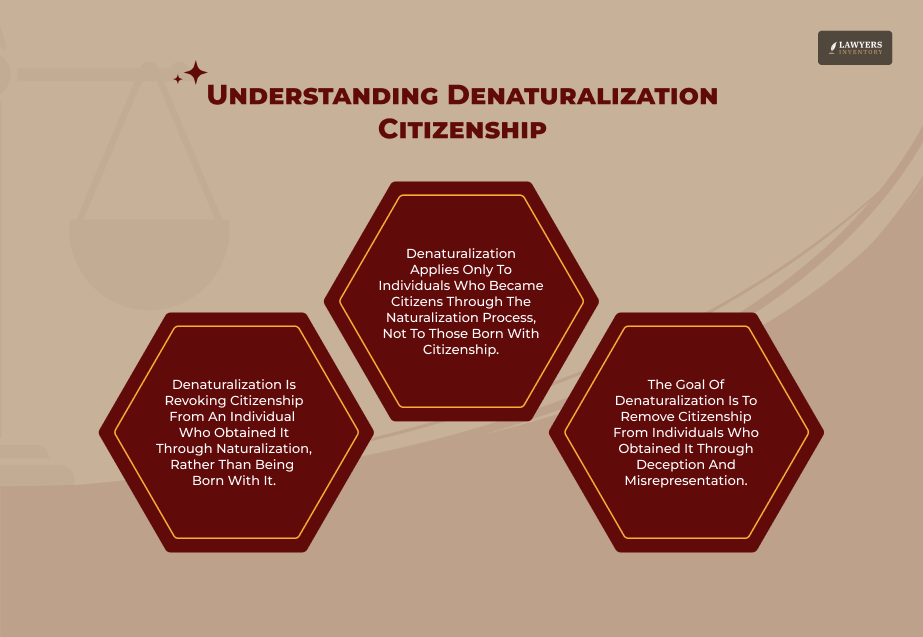
Before we go into the details of denaturalization, let us break things down for you. Firstly, what does a naturalized or derived citizen mean?
What Is Denaturalization Citizenship?
Well, now that we are familiar with what naturalization is, let’s know more. Denaturalization of citizenship is the formal revocation of citizenship.
Denaturalization is the revocation and cancellation of the court’s judgment admitting an individual to citizenship and the consequent withdrawal of the Certificate of Naturalization.
The consequence of this is that the grant of citizenship is effectively nullified, as though it never occurred.
Legal authority for such power is primarily in the Immigration and Nationality Act (INA), i.e., 8 U.S.C. § 1451.
Can Naturalized Citizenship Be Revoked?
Yes, the naturalization previously granted by the US government can be revoked through denaturalization.
Additionally, denaturalization must be in the form of a federal order canceling a naturalization order obtained through wrongful means (fraud or illegality).
Difference Between Denaturalization And Forfeiture Of Citizenship:
There is a need to distinguish denaturalization from other ways of losing U.S. nationality.
Denaturalization Citizenship applies to one who is naturalized for the purpose of gaining U.S. citizenship. Therefore, this includes foreign-born individuals who applied and were accepted.
Denaturalization is a mandatory, government-regulated process.
What Is Expatriation?
It is the loss of citizenship of a natural-born citizen is under a separate statutory regime.
Moreover, it requires the person to voluntarily act with the intent to relinquish U.S. citizenship before a consular officer abroad.
Note:
The status of a naturalized citizen and a derived citizen is of special importance in this regard. A derived citizen gains citizenship automatically through their parent’s naturalization.
This happens while they are still under 18. So, if either parent is denaturalized, it can lead to the child losing citizenship, too.
Why The Topic Matters?
The right to strip away denaturalization citizenship is not a technical legal matter. It matters on a range of grounds.
Legal Security And Human Rights:
Naturalized citizens form a large and growing proportion of the American electorate. Thus, the security of their status is crucial.
The threat of denaturalization undermines the assurance of equal citizenship. Moreover, it may expose an individual to statelessness or deportation.
Integrity Of Immigration Policy:
The government argues that denaturalization of citizenship is required to maintain the integrity of the naturalization system. This means that citizenship will not be obtainable fraudulently by the ineligible.
Thus, the US remains protected from those who may later pose risks to public safety or national security.
Chilling Effect:
Expansion of denaturalization activities, even limited, can bring about a chilling effect on the overall immigrant group.
Furthermore, this may discourage legitimate permanent residents from naturalizing or exercising their political rights for fear of investigation.
Understanding The Legal Basis And Constitutional Authority:
Powers of naturalization and immigration are quite untrammeled in the U.S. Congress. These powers are subject to immense flexibility from judicial review.
Constitutional and Statutory Foundation- Article I, Section 8, Clause 4
The source of denaturalization of citizenship in the Constitution is Article I, Section 8, Clause 4. It asks Congress to “establish a uniform Rule of Naturalization.”
Congress is in charge of establishing the rules for denaturalizing citizenship. Therefore, it also has the correlative power to rescind it if one violates these rules.
Immigration And Nationality Act:
The principal law that addresses the process of denaturalization of citizenship.
8 U.S.C. § 1451 (INA § 340):
The principal civil denaturalization statute establishes a judicial process for the revocation of naturalization. Some important grounds of revocation according to this statute include the following:
- “illegal procurement”
- “concealment of a material fact or willful misrepresentation.”
18 U.S.C. § 1425:
This statute criminalizes obtaining citizenship by illegal means. A criminal conviction under this code automatically results in naturalization revocation under a subsection of the INA, 8 U.S.C. § 1451(e).
Principles Of Due Process And Standards Required:
Citizenship is a Fundamental Right. The Supreme Court of the United States upholds stringent procedural and evidentiary burdens of the government in denaturalization proceedings.
These burdens arise out of the due process clauses of the Fifth and Fourteenth Amendments. They protect citizens from abusive government action.
Schneiderman v. United States:
According to Schneiderman v. United States, 320 U.S. 118 (1943), the SC held that the government bears a heavy burden of proof in a civil proceeding of denaturalization.
It must establish its case by “clear, convincing, and unequivocal evidence which leaves no doubt as to the issue.“
This is a more stringent standard than the “preponderance of the evidence” used in ordinary civil suits. Thus, the ruling further established the gravity of the possible loss of denaturalization citizenship.
The federal government cannot revoke an individual’s citizenship itself. This action must be taken by the U.S. Attorney’s Office and decided by a federal judge.
Restrictions On Government Authority:
The history of denaturalization use has established judicial recognition of restrictions on the government’s authority.
The Supreme Court has repeatedly reaffirmed that naturalized citizenship is of equal dignity and force with native-born citizenship.
Naturalization, A Judicial Act:
Since Naturalization is a Judicial Act, denaturalization is no different. Legally, it should occur through a civil action or a criminal conviction for naturalization fraud.
Afroyim v. Rusk:
Federal agencies such as USCIS or ICE cannot revoke citizenship on their own. Further, the government cannot use denaturalization to punish political dissent once naturalization has occurred.
Thus, an individual’s naturalized citizenship cannot be arbitrarily taken away or revoked for trivial reasons.
In Afroyim v. Rusk, 387 U.S. 253 (1967), the Supreme Court states that “a U.S. citizen cannot lose his or her citizenship unless he or she willingly surrenders it.”
This ruling restricts the government’s power to denaturalize based on post-naturalization conduct.
What Are The Grounds / Causes For Denaturalization?
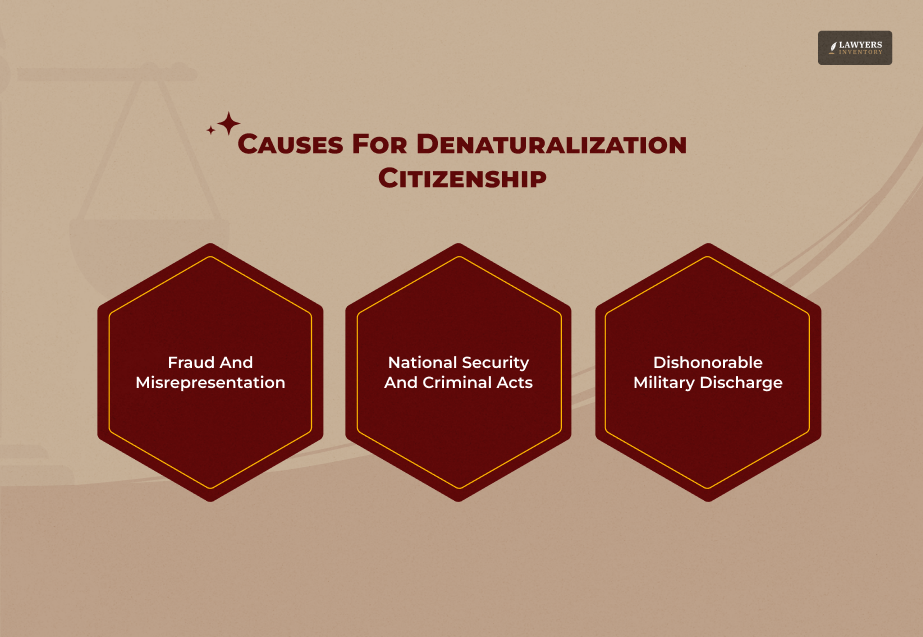
The grounds for denaturalization appear mostly in the past tense. It is a means for the government to establish that the citizen was never eligible for citizenship at the time of naturalization.
1. Fraud / Misrepresentation Or Concealment Of Material Facts:
This chapter of the USCIS Policy Manual talks about the most common recurring and most litigated basis for denaturalization of citizenship.
These are cases in which an individual procures naturalization by the following.
- Fraud,
- willful misrepresentation or
- concealment of a material fact.
In order to meet this legal obligation, the government needs to prove four things:
“1. The individual misrepresented or concealed some fact.
2. The misrepresentation or concealment was intentional (willful).
3. The fact misrepresented or concealed was material; and
4. The individual acquired citizenship because of the misrepresentation or concealment (causal relationship).”
2. Legal Standard Of Materiality In Denaturalization Proceedings:
Above all, the fact has to be material.
Time and again, the Supreme Court has held that a fabricated or concealed fact is material if the true facts would lead to the refusal of naturalization.
Fedorenko v. United States, 449 U.S. 490 (1981):
In this ruling, according to the official court documents, the SC establishes that the inability to meet a statutory prerequisite of naturalization makes the citizenship “illegally procured.”
Here, the individual had suppressed his guard service in a concentration camp.
The Court upheld the finding that the applicant was ineligible to meet the statutory prerequisite of being “lawfully admitted for permanent residence” due to ineligibility prior to admission (fraud).
Thus, this was sufficient to denaturalize citizenship.
Kungys v. United States, 485 U.S. 759 (1988) (not 1987):
This is the controlling precedent that develops the “materiality” test for denaturalization on the ground of “willful misrepresentation.”
The Court held that a misrepresentation is material if it has a “natural tendency to influence” the official decision.
This, if the true facts had led to inquiry regarding the applicant’s fitness regarding character or residence, would be sufficient grounds for denaturalization citizenship.
3. Illegally Procuring Citizenship:
Another core ground for denaturalization is the acquisition of citizenship through illicit means.
In such a case, the person was naturalized after not meeting one of the statutory requirements for naturalization, such as:
- Failing to meet the minimum residence or physical presence requirement.
- Not having the requisite lawful admission for permanent residence (LPR) status.
- Failure to demonstrate good moral character during the required statutory period.
However, in such cases, there is an absence of fraudulent measures.
Let’s say someone was naturalized, but years later the government discovers they were inadmissible at the time.
Or, the authorities find out that the subject was missing an LPR status, which, according to USCIS, is a naturalization prerequisite.
In these cases, the government may claim the naturalization was illicit and then carry out a denaturalization of their citizenship.
4. Membership In Proscribed / Subversive Organizations:
Statutory provisions also allow for the denaturalization of citizenship if the person falls under any of these categories.
- When they, within a certain period before the naturalization application, were a member of the Communist Party, another totalitarian party, or a terrorist organization. This is because such membership runs counter to the “attachment to the principles of the Constitution.”
- Lying about such membership in the naturalization application would constitute fraud.
5. Post-Naturalization Behavior:
While naturalized citizenship is forfeitable depending on one’s post-naturalization conduct, such instances are generally rare and legally complex.
The theory of denaturalization citizenship is typically retroactive.
The only important exception to the rule regarding post-naturalization conduct. It allows for loss of citizenship upon conviction of 18 U.S.C. § 1425 criminal fraud in attaining citizenship.
For this, the underlying crime of fraud should have taken place during the filing of the application.
6. The Materiality Standard- Maslenjak v. United States (2017):
The landmark case of Maslenjak v. United States (2017) has laid down limits to the government’s application of 18 U.S.C. § 1425 for denaturalization citizenship.
The Supreme Court ruled that, for a conviction to lead, the false statement has to be “material”, with a “natural tendency to influence” the decision of citizenship.
7. New Frontiers- Financial Misrepresentation And Tax Fraud As A Basis For Denaturalization:
In the last two years, the Department of Justice (DOJ) has directed the US government to proceed proactively with cases in which individuals committed serious crimes before naturalization but failed to disclose them.
To be more precise, the DOJ prioritizes denaturalization among individuals who have engaged in fraud. These instances may be of financial fraud against the United States or private parties.
When an individual commits a colossal tax evasion fraud, it disqualifies him from entering under the “good moral character” requirement for naturalization.
Now, if, at the time of naturalization, such an individual falsified their statement denying the act, their citizenship would be revoked through denaturalization.
What Are The Procedural Pathways And Standards?
The US denaturalization procedure is solely judicial and operates on either one of two independent channels: criminal or civil.
Civil Denaturalization (8 U.S.C. § 1451(a)):
It is the more conventional path.
The filing is made by the U.S. Attorney’s Office (USAO) in a U.S. District Court, requesting a judicial order revoking the naturalization certificate.
Thus, the government is the plaintiff in a civil action, and the defendant is the naturalized person.
Criminal Denaturalization (8 U.S.C. § 1451(e)):
One faces conviction under 18 U.S.C. § 1425 for naturalization or even for attempting to do so by fraud.
The Court wants proof of such a crime beyond a reasonable doubt. Once conviction is complete, denaturalization of citizenship takes place.
Government Must Prove Its Case: The Standard Of Proof In Denaturalization
The law also recognizes that revoking an individual’s U.S. citizenship is an extremely severe measure.
As such, the government, when seeking to carry out denaturalization, should bear the burden of proof for such action.
The standard required varies significantly depending on whether the case is civil or criminal.
In Civil Denaturalization Cases (The Most Typical Path):
The government must provide clear and convincing evidence for the denaturalization of citizenship.
Moreover, the evidence must be strong enough to entertain no doubt that the person is never legally eligible for citizenship.
Most significantly, no statute of limitations in these cases allows the government to bring a civil action against a naturalized citizen whenever there is cause.
Here’s something that you should take a look at from NewYork University Law Review Issue Volume 94, Number 3, June 2019:
“Denaturalization is no longer so rare. Naturalized citizens’ sense of security has been fundamentally shaken by policy developments in the last five years.”
“It is pursuing denaturalization as a civil-litigation remedy and not just a criminal sanction—a choice that prosecutors find advantageous because civil proceedings come with a lower burden of proof, no guarantee of counsel to the defendant, and no statute of limitations.”
In Criminal Denaturalization Cases:
The government must prove its case “beyond a reasonable doubt.” This is the highest legal standard, the same one used to find a person guilty of any other crime.
Should the person be convicted of criminal naturalization fraud, their citizenship will be revoked automatically.
Unlike the civil action, there is a 10-year statute of limitations for the underlying criminal act.
The “clear, convincing, and unequivocal evidence” requirement in civil cases stems from the high premium placed on being a U.S. citizen.
“In February 2020, DOJ announced the creation of the Denaturalization Section within DOJ’s Office of Immigration Litigation, which was “dedicated to investigating and litigating revocation of naturalization”.
While this section was disbanded under the Biden administration, it has been effectively reconstituted under current enforcement priorities.”
Procedural Features Of The Denaturalization Process: Statute Of Limitations (Or Its Lack In Civil Cases)
The worst aspect of denaturalization citizenship is that there is no statute of limitations on civil denaturalization.
The government can bring a civil revocation proceeding against a naturalized citizen whenever it wishes.
This may sometimes be decades later, after they have been naturalized. Thus, this absence of finality leaves the validity of their status perpetually under threat.
Rights Of The Accused:
Any person who is the subject of a denaturalization proceeding has the right to due process.
This includes their right to appear, present evidence, and the like. Most importantly, they may rebut the government’s charges before a federal magistrate.
Sixth Amendment Right To Counsel:
In criminal denaturalization, the defendant has a full Sixth Amendment right to counsel.
In civil actions, the lack of mandatory counsel for indigent defendants remains a significant criticism. However, judicial review serves as a check on such a system.
Immigration Status After Denaturalization:
An effective order of denaturalization revokes the Certificate of Naturalization and restores the individual to his former status. Thus, they then become a Lawful Permanent Resident (Green Card holder).
But since the cause of revocation is virtually always fraud or unlawful procurement, the individual is typically placed directly into removal or deportation proceedings.
What Are The Historical And Landmark Court Cases?
Supreme Court rulings have forever balanced state power against naturalized citizens’ constitutional rights.
Nishikawa v. Dulles (1958):
This case established that U.S. citizenship is a constitutional right one loses through their voluntary act of renunciation of said citizenship.
Costello v. INS (1964):
According to court documents, this ruling formulated the “relation-back doctrine”. This establishes that citizenship is void ab initio (from the beginning).
Thus, the government can cause it to go back to its prior status and even lead to deportation.
Precedent Revocation Cases:
Denaturalization has been a recurring means of punishment in political groups (1930s Communists) and war criminals (former Nazis).
These were the citizens who fraudulently obtained citizenship by keeping their pasts secret.
What Are The Recent Trends And Policy Developments?
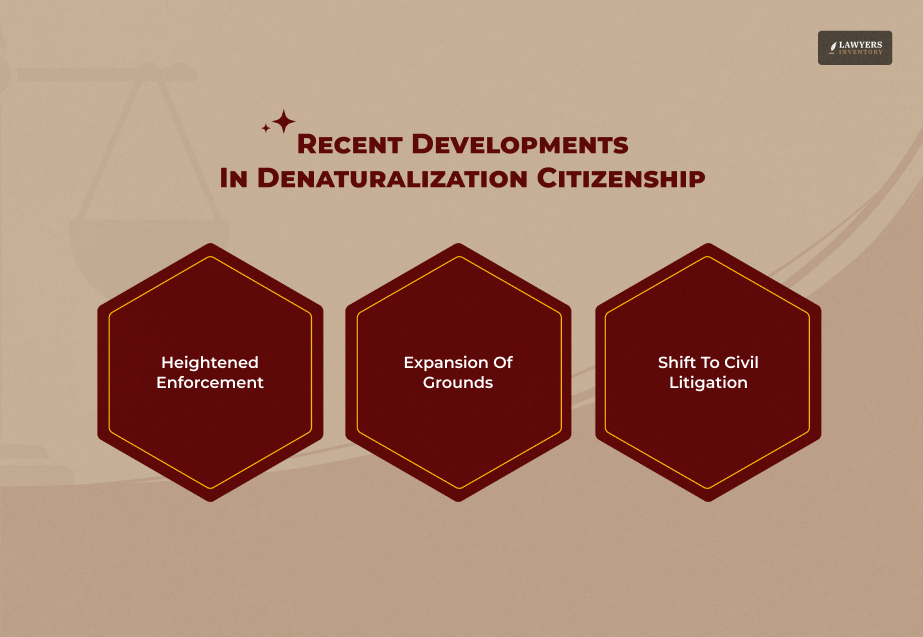
Denaturalization has taken enormous strides and consideration in recent years beyond the traditional.
Heightened U.S. Department Of Justice Prioritization To Prosecute Denaturalization Cases:
The Obama administration also had a larger number of denaturalization cases. They also utilized advanced digital record-keeping to search for possible instances of fraud.
However, the trend accelerated in scope under the Trump administration. Currently, denaturalization is at the top of the US government’s immigration enforcement strategy.
The Department of Justice (DOJ) regularly releases memos that specify new categories of individuals for denaturalization.
These memos protect US security against practices that endanger it or constitute war crimes. However, some of the new focuses are as follows.
- Those involved in cartel or gang interests.
- Someone who has been a part of human trafficking offenses.
- One who tried to obtain naturalization through fraud or through government corruption.
- Those who carried out economic fraud in the United States.
This heightened priority reflects a broader enforcement approach. Denaturalization of Citizenship is now a civil remedy against pre-naturalization wrongdoing.
Read Also: EB-5 Visa Lawyer: The BEST Immigration Lawyer for Investors?
Some Recent Cases:
Now, let’s look at some contemporary cases of denaturalization of citizenship.
DoJ’s Denaturalization Of Child Sex Abuser:
The case involving the Denaturalization of a child sex abuser by the Department of Justice shows a broader enforcement approach.
Here, the Justice Department used denaturalization as a civil remedy against pre-naturalization.
This led to the denaturalization of the citizenship of a convicted child sex abuse material distributor. He had hidden his criminality while going through the naturalization process.
Thus, the government holds that revoking citizenship serves the public interest by removing dangerous individuals as citizens.
Debate And Critiques:
This increased drive toward denaturalization is leading to enormous political and legal outcry.
Many hold that the growth of civil denaturalization risks crossing the line of authority and invading due process.
Due Process Concerns:
Civil denaturalization requires a lesser standard of proof than criminal proceedings. Moreover, there is no statute of limitations.
Thus, critics argue that it leads to the prosecution of long-time naturalized citizens for trivial or unintentional pre-naturalization defects.
Equality And Discriminatory Targeting:
A danger is that the enlarged category will be used to target specific ethnic or political groups for discrimination.
Operation Janus And Other Efforts To Reconsider Previous Naturalizations:
Operation Janus is a fascinating project by the Department of Homeland Security (DHS).
This is to identify naturalized citizens who may have been granted denaturalization due to the use of false identities or concealed past orders of deportation.
The procedure involved matching digitized prints against previous non-digitized records. This process has provided evidence for numerous current denaturalization-of-citizenship proceedings.
Moreover, it can reveal criminal histories or identity theft that would have escaped paper-recorded review for years or even decades.
Read Also: What Can A Green Card Holder Do If Detained?
What Are The International And Comparative Perspectives On Denaturalization Citizenship?
The United States’ denaturalization citizenship machinery is not alone. However, it fits within a system of emerging international human rights norms.
International Human Rights Norms:
Another basic principle of international law is the proscription of statelessness.
The 1961 Convention on the Reduction of Statelessness says that States are not to render a person stateless if it leaves them stateless.
The U.S. regime seeks to stand true to this principle. Therefore, it invokes the denaturalization of citizenship only in cases of fraudulent practices.
Provisions Under Which Denaturalization Under International Law:
International customary law and bodies such as the European Convention on Nationality (ECN) generally permit the deprivation of nationality in such cases.
- Nationality is obtained through fraud or false representation.
- The individual acts against the vital interests of the State.
What Are The Consequences And Impacts Of Denaturalization Citizenship?
The result of a successful denaturalization citizenship action is life-altering to the individual. It also has broader implications for the U.S. legal system and immigrant community.
For The Individual:
The most severe and direct effect is the deprivation of the privilege of citizenship through denaturalization. The individual loses all the rights and privileges of U.S. citizenship, including these.
- The right to vote,
- Travel on a U.S. passport,
- And work in the federal government.
They are immediately returned to the status they occupied prior to their naturalization.
After Denaturalization of citizenship, in order to begin deportation proceedings, almost immediately.
The individual can, however, fight their removal in immigration court without even the minimal protections of citizenship.
The act has a wide-ranging effect. Thus, certain rights still remain with the individual to prevent family disintegration as much as possible.
For Legal Regime:
Denaturalization is a necessary measure to maintain public trust in the naturalization process.
Moreover, it protects the integrity of the naturalization process and punishes misrepresentation and fraud through denaturalization.
Many believe that denaturalization has a deterrent effect. Thus, it also compels all applicants for naturalization to reveal the entire truth in their application forms.
Risk Of Abuse, Chilling Effect On Immigrant Communities:
Now that we have discussed all about the reasons and provisions of denaturalization, let’s delve a little deeper into the consequences of Denaturalization Citizenship.
Promoting Fear:
Forceful efforts to strip individuals of citizenship inculcate a deep sense of fear in individuals. They feel that their status can go back to “illegal immigrant” many years later, even for an insignificant “clerical error”.
Chases Participation:
The fear discourages eligible legal residents from seeking citizenship or participating in civic processes like voting or political organizing.
“Chilling Effect:”
Immigrants are afraid that seeking naturalization or becoming active will lead to a government investigation into their past, stirring unnecessary trouble.
Legal And Policy Safeguards:
The legal system has protections to prevent arbitrary loss of citizenship.
Judicial Review:
Denaturalization happens through a federal court. Thus, many fear that the judge will deliver adverse rulings.
However, the government’s burden of providing solid, exceedingly high-level proof is a protective factor for all immigrants.
Monitoring, Resisting, Or Opposing Denaturalization Proceedings:
The defense against denaturalization of citizenship is a serious, complex, and risky legal fight that requires experienced lawyers.
Immigrant Legal Advocacy Organizations’ Role:
Pro bono lawyers and immigration advocacy groups play a crucial role by providing specialized legal services to naturalized citizens.
Preserving The Right To Fairness:
They provide due process, screen the government’s evidence, and argue in federal court, which is necessary given the complexity of the evidence.
What Are The Potential Defenses Against Denaturalization Citizenship?
Legal methods generally used to defend a denaturalization case may include the following.
Lack Of Materiality/Causation:
Immigration lawyers usually claim that the secret fact was insufficient to influence the decision.
The ruling in the Maslenjak case helps them argue that a fair-minded official would not deny citizenship that may trigger their disqualification if they knew the fact.
Challenging The Evidence:
An immigration attorney may argue that the government did not provide the extremely high burden of proof (which should be “clear, convincing, and unequivocal” evidence).
Due Process Violations:
One’s lawyer may argue that the government investigation, charging process, or judicial proceedings infringe on the citizen’s constitutional rights.
Overcoming Willfulness:
An immigration attorney may also argue that the error was not a knowing misrepresentation or willful fraud. Rather, it could be an honest mistake, an accident, or a product of incompetent counsel.
Top Denaturalization Citizenship Issues (2026 Focus):
Now, we’re going to answer some of the most frequently asked questions about Denaturalization. Hope this helps!
Ans- Generally not. Despite the Department of Justice making denaturalization a top priority, you’ll need to commit conscious fraud for a loss of citizenship. A careless clerical error will not lead to the denial of your application.
Ans- If your citizenship is revoked, deportation will follow. Furthermore, children deriving their U.S. citizenship from you will also face revocation. Try getting in touch with a good immigration lawyer to show you the best way out.
Ans- Unfortunately, no. For civil actions denaturalizing a person, there is no statute of limitations. Current 2025 enforcement also holds that the length of time you have been a citizen does not safeguard against denaturalization.
Hope the article helps!
References / Bibliography:
Statutes (U.S. Code)
- 8 U.S.C. § 1451 (Revocation of naturalization)
- 18 U.S.C. § 1425 (Procurement of citizenship or naturalization unlawfully)
Court Opinions and Case Law Sources
- Schneiderman v. United States, 320 U.S. 118 (1943)
- Nishikawa v. Dulles, 356 U.S. 129 (1958)
- Costello v. INS, 376 U.S. 120 (1964)
- Maslenjak v. United States, 582 U.S. (2017)
Government and DOJ Policy
- Sheets on Denaturalization
NGO / Advocacy Reports
- Immigrant Legal Resource Center (ILRC) FAQs on Denaturalization
News Coverage Memos
- Department of Justice Policy Memos on Priorities for Denaturalization Cases (various dates)
Legal Scholarship and Articles
- Robertson, Cassandra Burke, and Manta, Irina D. “(Un)Civil Denaturalization” (discussing due process and the lack of a statute of limitations in civil cases)
National Immigration Forum Fact
- The Washington Post, NBC News, and other major outlets are reporting on DOJ initiatives and policy shifts in the pursuit of denaturalization actions.
Leave A Reply








What Prevents Immigrants from Applying for Lawful U.S. Residency?
Read More
How Immigration Lawyers Can Assist with EB3 Green Card Petitions?
Read More
What to Expect When Working With Immigration Lawyers in Chicago and Dallas
Read More
Can Green Card Holders Vote Locally? Know Your Rights as an Immigrant!
Read More
0 Reply
No comments yet.