Quick Answer

Yes. Under New York law, it is legal to record a conversation in NY as long as at least one party involved in the communication consents to the recording. This means if you are an active participant in the conversation, you can legally record it without informing the other participants. New York is legally classified as a "one-party consent" state under New York Penal Law §§ 250.00 and 250.05.
You might be preparing for a legal conflict, guarding yourself in a business meeting, or preserving critical evidence. In all these scenarios, you must answer one crucial question: “Is it legal to record a conversation in NY?”
Unfortunately, navigating various federal and state wiretapping laws can be a difficult task. In fact, you can easily land in a serious predicament if you tape a conversation without knowing the local law. Consequently, you could face severe civil and criminal penalties.
Is It Legal To Record A Conversation In NY?
Under New York Penal Law § 250.05, you commit a Class E felony if you secretly eavesdrop on a conversation without anyone’s agreement.
However, your own participation satisfies the statute. Therefore, the law permits the recording if you actively join the discussion. Source: Avvo]
Similarly, the Federal Wiretap Act (18 U.S.C. § 2511) mirrors this New York law. Specifically, this federal statute permits one-party consent for recording any oral, telephonic, or electronic conversation. [Source: Criminal Defense Lawyer]
Based on these laws, you can legally record an ongoing conversation in New York. The only condition is that you must personally participate in the discussion.
What Are The NY Rules For Recording Court Hearings And Public Meetings?
The One Party Consent Law makes it legal in N.Y. to record a conversation if one party approves it. But what about recording the public meetings or the court hearings?
If one party agrees to the record, is recording conversations, even on official occasions, legal?
New York Trial Courts do not allow any recording devices within the courtroom.
The Federal Appellate Courts permit specific recordings of conversations under exceptional circumstances.
However, it does not allow for the recording of any criminal matter. However, it may be allowed if the clerk is notified about the recording needs before the conversation.
Regarding the public meetings, the N.Y. The government allows people to record the conversation without obstructing anybody. Now, don’t think there can be any restrictions because the recording is permitted.
However, one clear thing so far is that several answers are available to whether recording a conversation in N.Y. is legal.
Exceptions To The NY Conversation Recording Laws
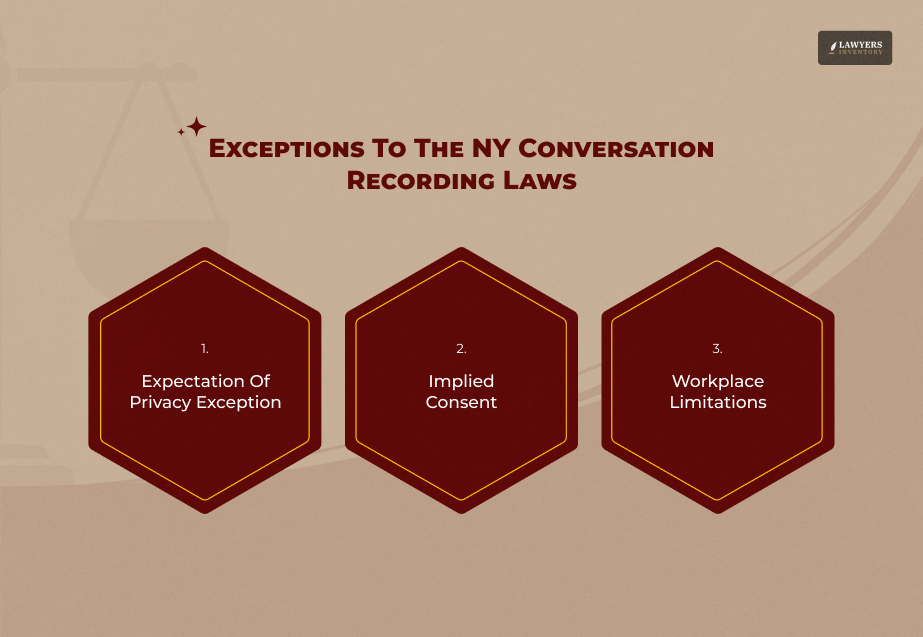
According to the Wiretap Law, recording a conversation between two people is illegal. However, there are certain exceptions.
The law cannot punish recording if the conversation is in a public location instead of a private one. The recording remains valid if the recorded individual did not treat the subject matter personally.
1. Expectation Of Privacy Exception
Consent laws mostly shield conversations where participants have a “reasonable expectation of privacy.” However, you bear the risk if you choose to have a private conversation in a public setting. [Source: PMC]
For example, someone might loudly brag in the open. If you record them, New York courts will not view it as illegal wiretapping. This is because the speaker expected no privacy. [Source: People v. Clark, Case No. 115776]
2. Implied Consent
Consent does not require spoken words. Instead, the law recognizes that a person’s conduct can imply consent. To illustrate, you might call a customer service line and hear a standard automated disclaimer.
This message warns you that the company records all conversations. If you stay on the line, the law assumes you agree to the recording. Therefore, your continued participation grants implied consent.
3. Workplace Limitations
State law may permit a recording. Nevertheless, private businesses can enforce different rules within their own operations. For instance, a company policy might explicitly forbid recording.
If you record secretly anyway, the law will not protect your job. Consequently, the company can still legally dismiss you for violating their policy. [Source: FindLaw]
What Are The Penalties For Violation Of The Law?
Although recording a conversation in N.Y. when one party approves it is legal, it is not lawful for all the U.S. states.
Washington, Massachusetts, New Hampshire, Connecticut, Pennsylvania, Illinois, Florida, Maryland, Nevada, California, Montana, and Michigan are the 12 states where you need the consent of 2 people to record a conversation.
So now, if anyone violates the law and records the conversation, they will face penalties.
1. Criminal Penalty
If you breach the Federal Wiretap Law, you will face criminal penalty charges under Section 2511 of Title 18.
They will get a sentence of 5 years in prison and a $500 penalty for this crime. But, the criminal penalty charges are different in all these 12 states.
For example, if someone violates the federal law in California, he will face one year in prison with a $2500 penalty. That is the law according to California Penal Code Section 631.
2. Civil Penalty
Even if someone does not face the criminal penalty in the eyes of the law, they can always be subjugated under the civil penalty charges.
For example, if you record a conversation with someone who resides in one of the 12 states, you will face the civil penalty.
The recorded person may file a lawsuit against you and even threaten to sue you.
Therefore, if wiretapping is not legal in these states, you must not do it until and unless everyone agrees to it. In such cases, the penalty charges depend on the person who filed the lawsuit in the first place.
Cross-State Conversations: A Major Legal Risk
It is legally allowed to record a conversation in New York if you personally give permission. However, you must take a very careful approach when calling someone outside of the state.
Currently, 12 states across the U.S. enforce “all-party” or “two-party” consent laws. For instance, California, Florida, Massachusetts, and Pennsylvania require everyone on the call to agree to the recording.
To illustrate the risk, imagine you are in New York and secretly record a call with someone in California. Because you hid the recording from them, California judges can take up the legal matter.
Consequently, you could face severe consequences if the ruling goes against you. Specifically, the court could slap you with very high fines or subject you to criminal charges under California Penal Code 632.
Therefore, you must always confirm the physical location of the person you are speaking with. In particular, you must take this precaution during any call involving participants across different states.
This May Also Help:
- What Are The Types Of Hold Harmless Agreements? Explained
- What Kind Of Lawyer Do I Need? Here Is Your Answer!
- How To Become A Lawyer
Leave A Reply







What Does Pro Bono Mean – And Does It Actually Mean Free?
Read More
What Is A Holding Company, And When Does It Actually Protect You Legally?
Read More
Litigation Vs. Arbitration: Which One Actually Decides Your Case?
Read More
Mediation Vs. Arbitration: Costs, Process, Enforceability, And Key Differences
Read More
What Is Public Policy? How Governments Make Rules And Courts Apply Them
Read More
0 Reply
No comments yet.