Summarize using AI





Prompt copied. Paste it into Gemini.
Today’s topic: Regulatory lawyers
With the intricate rules and regulations that we have today, understanding and following these laws can be quite a challenge. That is when people hire regulatory lawyers.
They are the ones who guide both individuals and businesses through the maze of regulatory requirements and ensure that they do not get into trouble with breach of contract.
These legal professionals help their clients maintain their security by making sure that they follow the regulations that are specific to their industry and by standing up for them when they have conflicts with regulatory authorities.
In this blog, we will break down the following things:
- What is regulatory law?
- Who are regulatory lawyers and what do they do?
- Who needs them and when?
- Different types of regulatory lawyers.
- How to choose them?
Therefore, if these are a few things that you want to know, keep on reading this blog till the end…
What Is Regulatory Law?
Regulatory laws are essentially the set of policies and roadmaps put in place by government bodies to run, check, and supervise certain businesses, activities, or ways of going. These statutes aim to:
- Preserve the public welfare.
- Keep fair play in the market.
- Protect the people, their properties, and the environment from any kind of harm.
To make sure that products are safe for use and consumption, the Food and Drug Administration (FDA) is the one that, for example, regulates the food and pharmaceutical sectors.
The Environmental Protection Agency (EPA) establishes regulations to alleviate pollution and preserve the environment. The Federal Trade Commission (FTC) assists consumers in a way that it implements laws against unethical business practices.
In addition, regulatory laws may be in charge of the operations of some sectors such as banking, transportation, and employment safety.
For example, the Securities and Exchange Commission (SEC) oversees investment and stock trading activities. At the same time, the Occupational Safety and Health Administration (OSHA) sets forth safety conditions in the workplace.
Regulatory laws offer a structure for different businesses and areas of life where they can operate, thus ensuring that they are accountable, transparent, and that there is protection for all the stakeholders involved.
Therefore, by understanding and abiding by these laws, both businesses and individuals will be able to avoid legal trouble and be part of the solution in making society safer and fairer.
Importance Of Regulatory Laws

Regulatory law is the most vital of the four main types of law. It has a direct influence on society, as it regulates public safety, economic competition, and environmental protection. By setting definite rules for businesses and individuals, regulatory law serves as a safety net, addressing market failures and moral weaknesses in business.
Who Are Regulatory Lawyers?
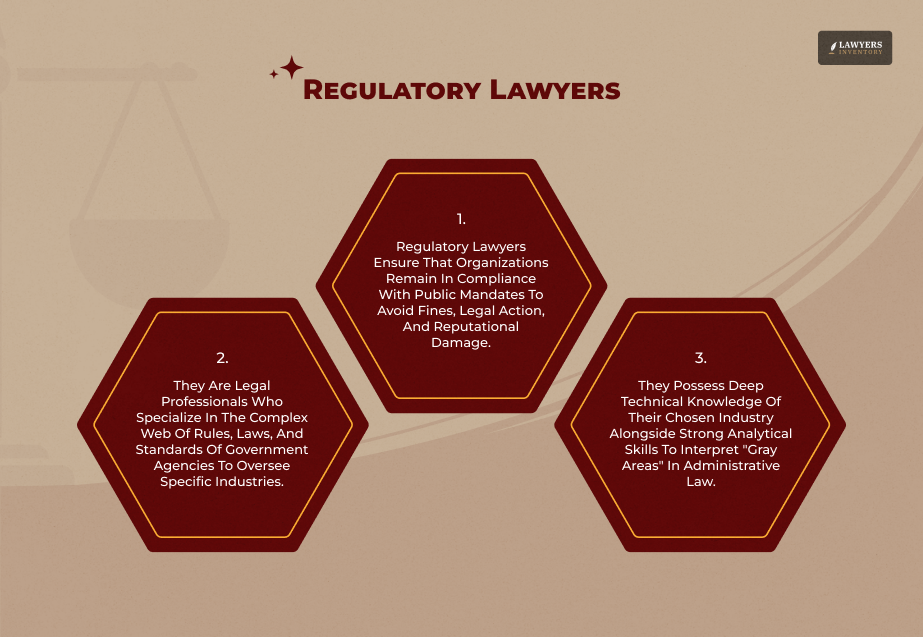
Regulatory specialists are attorneys who have the expertise required to successfully navigate the complex landscape of regulatory legislation.
They help people, companies, and organizations understand and follow laws and regulations set by governmental bodies.
In addition to law firms, they can be found in-house at corporations, public interest organizations, or government agencies as well. These lawyers also provide clients with guidance on avoiding trouble with the law, following rules, and getting the necessary permits and licenses.
By using their knowledge of contract law, they make sure their clients can understand the clauses in the agreements and have the capacity to make informed decisions.
Besides, they represent and support clients in negotiations, enforcement proceedings, and regulatory issues.
In addition, regulatory lawyers usually practice in industries with heavy government regulations, such as technology, healthcare, banking, and energy.
As guides and advocates, regulatory attorneys help their clients deal with the ever-changing regulatory landscape.
Also, they take on their clients’ burden of ensuring that they are still compliant and competitive with the latest rules and regulations.
Apart from that, attorneys who specialize in regulation are instrumental in protecting their clients’ interests, reputation, and financial stability.
On top of that, these lawyers are indispensable in the highly regulated environment of today, whether it is through the defense of regulatory proceedings or the assurance of compliance.
Who Needs A Regulatory Lawyer?
The need for regulatory lawyers arises when businesses and entrepreneurs are faced with very complicated laws and regulations. They are instrumental in compliance, securing the permits that are required, and steering clear of legal problems.
Persons who are in regulatory disputes or have been subjected to regulatory investigations need to get regulatory lawyers. These lawyers provide them with support and representation, aiming to resolve issues and reduce the amount of penalties.
When a company decides to enter a new market or start a new line of business, one of their main concerns should be regulation, hence the need for regulatory lawyers to help them know and adhere to the new regulations.
Also, those in industries that are heavily regulated, such as healthcare, finance, and energy, must have regulatory lawyers to help them keep track of changes in laws and regulations.
If a person is going through a regulatory enforcement action or has been fined, they should get a regulatory lawyer who will help them assert their rights and even negotiate the terms of their settlement.
To sum it up, anyone who is changing, being checked, or confronted with regulatory issues, and definitely anyone who is trying to be in compliance with the law, should hire a regulatory lawyer.
They are professionals who give clients the right information and represent them in such a way that the clients’ objectives are met and they are exposed to the least amount of risk.
When Do You Need A Regulatory Lawyer
Regulatory lawyers are essential when navigating complex regulations, ensuring compliance, or addressing regulatory issues.
Additionally, they provide expert guidance, representation, and support to help you achieve your goals while minimizing risks and ensuring compliance.
You can avoid costly mistakes, reduce legal risks, and focus on your core business by engaging regulatory lawyers.
You need regulatory lawyers in various situations, including:
- Starting a business.
- Expanding operations.
- Mergers and acquisitions.
- Compliance issues.
- Permitting and licensing.
- Regulatory disputes.
- Policy changes.
- Investigations and enforcement.
- International trade.
- Crisis management.
Regulatory Lawyers Types
There are several types of regulatory lawyers, each specializing in a specific area.
Each regulatory lawyer has in-depth knowledge of their area, allowing them to provide expert guidance and representation to clients.
Regulatory lawyers can stay up-to-date on the latest developments and effectively support their clients by specializing.
Here are some of the most common types of regulatory lawyers that you need to know about:
- Administrative Lawyers.
- Compliance Lawyers.
- Environmental Lawyers.
- Financial Regulatory Lawyers.
- Healthcare Regulatory Lawyers.
- Intellectual Property Lawyers.
- Labor and Employment Lawyers.
- Securities Lawyers.
- Tax Lawyers.
- Telecommunications Lawyers.
How To Choose The Right Regulatory Lawyer?
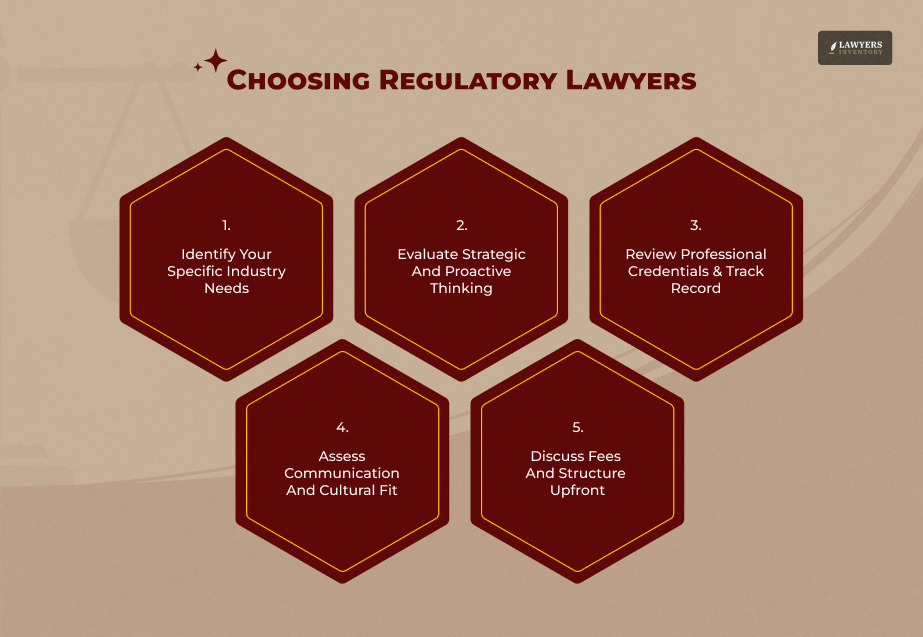
First of all, when hiring a regulatory attorney, one of the main things you should look at is their work history. Make sure they have worked in your industry or in a closely related regulatory field, e.g., banking or healthcare. Their work with highly regulated areas will enable them to anticipate your needs effectively.
Secondly, experience is also a very important element. Find attorneys who have previously won legal battles like yours. Check out their website, ask for referrals, or read some online testimonials to determine their level of experience.
Besides that, the ability to communicate well is very important. Select a lawyer who can break down the complex legal issues and explain them in a simple way. You want to be aware of the legal steps and get updates all the time.
Third, think about the lawyer’s charges and whether he/she will be accessible to you or not. Make sure the lawyer can give ample time to your case and you are clear about the way the lawyer charges, in order not to be shocked later. Check online, gather opinions, and trace their track record through their online profile.
Above all, when you are picking a lawyer, take into account their professional history, the field of law they specialize in, and their working style. If you weigh these factors rightly, you will be able to get a regulatory lawyer who fits your requirements and assists you in realizing your objectives.
Read Also:
Leave A Reply







Power Stick Deodorant Recall FDA: Your Complete Safety Guide
Read More
Is It Legal To Use True People Search? What Are Its Restrictions?
Read More
Case Is Being Actively Reviewed By USCIS – Meaning And Timelines
Read More
Refund Risk Under Income Tax Demand Notice Section 143(1) Summary Adjustments [A Complete Legal Assessment]
Read More
2026 Rules For The Legal Age Of Marriage In India
Read More
0 Reply
No comments yet.