
Today’s topic: Should I get a lawyer for a car accident that wasn’t my fault?
You were driving home, as usual, when suddenly you got into an accident. The other driver ran a red light and hit you. Police show up, take statements, and then they tell you that you are not the one who is at fault.
While that should technically be a relief, there are several other things that might run through your mind.
For instance, your car needs fixing, your neck is hurting more than you thought, and the insurance company keeps calling you with questions you don’t understand very well.
That is the point at which most accident victims feel they have nowhere to go. At times like these, most people generally think that if the accident “was not your fault,” then everything works out automatically and smoothly.
Unfortunately, that is not the way the insurance and legal systems normally operate. Fault does not guarantee decent treatment, on-time payments, or full compensation, especially when medical bills, lost income, or long-term injuries are in the picture.
Moreover, as Ben Crump mentions, “you may need to prove that you did not commit any wrongdoing.” Which is why it is best to keep a few options at hand.
In this blog, we will be breaking down the following things:
- What does “Not your fault” mean?
- When do you not need a car accident attorney?
- When are the times you should consider hiring legal help?
- How can a car accident lawyer help you in such cases?
- Cost of hiring a car accident lawyer.
- Evidence you should gather before hiring a lawyer.
Therefore, if these are a few things you want to know, keep reading this blog until the end…
What “Not Your Fault” Really Means
As we have already mentioned above, it can feel confusing when you know that the car accident was not your fault. Hence, wondering “Should I get a lawyer for a car accident that wasn’t my fault?” is only natural.
However, having a better understanding of a few things, like liability and the determining factors in such accident cases, can really help you clear things out.
Determining Fault vs. Liability
Being “not at fault” is a lot less clear-cut than it might seem. While police reports carry weight, they are not binding in law.
Insurance companies will have a look at the case themselves, too. They won’t just take a report at face value. They will review photos, witness statements, the damage on the vehicles, and even check what the traffic laws say.
In many states, insurers apply the comparative negligence principle, which means fault can be apportioned by percentage.
For example, you might be considered 80% not at fault, but still have your compensation lowered by 20%. That is the main reason why fault determinations are heavily disputed even in those cases where the accident is considered obvious.
The key takeaway: fault is a legal and financial concept, not just a casual conclusion at the accident scene.
No-Fault Insurance vs. Fault Systems
Some states follow no-fault insurance systems, where your own insurer pays certain expenses regardless of who caused the accident.
According to the Legal Information Institute, it “requires the insurance company to indemnify its policyholder for certain losses resulting from an automobile accident regardless of who caused the accident.”
This usually applies to medical bills up to a limit. In fault-based states, the at-fault driver’s insurer is responsible.
No-fault laws can restrict when you’re allowed to sue, which changes whether a lawyer is helpful early on.
When Do You Not Need A Lawyer?
In some situations, hiring a lawyer may be unnecessary. These typically include:
- Minor property damage only.
- No injuries or symptoms.
- You understand your insurance policy well.
- A fair, quick settlement with no disputes.
That said, even “simple” cases can become complicated if injuries surface later—something many accident victims don’t anticipate.
When You Should Seriously Consider A Lawyer

There are times when it is best to hire a lawyer. For instance, Nolo states that in cases of harassment from an insurance company or disputed fault, you should not wait to hire legal help.
You should strongly consider legal help if any of the following apply:
- Serious injuries or long-term recovery: Ongoing treatment, lost wages, or future care costs require accurate valuation.
- Insurance disputes or lowball offers: Insurers often minimize payouts to protect profits.
- Disputed or shared fault claims: Lawyers can challenge unfair fault percentages.
- Uninsured or underinsured drivers: Recovering compensation becomes significantly harder.
- Commercial vehicles involved: Trucking or company vehicles involve layered liability.
- Multiple parties involved: Chain-reaction crashes or rideshare accidents increase legal complexity.
Practical Steps After A Not-At-Fault Crash

1. Ensure safety and seek medical evaluation.
2. Call the police and request a report.
3. Document the scene and exchange information.
4. Notify your insurer promptly.
5. Speak with a lawyer before accepting a settlement.
How Can A Car Accident Lawyer Help You In Such Cases?
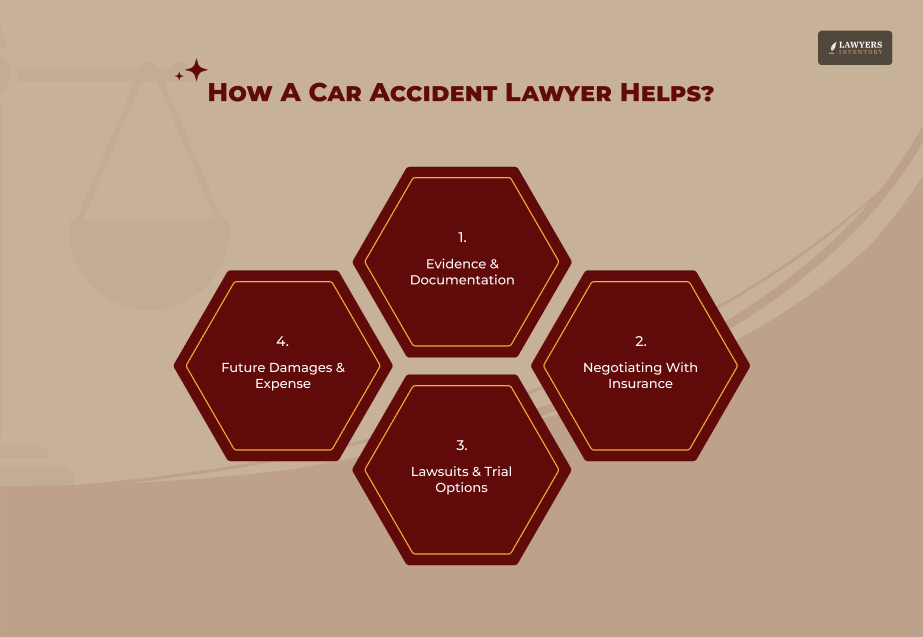
“Should I get a lawyer for a car accident that wasn’t my fault?” As you might have already understood, while it is not a compulsion, it is always best if you do so.
Here’s how they can help you:
1. Evidence & Documentation
To prove your case, a lawyer collects your side of the story through:
- Police reports.
- Medical records.
- Videos of the incident.
- Statements from witnesses.
- Expert opinions.
This proof is necessary in court if the other party denies responsibility or challenges the amount of the claim.
2. Negotiating With Insurance
Insurance adjusters are skilled negotiators whose goal is to limit the amount they pay you. Attorneys know the tricks, delays, recorded statements, and undervaluation that adjusters use and how to foil them.
3. Lawsuits & Trial Options
When negotiations deadlock, your lawyer may bring a lawsuit and manage the legal formalities, investigation, and requests for information.
Most cases are resolved by agreement rather than trial, but the threat of court often results in better offers.
4. Future Damages
Legal help is one of the greatest benefits in correctly accounting for future losses, such as the following:
- Medical treatment that continues.
- Lower earning capacity.
- Ongoing pain.
The lawyer takes all of these things into account when it comes to seeking compensation, even when the car accident was not your fault.
Cost, Evidence, Timeline When Hiring A Car Accident Lawyer
Most car accident lawyers work on a contingency fee basis, meaning you pay nothing upfront. The lawyer receives a percentage of your settlement only if they win your case. If there’s no recovery, you typically owe nothing.
Apart from that, when it comes to hiring a lawyer, there is one crucial thing that you need to do even before getting in touch with the lawyer. And that is the evidence.
Here’s a quick checklist that will be helpful:
Checklist:

• Police report and scene photos
• Medical records and doctor visits
• Witness names and statements
• Repair estimates, receipts, and invoices
Always remember that, irrespective of whether you have a lawyer or not, strong documentation strengthens your position.
Leave A Reply








What Is A Business Entity? A Simple Guide For New Business Owners
Read More
When Should You Take A Criminal Charge Seriously?
Read More
Who Is Responsible For Pest Problems In Dallas Rental Properties
Read More
Considering A Sexual Abuse Claim? Know What Legal Support Offers
Read More
0 Reply
No comments yet.