Summarize using AI





Prompt copied. Paste it into Gemini.
Wage Theft Claim Process At A Glance

• Statutory Baseline: The worker is covered under the FLSA or tougher state labor laws.
• Employer Breach: The employer commits a violation, such as withholding overtime or misclassifying roles.
• Legal Enforcement: The employee files a formal administrative claim with the DOL or initiates a private civil lawsuit.
• Remedial Resolution: The court or agency orders the recovery of back pay, interest, and liquidated damages.
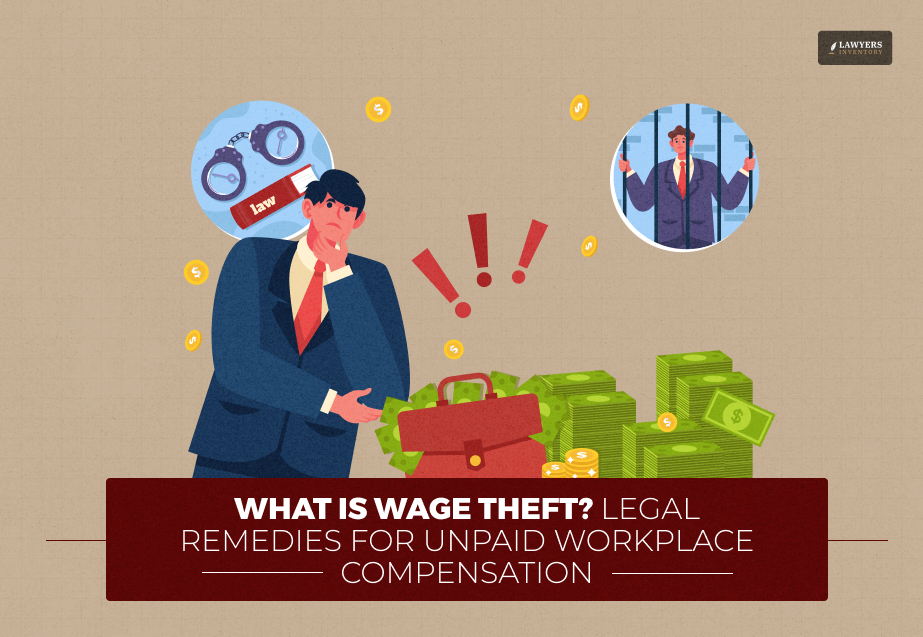
Wage theft is by far the biggest form of theft in the United States. In general, wage-related losses exceed all traditional property crimes. They exceed all robberies, burglaries, and vehicle thefts by quite a bit. The numbers speak for themselves.
The Economic Policy Institute conducted research on this issue. Their work made the scale of the problem clear. Billions of dollars are being taken from low-income wage earners every year. This massive financial loss happens just because of wage theft.
Knowing the exact statutory definitions of wage theft is very important. It matters for a legal audience. It is also crucial for any person looking for legal assistance.
You must realize that wage theft refers to many different types of illegal employer behaviors. It is not limited to just one practice.
These behaviors directly violate federal and state labor laws.
Because of this, they expose employers to serious legal consequences. Employers face lawsuits for such a crime. They also face double damages and civil fines.
The Legal Framework: The Fair Labor Standards Act (FLSA)
The primary federal statutory weapon against wage theft is the Fair Labor Standards Act (FLSA). Enacted in 1938 and codified under 29 U.S.C. § 201 et seq., the FLSA establishes federal standards for:
- Minimum wage.
- Overtime pay.
- Recordkeeping.
- Child labor.
Under the FLSA, the U.S. Department of Labor (DOL) Wage and Hour Division enforces federal compliance. However, individual states maintain their own labor laws.
Many jurisdictions enact statutes that offer significantly greater protections than the federal baseline. When federal and state laws conflict, the law most favorable to the employee applies.
The Common Manifestations of Wage Theft
Wage theft takes many forms. Some violations are blatant, while others hide within complex corporate payroll practices.
1. Minimum Wage Violations
One of the responsibilities of the FLSA is to fix a minimum federal wage. But, many states and cities set up even higher minimum wage rates.
One way for a thief to commit wage theft is by paying the worker a wage below the minimum legally mandated level. It is this type of violation that often affects tipped workers.
The law allows employers to deduct a portion of tips, referred to as the “tip credit, ” only when the employee’s tips and wages add up to the minimum wage.
It is an employer’s obligation to cover the difference if the sum of these two is still less than the minimum wage.
2. Failure To Pay Overtime
Federal law 29 U.S.C. 207 requires employers to pay non-exempt employees overtime if an employee works more than forty hours in a workweek.
Under the rules of Social Security, the minimum wage for any additional hours (hours over 40) would be equal to the basic hourly rate of such worker multiplied by one and one-half.
Employers frequently break the legal norm of overtime pay by either computing the extra pay over two weeks rather than one or by providing so-called “comp time” to their employees instead of monetary compensation.
3. Off-The-Clock Violations
To be considered lawful, an employee should not be required by their employer to work without being paid outside the set shift hours or even allowed to work unpaid outside the shift hours.
A typical such situation is, for example, the requirement to be present for a seminar training before or after the actual shift hours.
Besides, the law prohibits the employer from deducting working time by making the employees wear their protective gear without any payment for that.
Another example is that of being forced by work rules to reply to emails or answer the call during the unpaid lunch break.
4. Illegal Misclassification Of Employees
Putting employees on the books as independent contractors has become a common business practice. Employers do this to get around labor laws. One example is employers changing their internal records.
They show that a regular wage earner has changed into a contract worker. They classify them as a 1099 worker. Sometimes they change them into a salaried exempt professional. They do this to avoid giving overtime benefits.
By changing the status of a worker, an employer avoids specific financial duties. The employer does not need to pay overtime. They do not even have to pay minimum wage. They can also get rid of their payroll tax obligations.
Department of Labor regulations state the rules clearly. A working arrangement must meet the economic reality test. The arrangement must show a high level of freedom.
If there is not enough freedom, the worker must be considered an employee. The legal status is not defined just by the contract wording.
Direct Comparison: Federal vs. Aggressive State Protections
| Legal Element | Federal FLSA Baseline | Aggressive State Standards (e.g., California/New York) |
| Minimum Wage | $7.25 per hour. | Drastically higher state and municipal minimums. |
| Overtime Threshold | Based strictly on hours exceeding 40 per workweek. | Daily overtime limits (e.g., over 8 hours in a single day). |
| Liquidated Damages | Equal to the amount of unpaid wages (double damages). | Can include treble (triple) damages and compounding interest. |
| Statute of Limitations | 2 years for standard; 3 years for willful violations. | Up to 3 to 6 years depending on the state statute. |
The Financial And Legal Remedies Available To Victims
When an employee suffers wage theft, the law provides robust mechanisms for recovery. Legal recourse generally proceeds through an administrative complaint or a private civil lawsuit.
Back Wages And Retrospective Pay
The primary remedy in any wage theft action is the recovery of back wages. This represents the exact sum of money the employer unlawfully withheld from the worker.
Liquidated Damages And Treble Awards
Under federal law, successful plaintiffs are entitled to liquidated damages. These damages automatically double the award, serving as compensation for the delay in payment.
In highly protective states, courts can award treble damages or apply high statutory interest rates to the unpaid balance.
Attorney’s Fees And Shifting Costs
To ensure harmed workers can access legal representation, the FLSA includes a mandatory fee-shifting provision.
If the employee prevails, the court orders the employer to pay the employee’s reasonable attorney’s fees and litigation costs.
This provision allows plaintiffs to retain legal counsel without paying high upfront hourly rates.
Strategic Steps: Building A Defensible Wage Theft Case
Succeeding in a wage theft claim requires credible, documented evidence. Employers often possess professional payroll software, meaning the employee must meticulously track their own data.
Documenting Hours And Discrepancies
Employees must maintain personal logs of all hours worked. Do not rely solely on the employer’s timekeeping system, as corporate records can be altered or restricted. Keep physical journals, digital calendar entries, and copies of submitted timecards.
Preserving Communications
Save all text messages, emails, and voicemail recordings concerning scheduling, late pay, or off-the-clock directives. If a supervisor commands you to work through a lunch break, preserve that written instruction immediately.
Filing Timelines And The Statute Of Limitations
Time is a restrictive factor in employment law. The standard FLSA statute of limitations is two years, expanding to three years only if the worker proves the employer acted willfully.
State laws vary. Filing late completely bars an individual from recovering their stolen compensation.
Retaliation Protections Under the Law
In a large number of cases in which employees’ salaries have been stolen, the victims keep quiet due to fear.
They are afraid of getting fired, being demoted, or getting involved in hostile environments at work.
This fear is explicitly addressed by the FLSA under 29 U.S.C. § 215(a)(3). This section is a strict anti-retaliation law.
It is not legal for an employer to let an employee go, punish, or take other unfavorable actions against an employee for filing a complaint or joining a wage case.
If the employer is found to have retaliated, the employee may make a separate retaliation claim.
This will allow the employee to also claim more damages, like front pay, damages for pain and suffering, and punitive damages.
Leave A Reply







What Is The CCG Denver Restaurant Service Charge Lawsuit About?
Read More
What Is The Perm Processing Time And Why Is It Important?
Read More
Top Factors Influencing Workers’ Compensation in Georgia
Read More
Why Retaliation at Work Is Illegal — and What You Can Do
Read More
How To Maximize Your Workers’ Compensation Settlement
Read More
0 Reply
No comments yet.