Summarize using AI





Prompt copied. Paste it into Gemini.
Quick Answer

Legal rights are protections granted to citizens by federal and state constitutions and statutory laws. They ensure fair treatment when an individual interacts with the judicial system. The legal system resolves disputes through two completely distinct pathways: civil proceedings for private or financial conflicts, and criminal proceedings for violations of public law.
Navigating the legal system often proves overwhelming for individuals. This reality holds true during unexpected legal involvements. Understanding your rights protects your interests throughout any proceeding.
Legal Pathway Classification Framework At A Glance
| Legal Pathway | Initiator | Defender | Core Objective |
| Civil Proceedings | Plaintiff (Individual / Business) | Defendant | Obtains financial compensation or court orders |
| Criminal Proceedings | Prosecutor (The Government) | Defendant | Punishes violations of state law |
Defining The Scope And Nature Of Legal Rights
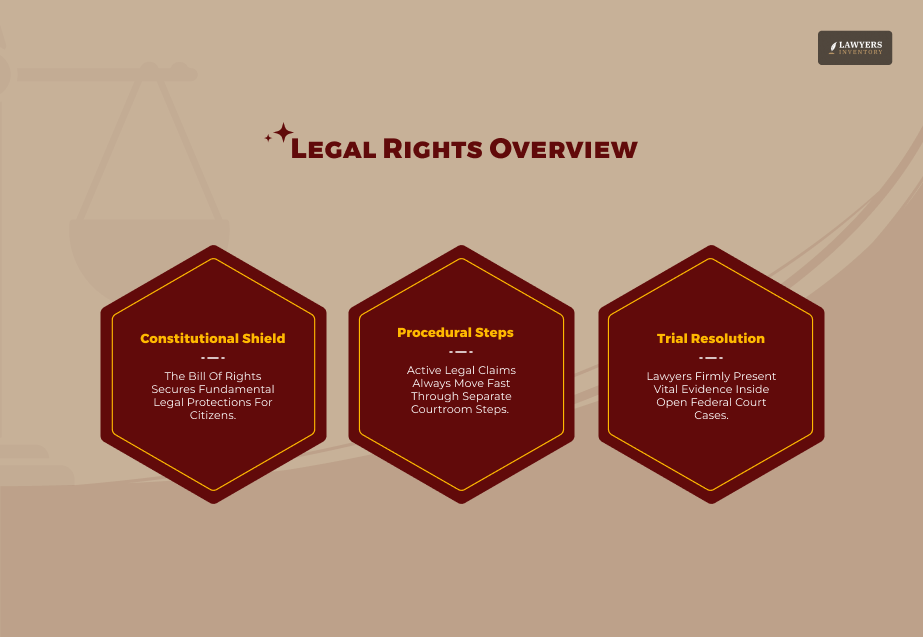
Legal rights form the baseline framework of a structured society. A constitutional state grants specific liberties to every citizen equally. These rights do not stem merely from abstract moral theories.
Instead, formal statutory law and constitutional provisions create these protections. They also enforce them. Legal protections ensure fair treatment during your interactions with the judicial system.
Rights are not completely static mechanisms. They adapt as legislative bodies update statutes. Superior courts also issue new judicial precedents that change these rights.
The state enforces these protections through established rules of law. If an entity violates your legal rights, you can seek a civil remedy. You can also pursue criminal interventions through law enforcement channels.
The Foundation Of Constitutional Guarantees
Constitutional law provides the highest level of protection for individual liberties. The United States Constitution contains amendments. These amendments shield citizens from arbitrary government actions.
For example, the Fourth Amendment explicitly outlaws unreasonable searches. It also bans illegal seizures by law enforcement officers. [Source: National Archives]
Furthermore, the Fifth Amendment protects individuals from forced self-incrimination. It stops forced confessions during investigations. It also guarantees due process.
Due process protects your life, liberty, and property. The Sixth Amendment secures the right to a speedy trial. It also grants an impartial jury and the assistance of defense counsel. [Source: LibGuides]
Statutory vs. Administrative Rights
Statutory rights emerge directly from legislation. Federal, state, or local governing bodies pass these laws. These laws address specific societal actions and employment standards.
They also establish consumer safety rules. For example, personal injury laws create explicit obligations between private parties. Contract codes do the same.
Administrative rights flow from rules created by specialized government agencies. These agencies include environmental protection groups and labor boards.
Transport authorities also create these rules. Understanding the specific right involved helps your legal team. They use this information to choose the correct court venue for your case.
The Structural Division: Civil vs. Criminal Proceedings
The modern legal system operates through two entirely distinct procedural pathways. Civil law addresses private disputes between individuals, corporations, or organizations. Criminal law manages offenses against the public order and the state itself.
Here’s a comparison of the core legal frameworks:
| Legal Feature | Civil Proceedings | Criminal Proceedings |
| The Initiating Party | An individual or business (Plaintiff) | The government or state (Prosecutor) |
| The Primary Objective | To obtain compensation or resolve a dispute | To punish the offender and deter crime |
| Standard of Proof | Preponderance of the evidence (>50% true) | Beyond a reasonable doubt (about 99% certainty) |
| Constitutional Right to Counsel | No. Litigants must pay or represent themselves | Yes. Guaranteed by the Sixth Amendment |
| Potential Outcomes | Monetary damages or court injunctions | Probation, fines, community service, or jail time |
Chronological Framework Of A Legal Case
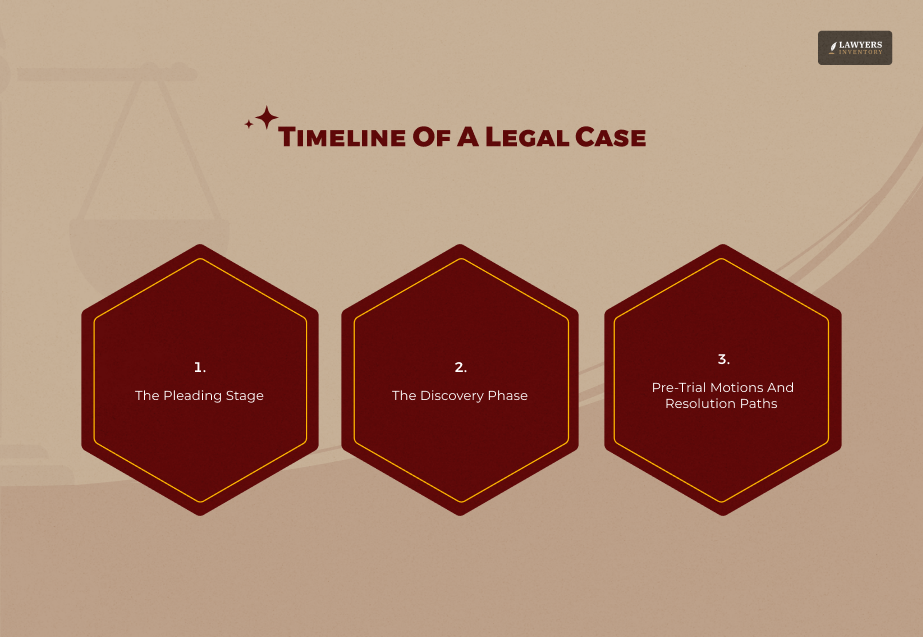
Legal cases do not proceed directly to a courtroom trial overnight. They follow a predictable, multi-phased chronological structure. Each phase features specific deadlines, formal filings, and strategic legal evaluations.
1. The Pleading Stage
Here’s what you need to do:
(i). Filing The Complaint
The plaintiff or prosecution brings the lawsuit. They prepare an official complaint document. Then, they submit this document to the court.
The complaint states the facts of the case. It details the laws supporting the claim. Finally, it outlines the plaintiff’s grievances and demands.
(ii). Serving The Summons
The court must deliver the summons next. A summons is an official notice. Law requires giving this notice to the defendant. The document grants permission to the court. This permission allows the court to resolve the dispute.
(iii). Submitting The Answer
The defendant receives the summons. They must respond within a set timeframe. The defendant must meet all legal deadlines. They can deny the allegations.
They can also raise legal objections. To do this, they file an official court document. This document contains their legal positions. It outlines the arguments for the trial.
2. The Discovery Phase
Here’s what happens in this particular phase:
(i). Exchanging Information
The legal teams exchange evidence. They use an official process. Sharing witness material helps both sides. Sharing documents also helps. This avoids surprises at trial.
(ii). Taking Depositions
Lawyers question witnesses. The witnesses are under oath. This happens outside the courthouse. Lawyers take down the evidence. They use it for later confrontation at trial.
(iii). Submitting Interrogatories
Plaintiffs and defendants deliver written queries. They send them to each other. The responding party must answer. They must answer under oath.
3. Pre-Trial Motions And Resolution Paths
Here’s what you need to know:
(i). Filing For Summary Judgment
One side files a motion. Either the defense or the plaintiff does this. They argue no material facts are in dispute. They ask the judge to decide immediately. The judge renders the verdict without a trial.
(ii). Request For Suppression Of Evidence
The defense files a motion to suppress. With this, they can:
- Allege the prosecutor got evidence illegally.
- Argue it violated constitutional rights.
- Ask the court to block it.
The state cannot use this evidence at trial.
(iii). Settlements And Plea Agreements
Most litigation disputes end in compromise. Parties resolve the issue privately. Criminal defendants make an agreement with the court. These methods are the most frequent resolutions.
The Core Elements Of Trial Advocacy
When negotiations fail, cases move into the trial phase. Trials require strict adherence to the Federal Rules of Evidence.
They also follow corresponding state procedural guidelines. Both sides present their arguments to a judge or an paneled jury.
Legal Evidence Categories
- Physical Evidence: Attorneys introduce physical objects, corporate records, and digital communications. They also use forensic analyses to prove their claims.
- Witness Testimony: Witness testimony adds essential narrative context to physical evidence. Fact witnesses describe events they personally observed or heard. Expert witnesses provide professional opinions on complex technical matters.
The judge evaluates the legal admissibility of each item. They complete this review before allowing the jury to see the evidence.
Developing An Effective Legal Strategy
A legal strategy matches the facts of a specific case with applicable statutory law. Your lawyer reviews the strengths of all available evidence.
They also check the weaknesses. They identify helpful legal precedents to sway the judge’s rulings.
A well-crafted strategy also prepares for the opponent’s counterarguments. It determines whether a jury trial offers the highest chance of success.
It also evaluates bench trials. In a bench trial, the presiding judge decides both the legal rulings and the final factual verdict.
Navigating Special Considerations And Appeals
Different practice areas require distinct procedural knowledge. Criminal cases carry much higher stakes than standard civil property disputes.
An individual’s physical freedom remains on the line. The prosecution must prove every element of an alleged crime. The defendant remains legally innocent until the state meets this heavy burden.
Critical Elements In Criminal Defense
Specialized legal representation remains essential during these intense proceedings. For example, individuals facing state or federal charges in Florida often retain Tampa Criminal Defense Lawyers to safeguard their constitutional rights.
These defense professionals cross-examine state witnesses. They challenge unlawful police investigations. They also present formal defenses in court.
Legal Representation Focus Areas
- Civil Litigators: These professionals manage contract breaches, injury claims, and property liens.
- Defense Attorneys: These specialists protect individuals against state-level criminal charges.
The Structure Of The Appellate Process
If a trial results in an unfavorable outcome, the losing party can seek an appeal. Appeals do not involve a brand-new trial.
They also ban the introduction of new witness evidence. Instead, an appellate court reviews the written trial record for significant legal errors.
The appealing party must show that the trial judge made an error. This error must alter the final outcome of the case.
Common grounds for appeal include incorrect evidentiary rulings. Flawed jury instructions also justify an appeal. Constitutional violations provide another ground. If the appellate court finds a major error, it can overturn the verdict. It can also order a new trial.
Actionable Steps For Individuals Facing Legal Action
Here are some of the steps that you need to take when it comes to safeguarding your legal rights:
Preserve All Communication:
Firstly, keep every text message, email, contract, and physical document related to your dispute.
Track Filing Deadlines:
Calculate your jurisdiction’s specific statute of limitations immediately. This step prevents losing your right to sue or defend.
Avoid Self-Incrimination:
Do not discuss your ongoing case on social media platforms. Never provide statements to opposing insurance adjusters.
Gather Initial Paperwork:
Collect all accident reports, police files, and relevant invoices before scheduling an attorney consultation.
Interview Specialized Counsel:
Finally, choose an attorney with documented litigation experience. Ensure they specialize in the specific field governing your case.
Disclaimer: The information provided in this article is for general informational purposes only. It does not, and is not intended to, constitute legal advice. Please consult an attorney for legal help.
Sources:
- United States Constitution: Article III (Judicial Branch Powers).
- United States Constitution: Fourth, Fifth, and Sixth Amendments (Bill of Rights).
- Federal Rules of Civil Procedure: Rules 26-37 (General Discovery Guidelines).
- Federal Rules of Evidence: Article IV (Relevancy and its Limits).
Leave A Reply






Do You Pay Taxes On Lawsuit Settlements? IRC Section 104 Explained
Read More
Non-Disparagement Clause Explained: Requirements, Enforceability, And What Changed Recently
Read More
Best Practices For Successful Trademark Registration
Read More
How To Clear A Bench Warrant Without Going To Jail: A Legal Guide
Read More
Is It Negligence Or Malpractice? How Courts Define Carelessness And Professional Misconduct
Read More
0 Reply
No comments yet.