Summarize using AI





Prompt copied. Paste it into Gemini.
Today’s topic: Hold Harmless Agreement!
It is primarily a legal contract, either a standalone document or a clause within a broader agreement. Under which one party agrees not to hold the other party legally responsible for certain claims, losses, or damages.
In simple terms, it’s a way to say, “If something goes wrong, I won’t sue you for it.” According to Merriam-Webster (Legal), a hold harmless agreement is a provision “between parties in which one assumes the potential liability for injury that may arise from a situation and thus relieves the other of liability.”
These agreements play a critical role in modern risk management. Now, it is interesting to note that different people use this agreement for different purposes. For instance,
- Businesses use them to limit exposure to lawsuits.
- Contractors rely on them to clarify responsibility on job sites.
- Property owners use them to protect against visitor claims.
- Individuals encounter them when participating in potentially risky activities.
Irrespective of whether you’re signing one, enforcing one, or drafting one, understanding how hold harmless agreements work—and where their limits lie—is essential.
So, if that is what you want to know, keep on reading till the end…
What Is A Hold Harmless Agreement?
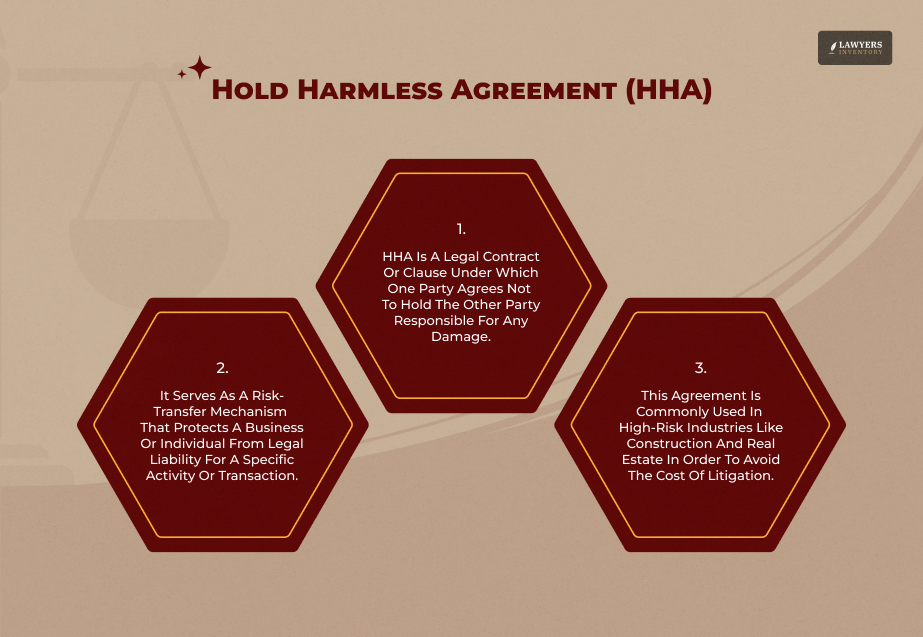
Legally speaking, a hold harmless agreement is a risk-allocation tool. It shifts legal and financial responsibility from one party to another for specific risks tied to an activity, transaction, or relationship.
The protected party is shielded from claims, while the other party agrees to bear the consequences if those claims arise.
You may also see hold harmless agreements referred to as:
- Liability waivers.
- Releases of liability.
- Assumption of risk agreements.
While these terms are sometimes used interchangeably in practice, their legal effects can differ depending on jurisdiction and contract language.
As explained by Nolo, a hold harmless clause typically prevents one party from being held liable for losses related to a particular activity, even if a claim arises later.
Types Of Hold Harmless Agreements
Not all hold harmless agreements offer the same level of protection. Understanding the different types is crucial before relying on one.
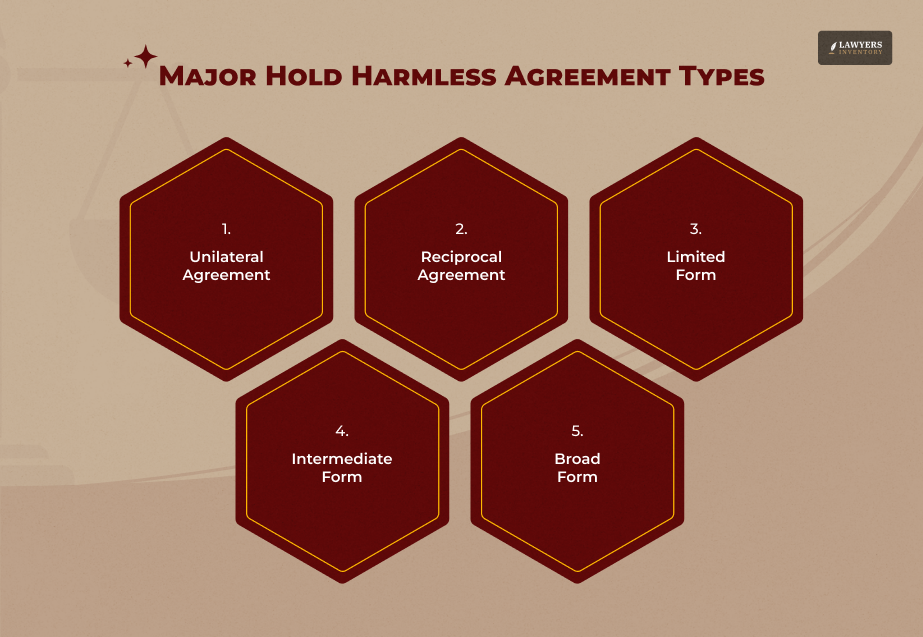
1. Unilateral Vs. Reciprocal Hold Harmless
Unilateral agreements place all the risk on one party. This is common when one party has significantly more control or bargaining power—for example, a property owner requiring a contractor to assume all liability.
By contrast, Reciprocal agreements require both parties to assume responsibility for their own actions. These are frequently used in business partnerships or joint ventures where risks are shared.
According to Business.com, reciprocal clauses are common in collaborative commercial arrangements where neither party wants full exposure.
2. Limited, Intermediate, And Broad Form Agreements
These classifications are especially common in construction and commercial contracts:
- Limited Form: The indemnitor assumes liability only for its own negligence or actions.
- Intermediate Form: The indemnitor covers all liability except for losses caused solely by the indemnitee’s negligence.
- Broad Form: The indemnitor assumes all liability, even when the indemnitee is negligent.
Broad form agreements offer the highest level of protection—but they are also the most controversial. As Insureon notes, many jurisdictions restrict or outright prohibit broad form hold harmless clauses, especially when they attempt to cover gross negligence. It also mentions that “if something goes seriously wrong, you may still be financially responsible.”
3. Standalone Agreement Vs. Contract Clause
A hold harmless provision may exist as:
- A standalone document (common for events, rentals, or recreational activities), or
- A clause embedded within a broader contract, such as a service or construction agreement.
When evaluating a hold harmless agreement, always consider:
- The scope of risk being transferred.
- Whether negligence is included.
- How clearly responsibilities are defined.
How Hold Harmless Agreements Work
At a practical level, a hold harmless agreement works by contractually shifting liability from one party to another. If a claim arises—say, an injury or property damage—the indemnitor agrees to absorb the legal and financial consequences.
Some of the liabilities that it covers include the following:
- Legal defense costs.
- Settlements or court judgments.
- Third-party claims.
- Property damage and bodily injury.
However, these agreements are not unlimited. Many states refuse to enforce hold harmless clauses that attempt to cover:
- Gross negligence.
- Intentional misconduct.
- Willful violations of law.
From a risk-management standpoint, hold harmless clauses function as contractual risk allocation tools rather than absolute shields. As noted in risk management studies from Yosemite Community College District, such clauses help define responsibility but do not eliminate risk entirely.
In other words, a hold harmless agreement reduces exposure—it doesn’t make risk disappear.
Hold Harmless vs. Indemnity vs. Insurance
These three notions are frequently confused with each other. However, in reality, they are different:
- Hold Harmless: Is a clause that stops one party from being considered legally responsible or sued.
- Indemnity: Is a clause whereby one party agrees to compensate the other for losses that have already taken place.
- Insurance: Is a means by which risk is shared with a third party (the insurer) in return for premiums.
For example, in a construction environment:
- A subcontractor might agree to hold the general contractor harmless.
- Indemnify them for losses.
- And have general liability insurance as a monetary backup.
According to LegalNature, insurance and indemnity clauses are frequently implemented jointly. Nevertheless, they are distinct from each other.
Essential Components Of A Valid Hold Harmless Agreement
A well-drafted hold harmless agreement must be clear, specific, and legally compliant. Here are the core elements that must be in the contract or agreement:
- Identification of parties.
- Description of the covered activity.
- Scope of liability covered.
- Duration and time limits.
- Jurisdiction and governing law.
- Signatures and execution.
- Optional notarization.
Jurisdiction And Enforceability In Hold Harmless Agreement
Different jurisdictions have different rules as to how the agreement can be enforced. For example, some states:
- Insist that the negligence be explicitly mentioned in the language of the contract.
- Forbid that the clauses cover gross negligence.
- Restrict the enforceability of such clauses in construction work agreements.
Judges can decide to remove the parts of the agreement that are unclear, unfair, or that go against the rules of the state.
Common law countries normally allow the execution of agreements that are reasonable. In contrast, the statutory systems that are present in the regulated industries are more stringent.
Expert Tips & Best Practices

Here are some of the things that you can do when dealing with hold harmless agreements:

• Always have agreements reviewed by an attorney
• Pair hold harmless clauses with appropriate insurance
• Avoid overly broad or vague language
• Clarify whether defense costs are included
• Treat hold harmless agreements as part of a broader risk-management strategy.

When drafted thoughtfully, these agreements protect relationships—not just balance sheets.
When You Might Need A Hold Harmless Agreement
You can often find hold harmless agreements in scenarios that entail an increased risk. For instance, these include:
- Construction contracts and subcontracting
- Event organization (marathons, festivals, conferences)
- Property rentals and real estate showings
- Recreational activities (skydiving, scuba diving, gyms)
- Professional services involving client premises
Some of the factors that usually determine the necessity and enforceability of such an agreement are industry standards, negotiating power, and local laws.
You might consider a recreational waiver normal. However, a broad form clause in a construction contract might undergo legal examination.
Read More:
Leave A Reply







Is It Legal To Use True People Search? What Are Its Restrictions?
Read More
Case Is Being Actively Reviewed By USCIS – Meaning And Timelines
Read More
Refund Risk Under Income Tax Demand Notice Section 143(1) Summary Adjustments [A Complete Legal Assessment]
Read More
2026 Rules For The Legal Age Of Marriage In India
Read More
What Is A Wet Signature? Legal Guide And 2026 Rules
Read More
0 Reply
No comments yet.