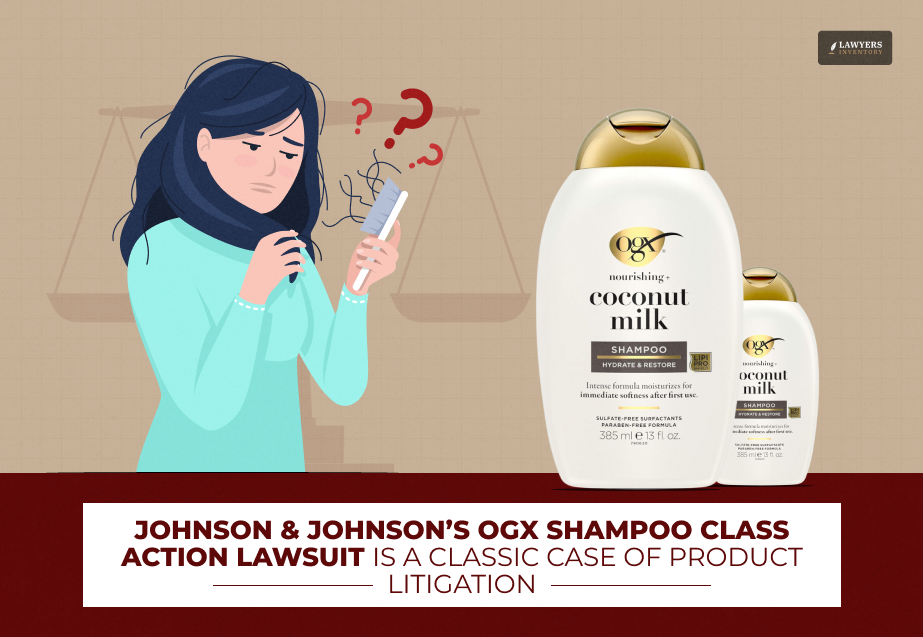
Today’s topic: OGX Lawsuit.
When we talk about beauty, we know the ingredients mean everything in a product. But what happens when there is a fault in the ingredients of a product? This is exactly what happened with Johnson & Johnson’s OGX lawsuit.
It all started in 2021 when plaintiff Larissa Whipple alleged that the company misrepresented the products as nourishing while concealing their harmful effects. (Source: Whipple v. Johnson & Johnson, Case No. 3:2021cv50226, Justia)
But how much of this is true? Did the shampoo really cause hair fall? Or was it just a one-person thing? In today’s article, this is exactly what I will be talking about.
If you have been following the updates regarding the Johnson and Johnson lawsuit and want to know about this product line, you have come to the right place.
In this article, I will talk about the following things:
- What is the OGX lawsuit about?
- What are the allegations in the lawsuit?
- How did OGX respond to the lawsuit?
- What’s the impact of this lawsuit?
So, if these are some of the things that you want to know, keep on reading this blog till the end…
Background of the OGX Lawsuit
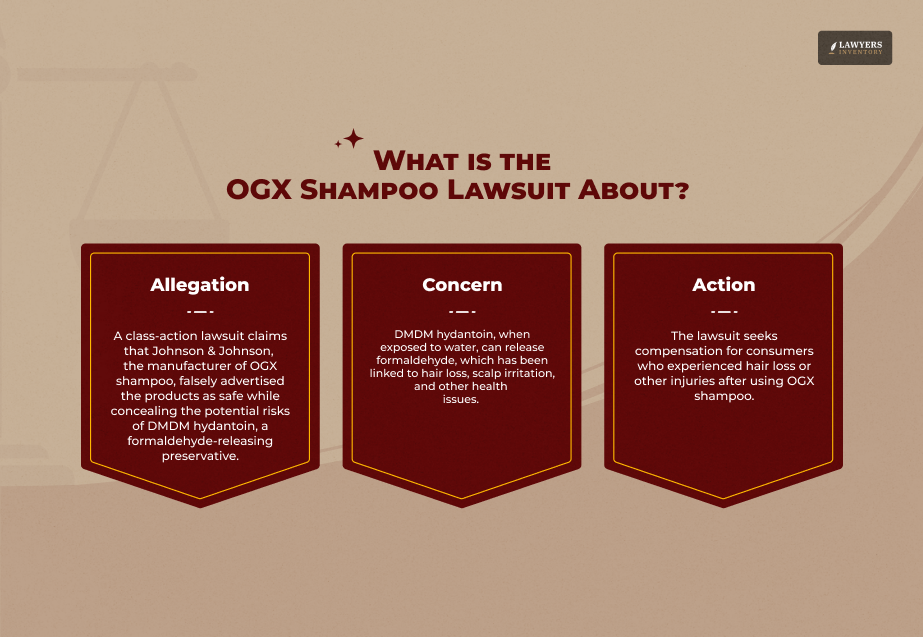
The popular OGX shampoo line from Johnson and Johnson (J&J) recently came to the forefront of a large-scale class action lawsuit.
The lawsuit, spearheaded by plaintiff Larissa Whipple, shook the personal care industry. It claimed that specific OGX hair care products contained components that lead to severe hair loss and irritated scalps.
The lawsuit mainly focuses on a chemical called DMDM Hydantoin. This is a preservative that produces formaldehyde. Manufacturers of J&J’s OGX shampoos and conditioners have been using it for at least ten years.
J&J claims to use the said chemical to avoid microbial development and mold from forming; however, the lawsuit claims that using it exposes consumers to unnecessary risks.
- Chemical Concerns: DMDM Hydantoin releases formaldehyde when it interacts with water. And formaldehyde is a known carcinogen to humans.
- Scientific Support: The International Agency for Research on Cancer (IARC) categorizes formaldehyde as a Group 1 carcinogen; this categorization has raised legal issues regarding the presence of formaldehyde in consumer consumables used daily.
Although the specific 2021 lawsuit (Whipple v. Johnson & Johnson) was voluntarily dismissed in 2022, the case remains a landmark example of the growing “clean beauty” litigation trend. It highlights a broader judicial shift toward requiring greater transparency in product marketing and a lower tolerance for toxic ingredients in the mass market.
What Are The Allegations In The OGX Lawsuit?
Like in the case of any particular lawsuit, the OGX lawsuit also had several legal arguments that the plaintiff has put forward. These were the basis of the cases against J&J’s shampoo.
“Through its labeling and an extensive marketing campaign, including through its website and online advertisements, Johnson & Johnson made a number of affirmative misrepresentations: that the Products contain special formulas (e.g. “Argan Oil, Biotin and collagen, Coconut Oil, Pomegranate”) intended to nourish and revive damage or dry hair, add softness and shine, and prevent frizzing and tangling; and that the Products “deeply nourish,” “gently cleanse,” and “repair hair.”
This is something that the lawsuit mentions. But is that all? Or are there other allegations that you need to know about before using the product? I have you covered in that regard as well.
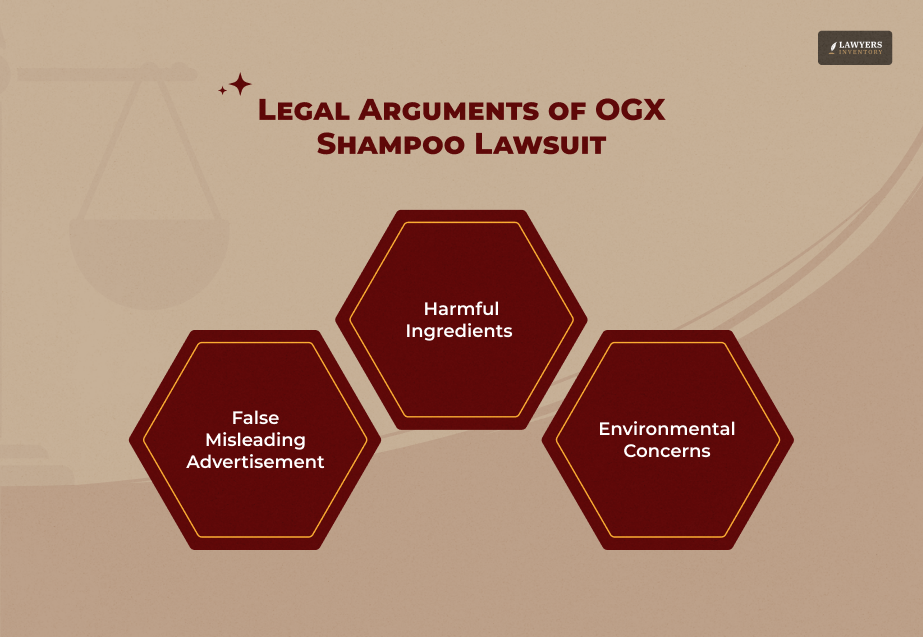
Here are the three main legal arguments of the lawsuit:
False Misleading Advertisement
Firstly, false advertising forms the core of the plaintiff’s case. They accuse Johnson & Johnson of falsely advertising the effectiveness of its OGX products. This is somewhat similar to the famous ZYN lawsuit, isn’t it?
Commercials indicated that these hair care products would “deeply nourish,” “gently cleanse,” and “repair” damaged hair. Nevertheless, the complaint argues that such promises are misleading. This is because they fail to disclose to consumers the risks associated with DMDM hydantoin.
Such deceit has resulted in customers thinking that they were using safe and efficacious products whilst in fact, these products put them at risk of harm.
Harmful Ingredients
Another major point of contention in the lawsuit is the inclusion of toxic substances in OGX products. The plaintiff points out DMDM hydantoin as the main issue since it releases formaldehyde.
Several health bodies have designated formaldehyde as a carcinogen to humans, which is why its presence in products is viewed as dangerous.
According to the lawsuit, J&J was aware of these dangers. However, they chose to incorporate DMDM hydantoin in their products and did not properly disclose the risk to customers.
On top of that, the plaintiff claims that the company had the option to use less harmful ingredients but decided not to change their product formulas despite the availability of such alternatives.
Environmental Concerns
Finally, what stands out in the end is how the legal case brings attention to nature issues when specific substances show up in everyday hygiene items.
It’s said these ingredients might harm people who use them. On top of that, what happens to nature could be affected too.
Individuals are catching on to the risks tied to chemicals such as DMDM hydantoin, so businesses face increasing pushes toward simpler, less risky ingredients. Still, change comes slow when profit lines get tangled.
When companies skip these steps, people start doubting them. Questions pop up about whether firms truly care about staying honest while keeping communities and nature safe.
Johnson & Johnson’s Response to OGX Lawsuit Claims
In 2012, Johnson & Johnson declared they would no longer use DMDM hydantoin in their products by 2015.
DMDM hydantoin “do not meet our safety and care standards,” according to the company’s safety and care commitment website.
However, it later claims that the preservative is used “in a small number” of its products when other preservatives are “incompatible” with other substances.
After the OGX Lawsuit broke out, people were eager to get an update or a response from the company. In an interview with Prevention, this is what Johnson and Johnson mentioned:
“We stand behind the performance and rigorous testing of our products. We carefully select our ingredients and include a list on the product’s label. At OGX, we are constantly evolving our formulas to improve hair care results and haven’t launched any new products with DMDM hydantoin in the last several years.”
Internet is Divided: Was The OGX Shampoo Class Action Lawsuit “Baseless?”
I was trying to do my research about the OGX lawsuit before writing this blog. And quite naturally, I went to Reddit to see some of the real consumers’ opinions about the shampoo. And I was shocked to see how people are divided.
In a deleted Reddit thread, one user wrote that the “concerns about DMDMH were completely ridiculous, as our bodies produce formaldehyde naturally and are excellent at removing it even if there was any chance of absorbing any significant amount through your skin.”
The user continued to mention the fact that this lawsuit was filed in 2021 during peak COVID 19 years. “Any product that isn’t right for your scalp might result in increased hair fall but that doesn’t mean the product in general is unsafe. Further, the uptick in autoimmune issues caused by COVID… have also resulted in a lot of people experiencing hair loss and just not linking it to the fact that they had COVID.”
“If OGX worked for you, go back to it,” they added.
Legal Developments in Johnson & Johnson Personal Care Litigation
The lawsuit against Johnson & Johnson’s OGX products continues to uncover a history of the company’s alleged false advertising and inability to reveal the disposal of hazardous substances.
At the beginning, the court papers by Larissa Whipple in 2021 referred to DMDM hydantoin, which is a formaldehyde-releasing preservative and has been connected with hair loss and scalp irritation.
Some of the federal cases in 2021 were settled in secret by 2022. However, the Carr v. J&J is still ongoing in the Eastern District of New York, where the case is about negligence and design defects, and the discovery deadlines are set to go on until the end of 2024. (Source: PACER)
New lawsuits, like that of Marina Scott in 2023, claim that benzene, which is a carcinogen, has been found in OGX dry shampoos.
Also, J&J is being questioned regarding its Neutrogena products for the allegedly misleading labeling of “preservative-free”.
These combined cases that use decades of toxicological studies, are a strong move to hold the corporation accountable and enforce the FDA’s regulations more strictly. (Source: Lawsuit Information)
Impact Of The OGX Lawsuit: Understanding Consumer Rights
The lawsuit against Johnson & Johnson’s OGX product line brings to light the important consumer protection and corporate transparency issues.
According to the case, deceptive marketing made it seem as if the products did not contain DMDM hydantoin, a chemical that releases formaldehyde and has been associated with hair loss and irritation of the scalp.
This case points out a serious violation of the “right to know.” It emphasizes that consumers should have accurate ingredient information in order to make informed and safe choices.
The legal action, which challenges the “nourishing” claims of big companies, is an effective way to hold them responsible.
Indeed, it represents a shift towards stricter control by the regulators and better safety standards for the formulation.
In the end, the OGX case gives the people a voice to call for higher compliance and greater transparency in the personal care industry. It gives priority to long-term health rather than misleading advertising.
Read Also:
- Sierra Mist Lawsuit: Did PepsiCo Really Clash with Influencer Over Identity Theft?
- University of Metaphysical Sciences Lawsuit and the Saga of Predatory Litigation
- 72 Sold Reviews Consumer Reports After Recent Lawsuit
Leave A Reply







Attorney Kenneth Powell: Fighting For Justice In Personal Injury Cases
Read More Why Allen Allen Allen & Allen Leads Virginia In Record-Breaking Verdicts
Read More

Attorney Josh Bonnici On The Responsibility Of Handling Serious Personal Injury Cases
Read More
How To Choose The Right Oil Rig Injury Lawyer For Maximum Compensation?
Read More
0 Reply
No comments yet.