Summarize using AI





Prompt copied. Paste it into Gemini.
After several data breaches that reportedly affected as many as 3 billion Yahoo accounts, the firm has agreed to a $117.5 million class-action Yahoo Data Breach settlement, providing the harmed parties with a maximum of $358 in compensation!
According to Ars Technica, those who had Yahoo accounts during the period 2012-2016 are now eligible to a cash payment of $100. However, depending on the number of people filing claims your final amount can be either more or less than $100.
In this article, we will be talking about the following things:
- What is the Yahoo Data Breach Settlement about?
- The entire evolution of the Yahoo Data Breach Settlement.
- Who is eligible to claim the settlement amount?
- What does the settlement offer?
- How to claim the settlement amount?
- What are the limitations of the suit and settlement?
Therefore, if these are a few things that you want to know, keep on reading this blog till the end…
Why The Yahoo Data Breach Settlement Matters
Few data breaches in history match the scale, duration, or global impact of the Yahoo security failures. Between 2013 to 2016, Yahoo suffered a series of breaches—now widely recognized as the largest data hacks in history.
According to Wikipedia, Yahoo initially disclosed in 2016 that at least 500 million accounts were affected (2014 breach), followed by an admission in 2017 that all 3 billion user accounts were likely compromised during the 2013 incident. A separate 2015–2016 breach compromised additional accounts through forged cookies.
Why is this so significant?
Because the affected population wasn’t a niche group. It included almost everyone who had a Yahoo Mail account, Flickr, Tumblr login, or any Yahoo-linked service—spanning over 3 billion accounts worldwide.
Though the class settlement only covers U.S., Israel, and certain Canadian users, the global impact makes these hacks among the most far-reaching cyber-incidents ever recorded.
What Types Of Data Were Compromised? What Does That Mean For User Risk?
According to Yahoo’s own statements and breach notices (yahoo.com), the exposed data included:
- Usernames and email addresses
- Dates of birth
- Telephone numbers
- Passwords (hashed)
- Security questions and answers
- Backup email accounts
- Account recovery details
- Potentially forged-cookie access tokens (2015–16 breach)
This type of information enables:
- Identity theft
- Phishing attacks leveraging accurate personal data
- Fraudulent account takeovers
- Credential stuffing across other websites
- Long-term impersonation risk, since DOBs and security questions rarely change
This is why the Yahoo settlement became not just a legal matter, but a wake-up call about how much damage large-scale data theft can inflict on the everyday user.
Evolution Of The Settlement: From $50m Offer To $117.5m Final Deal
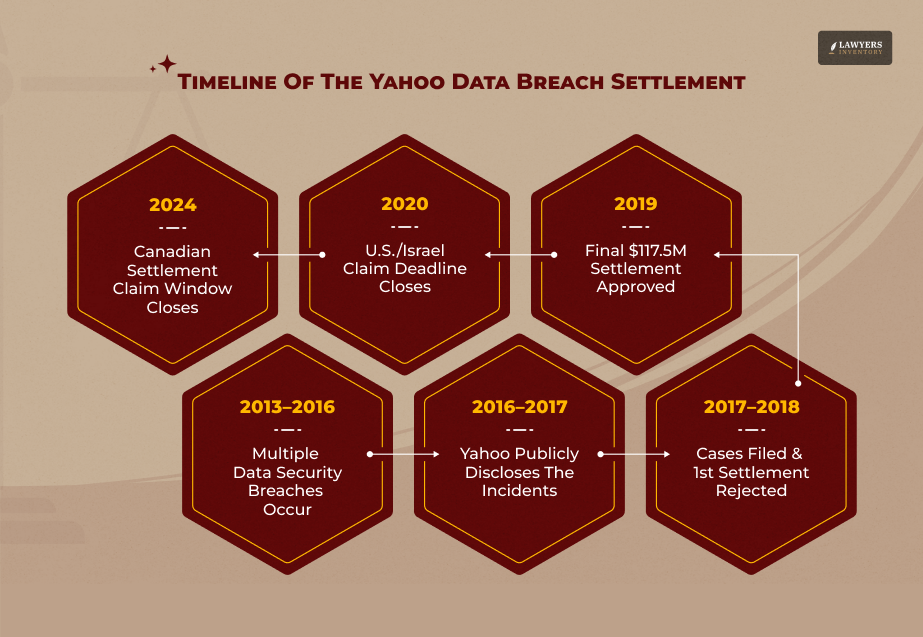
When Yahoo (then owned by Verizon/Oath) initially proposed a $50 million settlement in 2018, the offer included:
- Cash reimbursement for out-of-pocket losses.
- Two years of credit monitoring.
- Small business compensation.
- Refunds for paid Yahoo email services.
But TechCrunch and Tripwire reported widespread criticism:
- The amount was far too small compared to the number affected.
- The structure of attorney fees was unclear.
- Users argued that the credit monitoring offered little real value.
- The fund could not realistically compensate millions of people.
- There was no clear plan for how claims would be prioritized.
Court Rejection And Reasons
A federal court rejected the $50 million settlement, citing (Tripwire):
- Lack of transparency on how many people were actually eligible
- Inadequate justification for attorney fees
- Ambiguity about the size and definition of the class
- Insufficient compensation given the scale of the breach
- Concerns the deal offered “illusory” relief to most users
The rejection forced Yahoo back to negotiations.
The Final Settlement (2019): $117.5m
In 2019, Yahoo agreed to a $117.5 million settlement, which was approved by the court.
According to Reuters and Yahoo’s official settlement site:
- The fund applied to an estimated 194 million U.S. and Israel residents
- Covering approximately 896 million accounts
- (This is separate from Yahoo’s global 3-billion-account impact)
The $117.5 million settlement included:
- Reimbursement for documented losses.
- Alternative compensation for time spent.
- Refunds for paid Yahoo services.
- Two years of free credit monitoring.
- Payment of legal fees and administration costs.
Who Is Eligible For The Yahoo Data Breach Settlement?
First of all, you need to know if you are a class member. And who are they? A class member is anyone whose:
- Data was affected by the breach and
- Who fits the residency + account criteria
In case of this data breach case, users typically received:
- Official notice via email, or
- Could check using their account history
Eligibility Criteria
According to two official settlement websites, you were eligible if:
- You lived in the U.S. or Israel. (Or were part of the separate Canadian class)
- You had a Yahoo account anytime between January 1, 2012 and December 31, 2016
Eligible account types included:
- Free Yahoo Mail.
- Paid for Yahoo Mail (Pro, Plus, Ad-Free).
- Yahoo Small Business email.
- Yahoo Business services attached to affected accounts.
What Accounts Do NOT Qualify?
As noted by Ars Technica and the class website:
- Accounts created after December 31, 2016
- Users outside the U.S., Israel, or Canada
- Yahoo-owned platforms not tied to email login (case-specific)
- Deleted accounts without proof of ownership during the period
Categories & Payouts: What Does The Settlement Offer?
Having a clear understanding of exactly what the Yahoo data breach settlement offers to the class members is extremely important. This will ensure that you have a rather realistic expectation of the payout.
Category A: Documented Losses & Premium/Business Refunds
Per yahooclassaction.com:
- You could claim up to $25,000 for documented, verifiable losses (ID theft costs, bank fees, legal fees, credit monitoring you purchased, etc.)
- Paid Yahoo subscribers could claim 25% reimbursement of fees paid for premium services (2012–2016)
However, Ars Technica reports that due to the massive class size, pro-rata reductions were expected, and very few people received anywhere near the $25,000 maximum.
Category B: Alternative Compensation For Time Spent
If you didn’t have receipts, you could claim compensation for time spent dealing with the breach.
Based on Ars Technica and Tripwire:
- $25 per hour
- Up to 15 hours with documentation
- Up to 5 hours without documentation
Eligible activities included:
- Resetting passwords
- Contacting banks
- Monitoring credit
- Reviewing fraud alerts
Category C: Credit Monitoring & Fraud Resolution
If you didn’t want cash, the official website states how the settlement offered two years of free credit monitoring and fraud-resolution services.
This typically included:
- Credit report access
- Identity-theft detection
- Fraud alerts
- Resolution assistance
What Past Claimants Actually Got — Realistic Payouts
According to Ars Technica and CBS News:
- Many claimants received around $100
- Some received $358
- Very few approached the upper payout limits
Why? Because:
- Large class = millions of claimants
- Settlement fund capped
- High legal and administrative costs
- Pro-rata reductions applied almost universally (IT Governance, Kroll)
Read Also: Cencora Data Breach Settlement: Who Qualifies, How To Claim, What To Expect & What To Do Next
How To Claim: Step-by-Step Guide (For US/Canada/Israel Users)
Now that you are well aware of what the
1. Go To The Official Settlement Portal
The two valid portals were:
- yahoodatabreachsettlement.com
- yahooclassaction.com
Users filed their claim online using the provided form.
2. Prepare Documentation
Depending on what you were claiming:
- Proof of a Yahoo account.
- Notice email or claim ID.
- Receipts for losses (bank statements, invoices, fraud-repair costs).
- Time logs (if claiming time spent).
- Statements of paid Yahoo service fees.
3. Submit The Claim Form
The form allowed:
- Uploading documents.
- Selecting the type of compensation.
- Entering payment details (check, direct deposit, or e-transfer in Canada).
4. Deadlines
According to the official settlement website, the Yahoo breach claim deadline is as follows:
- U.S. & Israel: July 20, 2020.
- Canada: December 27, 2024.
5. What To Expect After Submitting
As the official settlement administrators explained:
1. Claims were reviewed individually.
2. Processing could take months.
3. Final payout was often significantly lower than initial estimates.
4. Payments were issued via:
- Check
- Direct deposit
- E-transfer (Canadian claimants)
Caveat: If your documentation was weak or millions of others claimed the same category, your payout could be minimal.
Criticisms, Limitations & Controversies
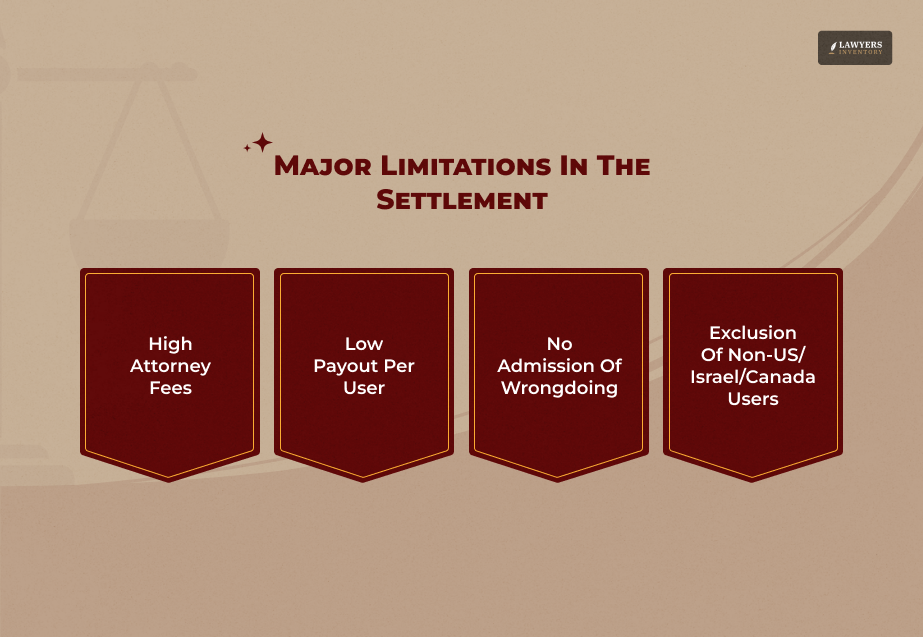
There are several limitations that you should know about when trying to get a part of the Yahoo credit monitoring settlement.
1. High Attorney Fees
About $30 million went to legal fees. Critics argued that attorneys gained far more than victims (Yahoo.com; IT Governance).
2. Low Payout Per User
Many received under $100, which critics (Ars Technica; Tripwire) said was disproportionately small compared to the:
- Scale of the breach
- Years of compromised data
- Serious security risks
3. No Admission Of Wrongdoing
As stated on yahooclassaction.com:
- Yahoo denied all liability
- Settlement ≠ admission of responsibility
- Standard corporate posture, but frustrating for victims
4. Exclusion of non-US/Israel/Canada users
A major gap in most reporting:
- Users in Europe, Asia, Latin America, Africa—millions whose data was stolen— had no settlement recourse
- No comparable international class actions have emerged
Read Also: Claim Your Payout: What The Robinhood Data Breach Class Action Means
What Happens After: Data Security, Identity Theft Risk & User Best Practices
Even if you claimed compensation, the risks do not disappear. Here are a few things that you should be aware of:
What Credit Monitoring Actually Does
Credit monitoring services help by:
- Alerting you to new accounts opened in your name
- Detecting suspicious credit inquiries
- Monitoring changes on your credit report
- Assisting with fraud resolution steps
Best Practices For All Yahoo Users (Even If Not Eligible)
Because your data may still circulate on dark-web markets:
- Change all passwords (especially if reused elsewhere)
- Enable two-factor authentication
- Monitor bank and credit card statements monthly
- Use a password manager
- Beware of phishing emails claiming to be Yahoo
- Check credit reports regularly
- Avoid security questions that use real personal data
Why The Breach Remains Relevant
Data from breaches—even a decade old—remains usable to criminals because:
- DOBs, mother’s maiden name, phone numbers rarely change
- Hackers use old data for “layered” attacks
- Stolen data is often resold repeatedly for years
Are There Still Outstanding Claims? What Should International Or Non-Class Members Know?
There are several things that the general public, international as well as non-class members, should know. These are as follows:
Claim Status
According to yahooclassaction.com:
- U.S. and Israel claim windows are closed
- Canadian claim window closed December 27, 2024
- All funds are now being distributed
- No new claims are being accepted
What About Users In Other Countries?
1. No global or international settlement exists
2. No known new class actions have been filed
3. Users should continue monitoring for:
- Identity theft
- Phishing attempts
- Financial fraud
Beware Of Fake Settlement Sites
Cybercrime Magazine warns of scams impersonating:
- “Yahoo settlement refund” websites
- Fake login portals
- “Claim your compensation” phishing emails
Users should:
- Never enter Yahoo credentials into unofficial sites
- Verify URLs
- Avoid sharing bank details with unknown organizations
Expert View & Analysis: Was The Settlement Fair? What Are The Lessons?
Was the settlement fair? This is one question that most people are raising.
| Pros | Cons |
| • Large fund for a data breach case. • Offered credit monitoring and reimbursement. • Provided at least some compensation to millions. | • Insufficient per-person payout. • Attorney fees consumed a huge share. • Global users were excluded. |
For many, this was less about money and more about accountability.
What This Case Teaches Companies
- Data security is a legal obligation, not an IT preference
- Delayed disclosure increases legal liability
- Massive breaches carry immense reputational damage
- Companies must invest in modern encryption and monitoring
- Failure to safeguard data can lead to costly litigation years later
Lessons For Users
- Never reuse passwords
- Enable MFA everywhere
- Change security questions to non-obvious answers
- Monitor accounts regularly
- Take breach notifications seriously
The Yahoo Data Breach Settlement remains a landmark case in the history of cybersecurity and class-action litigation. While compensation for individuals was limited, the case highlighted the importance of strong data governance—and the consequences when companies fail to protect user information.
Leave A Reply






Generational Equity Reviews- An Honest Guide (2025)
Read More
Your Ultimate Guide To The Amazon Prime Refund FTC Settlement
Read More
The Ultimate 2026 Guide To The Memorandum Of Association
Read More
Corporate Articles Of Association In 2026 [A Guide]
Read More
Cencora Data Breach Settlement: Who Qualifies, How To Claim, What To Expect, And What To Do Next?
Read More
0 Reply
No comments yet.