Today’s topic: Ohio rules of criminal procedure.
Having a clear set of rules that courts need to follow in criminal proceedings is extremely important. This is because it helps to ensure fair, just, and efficient trials. And that is exactly what the Rules of Criminal Procedures do for the State of Ohio.
The rules aim to safeguard the fundamental rights of the defendant that both the U.S. Constitution and the Ohio Constitution guarantee.
For instance, it is because of this law that defendants have the right to an Ohio Criminal Defense Attorney at their initial appearance.
In this blog, we will talk about the following things:
- What are criminal procedures?
- About the Ohio Rule of Criminal Procedures.
- Important laws in criminal cases.
- Statute of criminal proceedings in Ohio.
Therefore, to know more about these, keep reading…
What Are Criminal Procedures?
“Criminal procedure deals with the set of rules governing the series of proceedings through which the government enforces substantive criminal law,” according to Legal Information Institute.
Different levels of government have their own sets of laws (criminal codes). These specify what behavior constitutes a criminal offense.
One can find the federal crimes in Title 18 of the U.S. Code. Generally, these involve activities that cross state lines or affect federal interests.
Federal prosecutions are conducted under the Federal Rules of Criminal Procedure. This is a set of rules that the U.S. Supreme Court has issued and that Congress has approved. The Federal Rules set forth the procedure for a federal criminal trial.
They also include and explain all the rights guaranteed by the Bill of Rights of the U.S. Constitution, such as the right to:
- Due process and equal protection.
- Have a lawyer.
- Be confronted with the witnesses against one.
- A jury trial.
- Right not to be compelled to testify against oneself.
State prosecutions are conducted according to the criminal procedure code of the particular state.
Even though each state has its own criminal procedure code, a lot of them decide to follow the Federal Rules.
State procedural laws may grant a defendant in a criminal trial more rights than the U.S. Constitution and the Federal Rules, but they cannot provide less protection than the U.S. Constitution.
Understanding Ohio Rules Of Criminal Procedure
The Ohio Rules of Criminal Procedure (Crim.R.) is a document with legal force that defines the way in which courts must conduct criminal trials.
The Supreme Court of Ohio explains that it covers the procedure and practice of criminal cases in all Ohio courts.
The Supreme Court of Ohio issues these rules, and their main purpose is to ensure an “equitable, unbiased, prompt, and certain administration of justice” through the court system.
What Is The Core Structure Of The Ohio Rules Of Criminal Procedure?
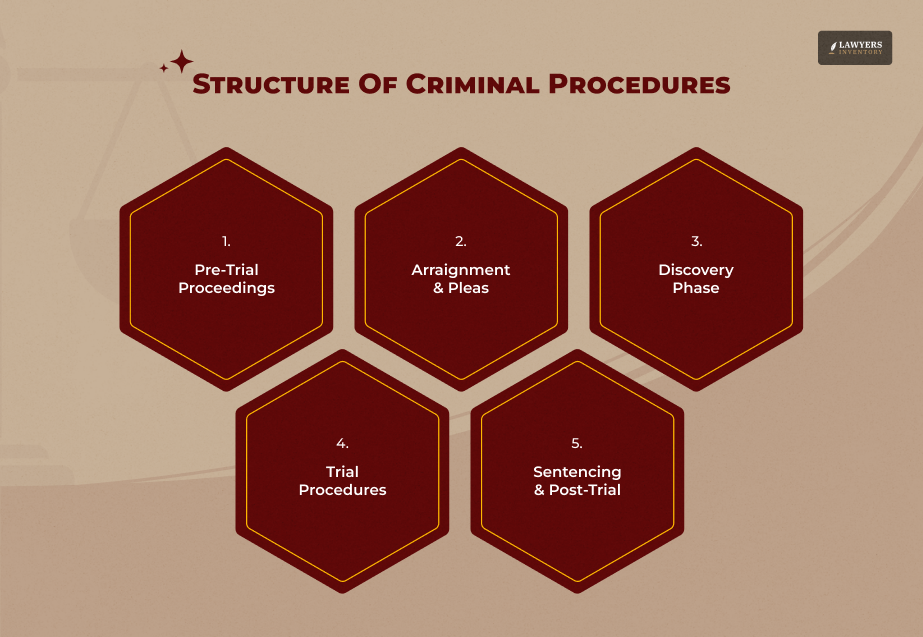
These regulations span the entire journey of a criminal case, essentially from the arrest stage to seeking relief after a conviction, such as:
- Pre-Trial Proceedings: Deals with complaints (Rule 3), warrants or summons (Rule 4), initial appearances (Rule 5), and grand jury procedures (Rule 6).
- Arraignment & Pleas: Rule 10 explains what happens at an arraignment, and Rule 11 lists the pleas that may be entered (Guilty, Not Guilty, No Contest, or Not Guilty by Reason of Insanity).
- Discovery: Rule 16 deals with the exchange of evidence and information between the prosecution and the defense.
- Trial Procedures: Guidelines for jury selection (Rule 24), motions for acquittal (Rule 29), and jury instructions (Rule 30).
- Sentencing & Post-Trial: This section covers sentencing (Rule 32), new trials (Rule 33), and post-conviction petitions (Rule 35).
Recent Rules In The Ohio Rules Of Criminal Procedure
Let us point out to you the recent changes:
- Victim’s Rights (Rule 2.1): It gives the victims the right to be heard either orally or in writing at the public hearings and states that the court must provide an interpreter if the victim needs one.
- Presence of Defendant (Rule 43): Details when the physical presence of a defendant is necessary and specifies the conditions under which the use of remote contemporaneous video technology for appearances is allowed.
- Bail (Rule 46): Has been changed and enhanced by the Ohio Revised Code Section 2937.011 to make sure that a bail schedule does not become a basis of holding the defendant unnecessarily simply because of the defendant’s inability to pay.
- Speedy Trial: The Ohio Revised Code Section 2945.71 governs the matter. Nevertheless, the rules are aligned to each other to make sure that trials are conducted within the strict timelines (for example, 270 days for a felony).
Most Important Ohio Laws And Legislation For Criminal Cases
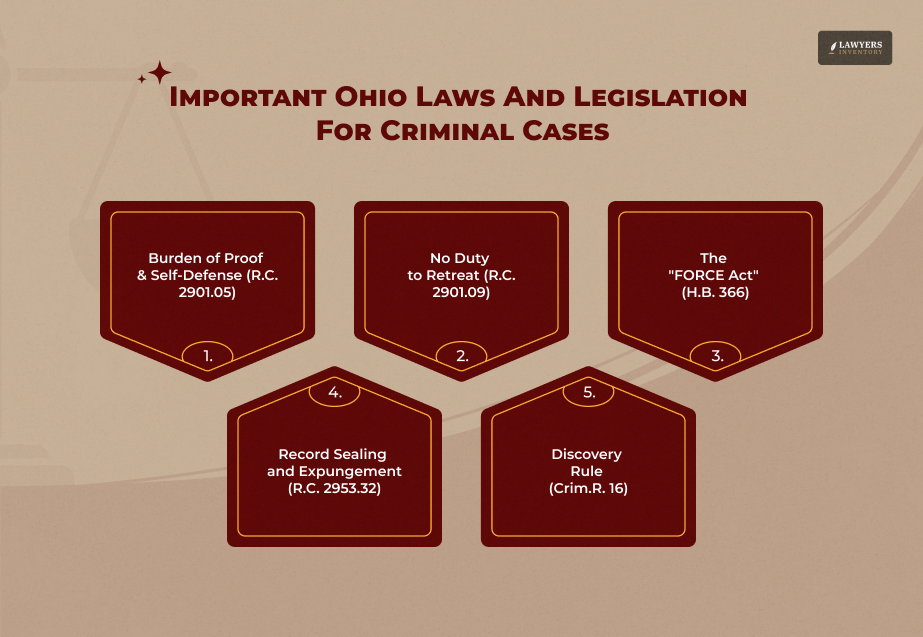
To help you get an idea, here are the main 5 laws and rules that had a great influence on Ohio criminal cases due to their direct impact on case outcomes and changes in the legal field.
1. Burden Of Proof & Self-Defense (R.C. 2901.05)
Firstly, this is the central, most important law. It is a provision that the state has to demonstrate the defendant’s guilt beyond a reasonable doubt.
More importantly, it was amended to shift the burden in self-defense cases. Basically, post-amendment, if the defendant provides evidence that they were acting in self-defense, the prosecution has to prove that they were not beyond a reasonable doubt.
2. No Duty To Retreat (R.C. 2901.09)
Secondly, there is the No Duty to Retreat law. Also popular as “Stand Your Ground,” this law essentially says that an individual who is at a place that they have a lawful right to be in does not have to run away before they can use force in self-defense.
This has completely changed (rather removed) the earlier “duty to retreat” requirement. Previously, it placed incidents outside a person’s home or vehicle under the obligation to retreat.
3. The “FORCE Act” / Organized Retail Theft (H.B. 366)
Enforced as of April 9, 2025, it is one of the most radical amendments to theft laws at the moment. It introduces a particular felony for organized retail theft.
As a result, prosecutors will be able to combine various thefts over a period into one count of a high-level felony.
4. Record Sealing And Expungement (R.C. 2953.32)
The large-scale expansions through 2023 and 2024 have altered the whole concept of how irreversibly a conviction is “sealed.”
Nowadays, more crimes than before – some non-violent one-third degree felonies included – can be put under a seal or even fully expunged (deleted). Thus, this opens a flourishing path from rehabilitation to employment.
5. Discovery Rule (Crim.R. 16)
Finally, there is the Discovery Rule that is extremely important when it comes to ensuring a fair trial. It describes an Open Court Discovery procedure by which the prosecution is obliged to share with the defense all the pieces of evidence.
This also includes the ones that are “exculpatory” evidence that might convince the court of the defendant’s innocence.
It basically prevents “trial by ambush” by ensuring that both parties receive disclosure of the evidence well in advance of the jury being selected.
What Is The Statute For Criminal Cases?
Rules basically determine the steps of how a case moves through the judicial system. Ohio Revised Code (R.C.) § 2901.13, on the other hand, fixes the legal time limit within which the court must initiate a prosecution.
Ohio Criminal Statutes of Limitations
Whether or not the case is time-barred depends on the nature and seriousness of the offense. Here’s what you need to know about:
- No Limit: There is no expiration date for bringing charges in the cases of First-Degree Murder and Aggravated Murder.
- 25 Years: Charges for Rape or Sexual Battery (and any related conspiracy or attempts) generally must be filed within 25 years.
- 20 Years: Some of the very serious crimes, which include manslaughter, kidnapping, and robbery, have a statute of limitations of 20 years.
- 6 Years: The majority of other felonies need to be processed within six years.
- 2 Years: For Misdemeanors (except minor misdemeanors), the statute of limitations is, in most cases, two years.
- 6 Months: Minor misdemeanors usually have the shortest statute, which is six months.
Interaction With Rules Of Criminal Procedure
While the Revised Code sets the time limit, the Ohio Rules of Criminal Procedure explain the actual act of prosecuting that stops the clock.
For instance, let’s take Rule 4 (Warrant or Summons). The courts have held that one of the elements of “initiating” a prosecution is that the authorities have to show reasonable effort in serving a warrant or summons.
Basically, according to Crim.R. 4(D), this means that personal service is generally required for a summons.
On the other hand, there is also a rule for tolling or pausing the Statute of Limitations. For example, let’s say that the defendant, by his acts, prevents the prosecution. They can do this by:
- Hiding.
- Leaving the jurisdiction.
Therefore, in such cases, as per this rule, the court will have to pause or toll the limitation period.
Leave A Reply







What Happens In A Mistrial? And What Every Defendant Needs To Know Immediately After
Read More
What Happens If A Jury Is Hung Twice? The Legal Answer Explained
Read More
Voyeurism As A Crime In The UK: Law And Legal Consequences Explained
Read More
What Is Wanton Endangerment? Is The Breonna Taylor Case Related To It?
Read More
How Can Criminal Identity Theft Occur And Your Legal Standing
Read More
0 Reply
No comments yet.