Summarize using AI





Prompt copied. Paste it into Gemini.
Today’s topic: Reckless driving Texas & its legal consequences.
“Reckless driving” refers to a type of driving that demonstrates a significant disregard for the safety of others or one’s own safety.
Now, it is true that the term is quite common. However, it might surprise you that the general public may not always be aware of its exact definition in the law.
You might be quite sure that you can recognize reckless driving if you see it. However, you might not know how to tell it in a way that is legally meaningful.
In order for a police officer or a prosecutor to take legal action against a reckless driver, several conditions must be fulfilled as per Texas law.
In this blog, we will be breaking down the following things:
- What counts as reckless driving in Texas?
- Penalties and long-term consequences of reckless driving.
- How to report a reckless driving incident?
- Damages you can claim in such a case.
Therefore, if these are a few things that you want to know, keep on reading this blog till the end…
Understanding Reckless Driving Texas: What Counts As Reckless Driving In Texas?
Texas Transportation Code 545.401 lays out the definition of reckless driving for motorists in Texas. It states that a reckless driving offense occurs when a person operates a vehicle with “wilful or wanton disregard for the safety of persons or property.”
The statute further specifies that such conduct must happen in certain settings, for example, on a public road or in a parking garage.
Therefore, “reckless driving” would not be considered in a situation where, for instance, somebody drives on a privately owned motorsports track that is closed to the public.
What Qualifies As Reckless Driving In Texas?
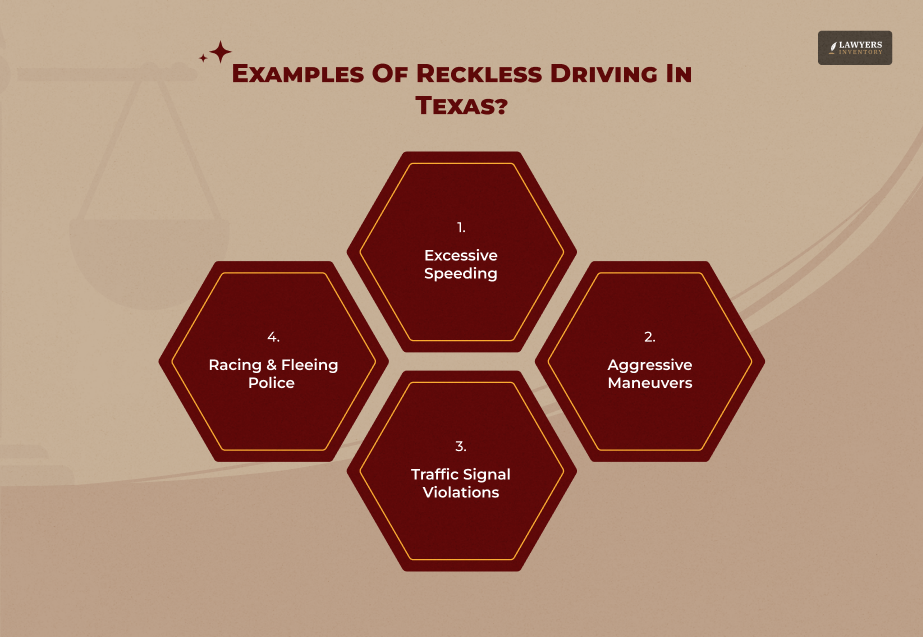
Here are some of the many factors that law enforcement can term as reckless driving in Texas:
- Speeding 25 mph or more over the limit.
- Weaving through traffic or changing lanes without signaling.
- Disobeying traffic lights or stop signs.
- Street racing on public roads.
- Escaping from police after a traffic stop.
- Tailgating, brake-checking, or passing on the shoulder at high speeds.
- Driving while impaired by alcohol, drugs, or extreme fatigue.
- Texting or using social media on the phone while driving.
Furthermore, these actions are generally combined. As a result, it generally does not take time to escalate the danger to all on the street.
Penalties For Reckless Driving In Texas
If you are found guilty of reckless driving in Texas, you might be at risk of heavy punishment. Usually, reckless driving is a misdemeanor, which can be penalized by:
- A fine of up to $200 for a first-time violation.
- A second or further violation may result in a fine of up to $500.
- Up to 30 days in jail.
- Driver’s license suspension for a period of 30 days.
Besides the direct criminal penalties, a charge for reckless driving could result in higher insurance rates and make it harder for you to get a job.
According to the Texas Criminal Defense Group, in the case of repeat offenders, their driving license could be suspended. “The designation of being a “habitual violator” applies to individuals who have accumulated four or more convictions from separate incidents within the past 12 months, or seven or more convictions within a 24-month period.”
Long-Term Consequences Of Reckless Driving In Texas
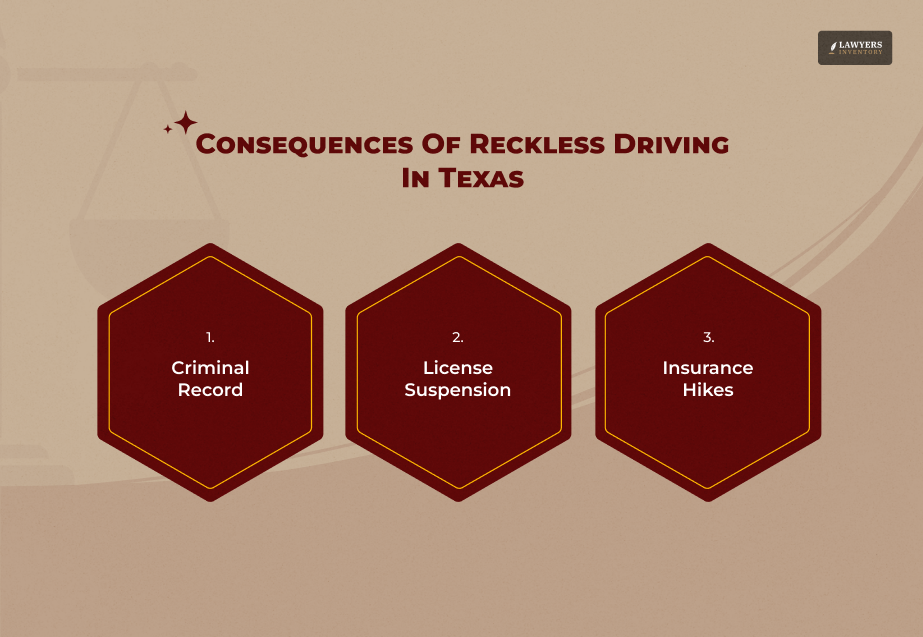
A reckless driving Texas conviction can have a lasting impact on your life, even after you have paid the fines. You could be experiencing:
- Insurance premiums: Typically, rates increase by 50 percent or more, resulting in an extra hundred or so dollars per year.
- Employment hurdles: Positions that necessitate driving or the attribute of trustworthiness in you may be unattainable.
- Civil liability: The parties who have sustained injuries have the right to sue for damages even years after the accident.
These additional expenses, most of the time, are more than the criminal penalties.
Read Also: What Is The New Rule For Senior Drivers In The USA?
How Much Is A Reckless Driving Ticket In Texas?
In Texas, reckless driving is a misdemeanor offense that can be punishable by a maximum fine of $200 and/or 30 days in jail.
However, do not be deceived into thinking that reckless drivers are forgiven simply by the nature of the offense.
Generally, reckless driving itself is a part of other crimes such as speeding, DUI, endangerment, and destruction of property.
More severe punishments are likely when a higher number of charges are associated with a reckless driving case.
How Long Does Reckless Driving In Texas Stay On Your Record?
Unlike the typical traffic offenses, a reckless driving misdemeanor is treated as a criminal charge.
So, you shouldn’t expect that it will only result in ‘points’ on your driving license that disappear three or four years after the conviction.
A reckless driving conviction can be detrimental to the life and reputation of the individual who committed the offense, more so one that has been combined with other charges or resulted in a felony.
Additionally, it can also affect the offender’s ability to find work or housing, besides being part of the official criminal record of the offender forever.
Now, the greatest method of lessening the consequences of a reckless driving charge would be to seek legal assistance from an experienced lawyer who can help you explore different legal options.
How To Report Reckless Driving In Texas?
If you see someone driving dangerously in Texas or witness a car wreck caused by a reckless driver, you can report them by calling 911 for emergencies or 1-800-525-5555 to reach the Texas Department of Public Safety.
You’ll need to provide details like the vehicle’s description, location, and direction of travel. Timely reporting helps protect others on the road and ensures reckless drivers are held accountable.
Your Rights And Remedies As A Victim Of Reckless Driving In Texas
If another driver’s recklessness left you injured, Texas law allows you to pursue compensation for:
- Medical expenses, including future treatment.
- Lost income and diminished earning capacity.
- Pain, suffering, and emotional distress.
- Property damage to your vehicle or belongings.
Prompt medical care, a detailed crash report, and legal guidance are critical. An experienced personal injury attorney can gather evidence, negotiate with insurers, and, when needed, file suit to ensure the at-fault driver bears the financial burden, not you.
Damages To Claim In Reckless Driving Cases In Texas
If you’ve been hit by a reckless driver in Texas, you can go after compensation with a personal injury or wrongful death claim.
The law says reckless driving means someone drove with a “willful or wanton disregard” for safety. This basically means that they didn’t care about the rules. These cases open the door to bigger recoveries than your typical negligence claim.
1. Economic Damages (Calculable Losses): Economic damages are a measure of financial outlays directly and clearly attributable to the accident:
- Medical Expenses.
- Lost Work-Time.
- Loss of Ability to Work.
- Property Damage.
2. Non-Economic Damages (Intangible Losses): Those damages reflect the various loss experiences after the accident:
- Mental Anguish.
- Scarring and Loss of Function.
- Loss of Enjoyment.
- Loss of Consortium.
Apart from these two, there’s also Punitive (Exemplary) Damages. These are the types that aim to punish the at-fault party for reckless and outrageous behavior. They are different from compensatory damages.
- Eligibility: In Texas, the plaintiff has to establish that the defendant’s conduct amounted to gross negligence, malice, or fraud.
- Examples: often, courts allow punitive damages when the defendant not only drives recklessly but also is speeding excessively, engaging in street racing, or is intoxicated (DWI).
- Limits on Amount: There is a certain extent to which the compensation for punitive damages may be paid in Texas, at the maximum. It is equal to $200,000 or double the sum of economic and non-economic damages (up to $750,000), whichever is higher.
Note: Texas uses the “51% Bar Rule.” If you’re more than 50% at fault, you can’t collect damages. If you’re partly to blame, your payout drops by whatever percent of the accident was your fault.
Leave A Reply






How Can Criminal Identity Theft Occur And Your Legal Standing
Read More
Understanding What Is Criminal Justice And How It Functions
Read More
Understanding The Core Differences Between Criminology Vs Criminal Justice
Read More
What Is The Difference Between Assault And Battery In Criminal Law?
Read More
Roblox Class Action Lawsuit: Who Can Help You & What To Do? [Complete Legal Guide]
Read More
0 Reply
No comments yet.