Today’s topic: What is the new rule for senior drivers?
On the first day of January 2026, the U.S. government implemented a revamped senior driver’s license regulation. According to sources, they aim to make quite a few changes that all drivers 70 years and older must understand.
It’s common knowledge that driving has been associated with independence, freedom, and self-reliance. Of course, this is especially true of seniors who require personal transportation to get to the doctor, do their daily shopping, or keep in touch with friends and family.
Unfortunately, the elderly constitute a growing demographic segment. As a result, there are several things that have led the politicians to change the way driving eligibility is assessed at the age of 70 and above.
These concerns include:
- The safety of the roads.
- Health problems that come with age.
- Fair treatment of elderly drivers.
The new rule is not about taking away a person’s freedom. Rather, it is about finding a fair balance between:
- Safety.
- Responsibility.
- Respect for one another.
It is a part of a wider discussion across the country about how age reduces driving performance. And the need to amend the law so that seniors can receive fair treatment.
It is crucial for all senior drivers and their families to know the ins and outs of this new rule since it will affect the whole life of a senior.
What Is The New Rule For Senior Drivers?
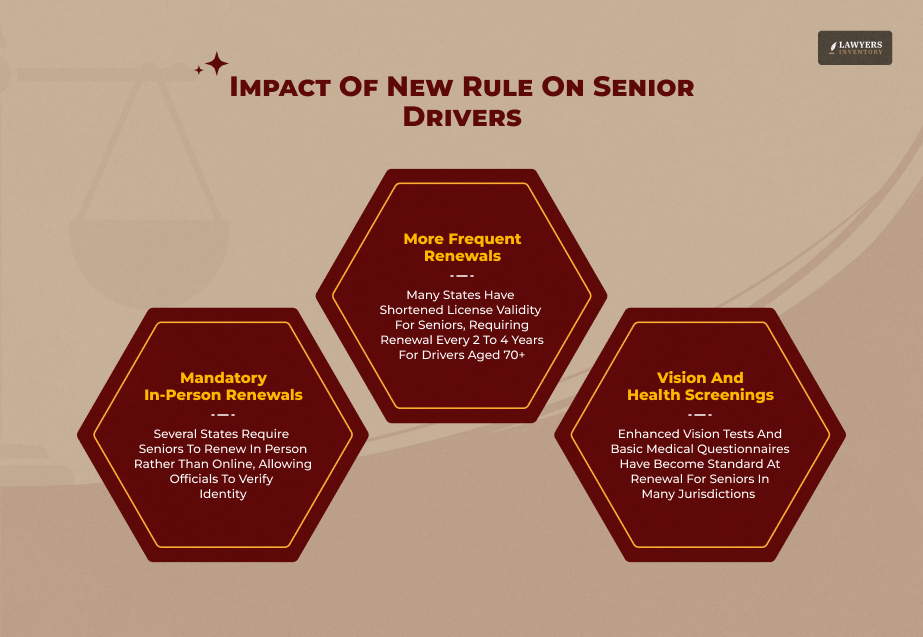
In January 2026, the U.S. Department of Transportation (DOT) started to implement its new policy towards drivers who are 70 years old and over.
This regulation is not about taking away licenses but rather strengthening them through safety checks.
Elderly people are now subjected to regular eye tests, reaction time tests, and occasionally, they are required to take a refresher driving course.
Furthermore, it is a preventive measure—checking the fitness of the driver, not penalizing the individual.
The concept is clear: help the elderly live their lives safely and independently. Additionally, to reduce the number of accidents caused by the deterioration of faculties due to aging.
Mandatory Vision Tests & Other Medical Check-Ups
An additional major component of the new legislation is the requirement for obligatory in-person vision testing and, in certain states, medical check-ups for the driver.
First, the drivers who are 70 years and older must be able to show that their sight is clear enough for them to be safe on the road. This becomes important, especially when one is traveling at night and on the highway, since having clear sight is a must.
Health check-ups could include factors such as pre-existing medical conditions. These include:
- Diabetes.
- Heart conditions.
- Neurological conditions.
Along with the effect of medication on the alertness of the subject, all these can impact the driving of seniors.
Physicians won’t be taking away the driving privileges of patients on their own. However, they will advise on the implementation of possible limitations that might be suitable. For instance, some senior drivers might be barred from driving at night.
Therefore, by balancing safety and giving elderly drivers an honest personal healthcare evaluation of their driving capacity, this policy is meant to be a protective measure for them.
It has even been suggested that a lot of seniors might be comforted and pleased at the thought that experts are helping to make sure their safety is always a priority.
Driving Trends Among The Senior Drivers
An Insurance Institute for Highway Safety (IIHS) study reveals that seniors 70 and older drive less than younger drivers in terms of mileage.
Moreover, AAA’s research shows that older drivers generally rank high in road safety. However, since aging affects driving abilities, state governments have different ways of controlling senior drivers, including license renewal procedures and age-based restrictions.
Impact On License Renewal For Senior Drivers
One main change that has come into effect as a result of this new law is the plan for elderly drivers to renew their licenses more frequently.
It is common that drivers renew their licenses once every five to eight years in many states. However, under the new policy, the elderly drivers will have to renew their licenses more frequently. Depending on the law, it is usually every two to three years.
This shorter renewal period is a great step. It makes it possible for the authorities to check drivers’ physical and mental capabilities more frequently.
Besides, the renewed schedule also provides the seniors with a formal occasion to talk about any health or sight problems that might affect their driving.
Moreover, this doesn’t mean that elderly drivers are presumed unsafe. On the contrary, it means that the changes in health may come faster as people get older.
Vision Tests & In-Person Renewals
Apart from having shorter renewal cycles, according to MB Law Firm, there are states that impose more rigid testing or personal renewals for seniors:
- In the states of Colorado and Washington, a vision test is also required as a renewal criterion for senior licenses.
- Illinois takes this a step further by requiring road testing of drivers 75 years of age or older.
Driving Refresher Course Is Optional
These rules also promote and, in some places, mandate refreshing courses especially designed for older drivers, states South City Hope.
Additionally, they clarify that these courses are not tests. Rather, they are conducting sessions for older drivers on current road rules and defensive driving skills.
With the advancements in technology and increased traffic complexities, refresher courses assist seniors in adapting to the changes.
Many seniors who have previously participated in these courses have found themselves more confident while driving their vehicles.
Moreover, some insurance companies also provide a discount on premiums to seniors who have participated in certified refresher courses.
Alternate Transportation For Senior Drivers
“The rules are designed to ensure that capable drivers can continue driving comfortably for as long as possible, while also identifying those who may need help transitioning to alternative mobility support,” according to South City Hope.
It is important to understand that there are several alternatives available for senior or ageing drivers. Alternative methods of transport exist. They are in place for those seniors who may no longer drive due to their inability to do so safely or may simply prefer not to.
Some of these, according to MB Law Firm, are as follows:
- Public transport.
- Call & Ride transportation.
- Uber Caregivers.
Even if driving is a significant part of independence in old age, being aware of state-specific regulations on driving and other transportation options is important. It can significantly contribute to road safety.
Read Also: Should You Get A Lawyer For A Car Accident That Wasn’t Your Fault?
Frequently Asked Questions (FAQs):
Now that you are aware of what is the new rule for senior drivers from January 2026, we hope we have answered most of your questions. However, here are some questions people often ask about this topic. Take a look at them before you leave:
Typically, most people stop driving between the ages of 75 and 85 years. Nevertheless, age becomes irrelevant when it comes to making a decision about when you should quit driving. Your health status and your brain function become relevant here.
The California Department of Motor Vehicles made a big change in the law that applies to those who are 70 years of age and older. Starting October 1, 2024, people 70 years of age and older renewing their driver’s licenses were subject to this new policy. There is no need anymore to pass a written knowledge test to get a license.
There is no age bar for drivers when it comes to obtaining a driving license in India. Applicants above the age of 50 years need to produce a medical certificate stating that they are fit enough to drive a vehicle.
Leave A Reply






Hung Jury vs. Mistrial: What Is The Difference And Why It Matters
Read More
NarodniyDimUkraina: An Overview Of The Kyiv-Based Brand Preserving Ukrainian Craftsmanship
Read More
What Is A Mistrial? Legal Definition, Causes, And What Happens Next
Read More
What Is A Sequestered Jury? Legal Definition, Process, And Everything You Need To Know
Read More
What Is A Hung Jury? Legal Definition, Causes, And What Happens Next
Read More
0 Reply
No comments yet.