
So, your landlord has initiated a legal action to reclaim their property.
Now, it is a race in your mind with timelines and questions. The scariest question at this point is how long after eviction court date do you have to move.
The short answer is that in the UK, you will get 14 to 28 days to vacate a property once the judge grants an outright possession order.
However, there can be exceptional circumstances, and under these circumstances, the timeline can be a maximum of 6 weeks.
However, remember that the possession order just initiates the process of eviction. The landlord cannot force you onto the street on the date mentioned in the possession order.
Your tenancy will continue legally even after that date. Also, nobody can physically move you out of your house until there is a warrant and the court-appointed bailiff executes an eviction.
“Getting a notice doesn’t always mean you’ll have to leave your home by the date it says. In most cases your landlord still has to get a court order before they can evict you and they can’t apply for a court order until the notice period has run out.
The court order is called a ‘possession order.” – (Source: Citizens Advice).
However, the landlord will not need to have an eviction notice if they are sharing the same accommodation with the tenants.
So, navigating the timeline and the different circumstances is stressful. You have to understand the mechanics of what happens inside and outside the courtroom so that you can buy some time.
You will need that time to find alternative housing or secure support from your local authority. In this article, I will break down the post-court eviction process in the UK.
What Are The Types Of Possession Orders?
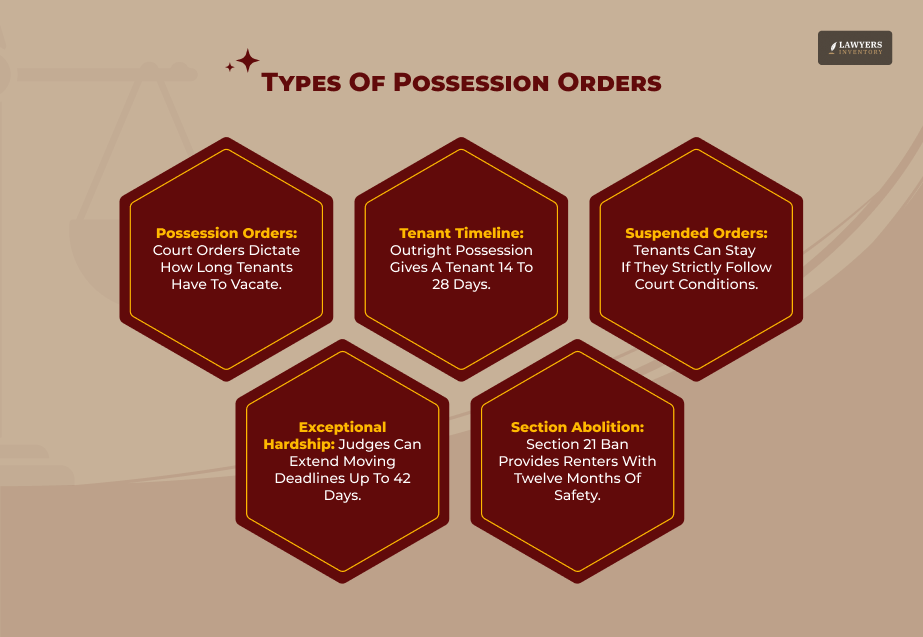
The answer to how long after eviction court date do you have to move depends on the type of possession order the court issues.
Once the landlord successfully proves the case, the judge will issue one of the following types of court orders.
1. Outright Possession Order
If the paperwork of the landlord is fully compliant, they will get an outright possession order from the court.
However, as I have mentioned, even an outright possession order does not mean that the tenant will have to surrender the keys immediately.
The judge will specify the date by which the tenant is expected to vacate the property. I will share the timeline shortly.
The Notice Before The Hearing
However, even before the landlord moves to the court for a hearing, they will have to give the tenant a proper notice. This notice or court papers will include,
- The Copies of the “Claim of Possession Forms”
- A Defence Form For The Tenant
- Moreover, There Will Be A Date For Your Court Hearing.
Here, the defence form is a crucial element. It is the tenant’s scope for disagreeing with the things the landlord has mentioned in the “Claim for Possession” form.
“The defence form is your chance to say why you owe rent or if you disagree with anything your landlord put on the ‘claim for possession’ forms. The judge will use the form to understand why you think you should remain in your home.” (Source: GOV.UK ).
How Much Time Do You Have For Eviction After The Possession Order?
The outright possession order gives the tenant 14 to 28 days from the date of the hearing.
If the tenant does not vacate the property on the same date, the landlord will have to move to the next step, which is the application for a warrant of possession to send bailiffs.
2. Postponed Or Suspended Possession Order
Are you being evicted for rent arrears or breach of contract under a section 8 notice? Then, the judge will not give any order to evict you immediately.
Furthermore, the landlord needs to establish a “ground for eviction.” These grounds may include:
- Having Rent Arrears
- Damaging the Property of the Landlord
- Causing Problems for the Neighbors.
Also, when the landlord is sending a Section 8 notice to the tenant, they will have to send a Form 3 or Form 3A along with it.
“Your landlord should give your section 8 notice in writing. They’ll usually use ‘Form 3’ if they’re a housing association or ‘Form 3A’ if they’re a private landlord. The form can be different as long as it includes the same details.” – (Source: Citizens Advice).
In such scenarios, the court may give the following orders.
Suspended Order
The suspended order means that the tenant can stay only as long as they comply with the strict conditions set out by the court.
The most common guideline is paying the rent on time and making payments every month toward clearing the rent arrears.
If you follow the guidelines, you can stay in the property and may never face eviction.
What Happens When The Tenant Breaches The Order?
When a tenant breaches the order, the landlord can apply for an eviction warrant immediately. Now, they do not need to take you to court for a hearing.
3. Dismissed Or Adjourned Cases
There can be cases where the landlord has made errors in their initial paperwork. They may even fail to protect the deposit of the tenant or serve an invalid notice.
Now, the case can be dismissed, and you do not have to move out.
Moreover, when the case is adjourned or dismissed, the landlord will have to restart the entire process.
In addition, a judge may not dismiss a case and still need more evidence to continue the case. In such a scenario, the judge will adjourn the case to a future date.
Can I Request More Time For Exceptional Hardship?
If the judge is about to issue an outright possession order, your legal representative or you can make a formal request to delay the date of possession.
Furthermore, under the UK housing law, a judge has the statutory power to extend the possession date to a maximum of 6 weeks or 42 days from the hearing date.
However, this will be only applicable if the tenant proves that moving out within the standard 14 days would cause them exceptional hardship.
What Qualifies as Exceptional Hardship?
There is no strict definition of exceptional hardship. So, the matter is absolutely at the discretion of the judge.
However, the reason cannot be something as trivial as the inability to find a house someone likes.
The cases of exceptional hardship include:
- Severe Illness or Disability
- Advanced Pregnancy
- Young Children or Vulnerable Dependents
- Imminent Alternative Housing
However, if you plan to claim exceptional hardship, you have to present concrete proof before the court.
As proof, you can present medical notes, letters from the council, or financial statements.
Also, you have to remember that 6 weeks is the absolute statutory cap for mandatory grounds or Section 21 evictions (now abolished).
So, a judge cannot extend your time past 42 days, no matter how tragic the circumstances.
The Abolition Of Section 21: Benefitting Both Tenants And Landlords?
“From 1 May 2026, due to changes introduced by the Renters’ Rights Act, landlords will no longer be able to issue section 21 notices and renters will have greater protections against eviction.” (Source: Crisis.Org).
This abolition, in simple terms, further means that the renters will now have greater protection when landlords plan to evict them.
In an interview with the Economic Times, Ian Morgan, the Managing Senior Associate of Pinsent Masons, has mentioned,
“The rules were often said to be complex and exacting and were open to exploitation by tenants as much as landlords.
The grounds mentioned in the new expanded Section 8, such as Ground 1A selling the property, are designed to enable the landlord to retain a degree of flexibility and do not require a fault by the tenant.“
He further added that a tenant will get a protection of 12 months when the tenancy begins. This protection ensures that a landlord cannot send an eviction notice to a tenant during these first 12 months for reselling or moving into the property.
What Is The Multi-Step Post-Court Eviction Timeline?
| Stage | Action | Who Is Involved? | Standard Timeframe |
| Stage 1 | The Possession Order Granted | JudgeLandlordTenant | Day 0 (The Day of the Hearing) |
| Stage 2 | The Possession Order Deadline | Tenant | 14 to 28 Days After Stage 1 |
| Stage 3 | Application for Warrant of Possession | LandlordCounty Court | Immediately After Stage 2 Passes |
| Stage 4 | Notice of Eviction Served | County Court Bailiffs | Variable (Takes Weeks to Process Depending on Court Backlogs) |
| State 5 | The Execution Date (Physical Eviction) | BailiffsTenant | Minimum 14 Days After Stage 4 Notice is Delivered. |
1. The Possession Order Window Expires
The judge sets the date, for example, 14 days from the hearing. It is the date on which you need to hand over the keys to the landlord.
You can stay past this date, and here you are breaching a court order. Still, the landlord cannot evict you manually.
2. The Landlord Applies For A Warrant
Once the possession of the deadline lapses, the landlord will move to the court and submit their paperwork to request a warrant of possession.
Thus, the court-appointed bailiffs get the legal authority to enter your property and evict you.
3. Waiting For The Court Backlog
The time span between a landlord applying for a warrant and the bailiffs actually arriving at your property will vary depending on the geography.
In busy metropolitan areas, it can take 4 to 12 weeks for a county court to process the warrant and assign a bailiff to the case.
4. The 14-Day Notice Of Eviction
By law, county court bailiffs cannot ambush you. They must deliver a formal Notice of Eviction directly to your property.
This notice gives you a minimum of 14 days’ warning. It will explicitly detail the exact date and timeframe (e.g., between 9:00 AM and 1:00 PM) when they will arrive to execute the eviction.
What Happens On The Actual Date Of Eviction?
When the bailiffs arrive, the tenant should move out of their property. However, if the tenant does not do that, the bailiff will carry out the eviction physically.
In this regard, Shelter England mentions,
“Only court bailiffs can evict you. You will get at least 2 weeks’ notice of an eviction date.”
The evictions usually happen between 9 AM and 5 PM, and the bailiffs can force enter your house and ask you to leave.
However, once the bailiff arrives, you must ask for the formal identification of the bailiff before cooperating.
Once you clear the premises, a locksmith will change the lock immediately, and the bailiffs will officially hand possession back to the landlord.
How Rules Differ Across The UK Nations?
The legal frameworks governing evictions differ dynamically depending on where your rental property is located.
1. Scotland
If you are in Scotland, the First-Tier Tribunal (Housing and Property Chamber) will handle the evictions.
The standard Country Court does not oversee it.
Furthermore, if the tribunal issues an eviction order, it will decide how long after eviction court date do you have to move.
By Scottish law, this timeline must be at least 6 weeks from the date the order is granted, and it can frequently be longer depending on the tribunal’s discretion.
2. Wales
In Wales, the Renting Homes (Wales) Act classifies tenants as contract holders.
Now, when a landlord gets a possession order from a Welsh Court, the timelines for moving out are similar to England, 14 to 28 days.
However, the preliminary notice periods leading up to the court date are much longer, and sometimes it may require a notice of 6 months.
Avoid Intentional Homelessness
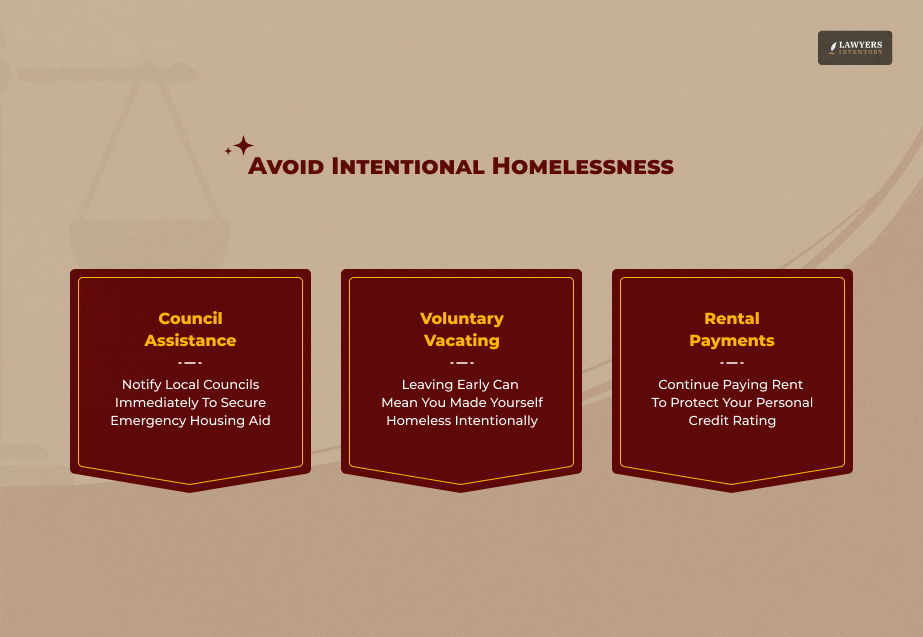
How long after eviction court date do you have to move?
This often becomes a dilemma for tenants facing eviction. The confusion regarding whether to leave on the court-ordered date or stay until the bailiffs arrive.
You cannot move too early if you plan to apply for emergency housing or social housing through your local council. This can penalize you.
Also, in this scenario, many local authorities in the UK will rule that you have made yourself homeless intentionally if you vacate a property voluntarily upon receiving a notice or an initial court order without a secured alternative.
You can seek help from the local councils once you get an eviction notice. However, despite being obligated to step in, these councils will ask you to remain in the rented house until the bailiff issues a 14-day notice.
If you are following this, you have the proof to present a definitive legal proof that you have exhausted all avenues to remain in your home.
Also, when you are waiting for the eviction, you must contact the local council immediately, and you don’t have to wait for a court date to notify your local council’s housing options team.
Furthermore, you must continue paying your rent for the time you are in the property. If you are failing to pay the credit, there will be a money judgment against you. This can again harm your credit rating.
Moreover, you can get in touch with charities such as Citizens Advice or Shelter England, which will help you with the cross verification of the paperwork and keep your council application moving forward.
Leave A Reply






Hung Jury vs. Mistrial: What Is The Difference And Why It Matters
Read More
NarodniyDimUkraina: An Overview Of The Kyiv-Based Brand Preserving Ukrainian Craftsmanship
Read More
What Is A Mistrial? Legal Definition, Causes, And What Happens Next
Read More
What Is A Sequestered Jury? Legal Definition, Process, And Everything You Need To Know
Read More
What Is A Hung Jury? Legal Definition, Causes, And What Happens Next
Read More
0 Reply
No comments yet.