Summarize using AI





Prompt copied. Paste it into Gemini.
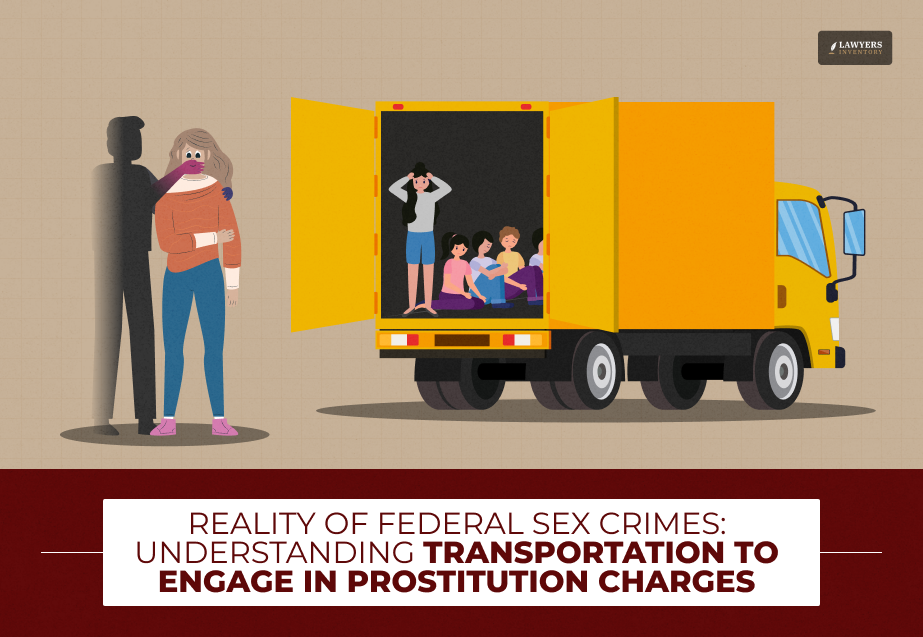
Today’s topic: Transportation to engage in prostitution charge.
When we analyze the landscape of the federal criminal justice system, we observe a massive gap between public perception and courtroom reality.
The media headlines focus heavily on sprawling, multi-jurisdictional indictments. They highlight complex racketeering operations. Furthermore, they showcase high-profile sex trafficking rings.
Yet, behind the scenes, we see federal prosecutors quietly relying on a much older statutory weapon. They use this weapon to secure swift convictions. Specifically, they charge individuals with transportation to engage in prostitution under 18 U.S.C. § 2421.
Commonly, the public knows this offense as a violation of the Mann Act. Over time, this charge has evolved significantly. It began as a 20th-century moral tool.
Today, however, it serves as the ultimate federal “catch-all” felony.
As legal analysts, we closely examine this ongoing evolution. We watch local, low-level prostitution allegations cross the threshold into severe federal penitentiary sentences.
In this blog, we will talk about the following things:
- What is the transportation to engage in prostitution charge?
- Shifting prosecutorial trends.
- Digital infrastructure and recent celebrity trials.
- How the federal government deploys this charge.
- How top-tier legal defense teams fight back
Therefore, keep reading!
What Is Transportation To Engage In Prostitution Charge?
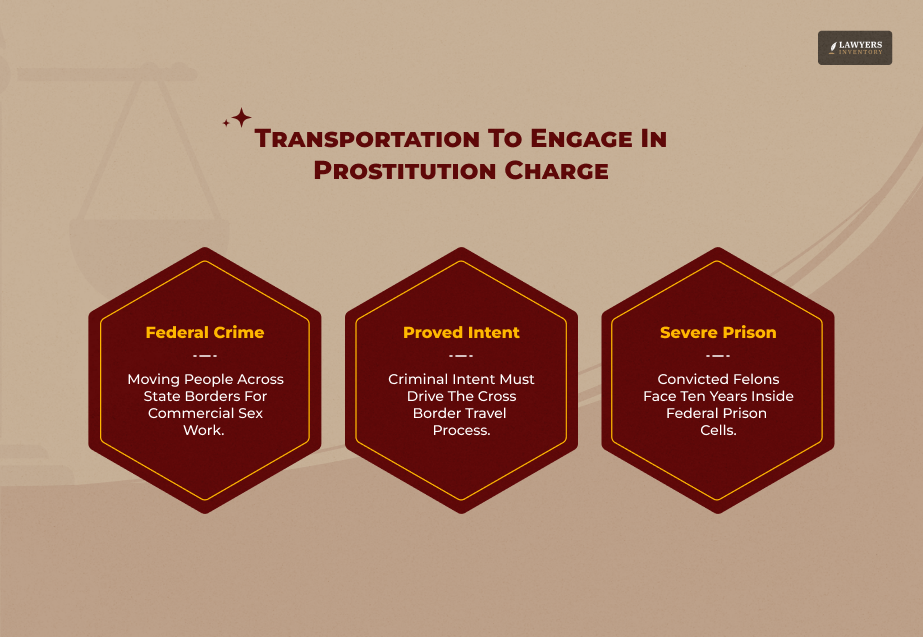
Transportation to engage in prostitution charge is a severe federal felony under 18 U.S.C. § 2421, commonly known as a Mann Act violation.
The government leverages this charge against individuals who knowingly transport someone across state lines or international borders for commercial sex.
Difference from Sex Trafficking

While frequently charged together, these offenses maintain distinct legal burdens. The Mann Act strictly penalizes the act of transport and requires zero proof of duress.
Conversely, sex trafficking charges explicitly require prosecutors to prove the defendant used active force, fraud, or coercion to induce commercial sex.
What Prosecution Must Prove In A Transportation To Engage In Prostitution Charge
To fully understand the immense power of 18 U.S.C. § 2421, we must first strip away media sensationalism. Instead, we must try to analyze its statutory mechanics.
Fortunately for federal prosecutors, they do not need to prove a grand, multi-layered conspiracy.
Rather, they must establish three core elements beyond a reasonable doubt:
- Interstate Travel: The physical movement of an individual across state lines or international borders.
- Knowing Facilitation: Actively taking steps to arrange, fund, or execute that specific transit.
- Criminal Intent: Maintaining a clear, dominant purpose to arrange prostitution or illegal sex acts.
Through our continuous analysis of case law, we identify a striking paradox that routinely shocks the general public.
Specifically, the government does not need to prove that any physical sexual transaction or financial payment ever occurred. In fact, the crime concludes the exact second the traveler crosses the state line.
Section 2421 is violated if the defendant, within the US, uses money to pay for an airline ticket to facilitate the offer or sale of a commercial sex act, even if the airlines deny the ticket or, once in the US, the people don’t want to go through with it.
In addition, we have to draw a line between 2421 and its totem pole, 18 U.S.C. 2422 (Coercion and Enticement). (Source: US Department of Justice)
Section 2421 criminalizes the movement of the device, while 2422 criminalizes attempts to persuade or cajole within the virtual world.
That means, the prosecutor may more often than not choose to use both, the two together, to effectively snare the defendant from both ends of the chain.
2. The “Prosecutorial Pivot” And The Split Verdict
By our focused tracking of federal court trends, we have come across a strategic occurrence we call the “Prosecutorial Pivot.”
Federal sex trafficking statute 18 U.S.C. § 1591 helps make it a very high barrier of proof to establish.
A conviction needs “evidence showing that the defendant engaged in force, fraud, or coercion, or caused or attempted to cause the so-called commercial sex acts.
Today, as well, these epic theories of prosecution often crash headlong into the walls of structure in a trial.
Juries regularly comb through cluttered, multi-year text message threads, intricate human relationships, and shared financial interests.
As a result, when they see evidence of a shared, lavish lifestyle, the concept of absolute coercion quickly becomes blurred.
Consequently, this evidentiary difficulty triggers a prosecutorial safety net, which ultimately leads to a split verdict.
Take, for example, this very exact play in the federal case against music power-broker Sean “Diddy” Combs.
The jury, in a decision that led to tears, dismissed the government’s ultimate grand conspiracy. And they found him innocent of the top rung sex trafficking charges.
Despite those key acquittals, the jury returned a guilty verdict on two of the Mann Act charges of transportation for prostitution.
Juries may not be convinced by a huge fictional crime syndicate story. But they will not be able to ignore the hard financial and travel bills.
When prosecutors present undeniable flight logs, ride-share receipts, and hotel bookings funded directly by a defendant, they pair this data with evidence of sexual parties.
Consequently, the simplicity of Section 2421 wins. This straightforward charge makes it nearly impossible for a jury to acquit.
Therefore, we emphasize a vital point: a conviction on these lesser transportation charges still carries devastating, life-altering federal prison time.
Can You Be Charged Under The Mann Act If The Other Adult Entirely Consented To The Travel?

Yes. You can still face a transportation to engage in prostitution charge in that case.

We must clarify that adult consent is completely irrelevant under 18 U.S.C. § 2421. The law does not care if the individual wanted to travel.

It does not matter if they actively sought out the arrangement. Instead, the crime focuses strictly on the defendant's intent when facilitating transportation across state lines for commercial sex.
3. How “Interstate Commerce” Became Fully Virtual
One of the most profound shifts we have documented involves the complete transformation of physical borders.
Historically, violating the Mann Act required a physical act. A defendant had to physically drive someone across a state line in a vehicle.
Today, however, we see a completely different landscape. Through our analysis of federal cybercrime task forces, we see that technology has lowered the bar. It has completely redefined the meaning of “interstate commerce.”
As a result, we are living in an era of virtual traps.
An individual can violate federal transportation laws without ever leaving their own living room.
If we look at the virtual breadcrumb trails that trigger federal jurisdiction today, the reality becomes clear:
- A person hooks into federal law by booking an airline ticket on a mobile app for an individual located in another state.
- An individual initiates an interstate wire, Venmo, Zelle, or CashApp payment to fund someone’s Uber or Lyft ride across a regional border.
- A user sends a simple text message, email, or direct message across state lines to coordinate the logistics of a meeting meant for commercial sex.
When we investigate how modern federal cases are built, we see a major shift in law enforcement tactics. Joint task forces blend the FBI with local police departments.
These teams rarely rely on traditional physical surveillance anymore. Instead, they use quiet, long-term digital forensics to build their cases.
We observe investigators utilizing geofencing warrants to map precise cell phone locations. They actively parse iCloud backups.
Concurrently, they pull extensive bank records months before making an arrest. By the time a grand jury unseals an indictment, the digital paper trail establishing interstate movement is already absolute.
Can Sending An Out-Of-State Mobile Payment App Trigger A Federal Indictment?

When we examine the virtual definition of interstate commerce, utilizing a digital application (like Venmo, Zelle, or CashApp) triggers federal jurisdiction.
If the app routes financial data through out-of-state servers to fund someone's travel or lodging, the federal government can step in.
Transportation To Engage In Prostitution Charge: Historical Context And The Selective Prosecution Debate
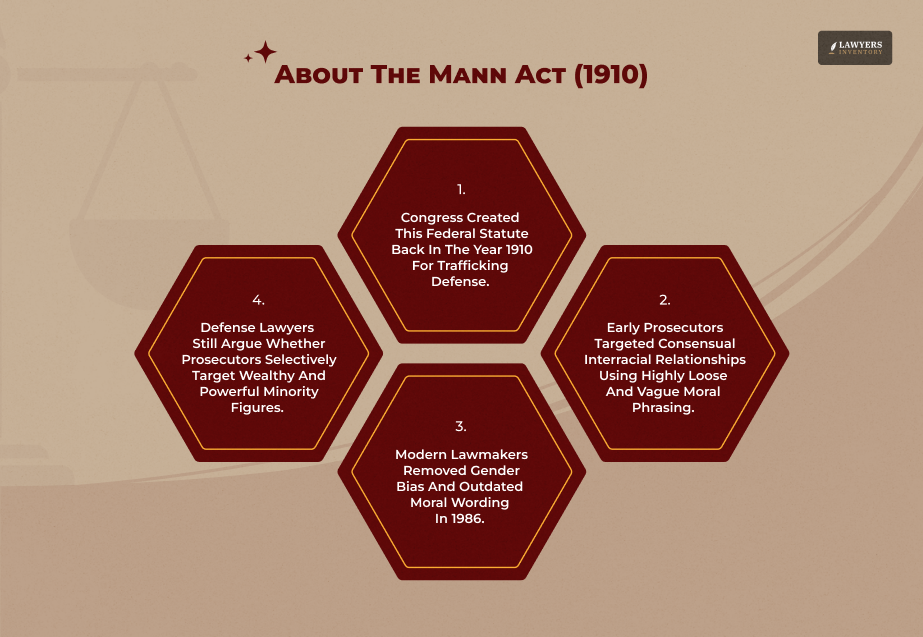
When we come to consider expert legal scholarship, we really cannot disregard the contentious history of the Mann Act. (Source: Department of Justice, United States)
The original was passed in 1910 as the “White-Slave Traffic Act” and made it illegal to knowingly sell or transport women across State lines for prostitution, debauchery, or for any other immoral purpose.
Because of this, in the early part of the 20th century, this highly imprecise moral term was armed to the teeth by prosecutors.
Rather than ending all real human trafficking, they selectively enforced the law to criminalize consensual/consensual premarital, conjugal, and interracial relationships.
The most headline-grabbing instance was when a jury of only white men sentenced heavyweight boxing champion Jack Johnson, while he was traveling with his white girlfriend in 1913.
The conviction was indisputably flawed and was pardoned in 2018.
While the statute was finally updated by Congress in the 1980s, where it also revised out 18th-century moral language and incorporated gender neutrality, the argument about selective prosecution continues today.
In recent high-profile cases, defense attorneys for people like R.Kelly and Sean Combs have forcefully contested that the government overuses this very allegation on affluent Black males.
Then again, federal prosecutors and civil rights activists argue that the updated act remains a structurally blind, indispensable machine.
Sentencing Guidelines, Penalties, And Collateral Fallout In Transportation To Engage In Prostitution Charge
We must emphasize that the consequences of a Section 2421 conviction are exceptionally severe. These cases operate under the rigid framework of the United States Sentencing Guidelines.
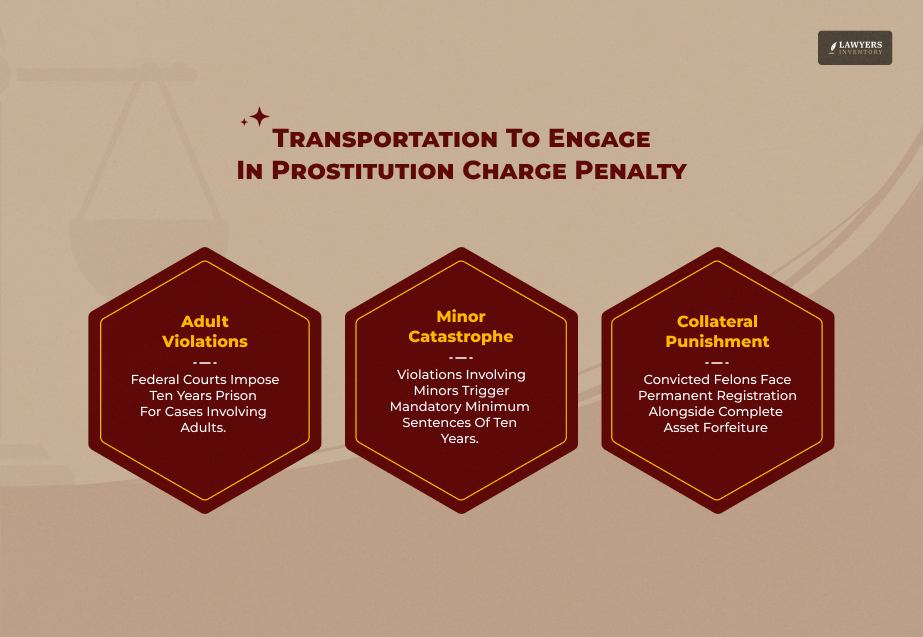
If your case involves an adult victim, you face a strict statutory ceiling. The court can sentence you to up to 10 years in federal prison per count, alongside a maximum $250,000 fine.
However, the entire legal landscape shifts into absolute catastrophe if the case involves a minor under the age of 18. Prosecutors pursue these specific violations under 18 U.S.C. § 2423.
A conviction for transporting a minor for commercial sex triggers a mandatory hammer, carrying a mandatory minimum sentence of 10 years, all the way up to life imprisonment.
Beyond the immediate prison sentence, we track a devastating trail of collateral fallout that follows a defendant for the rest of their life.
This aftermath includes several permanent, life-altering punishments:
1. Mandatory Sex Offender Registration:
A conviction forces strict tier-level registration on federal and state registries, completely destroying your future housing and employment opportunities.
2. Asset Forfeiture (§ 2428):
The government exercises total power to seize your property, vehicles, real estate, or bank accounts used to fund transportation.
3. Mandatory Restitution (§ 2429):
Judges legally order you to pay extensive financial restitution directly to the victims to cover their housing, medical, and long-term psychological care.
Strategic Defense For Transportation To Engage In Prostitution Charge
When we consult with elite federal criminal defense attorneys, they emphasize a critical rule. Defending against a Section 2421 charge requires an immediate, aggressive pivot away from standard state-court tactics.
The federal government boasts an overall conviction rate hovering near 95%. Therefore, the defense must dismantle the prosecution’s case using precise, constitutional maneuvers.
Dismantling “Intent”
The most common and fiercely contested battleground we see in the courtroom centers on the element of intent. The defense must prove that the defendant organized or funded the travel for entirely benign reasons.
If we can show the travel occurred for legitimate business employment, standard tourism, an artistic modeling contract, or a standard romantic relationship, the federal charge collapses.
Attacking The Jurisdictional Nexus
Alternatively, the defense can attack the geography of the case. They can prove that the alleged sexual activity and travel occurred entirely within the physical borders of a single state.
If they also prove the participants did not utilize internet databases or communication networks that cross state routing lines, the federal government loses its constitutional authority.
This forced pivot drives the case back down to local state courts, where penalties are significantly lighter.
Challenging Cyber-Stings And Entrapment
Many federal prostitution investigations stem from undercover cyber-stings. Therefore, we closely watch defense teams analyze the conduct of undercover agents.
The defense can build an entrapment defense if they can prove that federal authorities utilized:
- Extreme coercion.
- Financial baiting.
- Intense psychological pressure.
This showing can induce a total dismissal of the charges.
Constitutional Suppression Motions
Finally, we see experts aggressively attack the validity of the government’s electronic search warrants.
If the defense can prove that the FBI violated the Fourth Amendment during the investigation, they win a major advantage.
They can suppress illegally seized cell phone records, cloned hard drives, or cloud data, thereby throwing that vital digital breadcrumb trail out of court.
Legal Disclaimer: The information provided in this article does not, and is not intended to, constitute formal legal advice; instead, all information, content, and materials available on this site are for general informational and journalistic purposes only.
Leave A Reply







Is It Legal To Use True People Search? What Are Its Restrictions?
Read More
Case Is Being Actively Reviewed By USCIS – Meaning And Timelines
Read More
Refund Risk Under Income Tax Demand Notice Section 143(1) Summary Adjustments [A Complete Legal Assessment]
Read More
2026 Rules For The Legal Age Of Marriage In India
Read More
What Is A Wet Signature? Legal Guide And 2026 Rules
Read More
0 Reply
No comments yet.