Quick Answer

The basic structure doctrine is a judicial principle that restricts the Parliament of a country from changing, damaging, or destroying the essential features of the Constitution through amendments. The Supreme Court of India in the significant 1973 Kesavananda Bharati v. State of Kerala case developed this doctrine, and it operates as a boundary on Legislative capacity.
For the past few years, my major project has focused on constitutional jurisprudence. During this time, I observed real-time shifts in the interplay between law-making power and the courts. This dynamic relationship effectively keeps the political system under checks and balances.
To really understand this delicate mechanism, I pulled together different threads of the story. I analyzed Supreme Court verdicts, studied the Constituent Assembly discussions that shaped the Constitution, and examined global law.
While the common man often overlooks this hidden process, it remains a vital part of overall governance.
Furthermore, the judiciary acts as the guardian of the Constitution against potential abuse. It accomplishes this by denying Parliament unlimited constitutional amendment powers.
Consequently, this mode of operation places the supremacy and binding force of the Constitution far above parliamentary power.
What Is The Basic Structure Doctrine?
The Indian judiciary uses the Basic Structure Doctrine to protect the Constitution. This doctrine states that Parliament cannot destroy or alter the Constitution’s basic features.
The Supreme Court evolved this doctrine during the Kesavananda Bharati v. State of Kerala (1973) case. This landmark ruling laid certain limits to the amendment power that Article 368 gives to Parliament.
As the most powerful organ in Indian democracy, Parliament possesses enough competence to change the law.
However, Parliament holds this power only to a limited extent. It cannot change the fundamental features that embody the Constitution’s philosophy.
The Constitution itself does not define this “basic structure.” Instead, the Courts figure out these “basic features” from time to time.
According to legal experts, the constitutional basic structure includes five key pillars:
- The Constitution stands as the Supreme Document.
- A representative and democratic system runs the government.
- The legislature, executive, and judiciary divide powers among themselves.
- Secularism and Federalism define the nation’s character.
- The Courts maintain the power of judicial review.
The Basic Structure Doctrine works as a crucial check on power. This mechanism prevents a majority elected government from legalistically dismantling democracy.
It stops them from establishing tyranny. Finally, it protects citizens who might otherwise feel that the government has suppressed their freedoms.
Elements Of The Basic Structure Doctrine
In my review of the past five decades of jurisprudence, I have noted a deliberate strategy by the Supreme Court: the justices have intentionally avoided providing a singular, codified definition or an exhaustive list of what constitutes the “basic structure.”
Instead, the doctrine operates on a case-by-case basis, allowing the judiciary to identify essential features dynamically as novel constitutional challenges arise.
Through my analysis of these rulings, I have categorized the core principles that the courts have elevated to this sacrosanct status:
Supremacy Of The Constitution
The Constitution stands as the supreme law of the land. Therefore, government authorities must abide by its limitations at all times.
Consequently, no authority can supersede the Constitution or manufacture its own arbitrary laws. [Source: United Nations, International Law and National Frameworks]
Republican And Democratic Form of Government
The democratic and republican framework requires free, fair, and peaceful elections. According to iPleaders, under this system, the nation grants adult franchise to its citizens. Ultimately, citizens must periodically exercise these voting rights to sustain democracy.
Separation Of Powers
The system splits state power into three distinct branches: the legislature, the executive, and the judiciary. This division keeps institutional powers in check. Specifically, it ensures that one branch does not interfere with the work of another.
Judicial Review And Independence Of The Judiciary
Judicial review remains an absolute and unqualified right of the courts. To function effectively, the judiciary must operate free from executive influence.
According to US Legal Forms, this independence allows judges to do the following things:
- Carry out their constitutional obligations.
- Enforce rights.
- Ensure legal compliance.
Federalism And Secularism
The constitutional framework maintains the autonomy of different states to respect their unique histories and cultures. At the same time, the state maintains a strictly neutral stance on religion.
As a result, according to an op-ed published on The Hindu, these dual principles preserve national unity amid diversity.
The Golden Triangle
Articles 14, 19, and 21 interlock so closely that citizens cannot enjoy one right without the others. Because of this deep connection, legal experts rightly describe this combination as the “golden triangle.”
The Historical Evolution Of The Basic Structure Doctrine From 1951 To Present
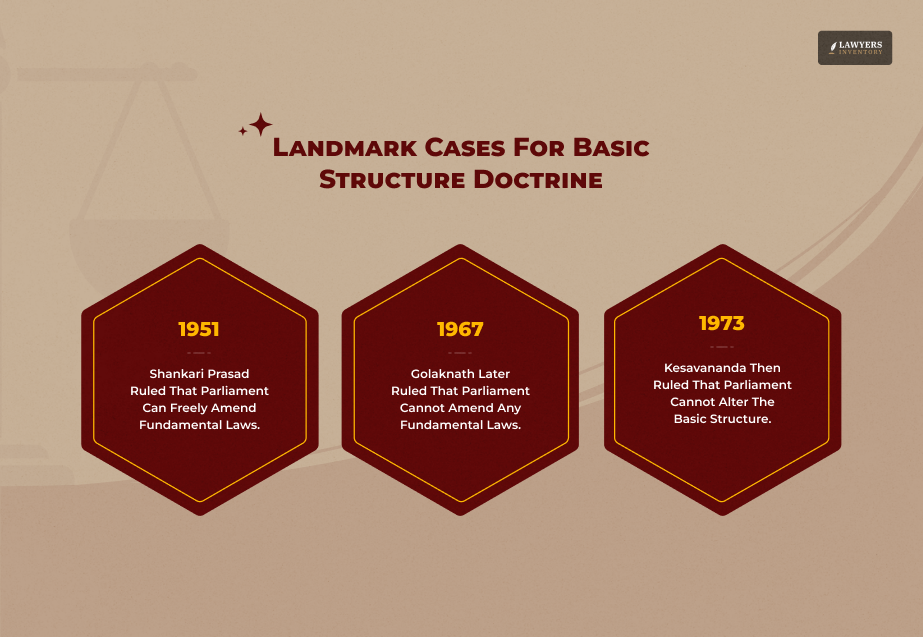
From what I have seen, the basic structure doctrine did not emerge overnight.
Rather, it was forged through a volatile, multi-decade struggle for supremacy between the Parliament – seeking to implement radical socio-economic land reforms – and the Judiciary, acting to defend fundamental property rights.
| Landmark Case | Year | Core Judicial Ruling & Impact |
| Shankari Prasad v. Union of India | 1951 | Parliament has absolute power to amend any part of the Constitution under Article 368, including Fundamental Rights. |
| Sajjan Singh v. State of Rajasthan | 1965 | Retained the Shankari Prasad view, though dissenting justices raised the first warnings about protecting core features. |
| I.C. Golaknath v. State of Punjab | 1967 | Total reversal; an 11-judge bench ruled that Fundamental Rights are transcendental and completely immune to parliamentary amendment. |
| Kesavananda Bharati v. State of Kerala | 1973 | The ultimate compromise; a 13-judge bench ruled Parliament can amend Fundamental Rights but cannot touch the Basic Structure. |
| Indira Nehru Gandhi v. Raj Narain | 1975 | Applied the doctrine for the first time to strike down the 39th Amendment, which sought to place the Prime Minister’s election beyond judicial review. |
| Minerva Mills v. Union of India | 1980 | Struck down sections of the 42nd Amendment that attempted to grant Parliament unlimited amending power, solidifying the doctrine’s permanence. |
| I.R. Coelho v. State of Tamil Nadu | 2007 | Ruled that any law placed in the Ninth Schedule after April 24, 1973, remains fully open to judicial review using basic structure tests. |
The Core Legal Tension: Judicial Supremacy vs. Parliamentary Sovereignty
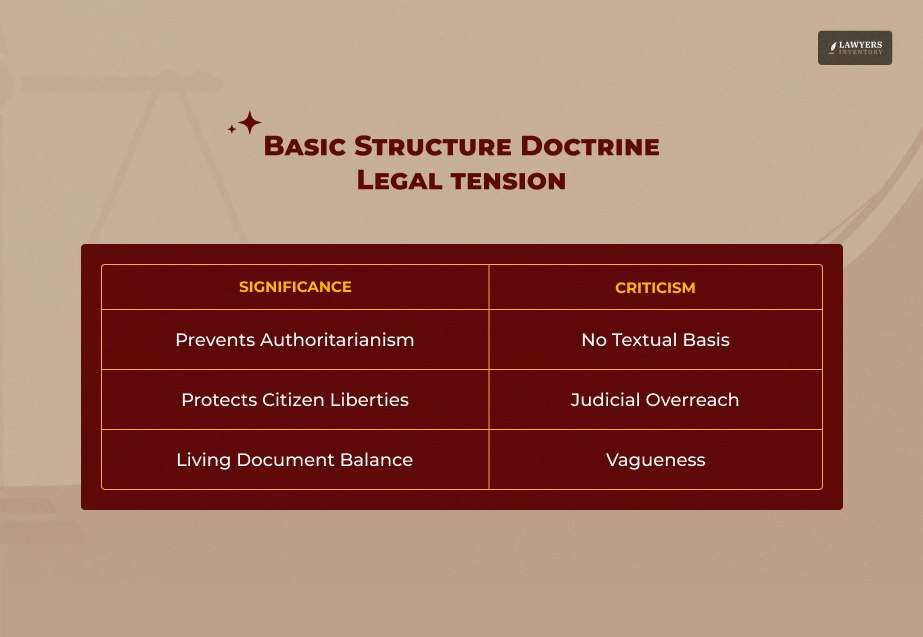
During my extended study of this topic, I have recognized that the basic structure doctrine resides at the center of an intense philosophical debate regarding the true locus of power in a constitutional democracy. This friction divides jurists into two distinct camps.
The Critique: Lack Of Democratic Legitimacy
Opponents whose arguments I have analyzed closely maintain that the doctrine establishes an unelected “tyranny of the robe.”
Critics argue that the judiciary invented the “basic structure” concept without a clear legal basis. They emphasize that the draft of the Indian Constitution completely lacks this specific term.
Consequently, critics claim the courts created this idea solely to grant themselves maximum power over constitutional amendments. [Source: iPleaders]
Furthermore, this criticism highlights that the will of the people flows directly through elected Members of Parliament in a representative democracy. Therefore, Parliament reflects true popular sovereignty when passing laws. [Source: Parliament, The United Kingdom]
Instead, a non-elected body now routinely annuls constitutional amendments. These amendments often carry the approval of a two-thirds majority from both houses of Parliament.
As a result, this judicial intervention arguably violates popular sovereignty and destroys the fragile institutional balance that the Constituent Assembly carefully designed.
The Defense: The Constitutional Conscience
Conversely, my research into majoritarian overreach highlights the indispensable nature of the doctrine as a safety valve.
Without it, a political party securing a massive legislative majority could theoretically use Article 368 to legally abolish elections, eliminate states, or establish a state religion.
The basic structure doctrine recognizes that a distinction exists between a temporary “amending power” granted to a parliament and the original “constituent power” possessed by the founders.
Parliament is a creature of the Constitution; it cannot use its derivative power to alter the identity of the very document that created it.
Functional Mechanics: The Core Testing Flow Of Basic Structure Doctrine
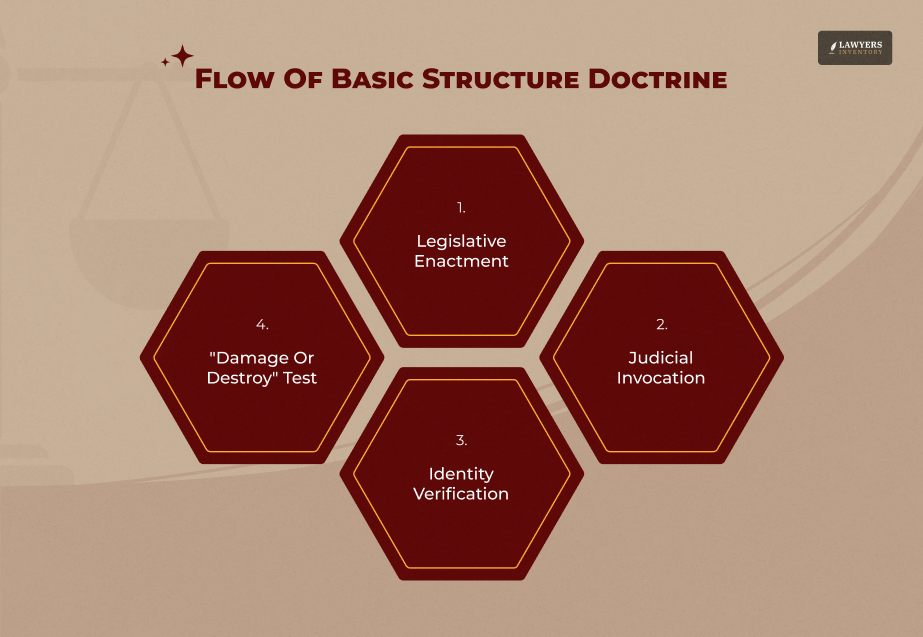
When I examine how a constitutional amendment faces a challenge on basic structure grounds, it is clear that the Supreme Court does not evaluate it on political or ethical merits.
Instead, my analysis of the operational framework shows it follows a highly structured legal test:
Step 1: Legislative Enactment
Parliament exercises its amending power under Article 368 to pass a Constitutional Amendment Act.
Step 2: Judicial Invocation
Aggrieved citizens or institutions file a writ petition challenging the amendment’s validity before a constitutional bench.
Step 3: Identity Verification
The Court identifies whether the targeted provision touches upon an established essential feature (e.g., judicial independence or secularism).
Step 4: The “Damage Or Destroy” Test
The Court evaluates the impact of the amendment on the broader constitutional ecosystem.
- Scenario A: If the amendment merely modifies a procedure but leaves the core identity intact – Amendment Upheld.
- Scenario B: If the amendment completely removes an institutional check or castrates a core principle – Amendment Struck Down.
The Ordinary Municipal Legislation Debate Over Basic Structure Doctrine
For decades, mainstream commentators accepted that the basic structure doctrine applied exclusively to constitutional amendments under Article 368.
However, while looking into recent court observations, I came across an intense current debate: can an ordinary piece of statute or municipal law be struck down for violating the basic structure?
While the Supreme Court has occasionally stated that ordinary laws must be tested against specific constitutional text (like Article 14 or 21) rather than the abstract basic structure, my evaluation of modern trends shows that the court increasingly invokes structural principles like the “Separation of Powers” or “Rule of Law” to invalidate ordinary statutes that cross institutional lines.
The Global Export Paradigm
While most public reference guides treat this strictly as an internal Indian legal event, my cross-jurisdictional research indicates that the basic structure doctrine has become one of India’s most successful jurisprudential exports.
Constitutional courts across the globe regularly cite Kesavananda Bharati to prevent democratic erosion in their own nations.
I have tracked instances where the Supreme Court of Bangladesh formally adopted the doctrine to protect its unitary state character.
Similarly, my study of global constitutional updates highlights the High Court of Kenya, which utilized basic structure reasoning in its historic Building Bridges Initiative ruling to strike down sweeping executive-led constitutional revisions.
It has also heavily influenced landmark judicial outcomes in Malaysia, Belize, and the Seychelles.
Leave A Reply






What Is A Preliminary Hearing? Core Procedures, Timeline, And What To Expect
Read More
What Is Grand Larceny? Felony Thresholds, Penalties, And Your Legal Options
Read More
Larceny vs. Theft: What’s The Real Legal Difference?
Read More
Is AI Ruining Your Legal Case? How To Detect And Correct Fabricated Law
Read More
Can You Get A DUI On A Bike? How Vehicle Codes Impact Impaired Cycling
Read More
0 Reply
No comments yet.